Church roofing and steeple repair in Nashville
A church roof is often several roofs in one: a steep sanctuary, a flat fellowship hall and a steeple nobody wants to climb. We repair them in an order your committee can fund.
- Services never disrupted
- Steeple access plans
- Answered 24/7
Short answer
Church roofing covers sanctuary roofs, steeples, fellowship halls and education wings, often with mixed materials. Commercial shingle runs $4.60 to $7.45 per sq ft installed, flat sections $7.15 to $11.80, and steeple work is priced per structure. We quote after a site visit and a walk with the building committee.
A church campus has several roofs that age at different speeds
The sanctuary from the 1950s, a fellowship hall added in the 1980s and a children's wing from the 2000s all sit under different roofs. A steep slate or shingle roof may be sound at fifty, while a flat roof over the kitchen at fifteen is leaking at every drain. Treating the campus as one roof makes for bad budgeting. A clear roof plan helps members see that their gifts are being used with care.
Building committees and trustees usually make decisions, often with limited funds. Repairs that wait for a congregational vote or a capital campaign can cost much more if water gets into plaster, organ chambers or choir lofts. We give committees a ranked list: what is urgent, what can wait a year and what needs saving for. Sanctuary ceilings with painted plaster are expensive to restore, so a small leak found early is the cheapest one.
We also respect the building. Many Nashville churches are historic, with stone, slate, copper and plaster interiors. Replacing a failed gutter liner with the wrong metal can stain stone for a very long time. We select materials that suit the architecture and the budget, and we explain trade-offs in plain terms. A short, plain-language summary of each option helps trustees explain decisions to the congregation.
Funding is often the real hurdle. Many congregations raise roof money through a capital campaign, a memorial gift or a building fund that grows slowly. We can break a large project into phases that fit the funds on hand, with a written scope for each phase. That lets the committee tell members exactly what this year's gift will pay for, and what is waiting on the next.
Signs the sanctuary or steeple roof is failing
Church leaks are often discovered after a Sunday service, when someone sees a stain or smells damp plaster.
Peeling paint or plaster in the sanctuary
Moisture working through a wall or ceiling usually begins at a valley, gutter or roof-to-wall joint. Look at the wall below the stain as well, because water often travels before it shows.
Slipped or missing slate or shingles
Loose pieces after storms expose the underlayment and let water in around nails.
Rusty or open steeple flashing
Where a steeple base meets the roof, flashing takes constant movement and weather and tends to fail first.
Water in the choir loft or organ chamber
Pipe organs and sound equipment are expensive and sensitive. Any moisture needs a fast response.
Damp walls in fellowship hall or kitchen
Flat roofs over these spaces have drains and rooftop units that are common leak points.
Stained stone or brick below gutters
Overflow from a clogged or sagging gutter streaks masonry and points to hidden roof edge damage.
Light or animals in the attic
Daylight through the roof boards or animal activity near the eaves shows openings that water uses too.
Slate repair, shingle replacement or metal reroof
Sanctuary roofs often face this choice. The answer depends on the existing roof, the architecture and the congregation's budget. Architectural review boards, if the church has one, may care about this choice as much as the budget does.
| Repair existing slate or tile | Replace with architectural shingle or metal | |
|---|---|---|
| Appearance | Keeps the original character | New look, with colors chosen to suit the building |
| Cost now | Moderate for repair, high for specialty slate | Moderate to high, depends on material |
| Cost over thirty years | Low if the slate is sound and fasteners are replaced | Predictable, with warranty options |
| Structure | Roof deck and rafters kept as is | Deck inspected and often upgraded |
| Fit for historic buildings | Often required by preservation boards | May need approval before changes |
| Maintenance needs | Periodic slate and fastener checks | Gutter and fastener checks after storms |
How we plan and carry out a church roof project
Scheduling around worship, weddings and funerals shapes the work as much as the weather does.
Walk the campus with the committee
We look at every roof, the steeple, gutters and downspouts, and ask which spaces matter most to the congregation. Ask the committee to bring the oldest photos of the building if they have them.
Inspect from above and from the attic
Roof surfaces, sheathing, rafters and plaster ceilings are checked for moisture, rot and insect damage. In a church attic, we look for old stains, wet insulation and daylight at the sheathing.
Build a ranked repair list
Items are sorted by urgency and cost, so the committee can fund the most pressing work first and plan the rest.
Choose materials with the committee
We show samples, explain warranty terms and note which materials suit historic or traditional buildings.
Schedule around the calendar
Noisy work avoids Sunday mornings, midweek services, funerals and weddings. We confirm the calendar with the office each week.
Protect the interior and close out
Pews, organs and floors are covered when needed. After the work, we walk the roofs with a trustee and leave a record of what was done.
Share the story with the congregation
We give the committee photos and a short written summary they can share in a bulletin or meeting, so members see where their gifts went.
Steeples, towers and the details above the sanctuary
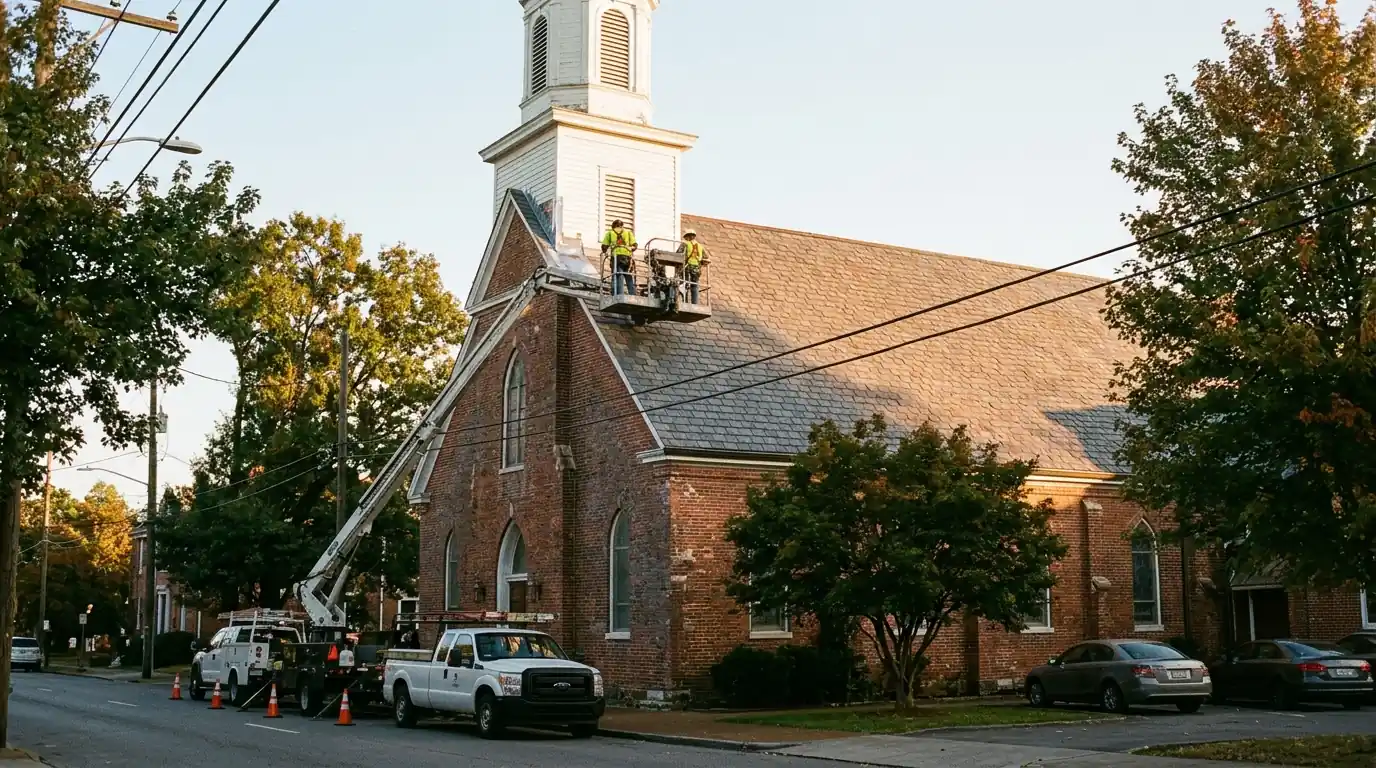
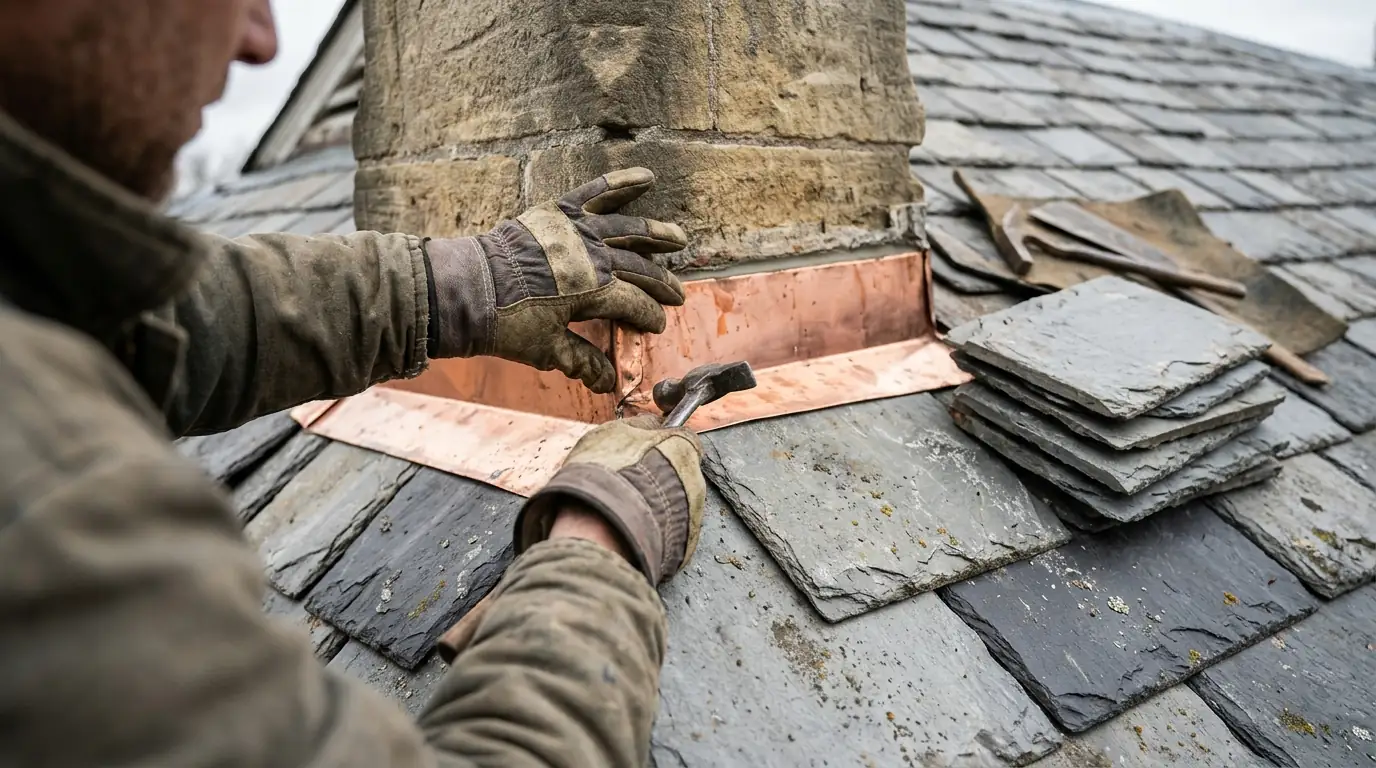
Steeples are small structures with big exposure. Wind drives rain into every seam, and temperature swings pull copper, wood and masonry in different directions. The base of a steeple, where it meets the main roof, is the weakest point. We inspect it with lifts or rope access, replace failed flashing with copper or stainless as the building requires and refasten loose cladding. Weather vanes, crosses and finials also deserve a look from the lift while we are up there.
Louvers, bell openings and crosses add penetrations that need their own flashing. A cross with a base plate that is only caulked will leak into the tower. We rebuild those details with soldered or mechanically fastened metal, and we recommend lightning protection checks by a specialist when the roof is open. Louvered openings need bird screens and sloped sills so rain does not blow into the bell chamber.
Where access is difficult, we use cranes, aerial lifts or scaffolding rather than ladders on slate. Walking on aged slate breaks it, and the repair then costs more than the leak. Planning access is part of the quote, and we explain the options to the committee in plain language. If the tower walls are masonry, we check the mortar and cap stones while we are there.
Bells, clocks and lighting on steeples often run on wiring that was added over time. When we open the tower for repairs, we photograph what we find and tell the committee about loose cable, abandoned conduit and unsealed penetrations. Those items belong to an electrician, not a roofer, but they affect how we flash the opening. Coordinating the two trades before closing the roof avoids opening it again next year.
What church roofing costs
Church projects range widely because roofs vary so much. These are Middle Tennessee planning ranges, and we quote after a site visit. Scaffolding or lift rental is listed as its own line so the committee can see it clearly.
| Work | Typical range | What moves it |
|---|---|---|
| Architectural shingle replacement, steep sanctuary roof | $4.60 to $7.45 per sq ft | Includes underlayment and ridge vent; steeper slopes cost more |
| Flat roof replacement over fellowship hall | $7.15 to $11.80 per sq ft | 60-mil TPO on a clean deck |
| Slate repair, replacing broken pieces and fasteners | $14.25 to $32.60 per sq ft of repaired area | Depends on matching and access |
| Steeple base flashing and cladding repair | $3,240.00 to $11,800.00 per steeple | Crane or lift access extra |
| Box gutter lining repair on built-in gutters | $32.50 to $78.40 per linear foot | Common on older masonry churches; access and liner material set the price |
What pushes a price up or down:
- Roof pitch and height, which control safety setup and access equipment
- Material, such as slate, tile, shingle, metal or membrane
- Condition of the deck and any rotted rafters or sheathing
- Historic review requirements for material or color changes
- Interior protection needed over pews, organs and finished ceilings
- Phasing to match a capital campaign or annual budget
Ranges reflect recent Middle Tennessee work and are not a quote; we price after a site visit. See the full Budget Guide.
What a building committee should gather before the walk
A little preparation makes the first visit more useful.
- A site plan showing each building and when it was built
- Photos or notes of past leaks and where they appeared
- Previous roof invoices, warranties and insurance claims
- The church calendar for services, weddings and funerals
- Historic review or denominational approval requirements
- Names of the trustees who can approve changes
- Budget limits and any pending fundraising timeline
- Wiring or lighting on the steeple that needs an electrician
- Gutter and downspout layout, since box gutters are common on older churches
Storm damage and church insurance
After the March 3, 2020 tornado and the December 9, 2023 storm, many Middle Tennessee congregations learned that their policies had roof age limits and wind deductibles. Photograph steeples, slate and gutters regularly, and keep a dated file. If a storm damages your roof, call our 24/7 line first. We secure the building, document the damage and give your insurer a clear record. Many churches also keep a small repair fund, and an annual walk with us costs far less than the damage a leaking valley can do to plaster and pews in a single wet spring.
Need church roofing on a Nashville building?
Call (615) 716-3057 any hour. We look at the roof, show you what we found and price the work before anything starts.
Where we do church roofing around Nashville
The ZIP codes below cover most of the buildings we work on. Every one links to its local page, and the full locations list has 62 more.
- Nashville 37219
- Downtown Nashville 37219
- East Nashville 37206
- Antioch 37013
- Madison 37115
- Donelson 37214
- Hermitage 37076
- Bellevue 37221
- Green Hills 37215
- Franklin 37064
- Brentwood 37027
- Murfreesboro 37130
- Smyrna 37167
- La Vergne 37086
- Mount Juliet 37122
- Lebanon 37087
- Hendersonville 37075
- Gallatin 37066
- Spring Hill 37174
- Columbia 38401
- Goodlettsville 37072
Work that often goes with church roofing
We install and repair systems from Carlisle SynTec, GAF, Johns Manville and Sika Sarnafil, and we patch whatever is already on your roof.
Church Roofing questions from Nashville owners
Can you repair a church steeple in Nashville without scaffolding the whole building?
Often yes. We use aerial lifts, cranes or rope access depending on the steeple, the site and the budget. Scaffolding is used only where it is the safest and most economical choice. We explain the access plan and cost to the committee before work starts.
How do you schedule roof work around church services?
We ask for the church calendar and avoid noisy work during services, weddings and funerals. Weekday work is typical, and quieter tasks may be done outside peak hours. The office gets a weekly update so staff and volunteers know what to expect.
Should we repair or replace an old slate church roof?
If most slate is sound and the fasteners are the problem, repair is usually more economical and keeps the original look. If the slate is delaminating throughout or the deck is failing, replacement makes sense. A close inspection from a lift or the attic settles the question.
Can our building committee phase the roofing over several budget years?
Yes. We rank repairs by urgency, fix active leaks first and plan the remaining roofs across your budget cycles. Each phase is written up so the committee, trustees and congregation can see what was done and what is next. Each phase comes with its own written scope and photos.
What do you do about leaks near a pipe organ?
We treat them as urgent. We locate the source, install a temporary cover if rain is coming and protect the space below. The permanent repair follows quickly. We recommend that the church's organ technician inspect the instrument for moisture afterward.