Commercial roofing in Nashville, Tennessee (37219)
Davidson County holds more roof types than most property managers can track: tower decks, brick warehouses, strip center membranes and church shingles. We survey, repair and replace all of them from our office on 4th Avenue North.
- Buildings
- Towers, warehouses, strip centers, churches, apartments
- Corridor
- I-40, I-65, I-24, Briley Parkway
- Watch for
- Ponding, open seams, hail bruising, spring wind
- Access
- Downtown crane limits, suburban dock and lot access
Short answer
Most Nashville commercial roofs fail at seams, drains and flashings long before the field membrane wears out. We find the real cause with a walk-through and core cuts, then recommend repair, coating or replacement based on whether the insulation is dry. Call (615) 716-3057 any hour and we'll set up a survey.
What a Davidson County roof inventory really looks like
Drive I-40 through the city and you'll pass nearly every commercial roof type we work on. Downtown towers carry ballasted or fully adhered membranes on concrete decks, mostly out of sight. Brick warehouses along the Cumberland River and Lebanon Pike have older built-up and modified bitumen systems, often with a coat of aluminum or acrylic on top. Strip centers on Nolensville Pike, Murfreesboro Pike and Charlotte Pike lean on single-ply TPO and EPDM with long parapet runs.
Apartment communities and churches add a different mix. Many use commercial architectural shingle on steep slopes, with low-slope membrane tucked behind dormers and over entry canopies. Office parks off Briley Parkway and the I-65 corridor tend to have mechanically attached single-ply over polyiso, plus rooftop units that wear the membrane around curbs and walk paths. Each type fails in its own way, so a survey starts with what you actually have, not what the drawings say.
That's why we don't quote from the street. A core cut tells us the insulation type, its moisture content and how many coverings are already on the deck. It matters, because building codes limit a roof to two coverings before a full tear-off. We also photograph every core location and mark it on a roof plan, so you can see what we saw and compare it against any earlier report.
Age matters as much as type. A roof installed before the 2010 flood and left alone has lived through freeze-thaw cycles every winter, summer surface temperatures high enough to soften asphalt, and a few hail seasons. By the time a stain shows up inside, the damage above is usually wider than it looks. Managers who book a survey before the rainy months can often choose a repair or coating, while those who wait for a leak often end up deciding on a section replacement under pressure.
Where Nashville flat roofs usually give up first
These are the failures we find most often when a property manager phones about a stain on a ceiling tile.
Ponding at drains and low spots
Water that sits for days after a rain points to deck deflection or a clogged drain. It speeds up seam and membrane wear.
Open seams on aging single-ply
Seams welded over dirt or rushed in cold weather show as fine lines a probe can slide into.
Cracked flashing at curbs and pipes
Summer heat and winter freeze-thaw cycles stress sealant and old base flashing around every penetration.
Alligatored or chalking coatings
A coating that has checked or lost adhesion is a sign to test the roof underneath before recoating.
Loose coping and edge metal
Spring straight-line wind lifts poorly fastened coping first, then peels membrane under it.
Hail bruising over insulation
Hail can crush insulation without puncturing the surface, so a roof looks fine and leaks months later.
Clogged scuppers behind parapets
Tree debris and trash collect where water should exit, and the overflow ends up in the wall cavity.
Mismatched patches from earlier repairs
Different contractors left different materials, and the joints between them are where water gets in.
Storm history that still shows up on local roofs
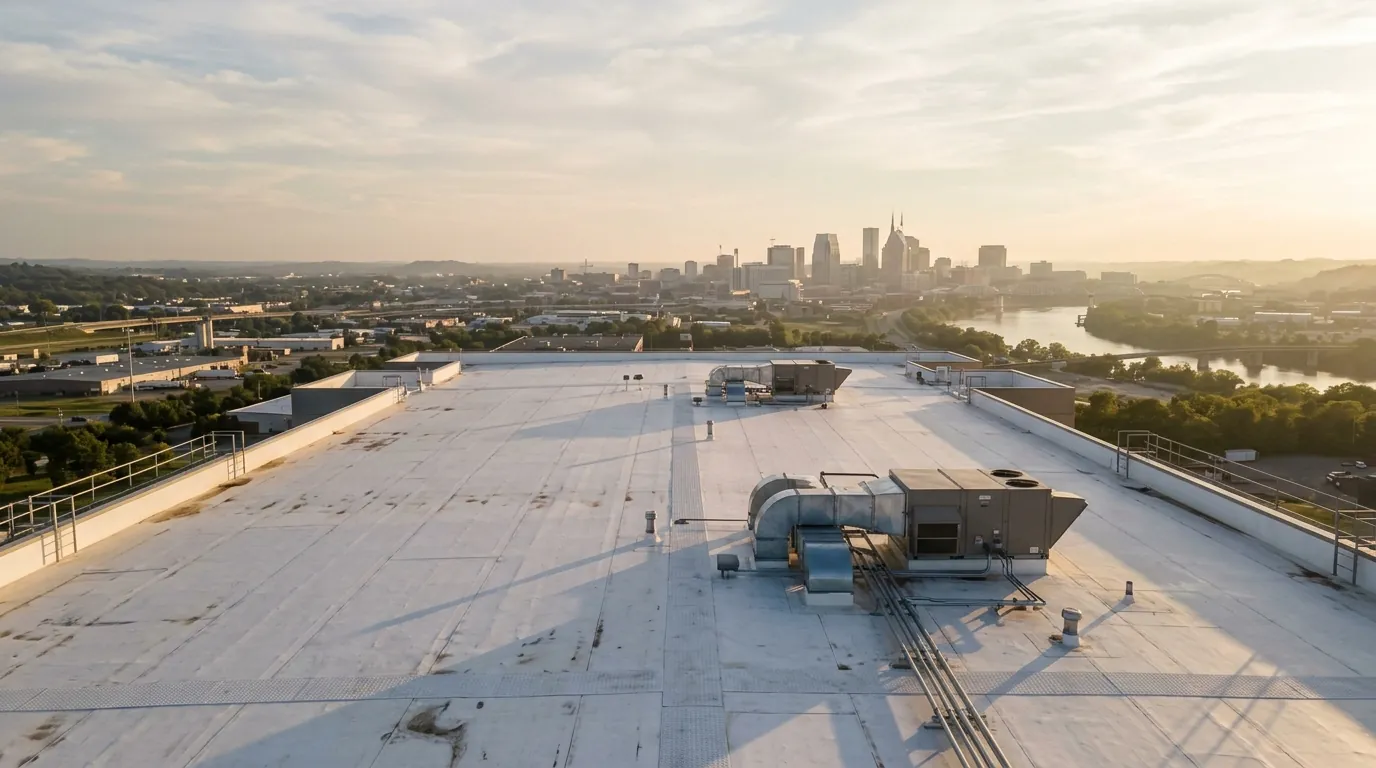
The March 3, 2020 tornado cut through North Nashville, Germantown and East Nashville, and the May 2010 flood left a mark on buildings near the Cumberland River. Many of the roofs we see now are patched repairs from those events, layered over original systems. We check old storm patches, torn flashing and displaced edge metal first, because those spots tend to leak next. Spring hail and straight-line wind finish off whatever was already weak. Hail does the same quiet harm in every part of town, bruising insulation under a membrane that still looks whole from the roof deck.
How we cover the neighborhoods and nearby counties
Each core neighborhood has its own page because the roofs differ: Downtown Nashville, The Gulch, SoBro, Midtown, Germantown, East Nashville, Music Row, West End and Green Hills. Beyond Davidson County we work in Williamson, Rutherford, Wilson, Sumner and Maury counties, including Franklin, Murfreesboro, Lebanon, Hendersonville and Columbia. Roofs in those towns face the same weather, but the building mix changes: more distribution warehouses toward Smyrna and La Vergne, more church campuses and offices around Franklin and Brentwood.
Permitting changes by jurisdiction. Metro Nashville Codes issues building permits inside Davidson County, while the other counties and cities run their own permit offices. We know which offices want a sealed scope and which want a simple application, and we plan the schedule around that. Phone us before you assume a permit is needed, because small repairs often don't require one.
Planning starts with one call. Give us the address and a short description, and we can usually tell you whether the roof sounds like a repair, a coating candidate or a replacement, then book the survey. For buildings outside Davidson County we explain the local permit route at the start. Sumner and Wilson counties, for example, route permits through different offices than Williamson or Maury, and each inspection office keeps its own rhythm.
What to have in front of you when you phone
You don't need a full file. These details let us give you a straight next step on the first call.
- The building address and the approximate roof size
- Whether the roof is membrane, metal, shingle or something older
- Where the water is entering and when it started
- Any past repairs, coatings or warranty paperwork
- Whether tenants or equipment are directly below the leak
- Roof access: ladder, interior hatch or exterior stair
Roofing work we do most in Nashville
Six services building owners here call about most. The full catalog has 45.
Close to Nashville
Roof trouble in Nashville?
Call (615) 716-3057 about a building in Nashville (37219). The line is answered 24/7, and the first question is always where the water is showing.
Roofing questions from Nashville
Do you work on commercial roofs across all of Nashville?
Yes. We cover the Davidson County core and the neighborhoods around it, plus Williamson, Rutherford, Wilson, Sumner and Maury counties. Our office is on 4th Avenue North, and the 24/7 line is (615) 716-3057. Residential homeowner roofs are outside our work.
What commercial roof types do you see most in Nashville?
TPO and EPDM on strip centers and offices, modified bitumen and built-up on older warehouses, metal on industrial and church buildings, and commercial shingle on apartments. We repair and replace all of them after a site survey.
Who pulls the permit for a Nashville roof replacement?
Metro Nashville Codes issues building permits in Davidson County. Outside it, each county or city runs its own office. We handle the permit steps for the scope we propose and tell you if a jurisdiction asks for anything extra.
How fast can you reach a leaking Nashville building?
Phone any hour and we answer. For an active leak we focus first on stopping water entry with a temporary repair or tarp, then plan the permanent fix once the roof is dry enough to evaluate.