Commercial roofing in Inglewood, Nashville (37216)
Inglewood's roofs sit along Gallatin Pike and the side streets behind it: strip centers, small offices and long-established churches. Many are low-slope roofs that have been patched many times and now need a straight answer.
- Buildings
- Strip centers, small offices, churches, auto retail
- Corridor
- Gallatin Pike, Eastland Avenue, Trinity Lane
- Watch for
- Stacked patches, scupper ponding, gravel loss
- Access
- Shared parking, tenant hours, deep strip roofs
Short answer
Inglewood commercial roofs are mostly strip centers, small offices, auto-oriented retail and churches near Gallatin Pike. Common failures are repeated patches, open seams at unit curbs, ponding at scuppers and old built-up roofs with gravel loss. We find the wet areas with cores and scans, then recommend repair, recover or replacement. Phone (615) 716-3057, 24/7.
Strip centers on Gallatin Pike and why their roofs repeat the same leaks
Gallatin Pike is one of the oldest commercial routes out of Nashville, and the strip centers lined up along it reflect many eras of building. A typical one is a long, shallow roof over a row of tenants, with a shared front parapet or canopy, a rear wall at the alley, and drains either at the back or through the sides. Because the roof is one long surface, a small failure at one end can send water through several bays.
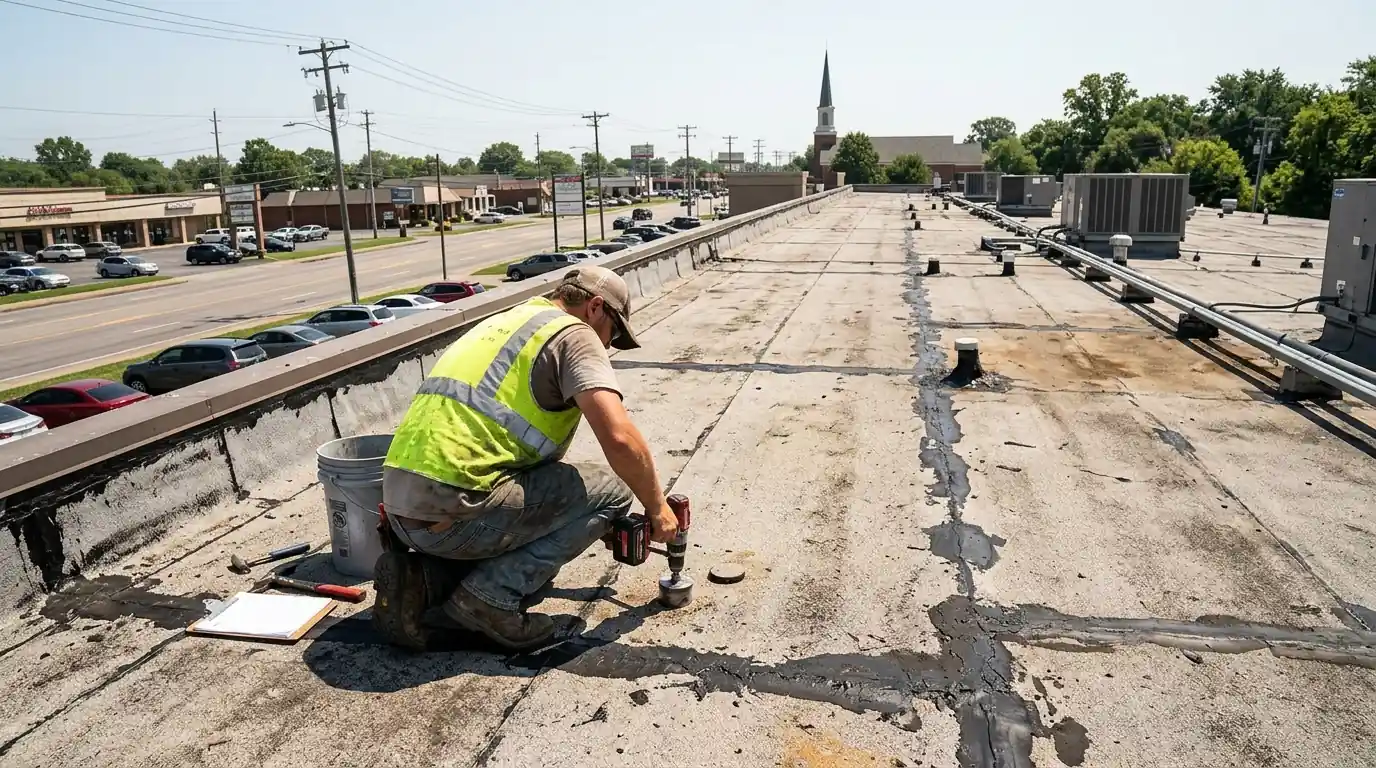
Repeated patching is the pattern we see most. A tenant calls the landlord, a handyman or small crew puts a bead of mastic on a seam, and the leak returns in a season. Over ten years the roof carries a dozen of these patches, each stuck on top of the last. At that point the repair budget is better spent on a recover or a new membrane than on another round of patching, and we say so plainly.
A long roof also moves. Heat in summer and cold in winter make a deep membrane expand and contract, and seams at walls and curbs take the strain. Heat-welded single-ply, properly attached at the edges, holds up to that movement better than old asphalt layers that have already hardened.
Auto-oriented tenants add their own chemistry. Tire shops, repair bays and fast-food counters vent oils, solvents and grease to the roof, and some of those compounds break down certain single-ply membranes and softened asphalt. If your tenant mix includes any of these, we will point out where chemical-resistant membrane, extra walk pads or a rerouted vent makes the next roof last longer.
Signs a strip center roof is past patching
These are the observations that usually move a landlord from repair to replacement.
Leaks that move between bays
Stains appearing in different tenant spaces after the same rain show the insulation is carrying water across the roof.
Ponding at back scuppers
Water that sits at the rear wall for days points to a sagging deck or scuppers set too high.
Mastic and tar covering large areas
A roof covered in black patch material has usually passed the point where each patch holds.
Open laps at the front canopy
Where the canopy meets the main roof, flashing laps pull open and let rain run into the wall.
Cracked pipe boots
Rubber collars around plumbing vents dry out in the sun and split.
Rust staining below roof edge
Brown streaks on the wall under the edge show corroding metal that no longer sheds water.
Churches and small offices behind the highway frontage
Away from Gallatin Pike, Inglewood's side streets hold neighborhood churches, small professional offices and light commercial buildings. Their roofs are a mix of low-slope membranes and older pitched shingle roofs. A congregation might own a one-story fellowship hall with a flat roof tucked behind a sanctuary with a steep one, and the joint between the two is the usual trouble spot.
The East Nashville tornado track in 2020 passed close to this part of the city, and some buildings here took wind damage on edges and rooftop equipment. If your roof was reset or patched afterward, ask for a walk of the edges and the flashing, because wind damage that looked cosmetic at the time can open up in the next cold snap.
For small offices, a restoration coating can be a reasonable choice, but only if the insulation is dry. A moisture scan or core cut decides it. Where the insulation is wet, a coating hides the problem and the roof continues to fail underneath.
Many Inglewood buildings also carry old signage. A pylon sign base, a wall sign bracket or an abandoned conduit run is easy to overlook until it leaks. We list every unused fixture on the roof and recommend removal and proper patching, because each one is another path for water that serves no purpose.
What a recover can and cannot fix on an Inglewood strip roof
A recover puts a new membrane over the existing one and costs less than a tear-off, because disposal and labor are lower. It is only allowed when the roof has one layer or fewer, the insulation is dry and the deck is sound. If a core shows wet insulation, or a second layer is already on, the old roof has to come off. We cut cores before any recover quote so the number you receive fits what is actually there.
How we keep tenants open during a strip center reroof
Most tenants on Gallatin Pike cannot close for a week. We plan so they do not have to.
- Work one section of the roof at a time and dry it in each day
- Keep entrance canopies clear and mark walkways for customers
- Stage materials at one end of the lot away from the busiest bays
- Protect rooftop vent and exhaust openings from debris
- Let each tenant know the day work happens over their space
- Sweep the lot with a magnet at the end of each shift
Roofing work we do most in Inglewood
Six services building owners here call about most. The full catalog has 45.
Roof trouble in Inglewood?
Call (615) 716-3057 about a building in Inglewood (37216). The line is answered 24/7, and the first question is always where the water is showing.
Roofing questions from Inglewood
Why does my Gallatin Pike strip center roof keep leaking after patches?
Stacked patches trap moisture and rarely fix the cause, which is often wet insulation or failed seams at walls. A moisture survey shows whether repair, recover or replacement makes sense.
Can an Inglewood strip center roof get a recover instead of a tear-off?
Yes, if it has no more than one layer, dry insulation and a sound deck. We cut cores before quoting so the recover price reflects what is actually under the surface.
Do you work on small church roofs in 37216?
We do, including steep shingle roofs and the low-slope annexes behind them. We schedule around services and give boards a written summary they can use for a vote.
How do Inglewood tenants stay open during a roof replacement?
We work in sections, dry in daily, protect entrances and tell each tenant when work reaches their space. Most stay open throughout the job.