Commercial roof replacement in Nashville, TN
Your roof has too many repairs, wet insulation or a membrane past its service life, and you need a replacement plan that keeps tenants working. We survey, design and install the new roof in phases that fit your building.
- Core cuts before bidding
- Phased around tenants
- Answered 24/7
Short answer
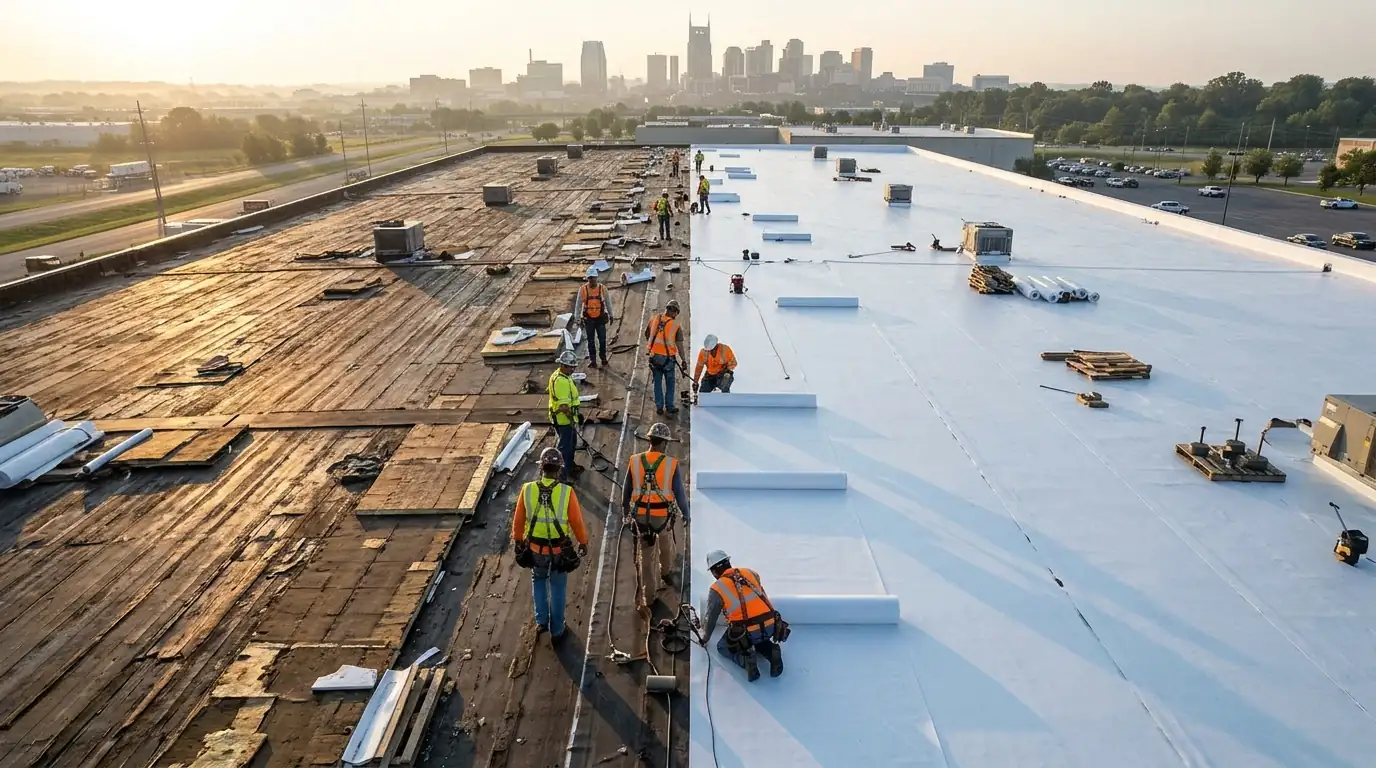
Commercial roof replacement means tearing off the existing membrane and often the insulation, then installing a new system on a sound deck. Typical installed cost for common systems runs roughly $7 to $18 per square foot in Middle Tennessee depending on system, insulation thickness and access. Occupied buildings are usually replaced in phases.
When replacement beats another round of repairs
Repairs make sense while most of the roof is dry and flexible. Replacement makes sense when the numbers flip: wet insulation in more than a few places, membrane that cracks when you flex it, seams that don't weld, or repair invoices that add up to a meaningful share of a new roof. A core cut and a moisture survey tell you which side of that line you're on.
Age alone doesn't decide it. A 12-year-old single-ply roof can have soaked insulation, while a 25-year-old modified bitumen roof may still shed water well. What matters is the condition of the membrane, the insulation under it and the deck, plus your plans for the building. A property you plan to sell next year needs a different answer than one you'll hold for twenty.
Building type shapes the plan. A church with a tall sanctuary and a low fellowship hall needs different tie-offs than a medical office with one big flat roof. An apartment community with 14 small roofs can be replaced one building at a time, which spreads cost across fiscal quarters and keeps most residents undisturbed.
Signs your commercial roof has reached replacement territory
No single sign settles it. When several show up together, the case for replacement gets strong.
Widespread wet insulation
Moisture surveys and cores that show saturated board across multiple areas mean patching can't catch up. Wet polyiso loses insulating value and adds weight to the deck.
Membrane that cracks or splits when flexed
A dried-out single-ply or alligatored coating won't take repair welds or adhesives reliably.
Repeated leaks in different places
New leaks every season show the whole system is failing, not one detail.
Open or shrinking seams across the field
When seams pull apart in many places, the membrane has shrunk or aged beyond reliable repair. Probing a sample of seams shows how widespread it is.
Ponding that has grown over the years
Deck deflection or insulation compression can make slope worse. Left alone, it adds weight and speeds aging.
Cumulative repair costs near a new roof
When the last several years of repair invoices approach the cost of replacing, stop paying twice.
Warranty expired with visible wear
No coverage and visible wear usually means the next failure is yours to fund in full.
Replacement system options for flat and low-slope buildings
Most commercial replacements in Middle Tennessee land on one of these systems. The right one depends on use, budget and rooftop equipment.
| 60-mil TPO | PVC | EPDM | Modified bitumen | |
|---|---|---|---|---|
| Seam method | Heat-welded | Heat-welded | Taped or glued | Torch, hot mop or cold adhesive |
| Good fit for | Offices, retail, warehouses | Restaurants and grease exhaust | Large simple roofs | Multi-layer redundancy and heavy traffic |
| Key strength | Reflective, widely installed | Chemical and grease resistance | Long track record, repairable | Layered protection |
| Watch for | Quality of seam welds | Higher material cost | Seam tape and flashing details | Open flame rules on some buildings |
| Typical install range | $7.15 to $11.80 per sq ft | $8.60 to $14.30 per sq ft | $6.90 to $10.95 per sq ft | $8.20 to $13.40 per sq ft |
How a phased replacement works on an occupied building
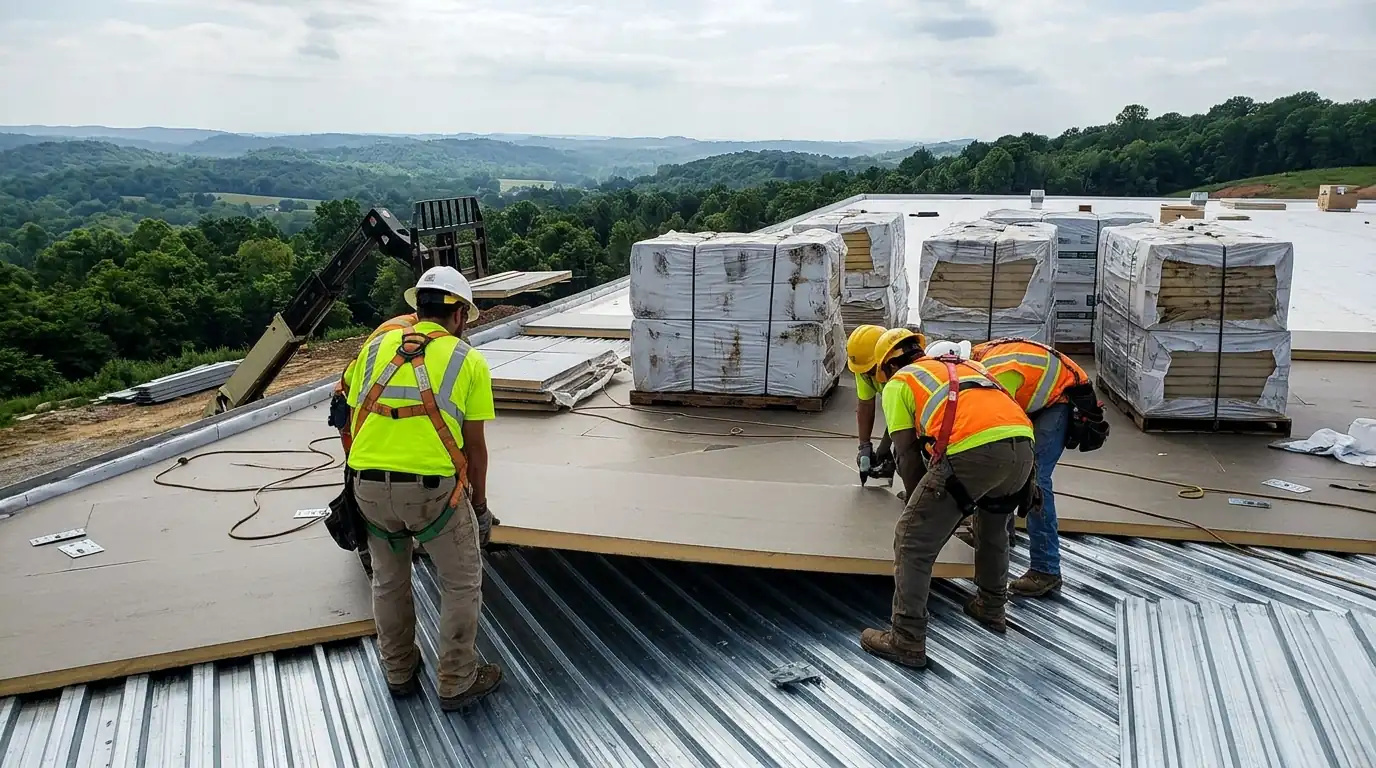
Most tenants can't close for a roof, so we break the job into bays and sequences that keep the building running.
Survey and cores
We cut cores, measure slope, check deck condition and document drains, penetrations and edge metal before pricing.
System design
We recommend membrane, insulation thickness, cover board and edge metal to match your goals and code requirements.
Phasing plan
We divide the roof into sections with their own tie-offs, so no section is ever open overnight without a weather-tight temporary seal. Phase lines follow expansion joints, parapets or rooftop unit lines whenever possible.
Tenant coordination
Noise-sensitive spaces, loading hours and parking get planned in advance, with notices drafted for your property manager to send. Hot work, adhesives and fumes are matched to the spaces below.
Tear-off and deck inspection
As each section is stripped, we inspect the deck for rust, rot or damage and mark repairs for approval.
Insulation and membrane installation
New insulation and membrane go in the same day on each section, with seams tested and details finished before we leave.
Final inspection and closeout
We walk the finished roof with you, present photos and, when the system and installer qualify, file warranty paperwork through the manufacturer's process. You also get a maintenance outline and drain-cleaning schedule.
What a commercial roof replacement costs in Middle Tennessee
Pricing moves with roof size, insulation, access and deck repairs. We quote after a site survey; these ranges are for planning.
| Work | Typical range | What moves it |
|---|---|---|
| Tear-off of existing membrane and insulation | $1.35 to $2.90 per sq ft | More for gravel-surfaced built-up roofs and multiple layers. |
| New insulation, 2 inches to 4 inches of polyiso | $2.10 to $4.65 per sq ft | Thickness set by code and R-value goals; tapered areas add cost. |
| 60-mil TPO, fully adhered or mechanically attached | $3.75 to $6.20 per sq ft | Excludes tear-off and insulation; flashing details add cost. |
| Deck repair allowance | $5.40 to $19.60 per sq ft of repaired deck | Only on areas found rusted, rotted or damaged during tear-off. |
What pushes a price up or down:
- Total area and number of separate roof levels.
- Existing roof layers and whether gravel or heavy ballast must be removed.
- Insulation thickness required by code.
- Rooftop units and penetrations that need curbs and flashing.
- Access: parking, crane, hoist or stair tower.
- Phasing requirements, tenant hours and weekend work.
Ranges reflect recent Middle Tennessee work and are not a quote; we price after a site visit. See the full Budget Guide.
Insulation, code and the two-covering limit
Building codes limit a roof to two coverings before a full tear-off is required. If your roof already has two systems, you have no choice but to strip it. And when a roof is replaced, energy codes can require added insulation, which changes cost and often changes edge details, since a thicker roof sits higher against parapets and curbs.
That ripple matters. Higher insulation means taller base flashing, longer fasteners and sometimes new coping or curb extensions. Metro Nashville Codes issues building permits in Davidson County, and other counties and cities run their own permit offices. We check requirements for your location during the survey so the bid reflects what the inspector will expect.
We tell you early what the code package adds to the quote. Owners who see the insulation line item as a surprise at the end of bidding often lose weeks resetting the budget, and tapered insulation for slope, covered in its own page, adds another line you may want to plan for.
Edge conditions deserve attention at the same time. ANSI/SPRI ES-1 covers test methods for edge metal, and a new roof is the cheapest moment to replace worn gravel stop or coping. Reusing old metal under a new membrane saves a little now and often leaves the perimeter as the first place the roof fails.
Decisions to make before you request replacement bids
Clear answers up front produce bids you can compare directly.
- How long you plan to own or operate the building.
- Your appetite for white reflective roofing or darker, patch-friendly surfaces, and whether the surrounding mechanical equipment will be reused.
- Any planned rooftop equipment changes, solar or new penetrations.
- Tenant quiet hours, deliveries and parking restrictions.
- Warranty length you want, and who will keep up the maintenance.
- Capital budget, and whether work can be split across fiscal years.
- Insurance requirements for the contractor and any lender conditions.
- Whether the building has an existing leak history by area, which helps us target deck inspections.
Ask what happens to the deck when the old roof comes off
Deck condition is the biggest unknown in any tear-off. Rusted steel, rotted wood plank or crumbling gypsum often hides under the old membrane. A fair bid names a unit price for deck repair and a method for measuring it, so neither of us argues later. If a bid says nothing about deck repair, ask. A low bid that excludes it often finishes higher than an honest one that includes an allowance. Call (615) 716-3057 and we'll explain how we measure it.
Need commercial roof replacement on a Nashville building?
Call (615) 716-3057 any hour. We look at the roof, show you what we found and price the work before anything starts.
Where we do commercial roof replacement around Nashville
The ZIP codes below cover most of the buildings we work on. Every one links to its local page, and the full locations list has 62 more.
- Nashville 37219
- Downtown Nashville 37219
- East Nashville 37206
- Antioch 37013
- Madison 37115
- Donelson 37214
- Hermitage 37076
- Bellevue 37221
- Green Hills 37215
- Franklin 37064
- Brentwood 37027
- Murfreesboro 37130
- Smyrna 37167
- La Vergne 37086
- Mount Juliet 37122
- Lebanon 37087
- Hendersonville 37075
- Gallatin 37066
- Spring Hill 37174
- Columbia 38401
- Goodlettsville 37072
Work that often goes with commercial roof replacement
We install and repair systems from Carlisle SynTec, GAF, Johns Manville and Sika Sarnafil, and we patch whatever is already on your roof.
Commercial Roof Replacement questions from Nashville owners
How long does a commercial roof replacement take in Nashville?
A mid-sized flat roof usually takes one to three weeks of installation, plus time for product approvals, ordering and permits. Large or phased projects take longer. Weather, deck repairs and tenant restrictions affect the timeline, so we give a schedule after the survey and keep it updated as work proceeds. Large roofs usually run in phases.
Can the building stay occupied during commercial roof replacement?
Usually yes. We phase the work by section, protect interiors and coordinate noise, parking and access with your property manager. Sensitive spaces like clinics or classrooms may need schedule changes. We set up temporary weather protection each night so rain never meets an open section.
Do I need a new roof or can I recover over the old one?
A recover is possible only when the existing roof has dry insulation, a sound deck, and only one covering. Moisture surveys and cores decide it. If cores show wet insulation or two layers already exist, tear-off is required by code and by good practice.
What warranty comes with a commercial roof replacement?
Manufacturer warranties, when the system and installer qualify, commonly cover materials and sometimes labor for set terms such as 15 or 20 years. Terms differ by manufacturer, so we share the specific warranty documents with you before you sign. Ask about maintenance conditions too.
Does a thicker insulation requirement raise the replacement price?
Yes. Energy codes can require added insulation on a replaced roof, which raises board cost and may require taller flashing and curb adjustments. We include these changes in the bid after confirming requirements for your location, so the price reflects what the inspector will expect.