Commercial roofing in La Vergne, TN (37086)
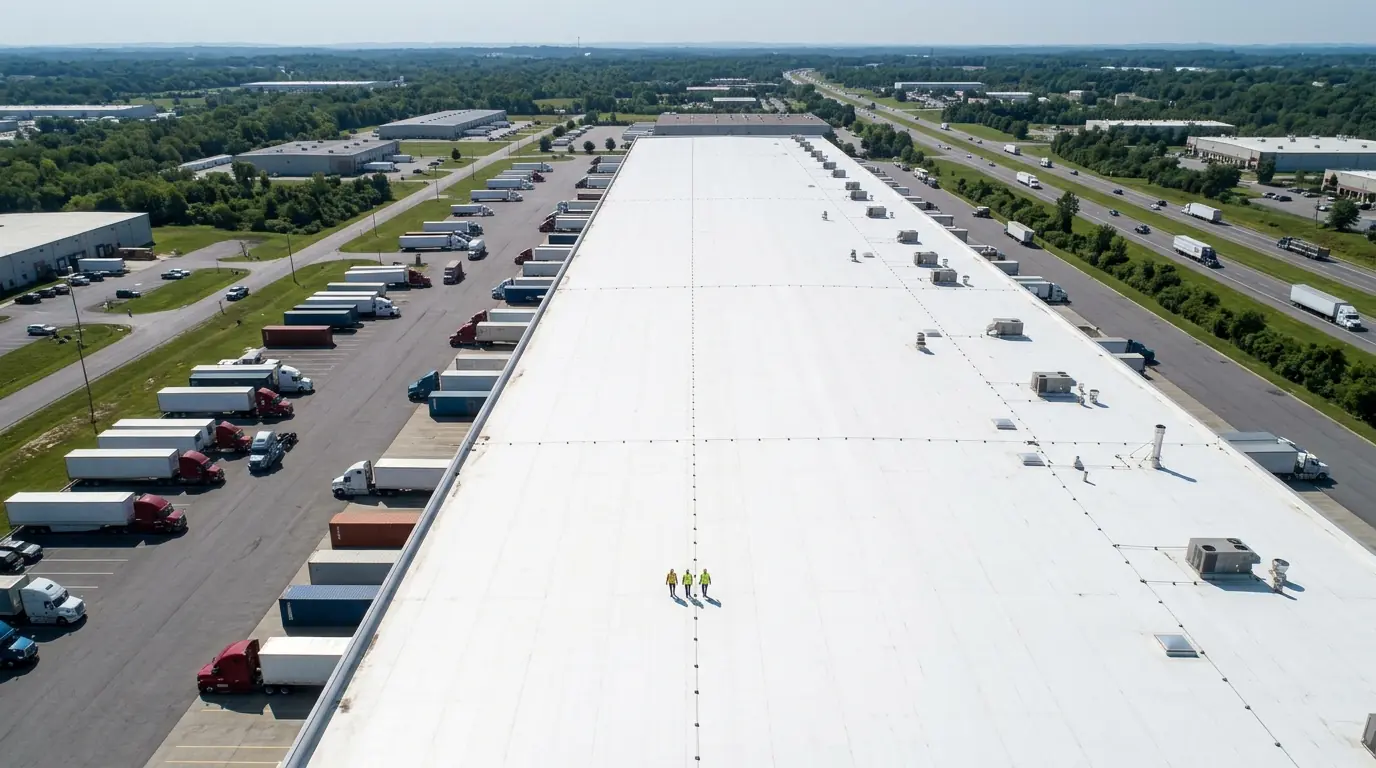
La Vergne is warehouse country: huge low-slope roofs along I-24 and Waldron Road, covering stored goods that can't get wet. At this scale a small seam failure can quickly turn into a very large insurance conversation.
- Buildings
- Large distribution warehouses, light industrial
- Corridor
- I-24, Waldron Road, Murfreesboro Road
- Watch for
- Ponding and perimeter wind uplift
- Access
- Truck courts, dock aprons, roof ladders
Short answer
Commercial roof trouble in La Vergne usually starts on very large distribution building roofs: failed seams, ponding at drains, wind-lifted perimeters and years of small patches. We survey in a grid, mark wet insulation, and quote after a site visit. Call the 24/7 line the moment product is at risk.
Why a warehouse roof in La Vergne is a different animal
The big boxes along I-24 and Waldron Road have roofs measured in acres, not squares. A single TPO or EPDM sheet can run the length of a football field, and a thousand feet of seam is a normal day's survey. On a roof that large, a drain that sits a quarter inch high or a deck that sags slightly between joists is enough to hold water for days after a rain.
That standing water matters. Ponding speeds up membrane wear, loads the structure, and pushes moisture through small seam defects that a sunny week would have hidden. Our first pass on these roofs is simple: walk the drains, mark every low spot, and pair the marks with the interior complaints. The pattern usually tells us where the repair has to go.
Scale also changes the economics of finding a leak. On a roof this large, replacing the whole membrane for a few failed seams makes little sense, and repairing only the visible stain may miss the actual entry point. Surveying in a grid, comparing the grid with the interior leak map, and marking each wet core lets us repair the right sections and leave the sound ones alone.
Wind behaves differently on these roofs as well. The perimeter and corners see the highest uplift, and edge metal that was fine for a small roof can peel on a big one. We check perimeter attachment and edge metal on every distribution roof before looking anywhere else. We record the perimeter condition in photos, since perimeter damage is the first thing an insurer or a warranty adjuster asks about.
Mechanically attached or fully adhered on a large roof
Distribution buildings often arrive with one system or the other. Knowing which you have changes how repairs and replacements are priced.
| Mechanically attached TPO | Fully adhered TPO | |
|---|---|---|
| How it holds | Fasteners and plates along seams or in rows | Adhered to the cover board or insulation with adhesive |
| Wind behavior | Can flutter or billow at the perimeter and corners | Stays flat, but the adhesive bond must be sound |
| Common failure | Backed-out fasteners and worn seam edges | Blisters or lifted flashing at curbs |
| Repair approach | Replace fasteners, rewelded patches at seam failures | Cut out the blister, re-adhere, then weld the patch |
| Good fit | Large open roofs with good decks | Roofs with high wind exposure or tall parapets |
Signs a distribution roof is about to cost you inventory
Warehouse managers feel the roof indirectly: a forklift driver mentions a wet spot, or a pallet ends up stained. These are the clues we trace back to the roof.
Drip lines under skylights
Older skylight curbs on big roofs crack and fill with debris, then spill water onto racking.
Stained roof deck near docks
Dock-edge roofs take wind-driven rain, and the membrane often stops short of the edge metal.
Rust at the underside of a steel deck
Orange streaks mean water has been reaching the deck for a long time, often from a single slow leak.
Soft, spongy steps
Wet polyiso under a membrane compresses underfoot. Walk it with a probe or an infrared scan before you plan a coating.
Billowing during wind
A roof that visibly puffs up in a gust is lifting off its fasteners, and the corners will go first.
Standing water at the base of roof ladders and equipment platforms
Standing water at the base of roof ladders and equipment platforms.
Edge metal that has bowed or opened along the dock side
Edge metal that has bowed or opened along the dock side.
How we protect stored goods while a La Vergne roof is repaired
At a distribution building the work plan has to protect what is underneath as much as the roof itself.
- Walk the interior with the operations manager to mark which racks and aisles sit below the wet area
- Stage tarps and poly sheeting before the first membrane cut
- Work one drainage area at a time and dry it in the same day
- Cover forklift lanes and dock doors that sit below roof access points
- Keep a weather watch and stop if a storm cell is within an hour of the site
- Photograph every repaired seam, drain and penetration for your records
- A look at the dock canopies and truck-court edges, where wind-driven rain gets in first
- A count of the penetrations on the roof so repairs can be priced per detail
Hail season and large-roof insurance claims
Spring hail and straight-line wind put thousands of square feet of La Vergne roofing at risk every year. After a storm, walk the perimeter and look for dents in edge metal, torn seams and puncture marks. Photograph them before any cleanup. A hail claim on a roof this size needs documentation, and we can walk the roof, tag damage and write it up when you call the 24/7 line.
Roofing work we do most in La Vergne
Six services building owners here call about most. The full catalog has 45.
Roof trouble in La Vergne?
Call (615) 716-3057 about a building in La Vergne (37086). The line is answered 24/7, and the first question is always where the water is showing.
Roofing questions from La Vergne
Can a La Vergne warehouse roof be recovered instead of replaced?
Sometimes. A recover needs dry insulation, a sound deck and no more than one existing covering. We confirm with core cuts and an infrared scan before we recommend it, because a recover over wet insulation fails early.
How do you find a leak on a very large La Vergne roof?
We pair interior leak locations with a roof walk, a drain-by-drain slope check and, where needed, an infrared scan at dusk. Water rarely drops straight down on a big roof, so we trace it along the deck.
Does ponding on a La Vergne distribution roof void a warranty?
Some manufacturer warranties exclude ponding beyond a set depth or time. Read the terms for your specific system. We note ponding in every survey so you have it on record.
How fast can you respond to a leak in 37086?
Call the 24/7 line at (615) 716-3057. If goods are at risk, tell us right away and we will talk through tarping and interior protection while a crew heads out.