Commercial roofing in Downtown Nashville (37219)
High-rise condos, hotels and parking structures downtown carry roofs that most people never see and everyone feels when they leak. We repair podium decks, tower roofs and mechanical areas while working around tight streets and event traffic.
- Buildings
- High-rise condos, hotels, parking structures, podiums
- Corridor
- Broadway, Second Avenue, Church Street
- Watch for
- Wind uplift, drain clogs, amenity deck leaks
- Access
- Tight streets, crane permits, event closures
Short answer
Downtown roofs sit under wind exposure, heavy mechanical loads and amenity traffic, so leaks usually start at drains, curbs and terrace edges. We trace the source, repair or replace the system, and plan crane, hoist and street access before any material arrives. Call (615) 716-3057 and we'll walk the roof with your engineer.
The roofs hiding above Broadway and the riverfront
Walk from the Cumberland River up toward the state capitol and the roofline changes block by block. Newer towers and hotels usually have concrete decks under fully adhered or ballasted membranes, with pavers or ballast on top. Older low-rise buildings on the side streets near Broadway often keep original built-up or modified bitumen roofs that have been patched many times.
Many downtown buildings stack roofs at different heights. A tower may have a podium roof at the fifth floor with a pool or lounge on it, a mechanical level above, and a high roof over everything. Each level has its own drains, flashing and wind exposure, and a leak in a guest room can come from any of them. We map the drainage and penetrations of every level before guessing.
Wind is the other defining factor. Towers catch gusts that never reach a suburban strip center, and the corners and perimeter of a high roof see the greatest uplift. Membranes, edge metal and coping all need fastening schedules sized for that exposure, and a roof repaired with ordinary suburban details can peel at the first strong storm. When we repair or replace a downtown roof, we check the perimeter attachment first and match edge metal to what the wind demands.
Garages and plaza decks add another layer. Many downtown structures put parking below and a landscaped or paved deck above, which means the roof is also a ceiling over parked cars and occupied lobbies. Expansion joints, drains and deck coatings all fail on their own timelines. We inspect them as part of the roof, not as another trade's problem, because water finds the weakest detail no matter whose scope it was.
Leak sources we check first on tower and podium roofs
Roofs at height behave differently from suburban flat roofs, mostly because wind and equipment loads are heavier.
Clogged roof drains and overflow scuppers
Leaves, trash and windblown debris block drains quickly, and a blocked primary drain with no overflow floods a deck.
Failed flashing at equipment curbs
Chillers, exhaust fans and cooling towers get serviced all the time, and every visit risks scuffed or cut base flashing.
Pavers shifted off pedestals
Amenity decks with pavers can hide membrane damage underneath until water shows up on the floor below.
Wind-peeled perimeter membrane
Corners and edges see the highest uplift, and a failed edge detail lets wind work under the whole sheet.
Cracked plaza and terrace waterproofing
Where the roof meets a patio slab or planter, movement joints and sealants are the usual failure points.
Failed expansion joints at garage decks
Where a parking structure carries a plaza or roof deck, joint sealant fails first and drips into the levels below.
Rusted or loose roof hatches
Access points take daily use, and a worn hatch curb lets water in beside the stair tower.
Getting materials onto a downtown roof
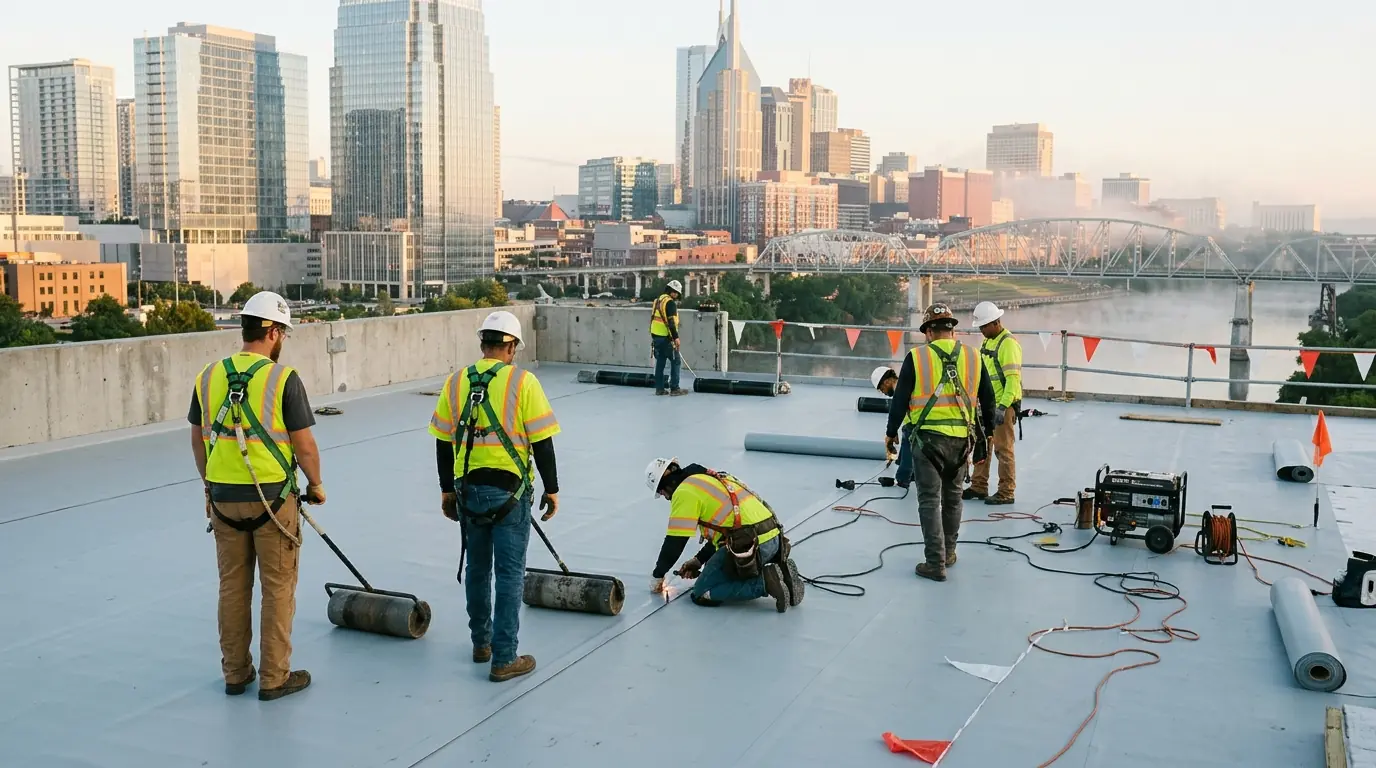
Downtown work starts with logistics. Streets near Broadway, Second Avenue and Church Street are narrow, loading zones are short, and event days at Bridgestone Arena or on Lower Broadway can close lanes without much warning. A crane lift may need a street permit and a flagged lane, and some buildings want hoisting through a freight elevator instead. We schedule deliveries for early morning, stage rolls and insulation in short loads, and coordinate with building engineers and garage operators before the first pallet is lifted. Hotels near Broadway also ask us to avoid early noise, so we split each day between quiet prep and louder tear-off.
Ballasted or fully adhered: what fits a downtown roof
Both are used on concrete decks here. The right answer depends on structure, wind exposure and what sits on top of the roof.
| Ballasted single-ply | Fully adhered TPO or PVC | |
|---|---|---|
| Weight on the structure | Heavy, requires engineer sign-off | Light, suits older frames |
| Wind exposure | Ballast can scatter without proper edge zones | Adhered to the substrate, less movement |
| Leak tracing | Ballast must be moved first | Easier to find and fix a breach |
| Foot traffic | Stone ballast takes traffic well | Needs walk pads on service paths |
What a downtown building manager should line up before work
A little preparation keeps the schedule short and the neighbors calm.
- Access to the roof through a hatch, stair tower or freight elevator
- Garage clearance and loading dock hours for deliveries
- Names of building engineers who control mechanical shutdowns
- Any amenity deck bookings or events during the repair window
- Existing roof drawings and prior moisture survey reports
- Notice to residents or hotel guests about noise from early starts
- How long a crane or street permit will take to arrive
- Wind and weather limits your insurer or building rules set
Roofing work we do most in Downtown Nashville
Six services building owners here call about most. The full catalog has 45.
Close to Downtown Nashville
Roof trouble in Downtown Nashville?
Call (615) 716-3057 about a building in Downtown Nashville (37219). The line is answered 24/7, and the first question is always where the water is showing.
Roofing questions from Downtown Nashville
Can you repair a roof on a Downtown Nashville high-rise without closing the street?
Often yes. Smaller repairs go up through freight elevators or stair towers with hand carry. Larger lifts may need a crane and a street permit, and we plan around event days so lanes close only when absolutely necessary.
What causes leaks on downtown condo and hotel podium roofs?
Most come from drains, curb flashing, terrace edges and amenity deck joints. A clogged drain with no overflow can also flood a deck fast. We trace the actual entry point before cutting anything open.
Do you work around Bridgestone Arena and Broadway event traffic?
Yes. We schedule deliveries for early morning and avoid game and concert windows when we need street access. For emergency leaks we still respond any hour, using hand carry where a lane isn't available.
Which membrane works on a downtown rooftop lounge or pool deck?
A fully adhered TPO or PVC membrane under pavers or pedestals is common, with protection layers and walk-safe finishes. The right build depends on structure, drainage and how the amenity is used.