Hail damage roof repair for Nashville buildings
A spring hail storm swept across your lot and the roof looks fine from the ground, but bruised membrane and cracked skylights don't leak until later. We inspect the roof, document what the hail did and repair what matters.
- Test areas on every roof
- Core cuts to confirm
- Insurance-ready photo report
Short answer
Hail damage on a commercial roof means fractured membrane reinforcement, bruised insulation, dented or punctured metal and cracked skylights or vent covers. It can leak months later. A proper inspection uses test areas, core cuts and photos to separate true functional damage from cosmetic marks, which also decides what insurance should cover.
What hail does to a flat roof that you can't see from the ground
Hail is an impact load. On a single-ply roof, a falling stone can fracture the reinforcing scrim or crush the insulation under the membrane without leaving a visible hole. The surface may show a faint dimple, a ring of cracked coating or a spot that looks slightly different in color. The leak often shows weeks or months later, in a different rain.
Spring is the season Middle Tennessee watches for it. Large hail has crossed Davidson, Williamson, Rutherford and Wilson counties in past springs, and every storm tracks a different path. A roof one mile away can be untouched while yours is bruised across the south slope. That's why we inspect the roof itself, not the storm map, and base findings on what we measure.
Insulation is the part owners forget. Polyiso and similar boards crush under impact and lose R-value where they're dented, and they hold water if the scrim above is cracked. A membrane patch over crushed board looks tidy for a season, then ponds. We probe and, where needed, replace the board along with the membrane over it.
How each roof system takes a hail hit
Hail resistance varies by material, thickness and what lies underneath. Here is what we see on the systems common around Nashville.
| TPO or PVC | EPDM | Modified bitumen or BUR | Metal panels | |
|---|---|---|---|---|
| Typical hail damage | Fractured scrim, punctures, bruised seams | Surface pitting, punctures, split on old membrane | Granule loss, fractured mat, blisters | Dents, cracked paint, seam stress |
| Functional vs cosmetic | Mostly functional once scrim breaks | Functional when membrane is cut or thinned | Functional when mat or ply is cracked | Often cosmetic unless seams or coating fail |
| Hidden risk | Bruised insulation below | Thin spots that fail later | Gravel hides cracks | Coating loss that invites rust |
| Common repair | Patch, reinforce or replace section | Patch or replace section | Re-cap or replace damaged area | Re-coat, replace panels, seal seams |
| Inspection method | Visual, probe and core cuts | Visual and tactile pressing | Core cuts and visual | Visual and seam checks |
Evidence that your roof took a hail hit
Some marks are obvious and some only show on a close walk. We check each of these.
Dented HVAC fins and vent caps
Soft metal records hail well. Dents on rooftop units, gutters and downspouts show where the storm was heaviest.
Spatter marks and cleaned patches
Fresh hail can scrub dirt off a membrane in round clean spots, then leave oxidation rings that stand out on a dark roof.
Scattered gravel and granules in drains
Fresh granules or surfacing stone in scuppers or drain baskets point to surface loss from impact.
Cracked skylight domes
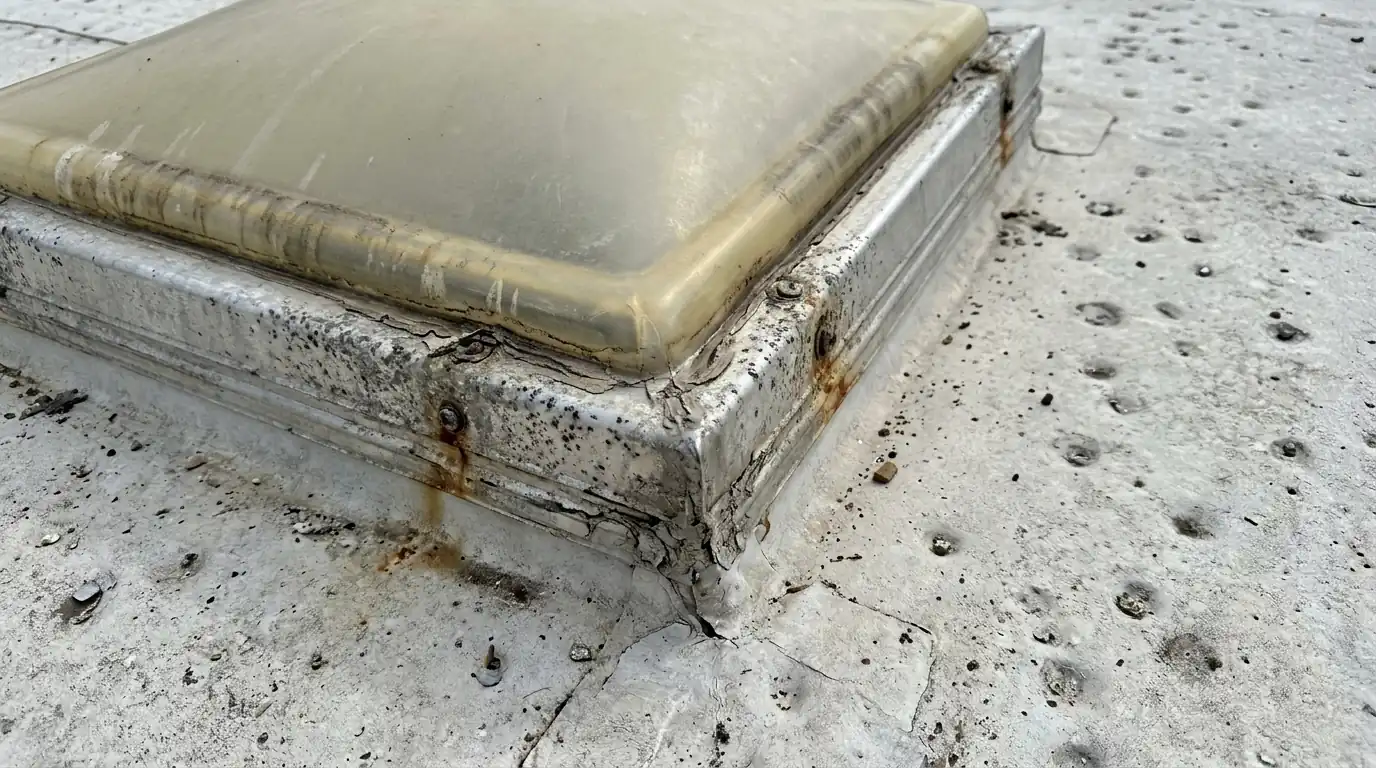
Acrylic and polycarbonate domes crack or craze under hail. Cracks may be hairline on the outside and leak underneath.
Dimples or soft spots in the membrane
When you press a gloved hand on a spot and it gives, insulation below may be crushed or wet.
New leaks after the first heavy rain
Water finds the cracked scrim or punctured spots a few weeks later, often in unrelated areas of the building.
Granule or mineral surface bruising on cap sheet
Round bare spots where mineral surfacing was knocked off expose asphalt to sun and age the sheet years faster than the rest.
How we inspect and document a hail loss
A hail inspection has to hold up to an adjuster's questions. We build the file as we go.
Date and weather research
We note the storm date, reported hail size and whether your building was in the path, using public weather records and the local reports around the Cumberland River corridor and the surrounding counties.
Ground and roof photos
Photos of dented equipment, gutters, vent caps and other soft metal establish that hail reached the building.
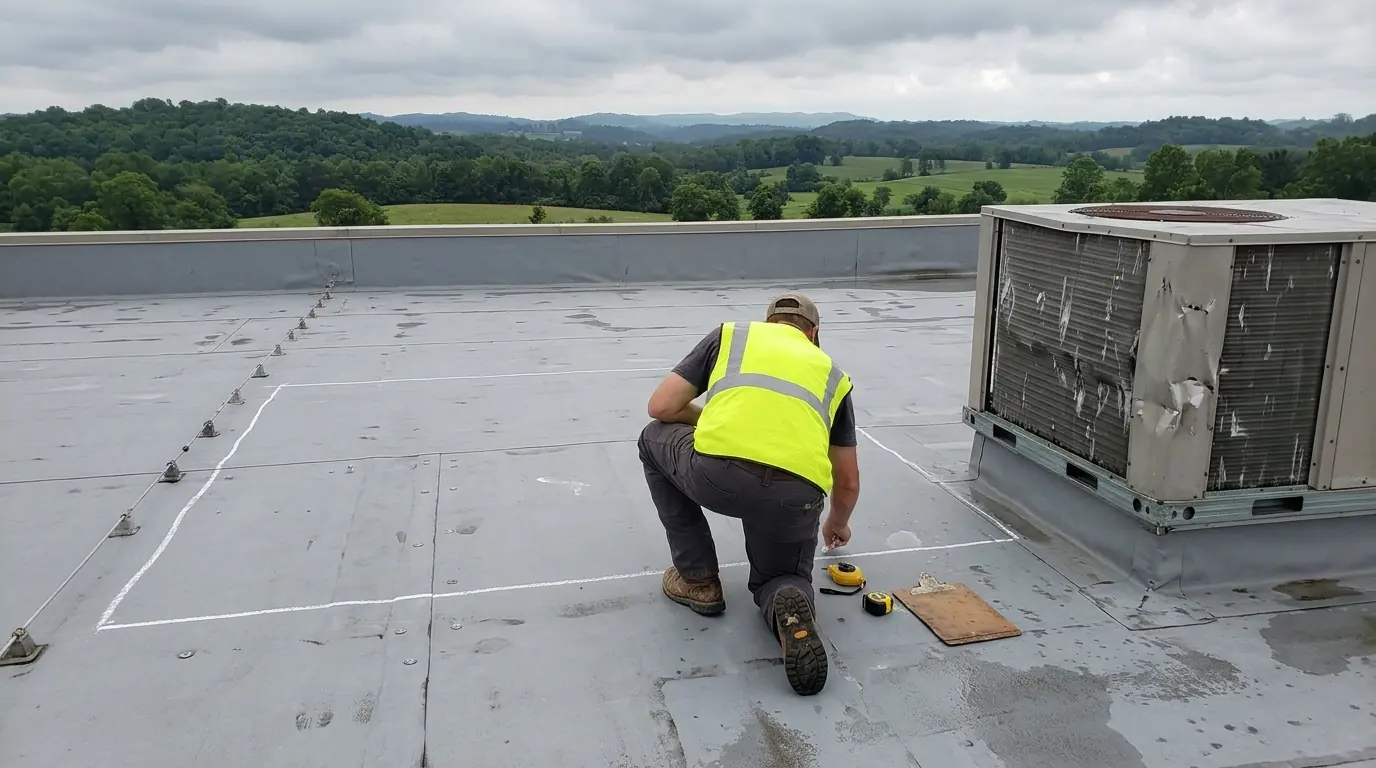
Test areas on the roof
We mark a set of ten-by-ten-foot squares across each slope or roof section and count and describe every impact within them.
Probe and core cuts
At suspect impacts we cut small cores to see whether the scrim fractured, the insulation crushed or moisture entered, then patch each core hole with the same system before we leave the roof.
Map and classify
Each impact is classified as cosmetic or functional, and the map shows where damage clusters and where the roof is intact.
Written report
You receive the photos, test-area counts, core results and a repair scope with a price range your carrier can review.
Repair scheduling
After your carrier's review, we schedule the permanent repair, keeping temporary seals documented in the meantime.
Hail repair cost ranges for commercial roofs
Costs depend on how many impacts are functional and how large the repair zones are. We quote from the inspection, not from a storm report.
| Work | Typical range | What moves it |
|---|---|---|
| Hail inspection with test areas and report | $690 to $2,150 per building | Based on roof area and number of sections; core cuts are included in the scope. |
| Patch of individual impacts on single-ply | $38 to $96 per impact | Used when damage is scattered and the membrane is otherwise sound. |
| Replace a membrane section and insulation | $9.40 to $16.20 per sq ft | For clusters of functional damage with crushed insulation. |
| Skylight dome replacement | $740 to $1,980 each | Depends on size and curb condition; includes flashing reseal. |
What pushes a price up or down:
- Number of functional impacts per test area.
- Membrane type and thickness, since thinner membranes bruise easier.
- Insulation condition below the damaged zone.
- Whether panels and coatings can be repaired or must be replaced.
- Access and the number of separate roof levels.
- Insurance deductible and what the carrier determines is covered.
Ranges reflect recent Middle Tennessee work and are not a quote; we price after a site visit. See the full Budget Guide.
Metal dents, cracked skylights and the small parts hail finds first
Dents in metal panels are the most photographed hail damage and the most argued over. A shallow dent in a standing-seam panel may not affect watertightness at all, while a dent that stretches a seam, cracks the paint or exposes bare steel starts a corrosion clock. The question isn't how the roof looks. It's whether the panel still sheds water and resists rust.
We press and probe the seams, check the finish with a close look for cracks, and note fastener heads near dents on exposed-fastener panels. Where the finish is intact and seams are tight, we say the damage is cosmetic. Where the coating has cracked or seams are strained, we recommend sealing, re-coating or panel replacement.
Skylight domes, plastic vent covers and fiberglass panels are the first things hail breaks, and the least expensive to fix if caught early. A cracked dome admits water at the curb and rots the deck beneath it. We replace the dome, reseal or rebuild the curb flashing and check the interior ceiling for old stains.
Roof hatches, exhaust fan housings and pipe caps get the same treatment. We tap each one, look for hairline cracks and compare them to what the storm records say, so the report separates hail damage from age-related cracking that insurers will not cover. If your policy has a cosmetic exclusion for metal, ask your agent before the adjuster visits, since appearance-only dents may be treated differently from damage that affects water shedding.
Paperwork to gather before the adjuster visits
Claims move faster when the file is complete. Bring these items together early.
- Date of the storm and any reports from the news or weather service.
- Roof plans, installation date and material list, if you have them.
- Warranty documents and recent inspection or maintenance records.
- Photos of the roof taken before the storm, even older ones.
- Invoices for prior repairs or recoating work.
- A copy of your policy with the deductible and any cosmetic exclusions.
- Notes about interior leaks and when each one began.
Do not sign a roof repair contract before the inspection is done
After a hail event, door-to-door crews arrive quickly and some push owners to sign before anyone has measured the damage. A roof with ten bruised spots needs ten patches, not a replacement, and a roof with widespread fractured scrim might need more than a patch. Insist on an inspection with photos, test squares and core cuts first. Then compare what the carrier writes with what the roof shows. Call us at (615) 716-3057 for a second look. We would rather lose a job than sign you to the wrong scope.
Need hail damage roof repair on a Nashville building?
Call (615) 716-3057 any hour. We look at the roof, show you what we found and price the work before anything starts.
Where we do hail damage roof repair around Nashville
The ZIP codes below cover most of the buildings we work on. Every one links to its local page, and the full locations list has 62 more.
- Nashville 37219
- Downtown Nashville 37219
- East Nashville 37206
- Antioch 37013
- Madison 37115
- Donelson 37214
- Hermitage 37076
- Bellevue 37221
- Green Hills 37215
- Franklin 37064
- Brentwood 37027
- Murfreesboro 37130
- Smyrna 37167
- La Vergne 37086
- Mount Juliet 37122
- Lebanon 37087
- Hendersonville 37075
- Gallatin 37066
- Spring Hill 37174
- Columbia 38401
- Goodlettsville 37072
Work that often goes with hail damage roof repair
Repairs and new roofs on Mule-Hide, GenFlex, Polyglass and Henry systems, matched to what the building already has where we can.
Hail Damage Roof Repair questions from Nashville owners
How can I tell if hail damaged my commercial roof in Nashville?
Look for dented rooftop equipment, vent caps and gutters, then have the membrane inspected with test areas and core cuts. Hail often breaks reinforcement without leaving a visible hole, so a ground-level look isn't enough. A written report with photos documents what the storm did.
Will my insurance pay for hail damage on a flat roof?
That depends on your policy, deductible and what the carrier finds. We can't decide coverage, but we document the damage with test areas, cores and photos so the adjuster has facts. If you disagree with a determination, a second inspection report can help. Ask your carrier early whether they'll send their own inspector.
Can hail damage be repaired without replacing the whole roof?
Often yes. Scattered functional impacts can be patched, and clustered damage can be replaced by section. Whole-roof replacement makes sense when damage is widespread, insulation is crushed across large areas or the membrane was already near the end of its service life.
How long after a hail storm do roof leaks appear?
Sometimes the first heavy rain, sometimes months later. Bruised membrane and fractured scrim take time to open under UV and thermal cycling. That delay is why we recommend inspecting soon after a storm and keeping dated photos of the roof.
Do you inspect skylights and metal panels after hail?
Yes. We check skylight domes for cracks and crazing, test curbs and flashings, and examine metal panels for dents, finish cracks and seam strain. Each item is photographed, classified as cosmetic or functional and included in the written report. We repair what we document.