Parapet and coping repair for Nashville buildings
Older brick buildings in Nashville often leak from the top of the wall, not the roof deck, and the stain shows up three floors down. We repair the parapet, the coping and the flashing behind them.
- Wall inspected both sides
- Answered 24/7
- Masonry and roof, one visit
Short answer
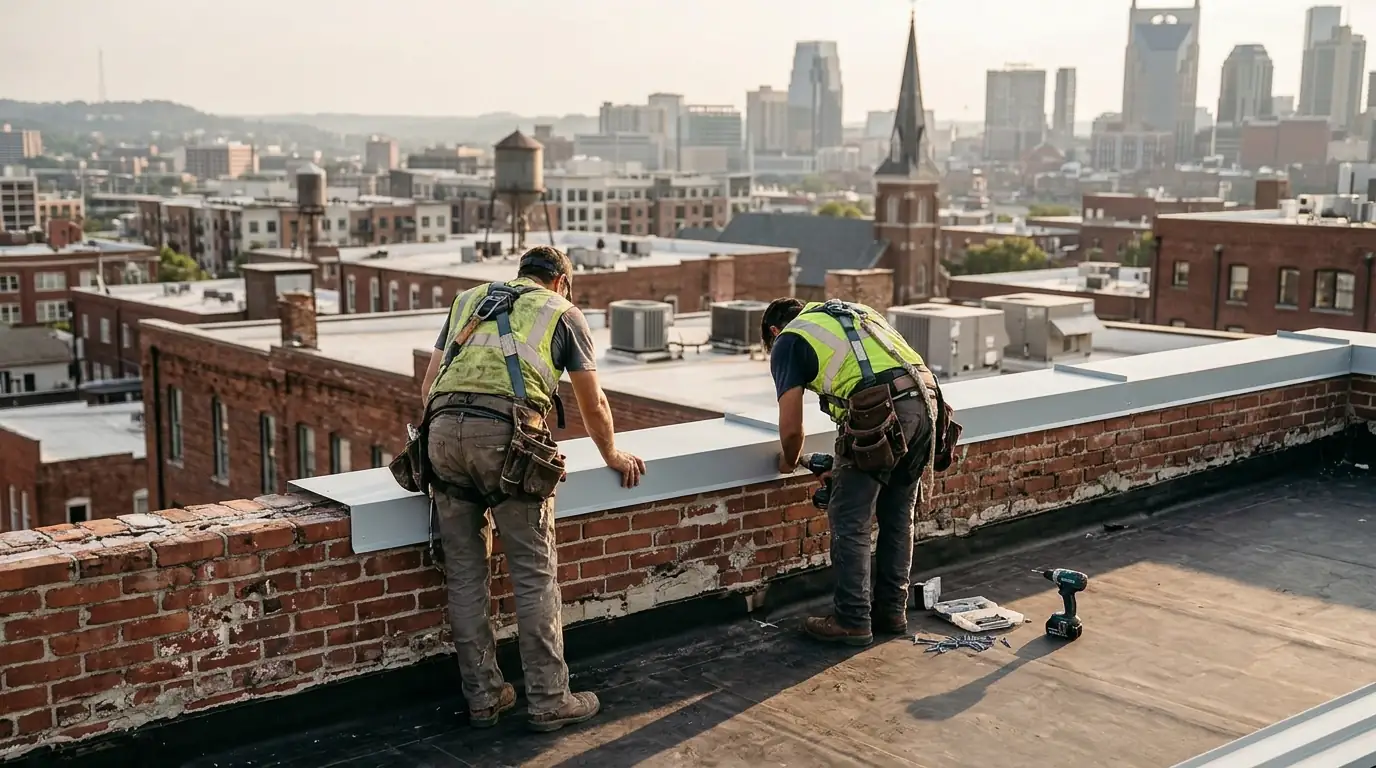
Parapet and coping repair restores the wall that rises above a flat roof, including coping caps, joints, brick, mortar and the flashing inside. Typical costs run $22.40 to $64.80 per linear foot for coping and repointing work, more if brick must be rebuilt. We quote after a site visit and a look at the wall from both sides.
Why a parapet leaks when the roof does not
A parapet is the short wall that rises above the roof edge on many downtown Nashville, Germantown and Wedgewood-Houston buildings. It hides the roof from the street, but it also sits exposed on three faces: inside, outside and top. Rain hits all three. If the cap on top lets water in, that water travels down inside the wall and appears as a stain on the floor below. Standing on the sidewalk, you can often read the staining pattern before you ever reach the roof.
Brick and mortar are porous. Season after season of Middle Tennessee humidity, summer storms and winter thaws, mortar joints lose material and open hairline paths. Water enters, turns to ice in a cold snap, expands and pushes a little more mortar out. The wall does not fail dramatically. It leaks a bit more every season until a ceiling tile drops.
The fix has to treat the wall and the roof together. Patching the membrane while the top of the parapet stays open to water only moves the leak around. We look at coping, mortar, brick face, through-wall flashing and the base of the wall where the membrane turns up, and repair in that order.
The interior face of the wall tells its own story. Plaster that blisters, paint that peels in a band below the ceiling and floor finishes that cup near the exterior wall all point to moisture moving through masonry. We ask to see these areas during the survey, because a stain on the third floor may start at a coping joint five floors up. Connecting what we see inside to what we find on the roof is how we avoid repairing the wrong place.
Signs the parapet is letting water into the building
Most of these can be seen from the roof or from a lift along the street side of the wall.
White powder on the brick face
Efflorescence means water is moving through the masonry and leaving salts behind. It is a moisture map of where the wall is wet.
Open joints between coping stones or panels
A gap you can slide a fingernail into is a direct path for rain to enter the top of the wall.
Leaning or stepped coping
Movement in the cap means the wall below has shifted, or the anchors have let go.
Spalled or flaking brick faces
Brick that sheds its outer layer has been taking in water and cycling through cold snaps and thaws.
Stains at the ceiling line below the wall
A horizontal brown stain beneath a parapet is a through-wall leak, not a membrane leak.
Vegetation in mortar joints or on the cap
Moss and small seedlings mean the joints hold moisture continuously.
Cracks that step along the mortar joints
A stair-step crack running diagonally through brick usually means movement, settlement or a failed lintel. It needs a mason's eye before any cap goes on.
Metal coping, stone coping or a coated cap
Choosing a new cap is a decision about drainage, wind and appearance. These are the options we most often price on Nashville masonry walls.
| Prefinished metal coping | Cast stone or precast coping | |
|---|---|---|
| Water shedding | Sloped to the roof side with a drip edge, joints covered by sealed splice plates | Sloped, but joints between stones need sealant that must be renewed |
| Wind resistance | Held by continuous cleats and tested to ANSI/SPRI ES-1 where specified | Heavy and fixed by mortar and anchors; rarely lifts but can crack |
| Appearance | Color-matched to trim, clean modern look | Traditional look suited to historic brick buildings |
| Repair after damage | Panels can be replaced individually | Cracked stones usually must be removed and reset |
| Cost in place | Moderate, depends on gauge and finish | Higher, with masonry labor |
| Upkeep | Check splice plates and fasteners each spring | Check joint sealant and reset loose stones as needed |
How we repair a leaking parapet
We work from the top down, because every layer below depends on the layer above keeping water out.
Survey both faces of the wall
We look at the roof side, the street side and the top, using a lift or swing stage where the wall is too tall for a ladder. We tap the brick with a hammer to find hollow spots.
Probe and map the moisture
A moisture meter and, if needed, a small test cut show how far water has traveled into the wall and the roof insulation beside it.
Remove failed coping and cap
Loose stones, bent metal and old sealant are lifted off. Anything salvageable is set aside for reuse.
Repoint and rebuild masonry
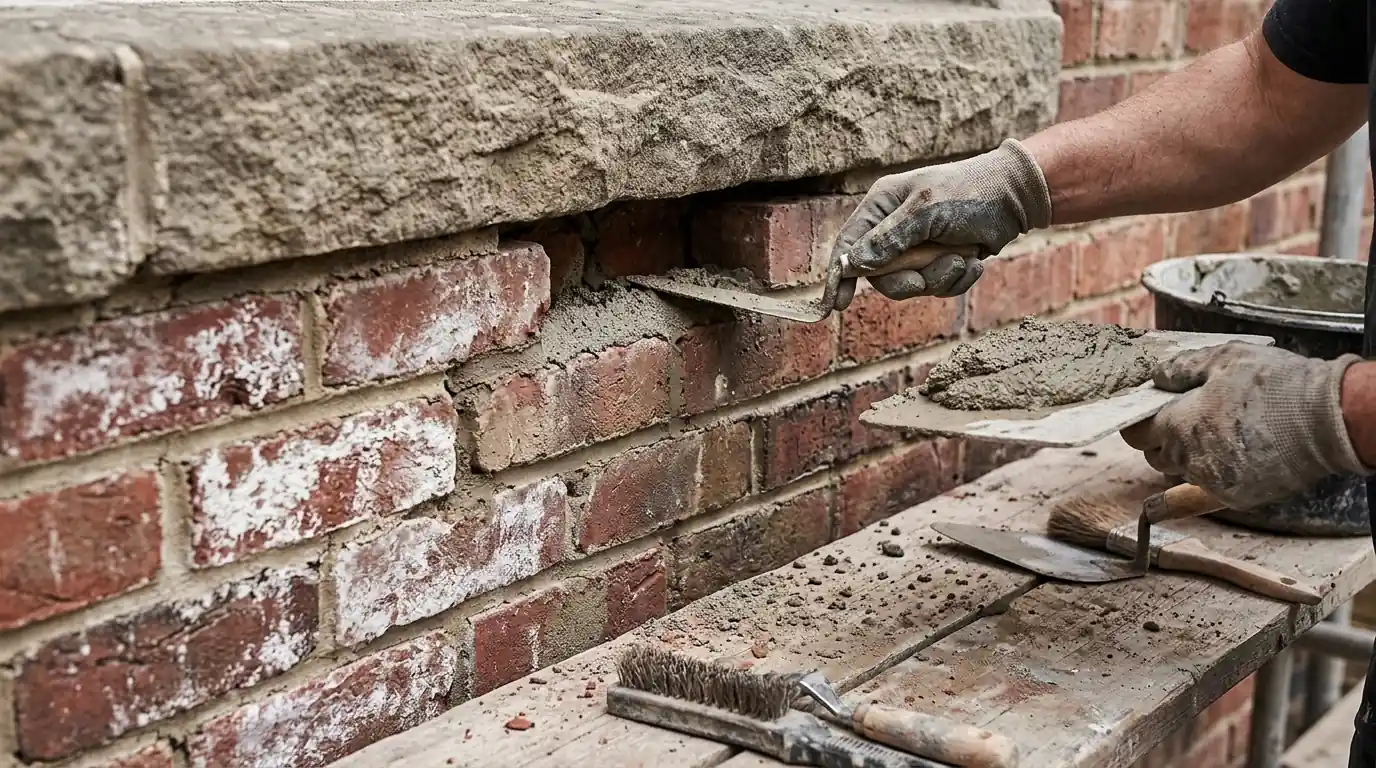
Damaged mortar is cut out to a uniform depth and replaced with mortar that matches the original in hardness, which matters on older soft brick. Spalled units are replaced.
Install through-wall and counterflashing
A new flashing layer is set under the cap and lapped over the base flashing, so water that gets past the top is turned out of the wall.
Set the new coping and seal splices
Cleats or anchors are fastened, joints are sealed and drip edges are checked. We photograph every section before closing out.
Recheck after the first storm
We revisit after the first sustained rain to check the interior face and the ceilings below, and we send a short note with photos for your building file.
Brick on older Nashville buildings needs a gentler hand
Many Nashville buildings from before the middle of the last century were built with soft lime-based mortar and relatively soft brick. If a repair uses modern hard, cement-heavy mortar, the brick takes the stress of movement and cracks, not the mortar. We test existing mortar and match the repair mix so the wall can keep breathing and moving the way it was designed.
Warehouse conversions in the Gulch, Germantown and East Nashville add another layer. Owners often cut new openings, add rooftop decks or put mechanical equipment against the parapet. Each change leaves something unsealed. We check for these alterations and flash them correctly before putting a new cap on top of them.
Parapet height and thickness also matter. A tall, thin parapet catches wind and may need bracing. A short, thick one holds water if the cap is flat. We note both on every survey and make sure the new cap slopes toward the roof side, never the street, so runoff does not stain the facade.
Buildings in historic overlay districts may need design review before exterior masonry, coping or color changes. If your building sits in Germantown, Edgefield or downtown, ask the planning office early so the repair does not stall at permit review. We can document existing conditions with dated photos and measured sketches, which reviewers usually want to see before approving a like-for-like repair.
What parapet and coping repair costs
These ranges are typical for Middle Tennessee commercial walls. Wall height, access method and brick condition move them, and we quote after a site visit.
| Work | Typical range | What moves it |
|---|---|---|
| Repointing mortar joints | $11.70 to $24.30 per sq ft of wall face | Includes removal to depth and color-matched mortar |
| Prefinished metal coping, removed and replaced | $22.40 to $41.85 per linear foot | Includes cleats, splice plates and sealant |
| Cast stone coping reset and rejointed | $31.60 to $64.80 per linear foot | Replacement stones are extra |
| Brick replacement in damaged sections | $38.50 to $79.20 per sq ft | Sourcing old brick can add weeks |
| New through-wall flashing in an existing parapet | $27.30 to $58.60 per linear foot | Requires removing and rebuilding a course of brick |
What pushes a price up or down:
- Height of the parapet and whether a lift or scaffold is needed
- Condition of brick, whether spalled or sound
- Presence of through-wall flashing, and how much must be added
- Street-side closures or sidewalk protection required by the city
- Cap material chosen and how long custom pieces take to arrive
- Whether the roof membrane must be lifted and re-flashed at the same time
Ranges reflect recent Middle Tennessee work and are not a quote; we price after a site visit. See the full Budget Guide.
What a parapet walk covers when we visit
Here is what you can expect us to look at before we give a number.
- Top surface of the coping for slope, cracks and open joints
- Mortar condition on all three faces of the wall
- Brick units for spalling, delamination or hollow sound when tapped
- Presence and condition of through-wall flashing
- Termination of base flashing and counterflashing at the wall
- Scuppers or drains that pass through the parapet
- Equipment, signage or rails fastened into the wall
- Interior side of the wall for stains, efflorescence or damp plaster
- Lintels and shelf angles near the top of the wall for rust or movement
Street-side work in downtown Nashville
Working on a parapet along Broadway, Church Street or near Music City Center often means closing a lane or protecting a sidewalk. We plan lift placement, pedestrian protection and delivery times before the first day on site, and we work around event days when downtown traffic is heaviest. Tell us if your building sits near Bridgestone Arena or the convention center, and we will schedule around game and show nights. Lift placement on a public right of way is arranged with the city well before the first day, and we build that time into the schedule we give you.
Need parapet & coping repair on a Nashville building?
Call (615) 716-3057 any hour. We look at the roof, show you what we found and price the work before anything starts.
Where we do parapet & coping repair around Nashville
The ZIP codes below cover most of the buildings we work on. Every one links to its local page, and the full locations list has 62 more.
- Nashville 37219
- Downtown Nashville 37219
- East Nashville 37206
- Antioch 37013
- Madison 37115
- Donelson 37214
- Hermitage 37076
- Bellevue 37221
- Green Hills 37215
- Franklin 37064
- Brentwood 37027
- Murfreesboro 37130
- Smyrna 37167
- La Vergne 37086
- Mount Juliet 37122
- Lebanon 37087
- Hendersonville 37075
- Gallatin 37066
- Spring Hill 37174
- Columbia 38401
- Goodlettsville 37072
Work that often goes with parapet & coping repair
Membranes, coatings and metal we work on every week include Versico, Duro-Last, Elevate and Gaco, plus older systems still in service.
Parapet & Coping Repair questions from Nashville owners
What is the difference between a parapet repair and a roof repair in Nashville?
A roof repair addresses the membrane and insulation on the flat part of the roof. Parapet repair addresses the wall that rises above it, including brick, mortar and coping. Many leaks are blamed on the roof when the parapet is the entry point, so we inspect both together.
How do you fix efflorescence on a brick parapet?
Efflorescence is a symptom, so we find where the water enters, usually coping joints, failed mortar or missing through-wall flashing, and fix that first. Then the powder is brushed or washed off. Cleaning without stopping the water source just lets it come back.
Do coping joints need sealant, and how often does it get replaced?
Butt joints between stone or metal coping depend on sealant, which hardens in the sun and pulls away. Plan on inspecting it every year and renewing it roughly every five to eight years. Metal coping with covered splice plates relies on sealant much less.
Can you repair a parapet without a lift?
Short parapets are often reachable from the roof side with ladders and harnesses. Taller walls, or work that includes the street face, need a lift or swing stage. We decide on the first visit and include equipment in the quote so there are no surprises.
Is a leaning parapet an emergency?
It can be. A wall that moves or rotates may fall in high wind, especially after a storm. Call our 24/7 line if you see a parapet leaning, cracked through or shedding brick. We secure the area first and then plan the repair.