Commercial roofing in Music Row, Nashville (37212)
Music Row is recording studios, publishing offices and converted houses tucked between busy avenues. A leak above a control room costs more than the repair, so we work quietly, schedule around sessions and fix the cause the first time.
- Buildings
- Studios, publishing offices, converted houses, small mid-rises
- Corridor
- 16th Avenue South, 17th Avenue South, Division Street
- Watch for
- Leaks above treated rooms, rooftop HVAC curbs
- Access
- Tight lots, session schedules, noise sensitivity
Short answer
Music Row buildings are small to mid-size commercial structures where roof leaks can damage sound-treated rooms and equipment. We trace the leak, repair or replace the roof with minimal noise and rooftop traffic, and coordinate with studio schedules. Phone (615) 716-3057 any hour if water is already entering a room.
Small buildings, expensive interiors
The area around 16th and 17th Avenue South is full of buildings that don't look big from the street but hold a lot of value inside. Many are converted houses with pitched roofs, others are low-rise offices and purpose-built studios with flat or low-slope roofs. The interiors can include acoustic panels, instruments, consoles and archives, all of which water can ruin quickly. Even a small leak can stain a ceiling tile that hides insulation or wiring, so we ask to see above-ceiling spaces when access allows.
That changes how we approach the work. A ceiling stain is not just a roofing issue, it's a risk to the room beneath. We start by finding where water enters, install a temporary cover if rain is coming, and only then plan the permanent repair with you. We plan the first call around what's directly below the leak.
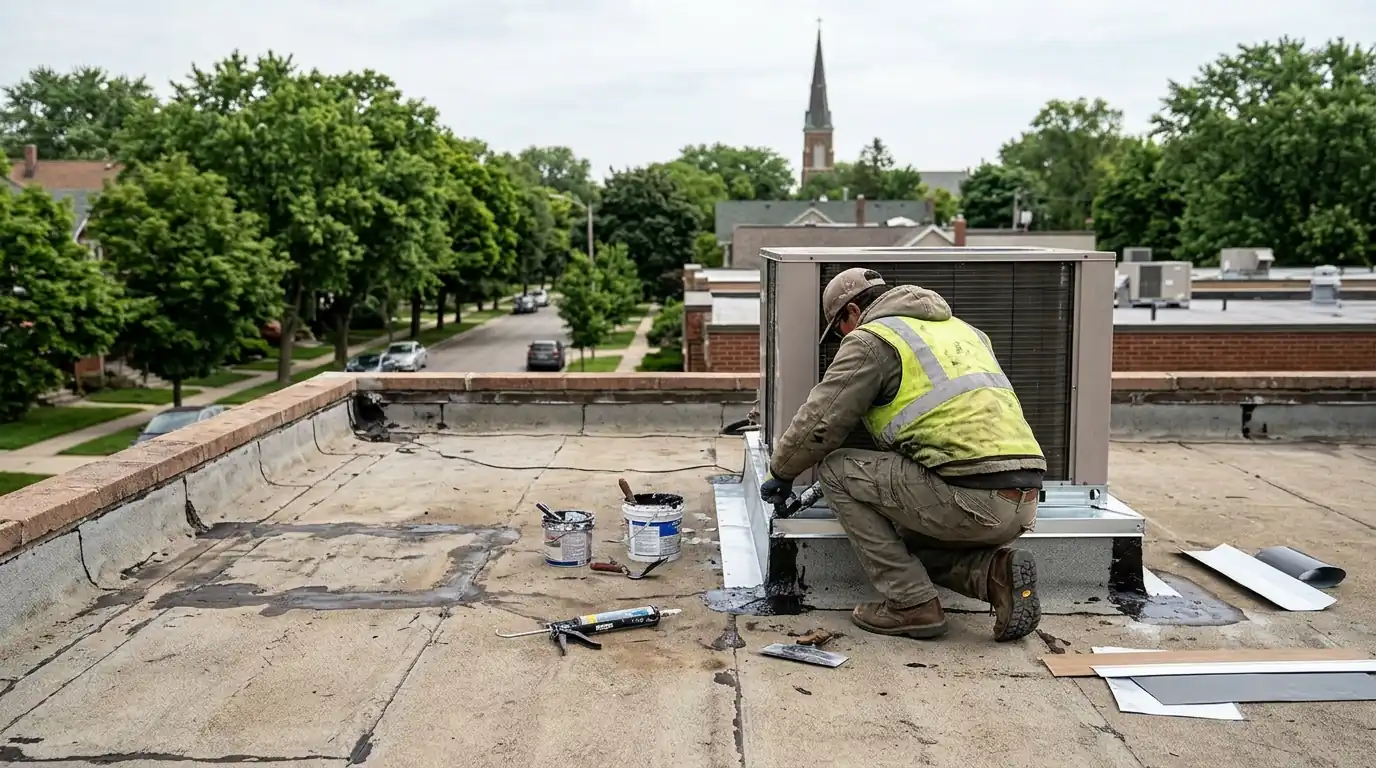
Heat and humidity add their own pressure. Studios keep temperature and moisture tightly controlled, so rooftop HVAC runs hard through Nashville's long summers. Condensate lines, refrigerant lines and electrical conduits all pass through the roof, and every one is a penetration. We check how those lines are flashed and whether they sit on supports or lie on the membrane, because a line resting on the surface wears through it over time and drips into the ceiling below.
Many buildings here share lots or sit close to neighbors, which limits where we can stage material and park trucks. Converted houses may have only a narrow side yard, while small mid-rises might have a garage entrance and nothing more. We measure before we promise, use short loads and hand carry where a truck can't reach, and make sure nothing blocks a neighboring studio's loading door during the work.
Working around recording sessions
Studio rooms are built to block outside sound, but a crew on the roof still creates vibration and noise that can show up on a recording. We ask which rooms are booked and when, and plan loud tasks like cutting, fastening and torching for gaps between sessions. Quiet work, such as inspection, flashing prep and sealing, can usually go on at other times. If a session can't be moved, tell us when you phone and we'll adjust the sequence. A tarp goes on first if rain is forecast, and neighbors on shared lots hear from us before we begin.
Early warning signs above a studio or office suite
Catch these before water reaches treated walls or equipment.
Ceiling tile or panel discoloration
A faint ring on tiles or acoustic fabric often means slow, repeated moisture.
Musty smell in a control room
A smell without a visible leak can mean a damp roof deck or wet insulation above.
Flashing gaps at HVAC curbs
Studios often have extra rooftop equipment for climate control, and each curb is a potential leak.
Shingle or membrane lifted by wind
Spring wind exposes weak edges, and small lifts let water in.
Water stains on exterior walls under the roofline
Stains below the eave or parapet often trace back to a failing edge or gutter.
Condensate lines lying on the membrane
Constant dripping and abrasion wear a path through the surface beneath the line.
Chimney and vent flashing on old houses
Converted houses keep old chimneys and stacks whose flashing was never designed for current use.
Water marks on drywall below roof overhangs
Marks beneath an eave point to failed edge metal or gutter backup that wets the wall.
Gutters packed with leaf debris
Overflowing gutters on converted houses soak fascia boards and push water under the first row of roofing.
Pitched house roof or flat studio roof: what changes
Music Row mixes both, and repairs differ.
| Converted house, pitched roof | Purpose-built studio, low-slope roof | |
|---|---|---|
| Common system | Commercial architectural shingle or metal | TPO, EPDM or modified bitumen |
| Typical leak points | Valleys, chimneys, dormers | Curbs, drains, seams |
| Noise during work | Moderate, mostly fastening | Varies, torch and welding are louder |
| Interior risk | Attic insulation, ceilings | Treated rooms and equipment |
| Staging space | Side yard or driveway | Parking lot or loading area |
What to tell us before a Music Row roof visit
A short list helps us protect the building and fit the schedule.
- Which rooms are directly below the leak
- Session or client schedule for the next two weeks
- Whether equipment can be moved or covered
- Parking or loading limits on the lot
- Roof type and any prior repairs or coatings
- Neighbor buildings that share a wall or drainage
- Any rooftop antennas or broadcast equipment
- Whether neighbors share a wall or drainage with the building
- Whether the building has an attic or crawl space above treated rooms
Roofing work we do most in Music Row
Six services building owners here call about most. The full catalog has 45.
Roof trouble in Music Row?
Call (615) 716-3057 about a building in Music Row (37212). The line is answered 24/7, and the first question is always where the water is showing.
Roofing questions from Music Row
Can you repair a Music Row studio roof without disrupting sessions?
We schedule loud steps around bookings and do quiet prep at other times. If a session can't move, we adjust the sequence. Active leaks still get a response any hour.
What roof types do Music Row converted houses usually have?
Commercial architectural shingle or metal on pitched sections, often with low-slope membrane over additions. We repair each part with the right material.
How do you protect equipment during a Music Row roof repair?
We install a temporary cover first if rain is possible, then plan the permanent work. We also ask what sits directly below the leak so we can protect it.
Why does my Music Row ceiling leak only in heavy rain?
Wind-driven rain often exposes small flashing gaps or lifted edges that stay dry in light rain. We trace those with a roof walk and water testing when needed.