Commercial roofing in Columbia, TN (38401)
Columbia is the Maury County seat, with a historic square, churches on almost every main street and industrial parks on the edges. Their roofs range from old brick-building flats to large metal and membrane systems.
- Buildings
- Square storefronts, churches, industrial parks
- Corridor
- Highway 31, James Campbell Boulevard, Nashville Highway, Highway 412
- Watch for
- Parapet flashing, church valleys, industrial seams
- Access
- Square parking, truck routes, Mule Day crowds
Short answer
Columbia commercial roofs include flat roofs behind parapets on the historic square, steep and low-slope church roofs, and large metal or single-ply roofs in industrial parks. Most leaks start at flashing, parapet caps, drains or aging seams. We trace the entry point, repair it correctly and quote replacement only if cores show it's needed.
The courthouse square and the buildings around it
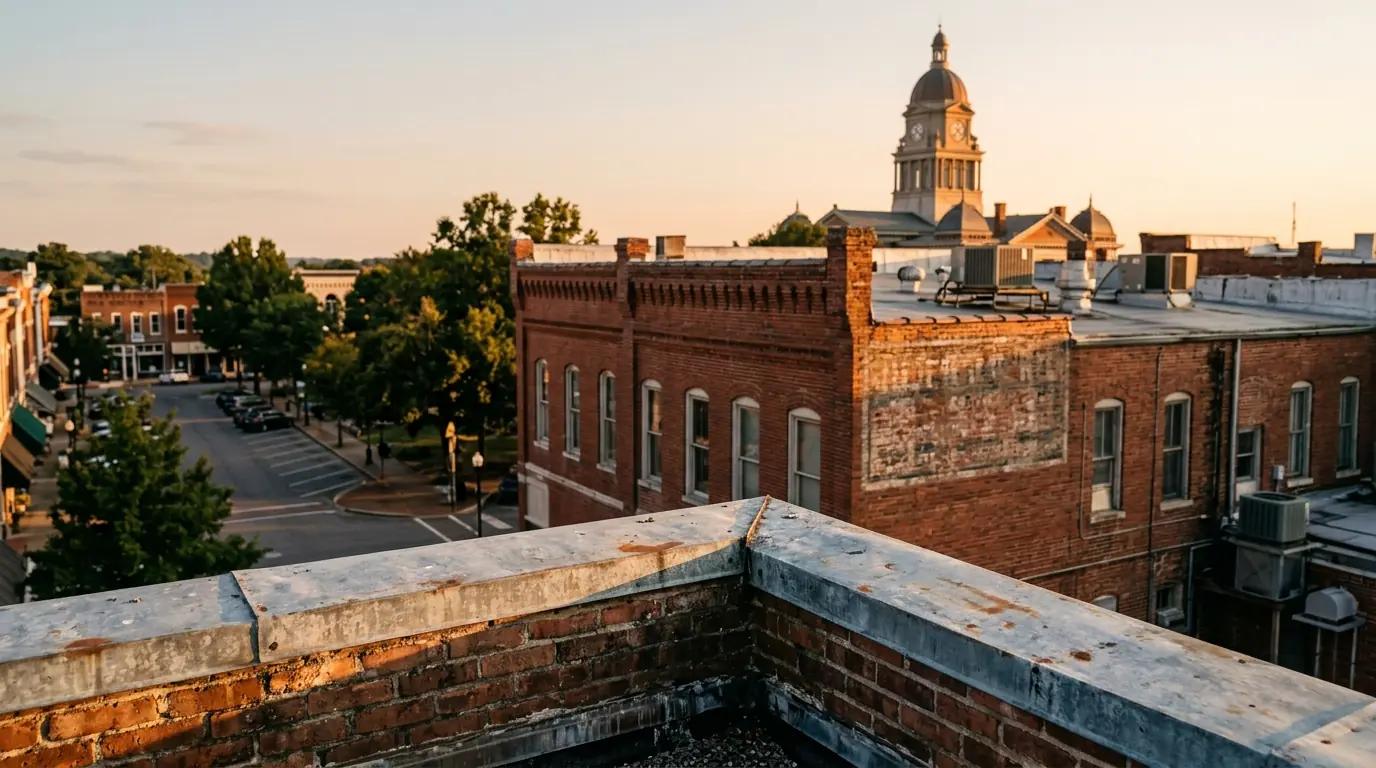
Columbia's square is lined with older two-story brick buildings that house law offices, restaurants and shops. Their roofs are low-slope, shared along party walls, and drained by a few internal drains or scuppers. Many were recovered or coated several times, and the layers hide how the roof is truly performing.
Because these buildings touch, a leak in one often starts in the neighbor's roof. We look at shared parapets, step flashings and wall caps, and we talk with adjacent owners when the entry point crosses a property line. A repair on one side that ignores the other can fail by next season.
Columbia's long history shows up in its buildings. Some downtown structures predate modern roofing standards, and their parapet walls, cornices and old brick details need respect. We avoid heavy-handed fixes that damage historic masonry, and we choose flashing metals and sealants that move with the wall instead of fighting it.
Drainage on older flat roofs deserves special care. Many were designed with minimal slope, and the original drain pipes run through the building. If a pipe has failed, a roof repair alone will not fix the leak. We coordinate with plumbers when the problem sits below the roof line.
Flashing failures we find again and again in Columbia
Flashing is where most leaks begin on older masonry buildings.
Counterflashing pulled from the brick
Mortar joints weather, and the metal edge loses its grip. Water slips behind it.
Sealant used as a fix
Caulk over a gap lasts a season or two. It hides a failed flashing without solving it.
Rusted metal at drains
Old drain boots and scupper liners corrode and leak at the joint to the roof membrane.
Parapet cap joints
Open cap joints let water into the wall cavity and down the interior.
Chimney or vent stack bases
Old vents left from earlier uses often have no proper flashing at all.
Cut-in tie-ins from past work
HVAC or signage changes leave patchy details that fail unnoticed.
Church and industrial roofs on the edges of town
Columbia has many churches, and their roofs often mix steep shingle or metal over sanctuaries with flat sections over additions. Valleys, step flashing and gutters are the usual trouble. We replace sections or repair details depending on the age and condition.
Industrial parks on the edges of the city use large metal or single-ply roofs. We look at fastener backout, seam condition and ponding. Heavy truck traffic and nearby operations can add vibration, dust and chemical exposure, and we choose repairs that tolerate that.
Industrial parks around Columbia vary in age and construction. Some buildings are tilt-wall with membrane roofs, others are metal buildings with exposed fasteners. We check each for ponding, seam wear and loose fasteners. Large roofs often benefit from a moisture survey, because a few wet zones can be repaired instead of replacing everything.
Churches, whether historic or new, are the third pillar of Columbia's commercial roofing. We repair valley flashing, replace worn shingle sections, reseal metal panels and renew low-slope sections over classrooms. Every church committee gets a written scope, a price range and a plan for protecting the sanctuary from weather during the job.
Mule Day and downtown event weeks
Columbia's annual Mule Day brings large crowds to downtown, with streets closed and parking limited. We don't schedule hoists, lifts or dumpsters on the square during those days. For any downtown job, we ask about local events, plan deliveries early and keep the sidewalk protected from falling debris.
Preparing a Columbia square building for a roof visit
A little preparation makes the survey faster and more accurate.
- Identify who owns or manages neighboring roofs
- Know where the roof hatch or ladder access is
- Locate interior stains and note when they appear
- Share past repair records or coating invoices
- Clear equipment that blocks drains or walls
- Tell us about tenants who need quiet hours
Roofing work we do most in Columbia
Six services building owners here call about most. The full catalog has 45.
Roof trouble in Columbia?
Call (615) 716-3057 about a building in Columbia (38401). The line is answered 24/7, and the first question is always where the water is showing.
Roofing questions from Columbia
Can you repair a leaking roof on a Columbia square building?
Yes. We check parapets, flashings, drains and shared walls, then repair the source. We coordinate with neighbors when the entry point is on a shared roof or wall.
What flashing problems cause leaks in Columbia?
Common ones are counterflashing pulling from brick, parapet cap joints, rusted drain boots and old vent bases. Caulk covers gaps for a short time, but a proper metal fix lasts.
Do you work on church roofs in Columbia?
Yes. We repair valleys, step flashing, gutters and low-slope sections, and schedule around services. Replacement is discussed after a survey.
Is there an emergency roofing line for Columbia businesses?
Yes. (615) 716-3057 is answered around the clock. We tarp or make temporary repairs first, then plan permanent work.