Emergency roof tarping and dry-in in Nashville
A limb came through the deck, a fire crew cut a vent hole, or the wind took a whole section, and the forecast shows rain by morning. We dry in the opening tonight with materials that will stay put.
- Answered 24/7
- Secured against wind
- Photo record for claims
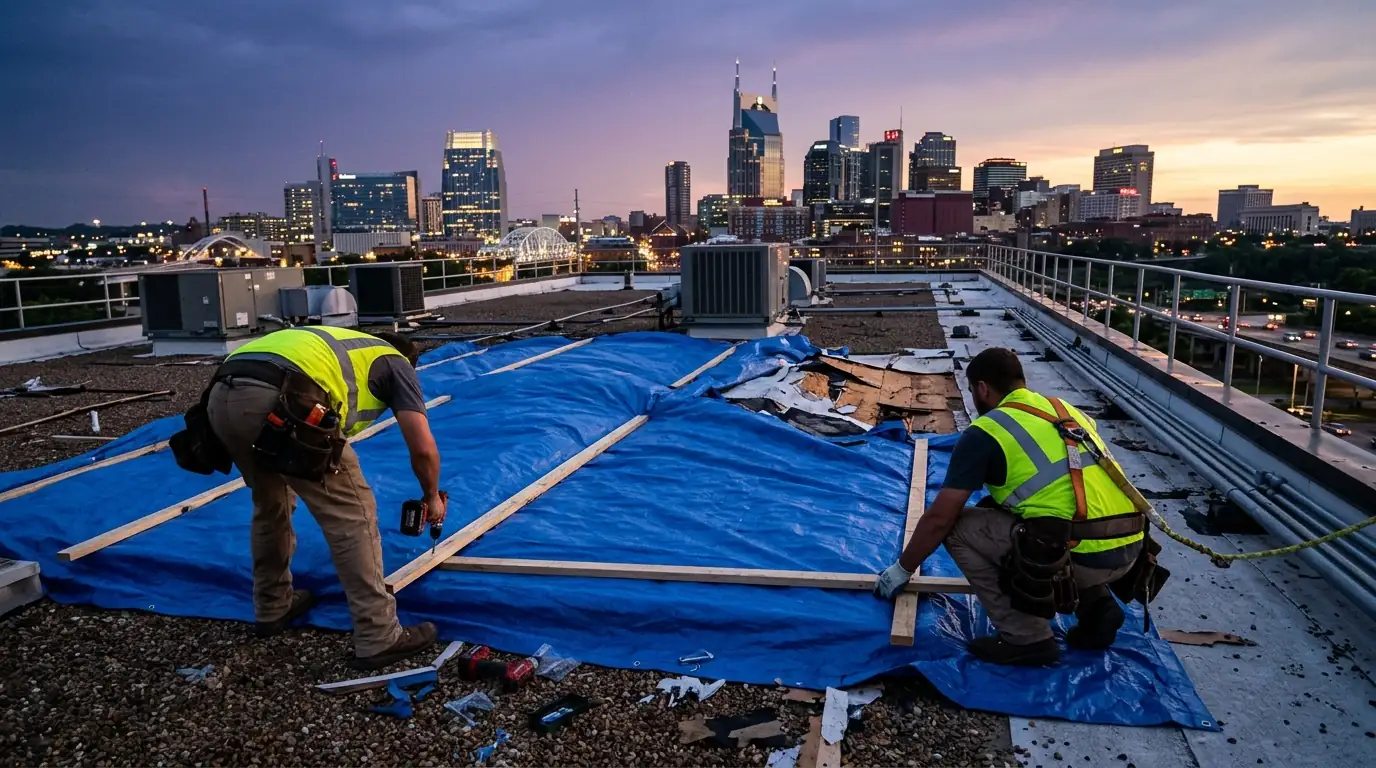
Short answer
Emergency tarping, also called dry-in, is a temporary cover that keeps rain out of a roof opening until permanent repairs are possible. Options include tarps, heavy plastic sheeting and temporary membrane. The right choice depends on opening size, roof slope, wind exposure and how long the cover must last. Most are meant for days to weeks, not seasons.
Dry-in is a holding action, so build it like one
The goal of a tarp isn't to look neat. It's to keep water out of the building until a permanent repair can happen, whether that's a day, a week or a month later because of insurance review, material delivery times or weather. Everything about the cover is built around that holding period: how it's anchored, where the water goes, and how it comes off.
Done badly, a tarp makes things worse. Water ponds in a fold, wind gets under the edge and the whole sheet tears off, and the building takes in more water than if nothing had been placed. We lay covers with the upslope edge tucked under and the downslope edge lapped over, so water runs off the cover instead of behind it.
Every building is different. A flat roof over a warehouse behaves differently from a pitched commercial shingle roof on a church, and a roof with rooftop units in the way needs a different layout than a clear expanse. We choose the method after seeing the roof, and we explain the trade-offs on the phone before the truck leaves.
Plastic sheeting, tarps or temporary membrane: which to use
Three materials do most emergency dry-in work. Each fits a different opening and a different holding period.
| Heavy plastic sheeting | Reinforced tarp | Temporary membrane | |
|---|---|---|---|
| Best for | Small openings and interior protection overnight | Medium to large openings on pitched or flat roofs | Large damaged areas that must hold for weeks |
| Holding period | One to three days | Days to a few weeks | Weeks to months with inspection |
| Wind resistance | Low | Moderate with battens and ballast | High when adhered or fastened at edges |
| UV resistance | Poor | Fair to good, depends on grade | Good |
| Main risk | Tears and flaps loose | Ponding in folds, edge lift | Surface must be clean and sound to adhere |
How we place a dry-in cover that survives the next gust
Speed matters, but so does the order. These are the stages we follow on most commercial openings.
Safety assessment
We check the structure around the opening for sagging deck, charred framing, exposed wires and loose debris before we step on the roof.
Debris removal
Limbs, glass, insulation and charred material are cleared from the opening so the cover can lie flat and the deck can be inspected.
Interior relief
If water has pooled in a ceiling, we relieve it into containers, set plastic over equipment and protect stock below.
Size and cut the cover
The cover extends well beyond the opening onto sound roofing, with extra width on the upslope side to shed water.
Anchor the perimeter
We secure the edges with battens, strapping and fasteners into solid framing, plus ballast where fastening is not allowed. Fasteners go through the cover into sound deck, never into the damaged area.
Control the water path
Folds and seams are arranged so water runs to the drains and scuppers rather than ponding or flowing back toward the opening.
Photograph and brief you
You get photos of the cover and a short written note on its expected holding period and what to check after rain, so your maintenance staff knows when to call us back.
When a tarp is the right call and when it is not
Tarping isn't always the best move. These situations help us decide.
Opening you can reach safely
If a crew can stand on sound surface beside the hole, a cover is realistic and quick.
Rain forecast within 24 hours
When weather is coming, even an imperfect cover beats an open deck.
Deck is soft or burned through
If the structure won't hold a person, the work is staged from the interior or with a lift. We won't walk on a deck we can't trust.
Very high wind or lightning
Covering a roof in a gale can be more dangerous than waiting. We cover the interior and wait for a safe window.
Opening spans several bays
Large damage may call for a temporary membrane or a staged approach, since a single tarp can't be tensioned across a wide span.
Long wait for permanent repair
If the permanent work is weeks out, we recommend a more durable temporary system rather than a basic tarp.
Opening over occupied space
If tenants or stock sit directly below, interior protection happens in parallel with the roof cover, not after it.
Tree strikes, fire openings and storm tears each need a different dry-in
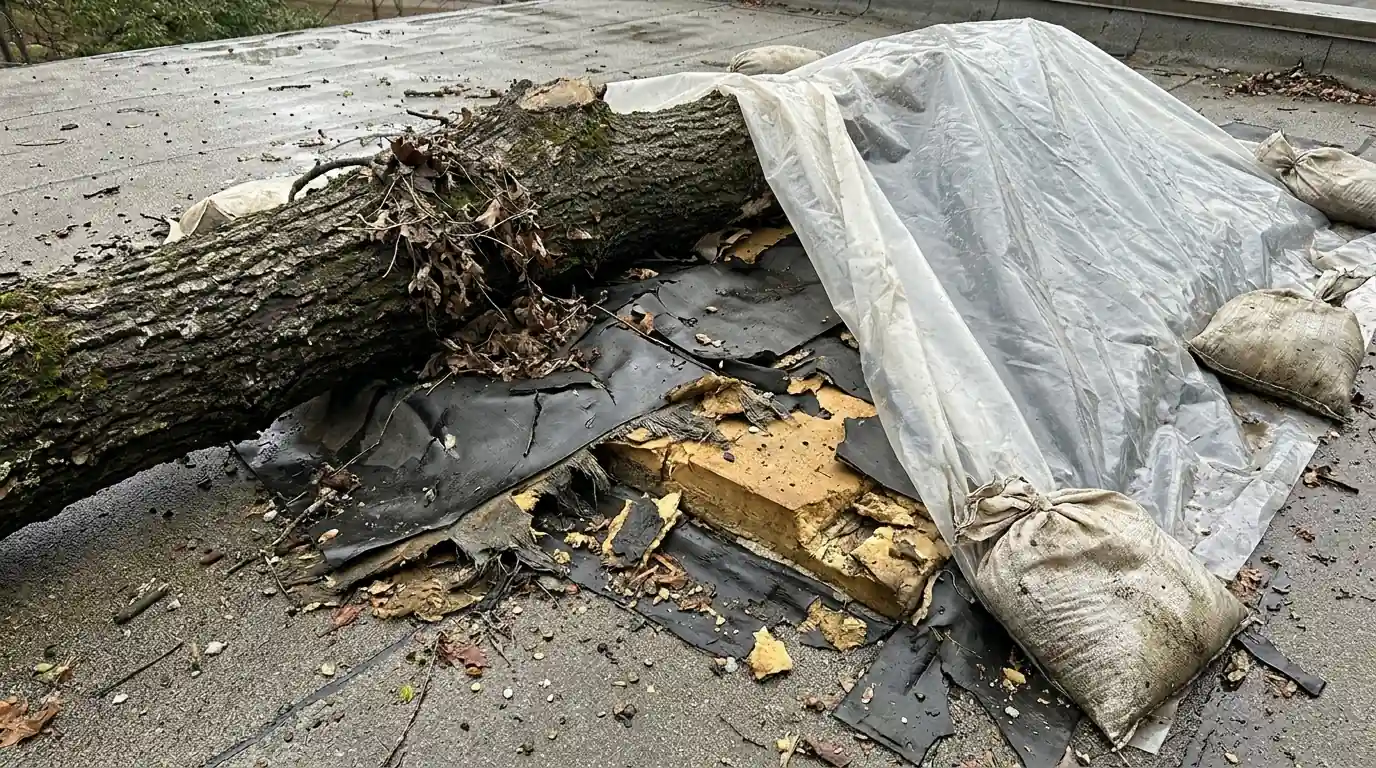
A tree through a flat roof usually leaves a ragged hole with broken deck, torn membrane and wet insulation. We remove the tree or limb with the tree crew's help, then cover the opening over a clean margin. Because the insulation under the membrane is wet, the cover has to extend well past the visible damage.
Fire is different. Firefighters cut ventilation openings to release heat, and the water used to put the fire out soaks the ceiling and insulation. Heat can also leave the deck weakened beyond the hole. We cover the openings, assess the burned deck before anyone walks on it, and keep clear records for the insurance process.
A storm tear is often a large, flapping section of membrane. We trim and secure what remains, then cover the open area. The key is to stop the tear from spreading, so we fasten the edge of the remaining membrane before placing a cover that overlaps it. On ballasted roofs we also clear loose stone from the work zone first.
After the March 3, 2020 tornado and the December 9, 2023 tornado, tarping demand across Middle Tennessee outran supply for weeks. Owners who had already identified their roof system, access point and a number to call got covered sooner. Keep a one-page building sheet near your phone. Photograph the roof access, rooftop equipment and drains in advance so a crew can plan from the photos.
What emergency tarping and dry-in costs
Cost depends on opening size, roof height and how much preparation the surface needs. We quote after seeing the damage, and these ranges describe typical work.
| Work | Typical range | What moves it |
|---|---|---|
| Plastic sheeting over a small opening | $240 to $585 per opening | Short-term cover with battens; interior relief priced separately. |
| Reinforced tarp, secured and ballasted | $1.75 to $3.60 per sq ft | Includes perimeter anchoring; steep or tall roofs cost more. |
| Temporary membrane dry-in | $3.95 to $6.85 per sq ft | Used for weeks-long holds on large or complex openings. |
| Debris removal and deck inspection | $385 to $1,240 per opening | Higher with fire damage, tree removal or hazardous materials. |
What pushes a price up or down:
- Opening size and how far the cover must extend past it.
- Slope, roof height and access equipment.
- Whether fasteners can be driven into sound framing.
- Time of day and the speed of dispatch.
- How long the temporary cover needs to last.
- Debris, fire residue or wet insulation that must be removed first.
Ranges reflect recent Middle Tennessee work and are not a quote; we price after a site visit. See the full Budget Guide.
What to do while the crew is on the way
A few quick steps protect the building and speed up the dry-in once we arrive.
- Keep people away from the area under the opening until it is inspected.
- Move valuables, records and electronics out of the drip zone.
- Turn off power to affected circuits if you can reach the panel safely.
- Take photos from several angles before anything is moved.
- Note the time the damage occurred and the weather at the time.
- Tell us where the fire department or utility has marked hazards.
- Make sure the roof access hatch or ladder path is open.
- Tell us whether any neighboring building or tree could drop more debris during the next gust.
A tarp left up too long becomes its own problem
Summer UV breaks down a plain tarp in weeks. Nashville's humid heat, afternoon storms and winter freeze-thaw all work on the cover and the roof below it. Wet insulation under a tarp rarely dries, and trapped moisture rots deck and breeds mold. We write the expected holding period on your photo record and recommend a permanent repair date. If the wait runs long, ask us about a temporary membrane that will hold better. Removing a tarp also matters: pulling it carelessly can tear the membrane edges it was lapped under.
Need emergency tarping & dry-in on a Nashville building?
Call (615) 716-3057 any hour. We look at the roof, show you what we found and price the work before anything starts.
Where we do emergency tarping & dry-in around Nashville
The ZIP codes below cover most of the buildings we work on. Every one links to its local page, and the full locations list has 62 more.
- Nashville 37219
- Downtown Nashville 37219
- East Nashville 37206
- Antioch 37013
- Madison 37115
- Donelson 37214
- Hermitage 37076
- Bellevue 37221
- Green Hills 37215
- Franklin 37064
- Brentwood 37027
- Murfreesboro 37130
- Smyrna 37167
- La Vergne 37086
- Mount Juliet 37122
- Lebanon 37087
- Hendersonville 37075
- Gallatin 37066
- Spring Hill 37174
- Columbia 38401
- Goodlettsville 37072
Work that often goes with emergency tarping & dry-in
We install and repair systems from Carlisle SynTec, GAF, Johns Manville and Sika Sarnafil, and we patch whatever is already on your roof.
Emergency Tarping & Dry-In questions from Nashville owners
How fast can you tarp a storm-damaged commercial roof in Nashville?
We dispatch as soon as the call is triaged and give you an arrival window by phone. Weather, daylight and roof safety decide how quickly work can begin. In dangerous wind or lightning we protect the interior first and return to the roof when it's safe.
How long can an emergency tarp stay on a commercial roof?
A reinforced tarp should be treated as a days-to-weeks solution, and plastic sheeting as one to three days. Temporary membrane can hold longer with inspection. Sun, wind and ponding shorten all of them, so plan the permanent repair as soon as insurance allows.
Will tarping affect my insurance claim?
Most policies expect you to prevent further damage, and emergency dry-in is a reasonable step. Keep receipts, photos and notes. We document the damage before covering it and record what we placed, but your carrier decides coverage, so ask them about temporary repair limits.
Can you tarp a roof if the deck is burned or soft?
Only after we assess it. If the deck can't carry a person, we stage the work from a lift or from the interior and we may need a structural opinion first. We won't walk on a deck we can't trust.
What is the difference between tarping and dry-in?
Tarping is one method; dry-in is the goal. Dry-in means making the building weathertight, using tarps, plastic sheeting or temporary membrane depending on the damage. We choose the system by opening size, wind exposure and how long the cover has to last.