Roof deck repair and replacement in Nashville
The old roof is off and the deck underneath is rusted, soft or broken, which no one could see until now. We measure it, price it by the unit and repair it right so the new roof has something solid to hold onto.
- Unit pricing before tear-off
- Pull tests on fasteners
- Answered 24/7
Short answer
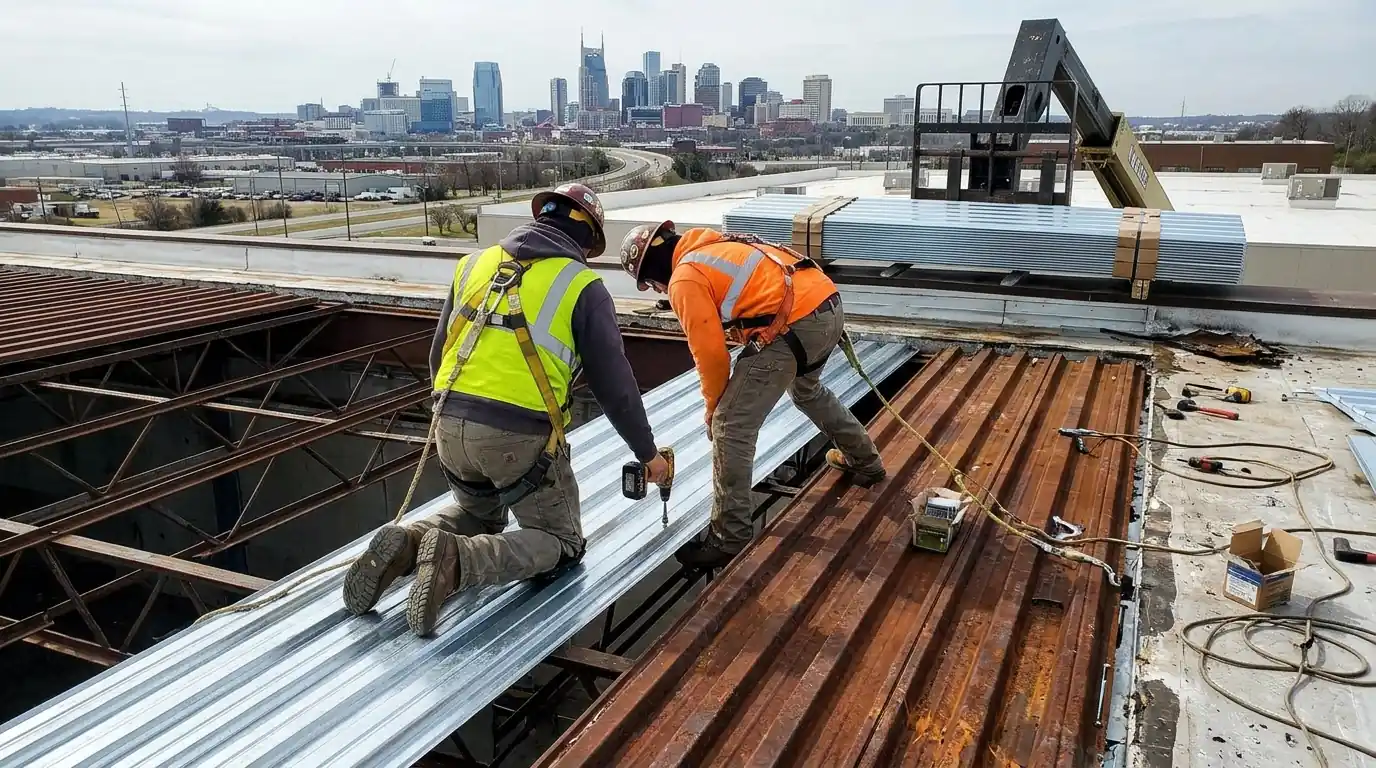
Roof deck repair replaces or reinforces the structural surface under a roof system when it is rusted, rotted, burned or crumbling. Steel deck panels are cut out and replaced, wood plank or plywood is cut back to sound framing, and gypsum or lightweight concrete areas are rebuilt. Most deck problems are found when the old roof comes off.
The deck decides whether the new roof holds
The deck is the part of a roof nobody sees until something goes wrong. It carries the snow, the wind uplift and the weight of every layer above it, and fasteners for the new roof grip it directly. If the deck is rusted through, rotted or crumbling, fasteners pull out in the first strong wind and the new membrane goes with them.
Decks fail slowly and quietly. A tiny leak at a pipe boot lets water run along a steel flute for years. A skylight curb that was never sealed soaks a wood plank until the fibers are soft. A leaky roof drain rots the deck around the sump. None of that shows on the surface, which is why we cut cores and check deck condition before pricing a replacement.
Older Nashville buildings add their own wrinkles. Mid-century warehouses near the rail corridors often have wood plank decks with tar and gravel on top, and downtown office buildings may have lightweight concrete over steel. Each material wants a different repair, and what we find under one gravel roof tells us little about the building next door.
What each deck type looks like when it fails
Different decks fail in different ways. Knowing which one you have shapes both inspection and repair.
| Steel deck | Wood plank or plywood | Gypsum | Lightweight insulating concrete | |
|---|---|---|---|---|
| Typical failure | Rust at flutes, holes under leaks | Rot, delamination, split planks | Crumbling, saturated, loss of fastener hold | Cracking, softness, poor fastener grip |
| Where to look | Under drains, curbs and long-term leaks | Around penetrations and skylights | Near leaks and drains where water entered | Under old leaks and at edges |
| Repair method | Cut out and replace panels, weld or fasten | Cut back to sound framing, replace boards | Remove damaged areas, replace with suitable board | Remove and replace damaged zones, test fastener pull-out |
| Fastener concern | Thin or rusted flutes hold poorly | Soft wood loses grip | Poor pull-out resistance | Variable pull-out resistance |
| Inspection method | Visual, probe, underside check | Visual, probe, moisture meter | Cores and pull tests | Cores and pull tests |
Warning signs of a bad deck before tear-off
We often suspect deck problems before the first membrane is cut. These clues tell us to plan for repairs.
Roof that gives or bounces underfoot
A roof that flexes when you walk across it has softened deck or weakened framing beneath the insulation.
Rust stains on ceilings or below the deck
Brown streaks on exposed steel flutes seen from inside point to long-term leaks above.
Sagging between joists or purlins
A visible dip across a bay shows a plank or panel has failed or the framing has moved.
Fasteners backing out of the roof
Screws that pop up through the membrane suggest the deck no longer holds them.
Old leaks at drains and skylights
The deck near a long-leaking drain or curb is the first place we expect to find damage.
Fire or heat history
A roof that had a fire, even a small one, may have charred or weakened deck that looks fine on top.
Daylight visible from inside
Light showing through a deck seam or gap means the panel is open or rotted through, and the repair area is larger than it looks from above.
What happens when the old roof comes off and the deck is bad
We handle deck discoveries in a fixed order so you see the damage, approve the scope and know what it costs.
Expose and clean
As each section of old roof is removed, we sweep the deck and remove debris so damage is visible rather than guessed.
Probe and walk
Technicians walk the deck, probe suspect areas with a pick and check for flexing, rust holes and soft boards.
Mark and photograph
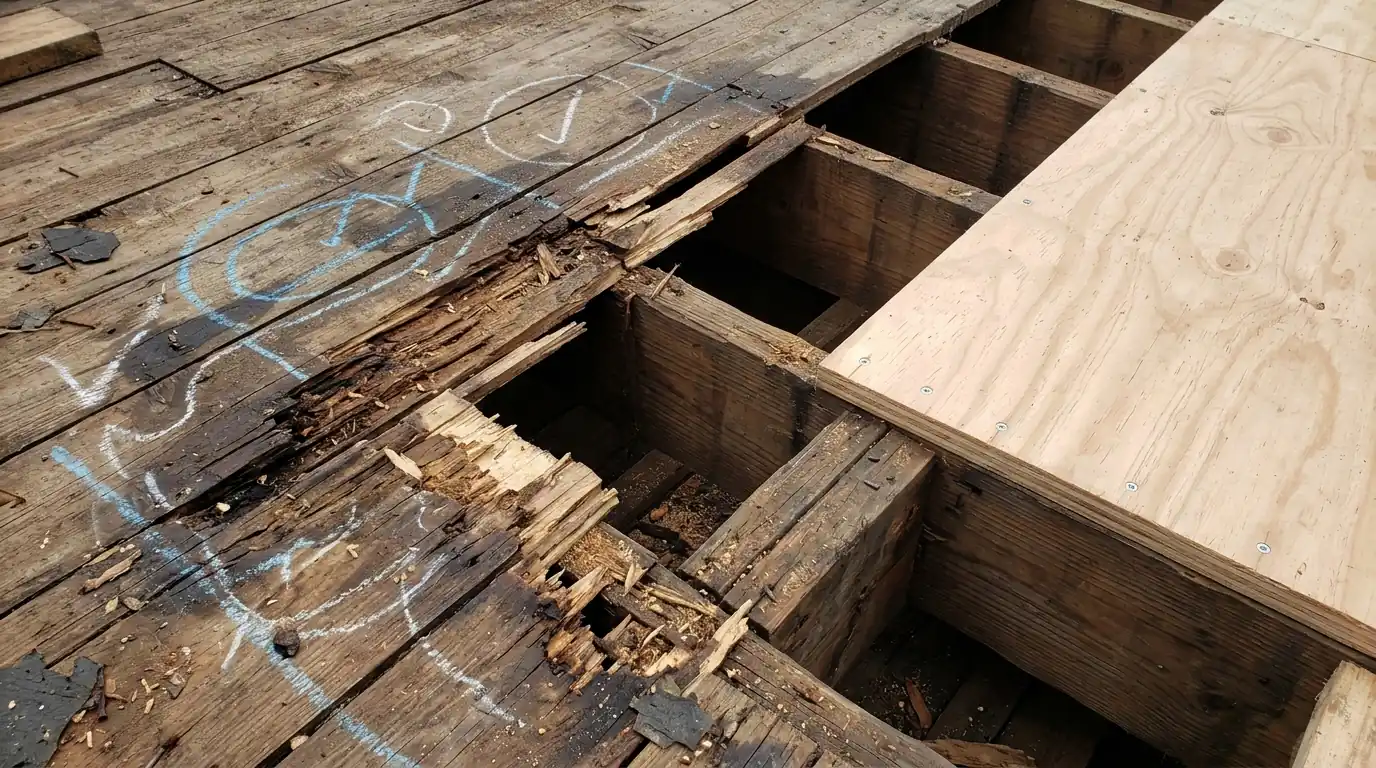
Damaged areas are marked with paint, measured and photographed, then logged on a plan with square footage for each.
Approve the scope
You or your representative sees the photos and measurements before any deck is cut. Unit prices from the bid apply to the measured area, and we hold work in any area you haven't approved.
Cut out and replace
Steel panels are cut back to a supporting member and replaced; wood is cut back to sound framing; gypsum and lightweight concrete are removed and rebuilt.
Pull test fasteners
Fastener pull-out tests on the repaired and nearby deck show whether it can hold the specified attachment pattern. Results go in your close-out file with the photos.
Close the deck before the roof goes on
We don't leave open deck overnight. Repaired areas are covered or protected until insulation and membrane are installed.
Deck repair unit prices and why they should be in the bid
Deck repair is the most variable line in any replacement. Ask for unit prices up front, and expect these ranges to shift with access and material.
| Work | Typical range | What moves it |
|---|---|---|
| Steel deck panel replacement | $6.75 to $14.90 per sq ft | Cut out, replace with the same gauge and fasten or weld to supports. Rust-treating adjacent areas adds time. |
| Wood plank or plywood replacement | $5.40 to $11.25 per sq ft | Includes cutting back to sound framing and new nailers if needed. |
| Gypsum or lightweight concrete repair | $9.80 to $21.60 per sq ft | Heavier materials, special fasteners and long cure or drying times. |
| Structural framing repair or sistering | $38 to $96 per linear ft | Used when joists or purlins are damaged; may need engineer review. |
What pushes a price up or down:
- Total area of deck damaged and how many separate areas.
- Deck type, gauge and thickness.
- Whether a structural engineer must review the repair.
- Access: hoist, crane or stair tower for deck panels.
- Weather, since exposed deck must be covered each day.
- Fire-rated deck assemblies that require compatible listed products.
Ranges reflect recent Middle Tennessee work and are not a quote; we price after a site visit. See the full Budget Guide.
Why unknown deck conditions cause so many bid disputes
Nobody can see the deck before tear-off, so every bid carries an assumption about it. A bid that assumes zero repairs looks cheap until the first rusted panel appears. A bid with an inflated allowance looks safe but costs more than the work. A fair bid names a unit price per square foot and says how the area will be measured and verified.
We recommend an allowance based on cores and the roof's history, not a guess. If cores show clean steel and no leak history, the allowance is small. If a roof has leaked at drains for years or has gypsum under the insulation, we raise it and explain why. Either way, you approve the measured area with photos before work proceeds, and unused allowance is credited back.
Change orders on deck repair are normal. What isn't normal is a surprise with no photos or measurements. We keep a log and update it daily so your facility manager and the GC see the same numbers we do, and we hold the work at any area you haven't yet approved.
What owners and general contractors can do to prepare for deck repair
A few decisions made before tear-off keep the schedule and budget under control.
- Agree on unit prices and an allowance before the contract is signed.
- Decide who approves measured deck repairs and how fast.
- Identify the deck type from drawings or inspection openings.
- Plan for a structural engineer if joists or purlins look damaged.
- Arrange access for materials like steel panels or plywood sheets.
- Decide how interior spaces are protected during deck work.
- Hold space in the schedule for weather and unexpected repairs.
When to call a structural engineer instead of just replacing panels
If rust has eaten through supporting joists, if a roof sags across multiple bays or if fire has damaged framing, panel replacement isn't enough. A structural engineer should review the condition and sign off on the repair. We stop the work, cover the area and bring in the engineer's review before proceeding, because a new roof over weak framing carries a risk no warranty covers. Call (615) 716-3057 and tell us what you see.
Need roof deck repair on a Nashville building?
Call (615) 716-3057 any hour. We look at the roof, show you what we found and price the work before anything starts.
Where we do roof deck repair around Nashville
The ZIP codes below cover most of the buildings we work on. Every one links to its local page, and the full locations list has 62 more.
- Nashville 37219
- Downtown Nashville 37219
- East Nashville 37206
- Antioch 37013
- Madison 37115
- Donelson 37214
- Hermitage 37076
- Bellevue 37221
- Green Hills 37215
- Franklin 37064
- Brentwood 37027
- Murfreesboro 37130
- Smyrna 37167
- La Vergne 37086
- Mount Juliet 37122
- Lebanon 37087
- Hendersonville 37075
- Gallatin 37066
- Spring Hill 37174
- Columbia 38401
- Goodlettsville 37072
Work that often goes with roof deck repair
Repairs and new roofs on Mule-Hide, GenFlex, Polyglass and Henry systems, matched to what the building already has where we can.
Roof Deck Repair questions from Nashville owners
How do you find out what condition the roof deck is in before tear-off?
We cut cores at several points, probe suspect areas, check the underside from inside the building where possible and review leak history. Cores show the deck type and surface condition. Complete certainty only comes at tear-off, so we price deck repairs with unit prices and an allowance.
Can a rusted steel roof deck be repaired instead of replaced?
Minor surface rust can be cleaned and treated, but panels with holes or heavy section loss are cut out and replaced. We repair or replace back to sound steel and supports, then test fasteners before installing the new roof. We photograph each panel we replace.
What is a roof deck allowance in a replacement bid?
An allowance is a set quantity of deck repair included in the price, typically with a unit price for extra or unused area. It gives the owner a fair number up front and a way to adjust after tear-off based on measured, photographed conditions.
Do you repair gypsum and lightweight concrete decks?
Yes. Gypsum and lightweight insulating concrete decks need specific fasteners and repair materials, and pull-out tests decide what attachment works. Damaged zones are removed back to sound material and rebuilt. These repairs cost more and take longer than steel or wood, so we plan carefully.
How long does deck repair delay a commercial roof replacement?
Small areas add a day or two. Large steel, gypsum or structural repairs can add a week or more, especially if an engineer is involved. We build time for deck work into the schedule and tell you early when the cores suggest more than usual.