Self-storage facility roofing in Nashville
One loose screw line on a long storage building can drip on twenty units, and every tenant claim lands on your desk. We fix roofs where the water gets in, not just where the stain shows.
- Unit-by-unit leak mapping
- Panel and fastener repair
- Answered 24/7
Short answer
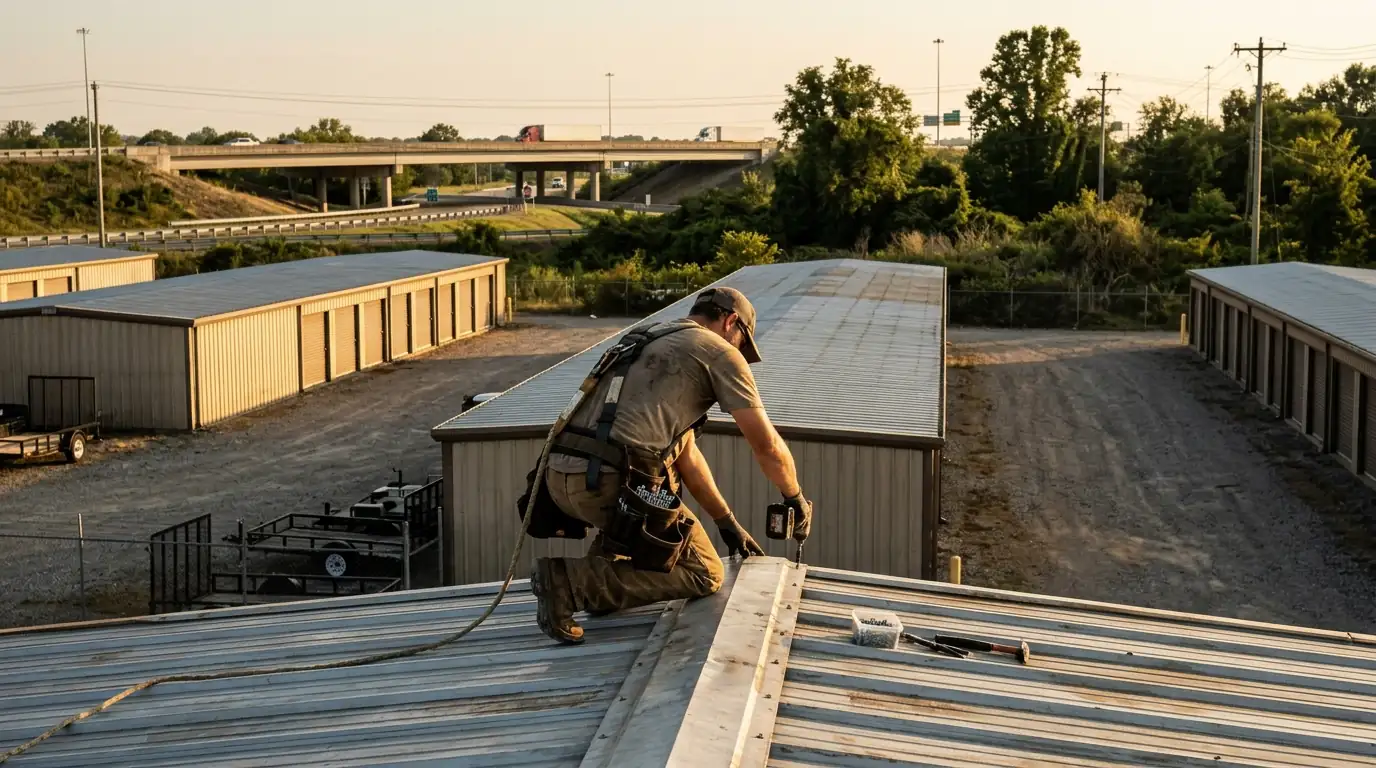
Self-storage roofs are mostly single-story metal panels or low-slope membranes over long, narrow buildings. Metal re-fastening and sealing often runs $1.35 to $3.10 per sq ft, a metal retrofit or new membrane runs $5.90 to $12.20, and climate-controlled sections cost more to protect. We quote after a site visit to the facility.
Why a small leak costs a storage owner more than it looks
A storage building is a row of small boxes, and a roof leak touches a lot of them at once. Water follows a purlin or a panel rib sideways, drips into the third unit down from where it came in, and soaks a tenant's mattress, couch or boxed records. By the time a manager gets the call, the tenant has photos and an opinion about your insurance. The cost of a roof repair is small next to a handful of claims, a vacated unit and a review that mentions the word leak.
Self-storage roofs also hide their problems. Units have no windows, so nobody looks up. Managers walk the property on a schedule, but a stain on a drywall ceiling or a rusted screw line is easy to miss. Facilities spread along I-24, I-40 and I-65 and out through Rutherford, Wilson and Williamson counties see the same cycle: heat in July, hail in spring, frost in February, and a slow rise in leaks every year of the roof's age.
Single-story drive-up buildings have a different risk profile than multi-story climate-controlled ones. A drive-up building may have a metal roof over bare units with open soffits, where moisture is a nuisance but rarely a ruin. A climate-controlled building has insulated ceilings, HVAC, sensitive goods and often a TPO or modified bitumen roof, where a leak damages both stored property and the building envelope. We treat the two as different jobs and price them that way.
Insurance adds pressure. A tenant claim for damaged goods often prompts the carrier to ask when the roof was last inspected and what was done about earlier leaks. A dated repair record, with photos and a plain description of the fix, answers that question in one short conversation. We leave a simple record after every visit, so the facility has proof of care on file when a claim or an acquisition review arrives.
What leaking storage roofs look like from the inside and out
Managers and maintenance staff don't need to climb a ladder to spot early trouble. These are the clues we ask about first.
Rust trails below a screw line
Orange streaks that run down a panel rib show a fastener has backed out or its washer has failed. Water is already getting into the lap.
Rows of drips after a warm rain
If the water appears along a single purlin line, a panel seam or fastener row is the problem rather than a hole somewhere in the field.
Condensation that looks like a leak
Cold nights and warm days make water bead under a bare metal panel. We separate condensation from leaks by checking the roof, the vents and any missing insulation.
Sagging or stained ceiling panels in climate units
Drywall or insulated ceiling tiles that stain in the same corner are telling you the roof above has a failed seam or wall flashing.
Gutters that leave a streak down the wall
Overflowing or detached gutters wet the foundation and the base of the door tracks, which then get blamed on the roof.
Loose or lifted panel ends at the eaves
Wind pulls at long panels, and the first sign is a rattle or a curled edge at the drip line.
Re-fasten and coat, metal retrofit or membrane for a storage building
Each fix has a place. The right one depends on the panel condition, the slope and whether the units below are climate controlled.
| Re-fasten and seal a metal roof | Retrofit or replace the roof | |
|---|---|---|
| Best fit | Panels are sound but fasteners are backing out and sealant has failed | Panels are rusted through or the lap seams are open all along the run |
| Disruption to tenants | Minimal, mostly exterior and quick | More staging, but units can stay in service building by building |
| Typical life gained | A few years if panels are sound, longer with a coating | A new roof with its own long-term warranty options |
| Cost range | Low, priced per fastener row or per sq ft | Higher per sq ft but closes out repeat leak trips |
| Climate-controlled fit | Rarely enough, since insulation may already be wet | Better, because moisture can be found and removed |
How we work a storage facility roof without closing the property
Storage facilities run on gate hours, tenant access and move-in days. We plan the roof around all three.
Walk the units and the roof together
We start inside with the manager, mark stained units on a plan, and then go up to find the source. Water travels, so the stain is rarely under the leak.
Map every leak to a building and a run
Each stained unit is tied to a purlin line, seam or flashing detail so repairs target the cause and not just the drip.
Check insulation and decking in climate sections
Cores and moisture readings in TPO or modified bitumen roofs show whether insulation is wet and has to be replaced.
Fix fasteners, laps and flashings
Backed-out screws are replaced with larger-diameter fasteners and new washers, laps are sealed, and ridge, eave and gable details are reworked.
Work building by building
Crews finish one building before opening the next, so gate access and tenant move-ins keep going. We plan around peak move-in weekends.
Document and walk the units below
Photos and a short written report show what was repaired. We check the stained units after the next rain and note any that still show moisture.
Through-fastened panels: what fails and why
Through-fastened panels are the standard cheap roof for storage, and they lean on thousands of small rubber washers to keep water out. Those washers dry, crack and lose their compression after years of Middle Tennessee sun. The metal also expands and contracts with the daily temperature swing, which works screws loose in their holes. A screw hole that started tight becomes an oval, and water finds the oval first.
Repair starts with understanding which fasteners are loose and why. Replacing a screw with the same size screw in the same hole rarely lasts, so we go to oversized screws or install screws at new locations where the metal is sound. Laps and ridge caps need sealant or butyl tape sized to the panel profile. Skylights and roof vents on older storage buildings are another common culprit and are often worth removing if they no longer serve a purpose.
When panels have rust at the laps or the finish has chalked badly, a coating system can extend life if the metal is sound. A silicone or acrylic coating over a cleaned, re-fastened roof gives a continuous skin and reflects heat, which helps climate-controlled buildings with cooling costs. Coating isn't a cure for rusted-through panels, though. We tell you honestly when the metal is past coating and the choice is a retrofit or replacement.
Gutters and drainage are the other half of keeping a storage roof dry. Long buildings shed a lot of water, and a downspout that dumps at the foundation can undermine a slab and soak the bottom of a roll-up door. We check the whole path from eave to ground, clear and re-pitch gutters, add splash blocks or tie-ins and note any spot where the pavement sends water back at a building. Fixing it often prevents a second round of claims.
What storage facility roofing costs near Nashville
These are planning ranges for Middle Tennessee. Facility size, access and building count change the numbers, so we quote after a site visit.
| Work | Typical range | What moves it |
|---|---|---|
| Re-fasten, seal laps and flashing on through-fastened metal | $1.35 to $3.10 per sq ft | Sound panels, mostly exterior work, minimal tenant disruption. |
| Metal roof coating system after repairs | $2.45 to $4.95 per sq ft | Silicone or acrylic over cleaned, re-fastened panels. |
| New single-ply over climate-controlled building | $7.35 to $12.20 per sq ft | Includes insulation, cover board and edge metal. |
| Metal retrofit over existing purlins | $5.90 to $9.85 per sq ft | New panels over a sound structure, priced by profile and gauge. |
What pushes a price up or down:
- Number of buildings and whether work can proceed building by building
- Gate hours, tenant access routes and move-in weekends
- Condition of purlins, decking and insulation under the panels
- Gutters, downspouts and ground drainage that may need rework
- Skylights, vents and old penetrations that can be removed
- Wet insulation in climate-controlled roofs, which adds tear-off
Ranges reflect recent Middle Tennessee work and are not a quote; we price after a site visit. See the full Budget Guide.
What a storage manager can track to help us find the leak faster
A simple log does a lot of work. Start one now if you don't have it.
- A unit map with leak or stain dates, marked after each rain
- Photos of stains, rust trails and any water on the floor
- Tenant claims and which units they involved
- Roof age, panel type and any past coatings or repairs
- Which buildings are climate controlled and which are drive-up
- Gate hours, access codes for the roof and a list of peak move-in days
- Insurance claim history related to roof leaks
- Gutter layout and whether downspouts tie into drains or discharge to grade
After hail and wind, walk the long buildings first
Spring hail and straight-line wind across Rutherford, Davidson and Wilson counties can dent panels, pull fasteners and lift end laps on long buildings, and the damage may not leak until the next heavy rain. Walk the roof lines while the weather is fresh and photograph dents with a tape measure for scale. If you see damage, phone (615) 716-3057 and we'll document the roof for your insurer and tarp any open seams. We answer 24/7, because a storm that hits at night is a call you want answered.
Need self-storage roofing on a Nashville building?
Call (615) 716-3057 any hour. We look at the roof, show you what we found and price the work before anything starts.
Where we do self-storage roofing around Nashville
The ZIP codes below cover most of the buildings we work on. Every one links to its local page, and the full locations list has 62 more.
- Nashville 37219
- Downtown Nashville 37219
- East Nashville 37206
- Antioch 37013
- Madison 37115
- Donelson 37214
- Hermitage 37076
- Bellevue 37221
- Green Hills 37215
- Franklin 37064
- Brentwood 37027
- Murfreesboro 37130
- Smyrna 37167
- La Vergne 37086
- Mount Juliet 37122
- Lebanon 37087
- Hendersonville 37075
- Gallatin 37066
- Spring Hill 37174
- Columbia 38401
- Goodlettsville 37072
Work that often goes with self-storage roofing
Membranes, coatings and metal we work on every week include Versico, Duro-Last, Elevate and Gaco, plus older systems still in service.
Self-Storage Roofing questions from Nashville owners
How do I tell condensation from a real leak in a metal storage building?
Condensation appears on cool nights and clears by midday, even when it hasn't rained. A leak shows up after rain and often follows a seam or screw line. We check the roof, vents and insulation to separate the two before recommending any repair.
Can you re-fasten a storage roof without moving tenants out of their units?
Usually. Most fastener and sealant work happens from the roof, so units stay in service. For retrofits and membrane work, we go building by building and keep gate access open. Anything involving ceiling removal in a climate-controlled unit is coordinated with the manager first.
Is a metal roof coating worth it on a storage facility?
It can be, if the panels are sound and the fasteners have been replaced. A coating gives a continuous skin and reflects heat, which helps cooling costs. It won't save rusted-through panels, and it can't dry out wet insulation. We check both of those before suggesting it for your facility.
What roof works best over climate-controlled storage units?
A fully adhered single-ply membrane over dry polyiso insulation is common, because it gives a continuous waterproof layer and helps with energy costs. Metal can also work if it's designed with a vapor control layer and good insulation. We recommend based on the building and its tenants' goods, not a default.
Who handles after-hours storm leaks at a storage facility near the interstate?
Phone (615) 716-3057 any time. We answer 24/7, and we can get to a facility along I-24, I-40 or I-65 to tarp open seams and protect units. We then document the damage for your insurer and plan the permanent repair once the roof is dry.