Roof flashing and penetration repair in Nashville
Most commercial roof leaks start where the membrane stops, at a pipe, a curb, a wall or a drain, not out in the field of the roof. We trace the leak to the exact detail and rebuild it.
- Detail-level leak tracing
- Answered 24/7
- Rebuilt, not caulked
Short answer
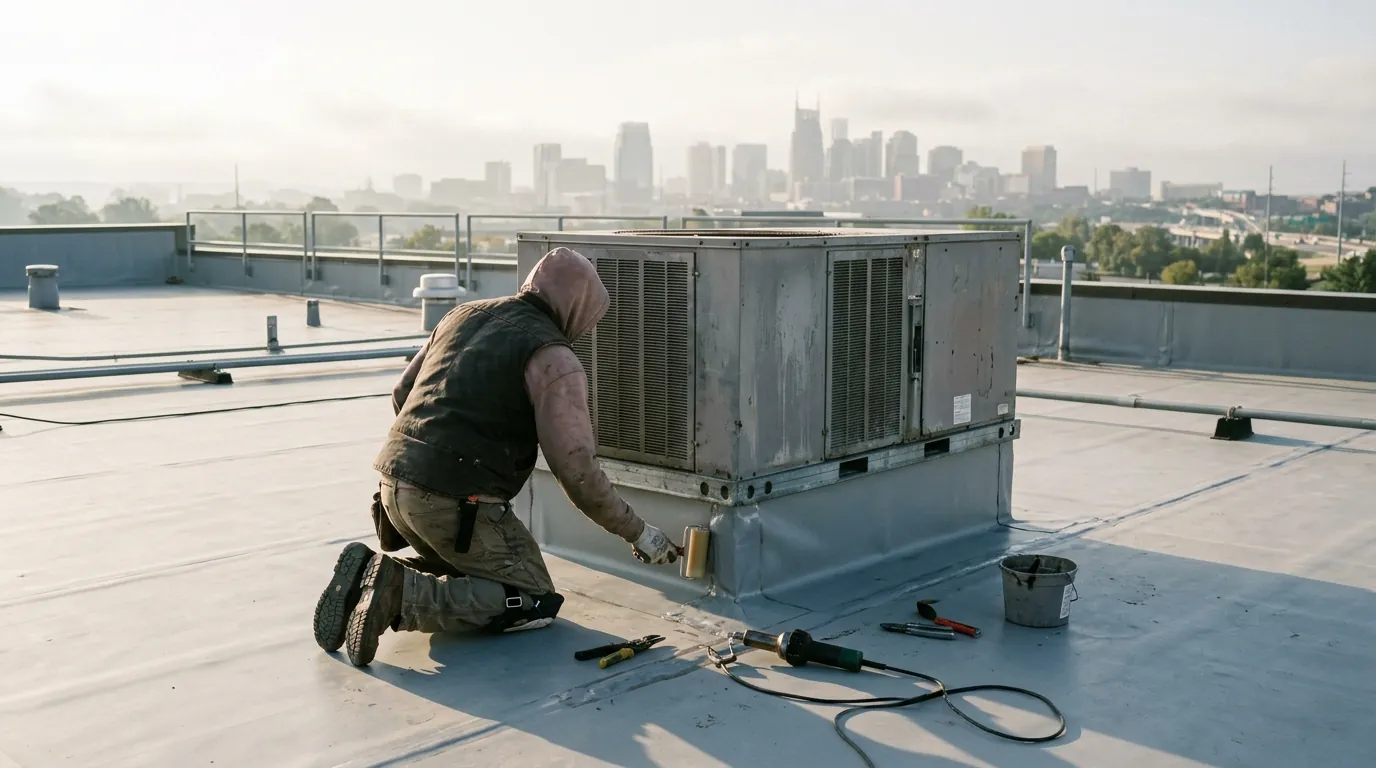
Flashing repair means replacing the pieces that seal a roof where it meets something else: walls, curbs, pipes, conduit and equipment. A typical commercial detail repair runs $14.60 to $38.90 per linear foot, depending on the membrane and wall type. We quote after a site visit, because the hidden condition behind the flashing sets the real scope.
Why the leak is usually at the detail and not in the field
A commercial membrane in the open field of a roof is a simple thing. It is one continuous sheet or a set of heat-welded seams, and it sheds water without much help. Every place it has to stop, turn up a wall or wrap a pipe is a place where somebody had to cut, fold and seal by hand. That is where the water finds its way in.
Flashing fails for ordinary reasons. Sealant dries out in Nashville summer heat and cracks in a winter cold snap. Thermal movement pulls base flashing away from the wall it was glued to. Rooftop units get swapped and the new curb is flashed by a mechanical contractor who has never welded a boot. Foot traffic from service techs tears corners.
We start with the assumption that the field is fine until a core cut or moisture scan says otherwise. Most calls we take on a leaking roof end at a detail that was either installed wrong or has simply aged out, and rebuilding that detail properly costs far less than replacing the roof around it.
Records change the economics of every later repair. When we finish a detail, we photograph it, mark its location on a roof sketch and note the membrane, the materials and the date. Six months later, when a tenant adds an antenna or a mechanical contractor swaps a unit, your facility team can see exactly what is under that boot and who should touch it. Property managers who keep these records spend less on repeat leak calls, because the next crew starts from facts instead of guesses.
Signs a flashing or penetration has failed
You can often spot these from a roof walk or a ladder at the access point, before a ceiling tile ever stains.
Gaps at the top of base flashing
If the termination bar has pulled away from the wall or the sealant bead is cracked, wind-driven rain runs straight behind the membrane.
Split or sun-cracked pipe boots
Rubber and neoprene boots on plumbing vents and refrigerant lines go brittle. A hairline split lets water run down the pipe into the ceiling.
Stains that follow a wall line
Brown rings on drywall or block along a parapet or rooftop wall usually trace to counterflashing or the wall joint above it.
Pitch pans full of cracked filler
Old pourable sealer shrinks away from the pipe and leaves a bowl that holds water instead of shedding it.
Bubbling or wrinkled membrane at corners
Inside and outside corners that billow or tent have lost adhesion, and the seam under them is often open.
Rust bleeding from an HVAC curb
Orange streaks below a curb point to a failed metal cap or fastener, and water is getting into the curb cavity.
Open laps at wall corners
Where two wall flashings meet at an inside corner, the lap is the usual first failure. Look for a lifted edge or a dark line of dirt where water has been wicking.
Rebuilding the detail versus a sealant patch
A tube of sealant is the cheapest thing on any roof, and it is also the most common reason we see the same leak twice. Here is how the two approaches really differ.
| Rebuild the detail | Sealant patch | |
|---|---|---|
| How it is made | Old flashing is cut out, substrate is cleaned and dried, new flashing is heat-welded or adhered to the field membrane | Sealant is troweled over the existing flashing and cracks |
| Typical life span | Matches the roof system around it, often well past a decade | A season or two before the bead splits again |
| Hidden damage | Wet insulation or rotted blocking is found and addressed while the detail is open | Moisture stays trapped under the patch |
| Warranty effect | Work can be documented for the manufacturer's repair requirements | Many manufacturers do not accept caulk over failed flashing |
| Cost today | Higher per detail | Lower per detail, higher over five years |
| Fit for older roofs | Can be tied into an aging membrane with the right primer and weld method | Often peels off a dusty or weathered surface within one season |
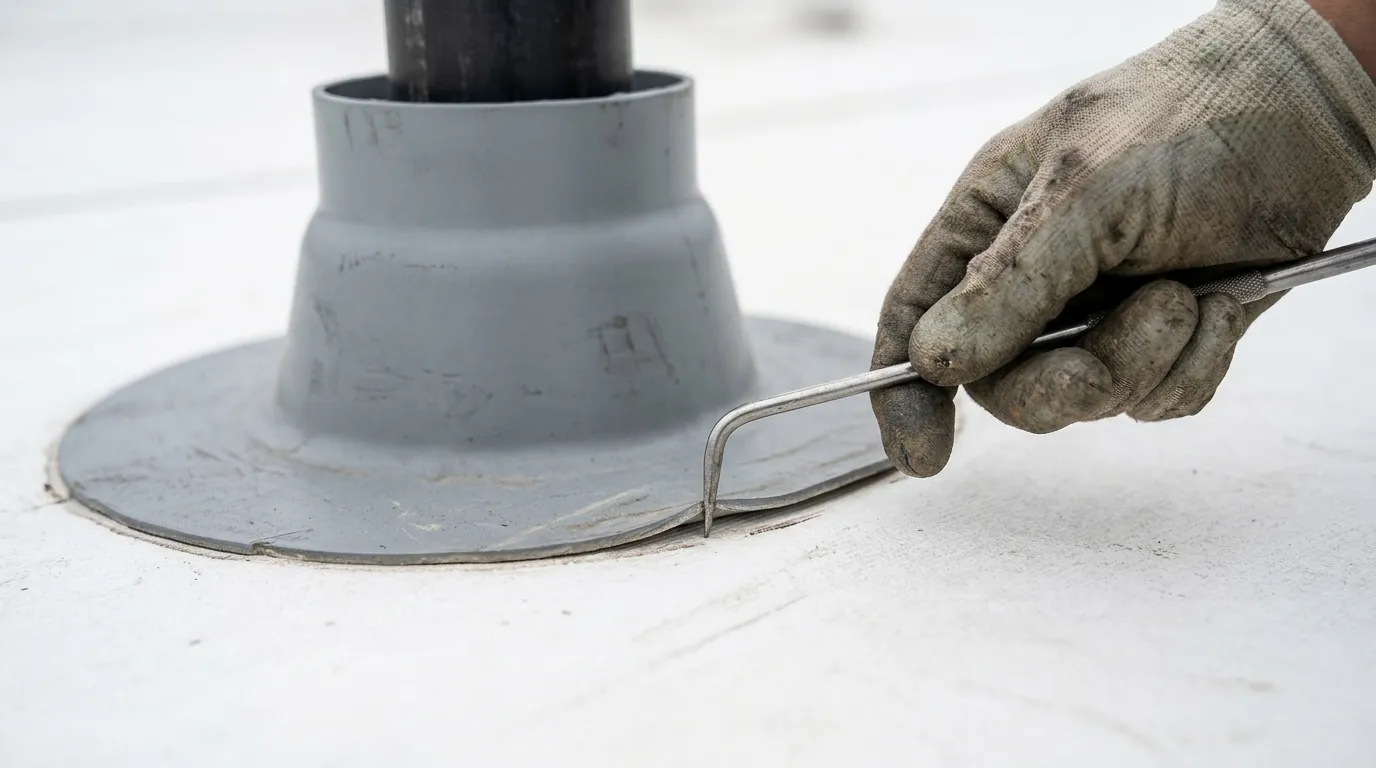
How we rebuild a failed penetration or wall flashing
The sequence is the same on a one-story strip center and a six-story office roof, only the access and the material change.
Trace the water
We walk the roof and the ceiling below, then mark the suspect details. Where the source is unclear, we use a hose test starting low and working uphill.
Identify the membrane
A small core cut tells us whether we are welding to TPO, PVC, EPDM, modified bitumen or a coated metal roof. The wrong adhesive or weld will fail within months.
Open the detail
We remove old sealant, boots, termination bars and loose flashing back to sound material, and check the insulation and deck underneath.
Dry and repair the substrate
Wet polyiso is cut out and replaced, blocking is fixed, and the surface is primed or cleaned to suit the new flashing.
Flash with the right material
That may be a prefabricated boot, a heat-welded corner, a new counterflashing or a formed metal cap, depending on the geometry.
Test and photograph
We probe every weld, water test where practical and send photos of the finished details so you have a record for the building file.
Recheck after the first heavy rain
We ask the building contact to call us after the next significant storm. A quick look at the ceiling below, or a hose test, confirms the repair is holding before we close the file.
Curbs, pitch pans and conduit: the penetrations that give trouble
HVAC curbs are the biggest repeat offender on Nashville flat roofs. The curb is a box, so it has four corners and four walls of base flashing, and any one can open up. When a unit is replaced, the new unit often sits slightly off the old footprint and someone cuts the flashing to fit. We rebuild curbs with wrapped corners and a metal counterflashing that sheds water over the top.
Pitch pans were the old answer for odd-shaped penetrations like a cluster of gas lines or electrical conduit. They work for a while, then the filler shrinks. Where we can, we replace them with a prefabricated boot or a spray-applied sealant system around the pipe group. Where we cannot, we rebuild the pan with fresh pourable sealer and a sloped top so water sheds off it.
Conduit and cable penetrations from rooftop solar, security cameras and antennas are a newer headache. They tend to be installed by trades who do not work on roofs, with a surface-mounted bracket and a dab of caulk. We seal them with an enclosed boot or a flashed pedestal and note where each one is, so the next installer does not add a new hole beside the old.
Expansion joints and area dividers deserve a mention too. Large roofs are cut into sections so they can move with temperature, and the joint between sections carries a cover of flexible membrane or formed metal. Foot traffic, ponding and sun break these covers down. We replace them with a welded, raised cover that sheds water and moves with the building, and we check that it ties properly into the wall flashing at each end.
What flashing and penetration repair costs
These are planning ranges for Middle Tennessee commercial roofs. Site conditions, access and the membrane type change them, and we quote after a site visit.
| Work | Typical range | What moves it |
|---|---|---|
| Pipe boot or small penetration replacement | $185.00 to $472.00 each | Prefabricated boot, welded or adhered to the field membrane |
| Base flashing replacement at a wall | $14.60 to $26.75 per linear foot | Includes new termination bar and sealant |
| HVAC curb reflash, four sides and corners | $890.00 to $2,340.00 per curb | Larger or taller curbs cost more |
| Counterflashing or reglet repair in masonry | $18.40 to $38.90 per linear foot | Depends on mortar condition and access height |
| Pitch pan rebuild with sloped sealer | $265.00 to $640.00 per pan | Prefabricated boots, where they fit, cost less over time |
What pushes a price up or down:
- How much wet insulation is found under the failed detail
- Height of the wall or curb and whether lifts or scaffolding are needed
- Membrane type, because some need specific primers or welding
- Number of details in one visit, since mobilization is shared
- Condition of the masonry or wall substrate the flashing attaches to
- Whether the roof is under a manufacturer warranty with repair rules
Ranges reflect recent Middle Tennessee work and are not a quote; we price after a site visit. See the full Budget Guide.
What to tell us when you call about a leaking detail
A few facts get the right crew and materials to the roof on the first trip.
- The building address and which floor or suite is dropping water
- Whether the leak shows up only in rain or also on dry, humid days
- Roof access method: ladder, interior hatch, exterior stair or locked gate
- Whether any rooftop units, antennas or solar were installed recently
- The roof membrane type if you know it, or a photo of the surface
- Any existing warranty paperwork or repair history
- Tenant or operating hours that limit when we can work
- Photos of the stain, the ceiling tile and the nearest roof equipment
- Whether a mechanical or electrical contractor has worked on the roof lately
After the March 3, 2020 tornado, flashing told the story
When we look at roofs hit by straight-line wind and the tornado that crossed North Nashville, Germantown and East Nashville, edge and wall flashing failed long before the field membrane did. Wind gets under a loose termination, peels the base sheet back and lets rain follow. If your building sits in one of those corridors and has never had its details inspected, a detail-by-detail walk is worth more than a full roof survey.
Need flashing & penetration repair on a Nashville building?
Call (615) 716-3057 any hour. We look at the roof, show you what we found and price the work before anything starts.
Where we do flashing & penetration repair around Nashville
The ZIP codes below cover most of the buildings we work on. Every one links to its local page, and the full locations list has 62 more.
- Nashville 37219
- Downtown Nashville 37219
- East Nashville 37206
- Antioch 37013
- Madison 37115
- Donelson 37214
- Hermitage 37076
- Bellevue 37221
- Green Hills 37215
- Franklin 37064
- Brentwood 37027
- Murfreesboro 37130
- Smyrna 37167
- La Vergne 37086
- Mount Juliet 37122
- Lebanon 37087
- Hendersonville 37075
- Gallatin 37066
- Spring Hill 37174
- Columbia 38401
- Goodlettsville 37072
Work that often goes with flashing & penetration repair
Membranes, coatings and metal we work on every week include Versico, Duro-Last, Elevate and Gaco, plus older systems still in service.
Flashing & Penetration Repair questions from Nashville owners
How long does roof flashing repair take on a commercial building?
A single curb or a handful of pipe boots is usually a half-day job once material is on site. A full wall line of base flashing and counterflashing can take two to four days. We schedule around tenants and weather, and emergency leaks get tarped first so repair can be done properly.
Can you repair flashing without replacing the whole roof?
Yes, in most cases. If the field membrane is sound and the insulation under it is dry, rebuilding the failed details extends the life of the roof. A core cut or moisture scan at the leak tells us whether the problem stays local or has spread under the membrane.
Why do pipe boots keep failing on my Nashville flat roof?
Rubber and neoprene boots are exposed to ultraviolet light and summer heat, and they crack at the pipe collar within a few seasons. Replacing them with a prefabricated boot heat-welded to the membrane, or a sealed metal collar, lasts much longer than a boot held with caulk.
Does flashing repair affect my manufacturer warranty?
It can. Some manufacturers require that repairs use their approved materials and methods, and unapproved patches can void coverage. Tell us if the roof has a warranty, send the paperwork if you have it, and we will build the repair around those rules where the system qualifies.
Do you handle rooftop solar and equipment penetrations?
We seal and flash penetrations from equipment, conduit, solar mounts and antennas on commercial roofs. We cannot install the equipment itself, but we can flash the roof side of the work so the penetration is watertight and documented for the next trade on the roof.