Roof drain, scupper and gutter repair in Nashville
Water that cannot leave your roof finds its own way off, usually through a ceiling. We clear, rebuild and reflash drains, scuppers, box gutters and downspouts so the roof drains the way it was designed to.
- Drains flushed to confirm flow
- Overflow scuppers checked
- Answered 24/7

Short answer
Commercial roof drain repair covers clearing clogged drains, replacing cracked or missing clamping rings and strainers, rebuilding scuppers and overflow openings, relining box gutters and fixing downspouts. It is one of the most common causes of commercial roof leaks and ponding. Most fixes are straightforward when done before water has soaked the insulation.
Why drains cause so many commercial roof leaks
A flat roof is a shallow tray, and its drains are the only way out. When a drain clogs, the tray fills. A few inches of standing water is a big load on a roof deck, and it forces water into every weak seam and flashing. Many leaks that look like membrane failures turn out to be drain failures, and the fix costs a fraction of a membrane repair. A drain that needs ten minutes of attention in October can cost a ceiling in March if nobody looks.
Failures come in a few familiar ways. Leaves and pollen mats plug strainers. Sediment from aging gravel or granulated roofs builds up inside the sump. Clamping rings crack or lose bolts, which lets water run down the outside of the pipe. The membrane around the drain bowl shrinks or splits. Each has its own repair, and each is often a quick one when found early.
Middle Tennessee gives drains a hard time. Fall leaf drop clogs them from October through December, spring storms dump heavy rain in short bursts, and summer thunderstorms can overwhelm a partially blocked line. If the primary drain cannot keep up and the overflow scupper is blocked or missing, water has nowhere to go but up and over the curb. Clearing the roof before those seasons is the cheapest protection a building gets.
Warning signs at the drain
These are the clues we look for when a building owner calls about ponding or a ceiling stain near a drain line.
Water standing around the drain for a day or more
A healthy drain empties the area within hours of rain. A ring of water means the line is partly blocked or the sump sits too high. Pollen season in April leaves a yellow-green mat that does the same.
Rust or staining on the pipe inside
Brown streaks on the interior drain line or wall point to leaks at the clamping ring or in the pipe joint. Water stains that grow after each rain are the clue.
Cracked or missing strainer domes
A broken dome lets debris into the line, and a missing one can send a gravel pile straight down to the first elbow. We replace domes with the right size, since a loose one fails again.
Gutters overflowing at one corner
A downspout that is plugged or kinked backs water into a box gutter, where it spills over the back edge and into the wall. Look for water marks on the wall below the downspout outlet.
Membrane lifting around the drain bowl
Shrinking single-ply or alligatored asphalt around a drain often leaves a gap the water enters first. A bare patch around the bowl usually means the membrane has shrunk.
No visible overflow route
If the parapet is high and there is no scupper to relieve the roof when drains fail, the roof is carrying risk it was not meant to. We can cut in a scupper or add an overflow drain when the design allows.
How we clear and repair a drain
Clearing alone is not a repair. Here is how we work from the surface down to the pipe.
Remove debris and the strainer
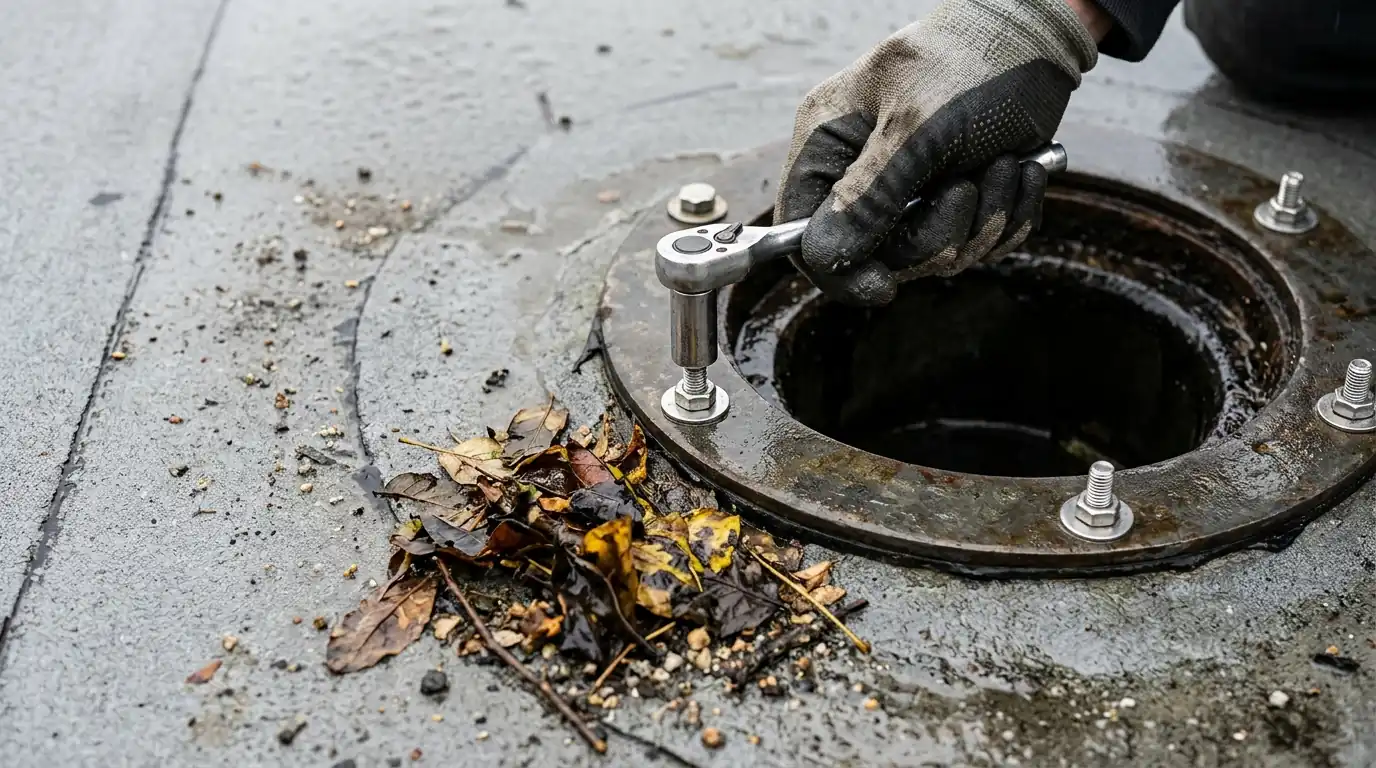
We pull the dome, bag the leaves, grit and trash and photograph the drain bowl before we touch anything else. Photos show the owner what was in the line.
Flush the line with water
A hose test shows how fast the drain moves water. We follow a slow line to the first cleanout and, if needed, use a drain snake or jetter. If water sits in the bowl after the test, the line has a problem.
Inspect the clamping ring and bolts
We check ring cracks, missing bolts, rusted surfaces and the gap between ring and membrane. Replacement rings and domes are fitted as needed. A new ring is cheap compared with wet insulation.
Repair the membrane around the bowl
Splits and gaps are cut out, a new patch or flashing is heat-welded or adhered, and the seam is probed to confirm a tight bond. Patches are probed so they hold.
Adjust sump and slope
If the drain sits above the roof surface, we rebuild the sump with tapered insulation or a cricket so water runs toward it. A cricket behind the drain keeps water from stalling.
Test again and photograph
A second flush confirms flow, then we log photos for your records. We tell you if a line needs a plumber below the roof. Reports go in your roof log.
Scuppers, gutters and interior drains: how they differ
Roofs shed water three common ways. Each fails differently and gets repaired differently. Knowing which you have helps you describe the problem when you call.
| Scuppers and box gutters | Interior roof drains | |
|---|---|---|
| How water leaves | Through an opening in the parapet or a gutter along the edge | Down a pipe inside the building through a drain bowl |
| Common failure | Debris blockage, rusted metal, split seams in the liner | Clogged strainer, cracked clamping ring, blocked line |
| Typical repair | Clean, reseal, reline or replace the box gutter | Clean, replace ring and dome, flush the line |
| Overflow role | Scuppers often serve as the overflow path | Needs a separate overflow drain or scupper |
| Where it shows up | Stains on exterior walls and wet parapet interiors | Ceiling stains below and wet insulation near the bowl |
Box gutters on older Nashville brick buildings
Many older commercial buildings in Germantown, Wedgewood-Houston and downtown have built-in box gutters, which are metal-lined channels set behind a parapet or cornice. They carry roof water to downspouts, and they fail quietly. The liner rusts or splits at solder joints, and water leaks into the wall below, sometimes for years before anyone sees it. These roofs usually carry thin counterflashing that deserves its own look.
Repair depends on the liner. A few pinholes may be patched with fabric and sealant, but a rusted-through liner calls for replacement with new sheet metal or a membrane liner. We also check the downspout outlets, expansion joints and any wood blocking under the gutter. Rotted wood has to come out before the liner goes in.
These repairs are slow, careful work, often on a ladder or lift above a sidewalk. We plan access and traffic control, work in dry weather and photograph the old liner before it comes out. The goal is to stop the slow leak into the masonry, which a patch on the roof surface will never fix. Where the budget is limited, we repair the worst reach first and plan the rest.
What drain, scupper and gutter repairs cost
Drain work varies from a quick clearing to a rebuilt box gutter. We quote after a visit, since the line, roof type and access change the price. Pricing for older buildings rises when wood and masonry repairs are involved.
| Work | Typical range | What moves it |
|---|---|---|
| Drain clearing and flush | $135 to $330 per drain | Strainer removal, hose test and photos. |
| Clamping ring and strainer replacement | $215 to $565 per drain | New ring, bolts, dome and reflashing of the bowl. |
| Scupper rebuild or new overflow opening | $425 to $1,180 each | Sheet metal, sealant and membrane tie-in. |
| Box gutter relining | $28.50 to $64.75 per linear ft | Depends on the liner and wood repair needed. |
What pushes a price up or down:
- Number of drains and whether lines beyond the roof are clear
- Condition of the membrane around each drain bowl
- Height of the parapet and scupper size needed for overflow
- Rotted wood or deck behind box gutters
- Access, including lifts, traffic control and sidewalk protection
Ranges reflect recent Middle Tennessee work and are not a quote; we price after a site visit. See the full Budget Guide.
Drain checks every facility manager can run
A quick look after heavy rain can spot trouble early, even without a roof visit. Write down what you see and call us if the pattern repeats.
- Check from a window or ladder for standing water 24 hours after rain
- Look for brown stains on interior drain pipes and ceiling tiles beneath
- Confirm every drain has a strainer dome and it is intact
- Look at downspout bases for pooling or splash marks
- Make sure overflow scuppers are open and the openings are not caulked
- Check for gutters pulling away from the wall
- Note trees close enough to drop leaves or seed pods on the roof
- Keep a log of dates when drains were last cleared
Heavy rain tests overflow scuppers, and 2010 showed how much rain falls
The May 2010 flood is a reminder of how much water Middle Tennessee can deliver in a short time. Drains designed for ordinary storms depend on a secondary route when the primary line plugs. Check that your roof has overflow scuppers or an overflow drain, that the openings are not blocked or caulked shut, and that the parapet height leaves room for water to exit. If not, we can add or reopen one. It is a small fix with a big payoff.
Need roof drains, scuppers & gutters on a Nashville building?
Call (615) 716-3057 any hour. We look at the roof, show you what we found and price the work before anything starts.
Where we do roof drains, scuppers & gutters around Nashville
The ZIP codes below cover most of the buildings we work on. Every one links to its local page, and the full locations list has 62 more.
- Nashville 37219
- Downtown Nashville 37219
- East Nashville 37206
- Antioch 37013
- Madison 37115
- Donelson 37214
- Hermitage 37076
- Bellevue 37221
- Green Hills 37215
- Franklin 37064
- Brentwood 37027
- Murfreesboro 37130
- Smyrna 37167
- La Vergne 37086
- Mount Juliet 37122
- Lebanon 37087
- Hendersonville 37075
- Gallatin 37066
- Spring Hill 37174
- Columbia 38401
- Goodlettsville 37072
Work that often goes with roof drains, scuppers & gutters
Membranes, coatings and metal we work on every week include Versico, Duro-Last, Elevate and Gaco, plus older systems still in service.
Roof Drains, Scuppers & Gutters questions from Nashville owners
How do you fix a clogged roof drain on a Nashville commercial building?
We remove the strainer, clear debris, flush the line with water and snake or jet it if flow is slow. We also check the clamping ring and membrane around the bowl. A clean drain that leaks at the ring still needs a repair, so we check both.
What is a clamping ring on a roof drain, and why does it fail?
The clamping ring is the metal collar that presses the membrane against the drain bowl and seals it. Rust, cracks, missing bolts or a membrane that has shrunk away can leave a gap. Water then runs around the pipe and into the ceiling below.
Do commercial roofs need overflow scuppers in addition to drains?
Many roofs with parapets and interior drains need a secondary route for water in case the primary drains clog. Code and design requirements vary by building and date. We inspect what you have and recommend adding or reopening overflow openings where water would otherwise back up.
Can a box gutter on an older brick building be repaired without replacement?
Sometimes. Small pinholes and failed seams can be patched with fabric and sealant. A rusted liner or rotted wood behind it calls for a new liner. We open the gutter, look at the condition and give you a range before deciding.
How often should roof drains be cleaned in Middle Tennessee?
At least twice a year, in late fall after leaves drop and in spring before storm season. Roofs under oak, maple or tulip poplar trees may need an extra visit in early summer. After heavy rain or storms, a quick check is also wise.