Retail and restaurant roofing in Nashville
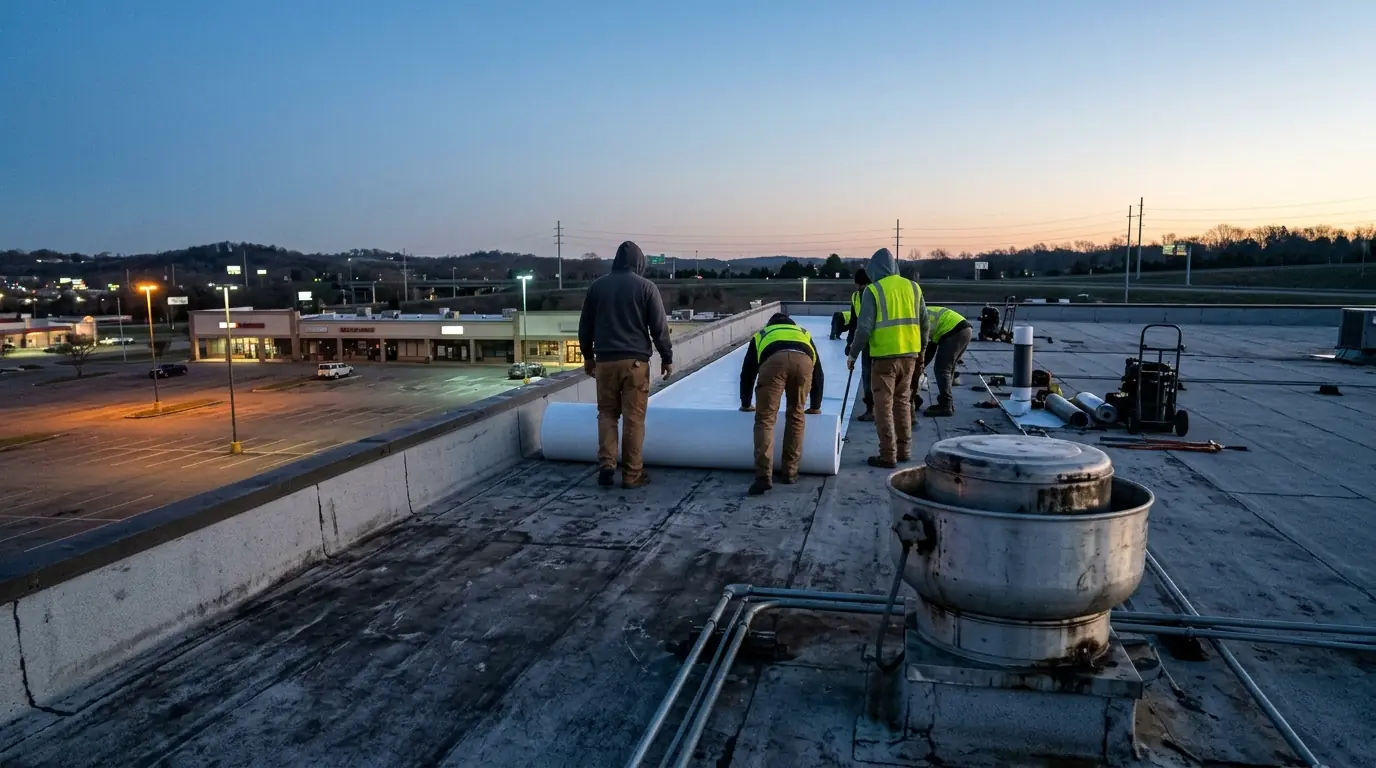
Strip centers and restaurants cannot close for a re-roof, and kitchen exhaust grease eats membranes. We work nights and early mornings, and we coordinate with each tenant before a single sheet comes off.
- Night and early work
- Grease-resistant membranes
- Answered 24/7
Short answer
Retail and restaurant roofing covers repair, replacement and coating of low-slope roofs on strip centers, standalone restaurants and shopping pads. Grease-resistant TPO or PVC membranes cost about $7.15 to $11.80 per sq ft installed on a clean deck. We quote after a site visit and a conversation with the landlord or tenant.
A strip center has one roof and a dozen tenants
Most strip centers along Nolensville Pike, Gallatin Pike or Charlotte Pike share a single roof over many tenants. A leak over the dry cleaner can be caused by a failed curb on the other side of the building, and the lease decides who pays. Facility managers get calls from each tenant, and the roof has to be repaired without disrupting any of them. The landlord usually holds the roof obligation under the lease, but the tenant feels every drip.
That means constant communication. Before any work starts, we ask for a tenant list and note anyone with sensitive needs: a salon with open chemicals, a pharmacy with temperature-controlled stock, a restaurant with lunch rush hours. Noise, dust and hot work are scheduled around them. Tenants who can be given notice a week ahead are more tolerant of daytime noise. That conversation takes place before the first quote, so everyone knows the schedule and the noise they can expect.
Retail roofs also carry a lot of equipment. Rooftop units for every suite, exhaust fans, satellite dishes, signage supports and sometimes the previous tenant's abandoned ductwork. We map each item, find which suite it serves and flash around it properly. Abandoned penetrations get capped and flashed out of existence. Where a unit has been abandoned, we cap the curb and remove the penetration instead of flashing around a hole that serves nothing.
Signs and canopies add their own problems. Pylon sign bases, awning brackets and storefront parapets are fastened into the building by sign companies who rarely flash their work. We find those fasteners during the survey and seal or rebuild them, and we tell the landlord which tenant's sign hardware is involved so costs can follow the lease. A leak that looks like a roof failure is sometimes just a loose bolt on a sign bracket.
Signs a restaurant or retail roof is in trouble
Kitchen exhaust, rooftop units and busy tenant traffic wear a retail roof faster than a quiet office roof.
Dark, greasy film around exhaust fans
Grease that spills over the fan curb attacks many membranes, softening seams and breaking down flashing. Spills tend to follow the wind, so the worst of it lands downwind of the fan.
Soft spots near the kitchen
A roof that gives underfoot over a restaurant usually has wet insulation from a slow leak at an exhaust curb. Any soft spot should be probed with a core cut, not just a tap test.
Ceiling tile stains in a few suites only
Localized leaks point to a flashing or drain problem, not a failed field membrane.
Cracked or loose walkway pads
Service techs walk the same path to rooftop units every month. Worn pads expose the membrane.
Odor or insects entering through ceilings
Gaps around penetrations let in more than water, and are sometimes found by chasing a smell.
Repeated emergency calls from the same tenant
A pattern means the real repair has been deferred, and patches keep failing at the same detail.
Rooftop unit condensate staining
Green or black streaks beneath a condensate line show water draining onto the membrane every day. It wears the surface, and ponding builds there.
Grease-resistant membrane choices for restaurant roofs
Not every membrane handles animal and vegetable fats well. Here is how the common choices compare. A restaurant kitchen exhaust is the main reason this choice comes up on retail roofs at all.
| PVC membrane | TPO with grease-resistant formulation | |
|---|---|---|
| Grease resistance | Very good, widely used over kitchens | Good when formulated for it, ask for the product data sheet |
| Seam method | Heat-welded | Heat-welded |
| Cost | Higher | Lower |
| Reflectivity | High | High |
| Best location | Roof directly over cooking exhaust | General retail areas and low-grease zones |
| Cost over the life of the roof | Higher first cost, fewer repairs near fans | Lower first cost, more attention near the kitchen |
How we schedule and run retail roof work
A retail roof project is a coordination job first and a roofing job second.
Meet the landlord and tenants
We collect lease constraints, hours, noise limits and any tenant that needs special protection. Each gets a notice with dates. Bring the lease language that assigns the roof, and we will note it in the scope.
Survey the roof and kitchen exhaust
We check every curb, fan, grease trap vent and hood discharge, noting grease buildup and cap condition.
Plan night and early morning work
Loud or dusty tasks happen outside business hours. Material is staged away from fire lanes and customer parking. We keep fire lanes and customer walkways clear and mark them with cones before the first load arrives.
Protect interiors and walkways
Ceiling tiles, sensitive stock and covered walks are protected. Cones and barricades keep customers away from the work area. Barricades and signs go up the day before.
Install in sections
A section is torn off, dried in and finished before we leave, with temporary closures at every opening. We take progress photos so a landlord can answer a tenant's question the same day.
Clean up and report
Parking lots and drive-throughs are swept and checked for screws. We send a written summary and photos to the landlord.
Hand over a tenant-friendly summary
The landlord gets a one-page summary for tenants: what was done, what warranty applies and who to call if a ceiling stains.
Handling grease, hood fans and rooftop kitchen exhaust
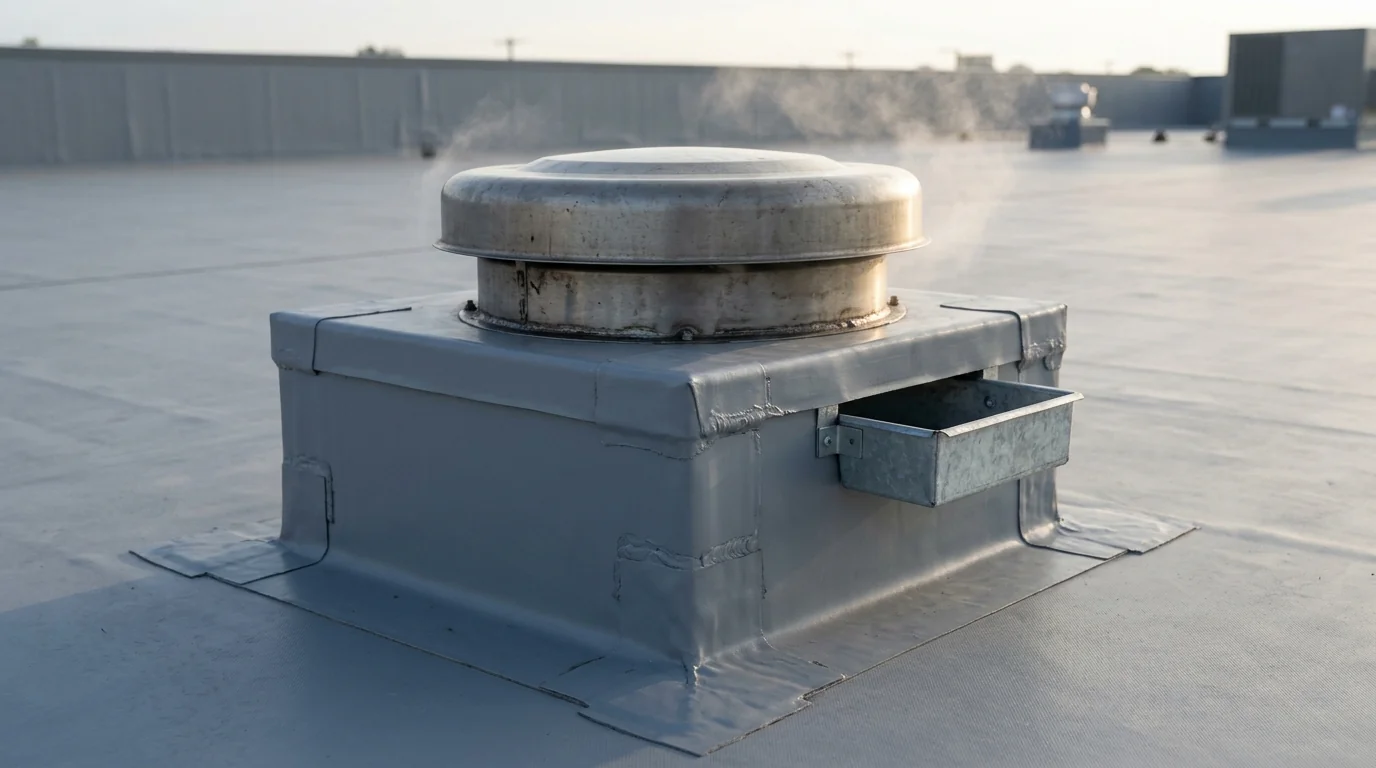
Kitchen exhaust fans discharge hot, grease-laden air. Over time, grease drips onto the roof and soaks into the membrane. On a TPO roof without grease resistance, the surface softens and seams open. We install grease containment systems, such as catch pans or hooded fans with drains, and replace the membrane near the fan with a grease-resistant formulation. Grease also wicks into insulation, so we check for it with a core cut before deciding to patch or replace.
Fan maintenance matters as much as roofing. If the restaurant's exhaust contractor cleans the hood but not the roof side, grease still reaches the roof. We tell the tenant what we find, so the exhaust vendor can clean the curb and the discharge cap. A new roof around a greasy fan will be damaged within a season. Even a good kitchen exhaust cleaning schedule cannot reverse what has already soaked into a roof.
We also look at condensate lines from rooftop units, which can drain onto the membrane and leave algae and staining, and at lighting poles or signage bases that interrupt drainage. Repairing these upstream causes is cheaper than replacing the membrane around them. Overflow from clogged scuppers can leave water sitting against a parapet and wicking behind flashing.
Drive-throughs and pad sites have another quirk: canopies. A drive-through canopy sheds water onto the main roof at a wall, and that valley sees more water than any other part of the building. We check scuppers, downspouts and the transition flashing there first, and we often add a small cricket and a protective splash pad so the main membrane is not asked to handle a stream of runoff all day.
What retail and restaurant roof work costs
Night work, protection and tenant coordination add to the base roofing price. These are Middle Tennessee planning ranges, and we quote after a site visit. Night differentials and tenant protection are listed as separate lines so the landlord can see them.
| Work | Typical range | What moves it |
|---|---|---|
| 60-mil TPO replacement on a strip center | $7.15 to $11.80 per sq ft | Clean deck, includes insulation and edge metal |
| PVC replacement over restaurant kitchens | $8.60 to $14.25 per sq ft | Grease-resistant membrane and extra flashing |
| Exhaust fan curb repair and grease pan install | $520.00 to $1,480.00 per fan | Includes membrane patch around the curb |
| Section repair and recover over one suite | $6.40 to $10.35 per sq ft | Dry insulation required |
| Sign bracket and canopy penetration sealing | $240.00 to $690.00 per location | Includes boots or sealed pedestals |
What pushes a price up or down:
- Night and weekend labor needed to avoid disrupting tenants
- Number of rooftop units, fans and penetrations per suite
- Presence of grease and the need for a PVC or specialty membrane
- Access across customer parking and loading zones
- Whether the roof is shared among tenants or separated by firewalls
- Wet insulation found around leaking exhaust curbs
Ranges reflect recent Middle Tennessee work and are not a quote; we price after a site visit. See the full Budget Guide.
What a landlord should gather before calling
Having these on hand speeds the survey and the quote.
- A tenant list with suite numbers and contact names
- Lease language about who handles roof leaks and repairs
- A map of kitchens, grease exhausts and hood systems
- Previous roof repair invoices and leak logs
- Mall or association rules for night noise and parking
- Insurance paperwork required of contractors
- Hours when each tenant is open, closed or serving a lunch rush
- Which suites have refrigeration or electronics under the roof
- Where customers park and walk relative to the work area
Plan around holiday shopping and restaurant weeks
Retail around CoolSprings Galleria, the Gulch and West End builds toward a holiday peak, and restaurants fill for Nashville event weekends. Roof work in those windows costs tenants real money. We help landlords plan projects for late winter or early spring, so tear-off is done before storm season and well clear of the busy months. Landlords who book in January usually get a choice of dates, while those who wait until spring storms often take the first opening available.
Need retail & restaurant roofing on a Nashville building?
Call (615) 716-3057 any hour. We look at the roof, show you what we found and price the work before anything starts.
Where we do retail & restaurant roofing around Nashville
The ZIP codes below cover most of the buildings we work on. Every one links to its local page, and the full locations list has 62 more.
- Nashville 37219
- Downtown Nashville 37219
- East Nashville 37206
- Antioch 37013
- Madison 37115
- Donelson 37214
- Hermitage 37076
- Bellevue 37221
- Green Hills 37215
- Franklin 37064
- Brentwood 37027
- Murfreesboro 37130
- Smyrna 37167
- La Vergne 37086
- Mount Juliet 37122
- Lebanon 37087
- Hendersonville 37075
- Gallatin 37066
- Spring Hill 37174
- Columbia 38401
- Goodlettsville 37072
Work that often goes with retail & restaurant roofing
Membranes, coatings and metal we work on every week include Versico, Duro-Last, Elevate and Gaco, plus older systems still in service.
Retail & Restaurant Roofing questions from Nashville owners
Can you re-roof a Nashville restaurant without closing it?
Usually yes. We schedule loud and dusty steps for hours when the restaurant is closed, protect the kitchen and dining room ceilings, and complete each section the same night. If a particular step cannot be done without disruption, we tell the owner in advance.
What roof membrane is best over a commercial kitchen?
Grease-resistant PVC is the usual choice over cooking exhaust. Some TPO formulations also resist grease. We check the product data sheets for the specific membrane, install containment pans at the fans, and keep the membrane clean in the exhaust zone.
Who pays for roof repairs in a strip center, landlord or tenant?
That depends on the lease. Many strip center leases make the landlord responsible for the roof and pass the cost to tenants as common area charges. We provide itemized repair reports and photos to support whichever party pays. Either way, we keep an itemized record so the numbers hold up.
How do you handle multiple tenants during a re-roof?
We meet the landlord, collect tenant information and send written notices with dates and noise windows. Sensitive tenants get special scheduling. During work, a point person answers calls and the 24/7 line stays open for emergencies. A named contact answers questions from tenants throughout, so the landlord is not fielding every call.
Can rooftop unit work be done during a re-roof?
Yes. We coordinate with the HVAC contractor to lift or disconnect units when needed, reflash curbs and set the units back down. Doing this during the roof project avoids paying twice for access and keeps the new warranty intact. That keeps the warranty paperwork in one place.