Commercial roofing in Bedford County, TN (37160)
Bedford County is built on manufacturing, horse country and a courthouse-square downtown in Shelbyville. We repair and coat the big plant roofs and look after the older masonry and church roofs in the smaller towns.
- Buildings
- Plants, warehouses, masonry storefronts, horse barns
- Corridor
- Highway 231, Highway 41A, Highway 64, Highway 82
- Watch for
- Ponding on plant roofs, old patched flashings
- Access
- Plant shift schedules, narrow town streets
Short answer
Bedford County commercial roofs split into three groups: large manufacturing and warehouse roofs around Shelbyville, older flat roofs on masonry buildings in town centers, and barn-style metal buildings tied to the horse industry. Leaks start at seams, drains and flashings. We survey the roof first and quote after a site visit.
Where Bedford County's roofing work comes from
Shelbyville is the county seat and its commercial center, with plants and warehouses on its edges and an older downtown around the courthouse square. Wartrace and Bell Buckle sit to the northeast, smaller and quieter, with brick main streets, antique shops and church properties. Normandy and Unionville add rural buildings further out.
Bedford County is also known for the Tennessee Walking Horse, and that heritage shows up in the building stock: large metal barns, arenas, stables and event buildings that need long runs of panel and gutter. Their roofs rarely get inspected, since nobody wants to climb a barn roof until water drips on a horse stall.
The mix means one week we may be mapping a membrane on a plant roof and the next resetting loose panels on a show barn. The same survey habits apply to both: find the source, record it, and fix the cause rather than the symptom.
Bedford County sits on the Duck River, and heavy spring rain keeps humidity high through summer. Moisture matters on roofs because it settles into insulation, feeds algae and slows drying after a leak. We pay attention to how a roof dries, not just how it sheds water, since a surface that stays damp for days is aging faster than one that dries by noon.
Smaller towns like Wartrace and Bell Buckle also have buildings that were never meant to carry modern rooftop equipment. A new air handler on an old brick roof needs a proper curb and flashing, and we check that the structure under it is sound before anyone sets the unit on the membrane.
Manufacturing roofs have their own failure modes
Plant roofs are large, flat and often crowded with exhaust fans, make-up air units, vents and conduit runs. Exhaust and process heat age membranes faster near stacks, and grease or chemical residue can attack some membrane types. We ask what the plant makes and where exhaust lands before recommending a repair material.
Ponding is the other recurring problem. Long spans deflect over time, and shallow birdbaths form near mid-span even when the roof was designed to drain. Water that sits for days speeds up seam wear and adds weight. We measure depth and location, then talk through tapered insulation, added drains or a coating where the roof allows it.
Production schedules matter as much as weather. Most plants cannot stop a line for roof work, so we agree on quiet areas, noisy hours and where hot work is allowed before we mobilize.
Coatings suit some plant roofs and not others. Silicone resists ponding water well, while acrylic does better where the roof drains freely. Picking the wrong one wastes the budget, so we match the product to the roof's drainage and then write the coating thickness and prep steps into the scope, with the surface cleaned and the seams repaired first.
Where a plant has outlived its original membrane and the insulation is wet, we plan a staged replacement. Working one bay at a time, with temporary seals at the end of each day, keeps production going and keeps the building watertight while the old roof comes off and the new one goes down.
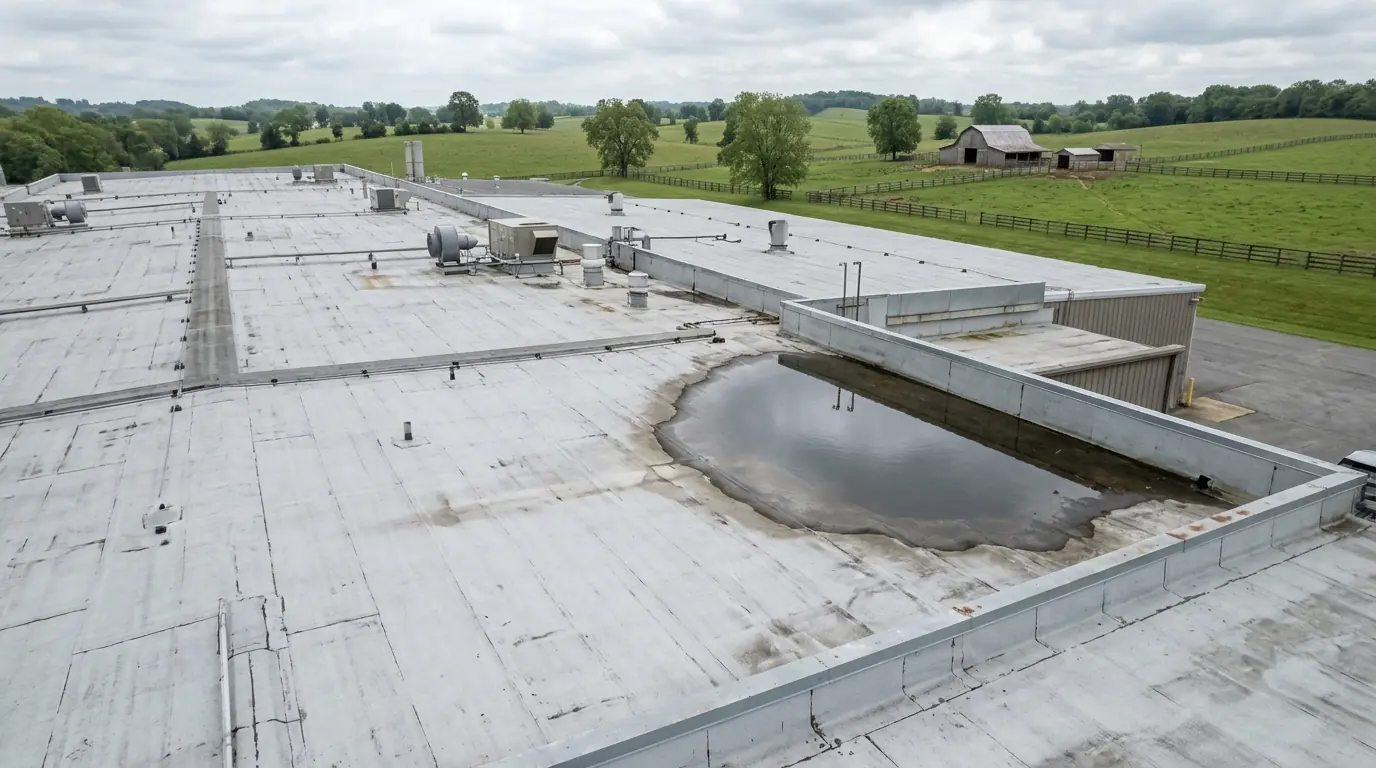
What we find on Shelbyville-area plant and warehouse roofs
These show up again and again on mid-sized industrial buildings.
Open seams near roof-top fans
Vibration and heat loosen field seams and flashing laps around equipment.
Wet insulation under ponds
Standing water finds pinholes. Insulation underneath absorbs it and stops working.
Cracked pitch pans
Old sealant pockets around pipes shrink and open, leaving a direct path inside.
Skylight curbs with failed sealant
Daylighting panels leak at their curbs well before the panels themselves fail.
Corroded gutters and downspouts
Poor drainage at the edge sends water back under the first row of panels.
Older roofs on Shelbyville's square and nearby streets
Downtown Shelbyville has masonry buildings with low-slope roofs behind parapets. Cast-iron drains, cracked coping and shared walls are the usual trouble. Work there is tight: small crews, limited staging space, tenants downstairs. We cover drains and openings at the end of each day and tell you early if a mortar or coping repair belongs to a mason, not a roofer.
Questions to settle before roof work at a Bedford County plant
Production comes first. These keep the roof from interrupting it.
- Which roof areas sit over sensitive equipment or clean rooms
- Where exhaust, steam or chemical vapors vent onto the roof
- Safe staging and truck access around loading docks
- Shift hours when noise or lifts are acceptable
- Fall-protection requirements your site already uses
- Who signs off on hot work permits, if torches are needed
Roofing work we do most in Bedford County
Six services building owners here call about most. The full catalog has 45.
Roof trouble in Bedford County?
Call (615) 716-3057 about a building in Bedford County (37160). The line is answered 24/7, and the first question is always where the water is showing.
Roofing questions from Bedford County
Can you coat a leaking plant roof in Bedford County instead of replacing it?
Sometimes. A coating works when the insulation is dry and the membrane is sound. We take core samples and run a moisture survey first, because coating over wet insulation fails.
Do you work on horse barns and arenas around Shelbyville?
Yes. We repair and replace metal panels, ridge vents, gutters and skylights on large agricultural and event buildings, working around animal schedules.
Can you service Wartrace and Bell Buckle?
Yes. We cover both towns, including older storefronts and church roofs. Call the 24/7 line with a short description and we plan the visit.
How do you schedule roof work around shifts at a Shelbyville factory?
We agree on work zones, noisy hours and delivery times with your maintenance lead before we start, and we keep lifts and debris away from active dock doors.