Commercial metal roofing in Nashville, TN
You're choosing between a standing seam roof that costs more up front and an R-panel roof that costs less. We lay out what each does over time on a warehouse, church or retail building in Middle Tennessee.
- Standing seam and R-panel
- Fastener and seam checks
- Answered 24/7
Short answer
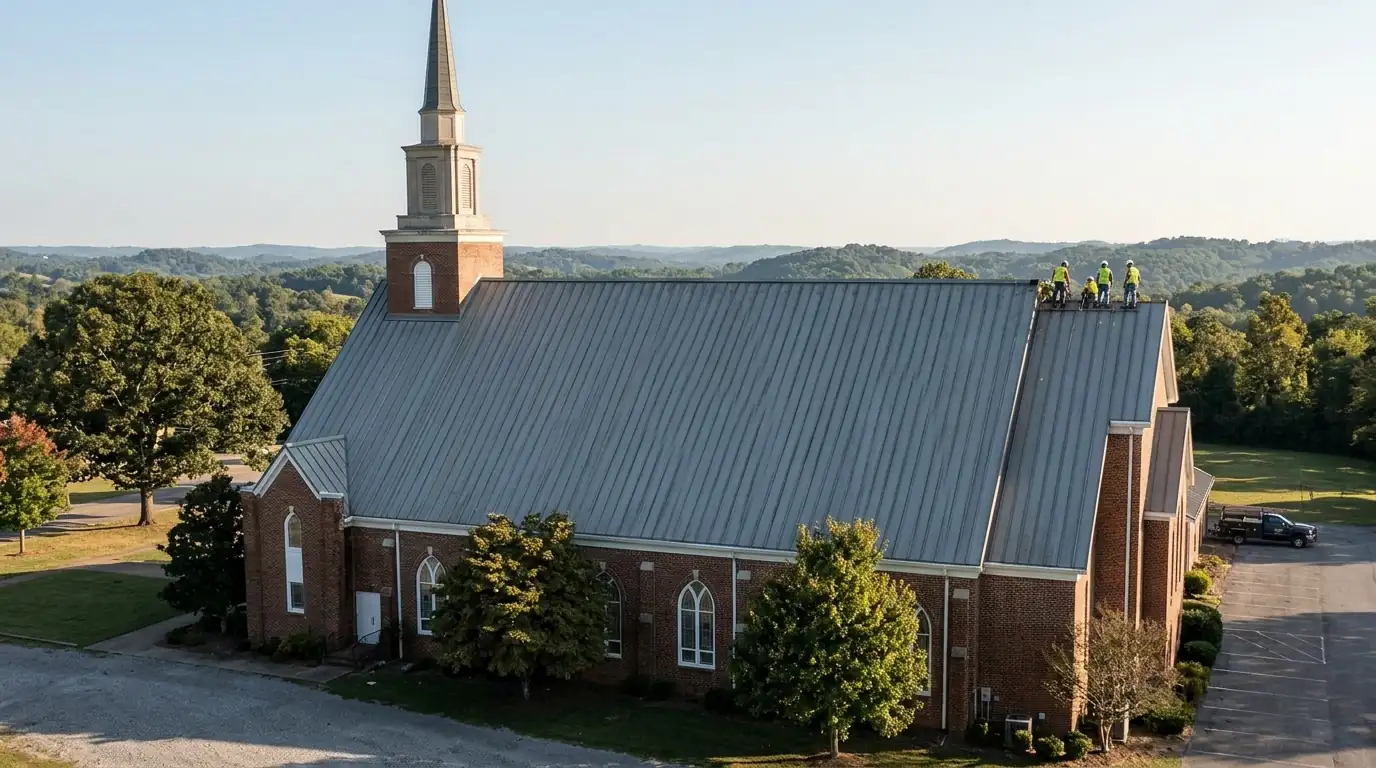
Commercial metal roofing comes in two main types: standing seam, with concealed clips and raised seams, and through-fastened R-panel, screwed down through the face. Nashville installed cost typically runs $9.40 to $17.60 per sq ft for standing seam and $5.90 to $9.30 for R-panel, depending on gauge and building. We quote after a site visit.
Which buildings in Middle Tennessee suit metal roofs
Metal roofing belongs on buildings with enough slope to shed water, framing that can carry the load, and an owner who wants a long service life with modest upkeep. In practice that covers pre-engineered warehouses along I-24 and Murfreesboro Pike, distribution buildings near Smyrna, church sanctuaries with steep pitches, and strip retail with sloped fascias. Light weight and long panels make it a practical fit for large footprints.
Metal also handles Middle Tennessee weather well. Spring hail dents panels more than it punctures them, summer sun reflects off light-colored finishes, and winter freeze-thaw doesn't crack the steel the way it can crack brittle membranes. The main enemies are fastener movement, sealant aging and trapped moisture at laps and penetrations, and all of those can be managed with careful installation and periodic checks.
Where metal is less suited is a roof with almost no slope, a heavily cluttered roof with many curbs and penetrations, or a building that needs a quiet interior under rain. For those, a membrane or foam system may serve better. We tell you when metal is the wrong choice, because a good fit saves you from a roof that leaks at the first sign of a weak seam.
Noise and heat deserve a mention too. Uninsulated metal drums in a downpour and radiates summer heat into the space below. A layer of blanket insulation under the panels, or a thermal spacer block at each purlin, takes much of both away. For a church that holds quiet services or a retail center with tenants sensitive to noise, we recommend pricing the insulated version alongside the bare panel. The extra cost is easy to see, and the comfort gain tends to justify it.
Standing seam against through-fastened R-panel
Both are metal, but they behave differently over time. This is the comparison we walk through with warehouse owners, church committees and retail landlords.
| Standing seam | Through-fastened R-panel | |
|---|---|---|
| Fasteners | Concealed clips, so no screw heads exposed to weather | Screws through the panel face, each with a washer that can age |
| Thermal movement | Panels float on clips and expand and contract freely | Fixed at each screw, which can slot and back out over time |
| Leak risk | Fewer penetrations, so fewer potential leak points | Thousands of fastener holes on a large roof, plus lap sealant |
| Slope needs | Works on lower slopes, often down to a modest pitch | Needs steeper slope and well-sealed laps |
| Appearance | Clean raised ribs, crisp lines | Exposed fasteners and a utilitarian look |
| Upfront cost | Higher per square foot | Lower, which is why it's common on warehouses |
What commercial metal roofing costs in Nashville
Price depends on panel type, gauge, finish, insulation and roof complexity. These are working ranges, not a bid, and site conditions change them. We quote after a site visit.
| Work | Typical range | What moves it |
|---|---|---|
| Through-fastened R-panel, 26-gauge | $5.90 to $9.30 per sq ft | Common on warehouses and light industrial buildings. |
| Standing seam, 24-gauge, Galvalume | $9.40 to $14.70 per sq ft | Includes clips, trim and standard flashing. |
| Standing seam with PVDF finish and added insulation | $12.80 to $17.60 per sq ft | For churches and retail where color retention matters. |
| Tear-off of old metal or shingles | $1.45 to $3.85 per sq ft | Added when recover isn't allowed by code or condition. |
What pushes a price up or down:
- Panel gauge and finish, since PVDF coatings cost more than standard polyester
- Roof pitch, height and the number of valleys, hips and curbs
- Insulation and vapor retarder requirements under the metal
- Whether the job is a recover over an existing roof or a full tear-off
- Delivery times on custom colors and long panel lengths
Ranges reflect recent Middle Tennessee work and are not a quote; we price after a site visit. See the full Budget Guide.
How we install a commercial metal roof
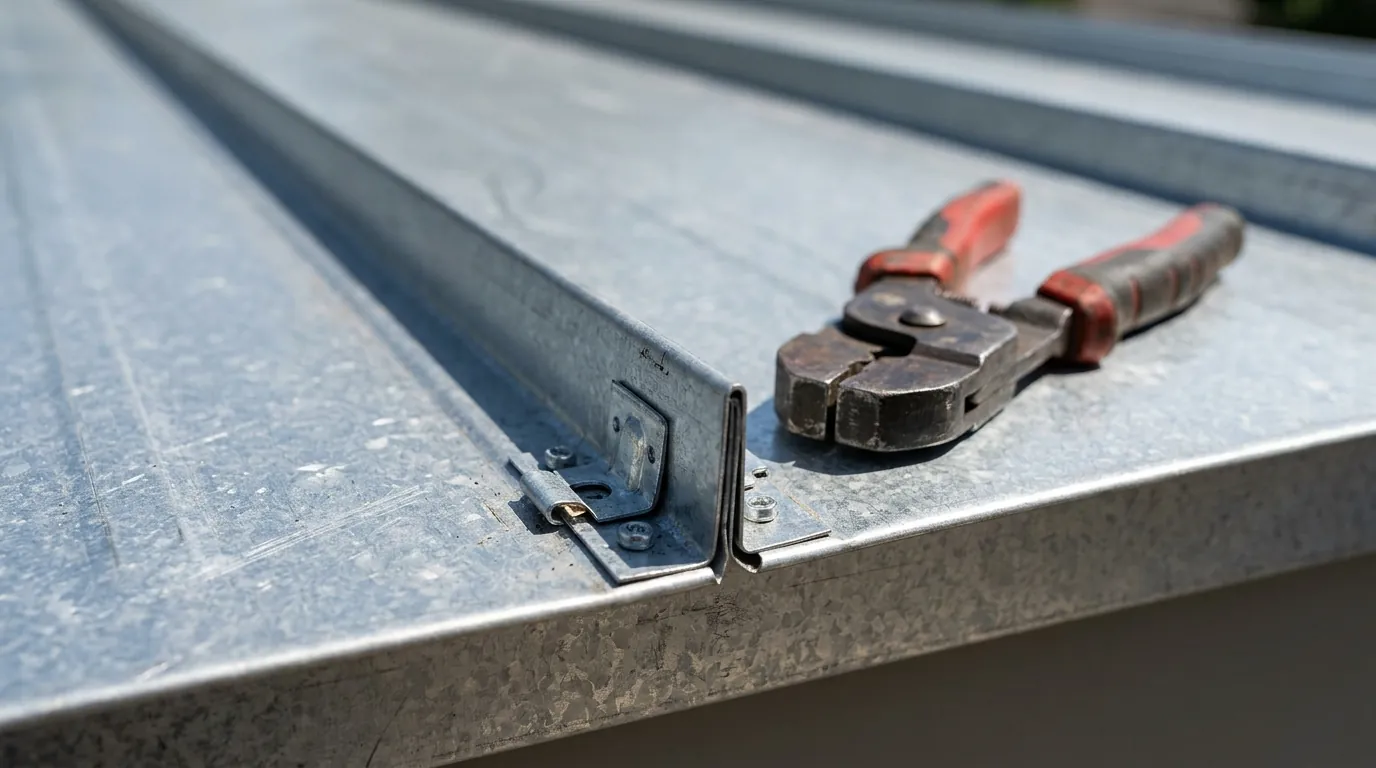
The panels are the visible part. The sequence below covers what happens under and around them, because that is where most leaks and repeat repair visits on metal buildings actually start, whatever the brochure says about the panels themselves.
Measure and survey
We check framing, purlin spacing, deck condition and slope, then confirm panel lengths and trim before ordering. Measuring twice here avoids a short panel arriving on a Friday with a crew standing by.
Substrate prep
Old roofing comes off or is prepared for a recover. Deck repairs, underlayment and insulation go in where needed, and any rotted purlin or corroded framing member is flagged before panels cover it.
Eave and rake metal
Starter trim and drip edge are set to line, which keeps panels straight across a long run.
Panel set and clips
Standing seam panels are locked to clips along each seam. R-panel is screwed into purlins on the specified pattern.
Seam closing and sealant
Standing seams are mechanically seamed. Laps and penetrations are sealed with butyl tape and compatible sealants, and we check seam closure along the whole run with a gauge, not by eye.
Flashings, curbs and ridge
Pipes, curbs and ridges get formed metal flashing with sealed terminations and vented closures where needed. We photograph each detail before we leave and walk the roof once more after the last panel is set.
Details that matter on churches and retail centers
A church roof is a visible building. Parishioners look at it every Sunday, so finish and line quality matter as much as leak resistance. We recommend standing seam with a PVDF finish for most sanctuaries, and we plan panel lengths so a seam doesn't land awkwardly on a steeple base or cross. Valleys and dormers deserve extra attention, since they carry more water than the field of the roof and fail first when sealed carelessly.
Retail centers have different needs. A strip center along Gallatin Pike or Nolensville Pike may have a metal canopy, parapet returns and tenant rooftop units that are serviced often. We plan walk paths, curb flashing and unit support rails so technicians don't step on seams. Where the center's tenants have different lease terms, we phase the work to limit noise and keep entrances open, and we tell you the schedule before the first panel goes up.
Warehouses are the simplest case, but not trivial. Long panels, wind uplift at eaves and ridge, and daily temperature swings in a big steel building all show up in the details. We follow the panel maker's clip spacing and fastener patterns and check the framing before we specify, because a roof can only be as good as the purlins beneath it.
Wind is the other design driver. Eaves, corners and ridges see the highest uplift, which is why those zones get tighter clip spacing or extra fasteners. After the March 2020 and December 2023 tornadoes, many owners across Middle Tennessee started asking about uplift ratings, and that is a fair question. We share the panel maker's tested assembly data and explain which edge details back it up, so you aren't guessing about performance in a hard blow.
Signs a metal roof is asking for attention
Metal gives away its problems in small ways long before water reaches the ceiling. If you manage a warehouse, church or retail building, these are the details worth a flashlight and ten minutes on the roof each spring.
Backed-out screws
On R-panel, a screw head sitting proud of its washer is a leak point. Repeated thermal movement works fasteners loose over time.
Cracked or dried lap sealant
Butyl and sealant at panel laps age in sun. Gaps at laps let wind-driven rain travel under the panel.
Rust streaks below fasteners
Orange stains at screw heads or cut edges show the coating has failed and moisture is working into the steel.
Oil canning or waviness
Visible ripples in flat panels are mostly cosmetic, but severe waves can point to framing or clip problems.
Fading and chalking
A polyester finish that has gone chalky is losing its protection and is a candidate for cleaning and a recoat.
Pinholes near fastener lines
Tiny holes along rust trails mean the panel has started to perforate and needs repair or replacement.
Questions to ask any contractor bidding your metal roof
These keep bids comparable and surface weak points early. A bid that can't answer them in writing is usually leaving something out, and the missing piece tends to show up later as a change order.
- Which panel profile, gauge and finish are quoted?
- Are clips and fasteners spaced to the manufacturer's wind uplift data?
- How are penetrations, curbs and ridge flashed and sealed?
- Is insulation, vapor retarder and condensation control included?
- Is the job a recover or full tear-off, and what happens to the old roofing?
- What are the delivery times for custom colors and long panels?
- What manufacturer warranty applies, if the system and installer qualify?
Condensation can look like a leak
On a big steel building, warm, humid air meets a cold roof deck on a clear winter night and condenses, then drips. Owners often assume the roof is leaking. Before we cut or replace anything, we check for condensation by looking at timing: drips after rain mean a leak, drips on a cold, dry morning mean moisture control. The fix may be insulation, a vapor retarder or ventilation, not new panels.
Need commercial metal roofing on a Nashville building?
Call (615) 716-3057 any hour. We look at the roof, show you what we found and price the work before anything starts.
Where we do commercial metal roofing around Nashville
The ZIP codes below cover most of the buildings we work on. Every one links to its local page, and the full locations list has 62 more.
- Nashville 37219
- Downtown Nashville 37219
- East Nashville 37206
- Antioch 37013
- Madison 37115
- Donelson 37214
- Hermitage 37076
- Bellevue 37221
- Green Hills 37215
- Franklin 37064
- Brentwood 37027
- Murfreesboro 37130
- Smyrna 37167
- La Vergne 37086
- Mount Juliet 37122
- Lebanon 37087
- Hendersonville 37075
- Gallatin 37066
- Spring Hill 37174
- Columbia 38401
- Goodlettsville 37072
Work that often goes with commercial metal roofing
Repairs and new roofs on Mule-Hide, GenFlex, Polyglass and Henry systems, matched to what the building already has where we can.
Commercial Metal Roofing questions from Nashville owners
Is standing seam worth the extra cost over R-panel?
For many buildings, yes. Concealed clips mean fewer penetrations, and panels move freely with heat, so fastener failures are less likely. R-panel is cheaper and fine for warehouses with good upkeep. We price both and explain what each costs to maintain over the years, so the comparison is clear.
How long does a commercial metal roof last in Middle Tennessee?
A well-installed metal roof can serve for a long time, with finish and fastener condition setting the pace. Standing seam usually ages more gracefully than exposed-fastener panels. We inspect seams, sealants and fasteners regularly so small issues don't grow into leaks.
Can new metal go over my old roof?
Sometimes. Building codes limit roofs to two coverings before a full tear-off, and the existing roof must be dry and structurally sound. We check what is under the roof and what the framing can carry, then tell you whether recover is allowed.
What colors and finishes are available for church roofs?
Most panel makers offer a wide palette in polyester and PVDF finishes. PVDF holds color longer, which matters for a prominent building. We bring samples and discuss fade resistance, reflectivity and how the color will look against the surrounding brick and trees.
Can you stop a metal roof leak in the middle of the night?
Phone (615) 716-3057 at any hour. We answer 24/7. We find the entry point, apply a temporary seal or tarp if needed, and plan a proper repair or replacement of the failed fastener, seam or flashing once conditions allow and the panels are dry.