Storm and wind damage roof repair in Nashville
Last night's wind peeled back a corner of your membrane, tossed a rooftop vent cap into the parking lot and left a tree limb on the parapet. We make the roof watertight fast, then repair the failure, not just the visible damage.
- Perimeter-first inspection
- Answered 24/7
- Photo-documented damage
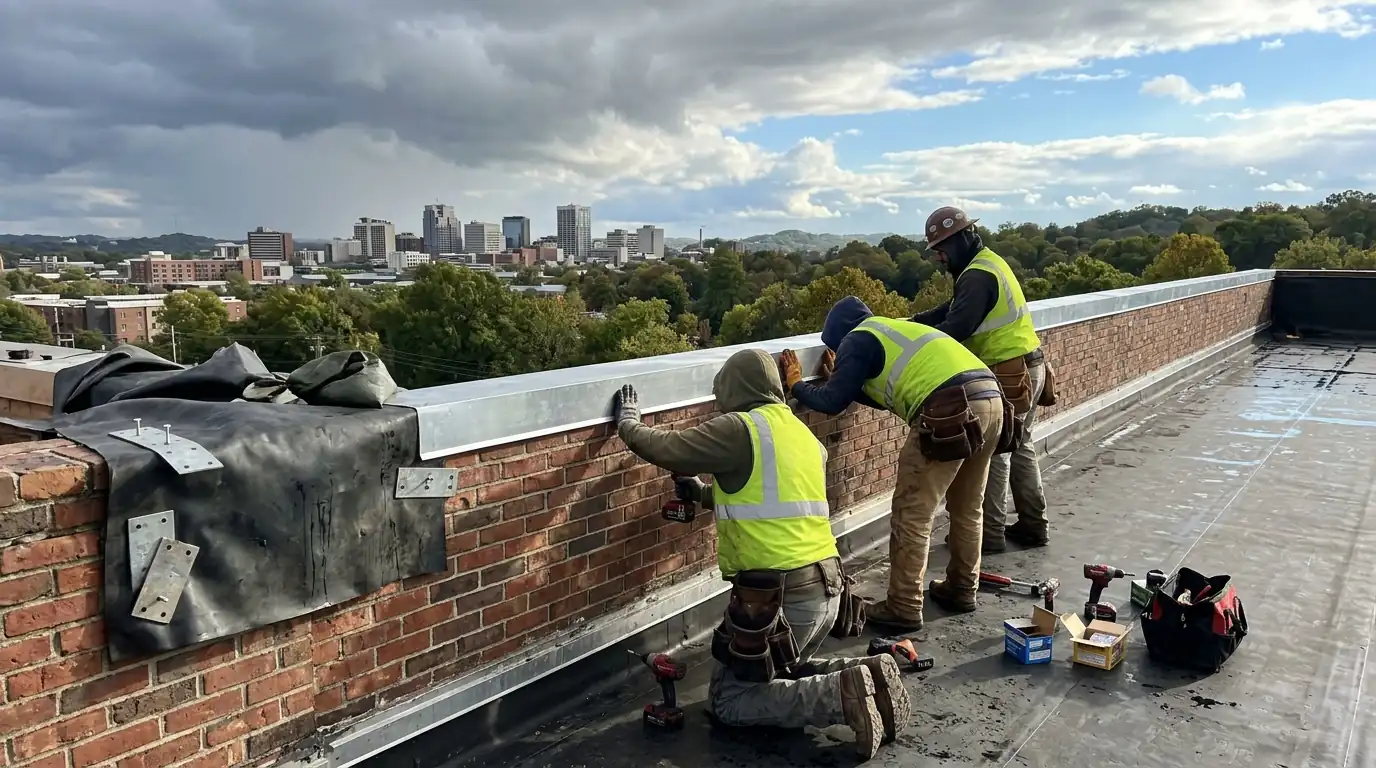
Short answer
Storm and wind damage repair covers membrane peeled at corners and edges, loose or missing edge metal and coping, debris punctures and displaced rooftop equipment. Work starts with a temporary dry-in, then a survey for hidden damage such as lifted insulation, then a permanent repair. Wind damage begins at the perimeter, so that's where we look first.
How wind actually takes a flat roof apart
Wind doesn't push down on a flat roof. It pulls up. As air flows over a building, it separates at the edges and creates suction that's strongest at corners, then along the perimeter. If an edge detail is weak, the wind gets under the membrane or the edge metal and lifts it, and a small opening can peel a large area within a few gusts.
That is why storm damage often looks dramatic at a corner and invisible in the middle. It's also why a roof that survived a storm can fail in the next one. A lifted edge, a loose coping run or a membrane that has already shifted is a weak point waiting for the next gust. We repair the cause, not only the tear you can see.
Roofs with older adhesives, widely spaced fasteners or perimeter metal that was never tested for uplift fail first. A building on an open lot along I-24 or Murfreesboro Pike sees more wind than one tucked between taller neighbors downtown, and a rooftop unit's own bulk can create turbulence that loads nearby membrane harder than the rest of the roof.
Storm damage that hides after the wind stops
Walking the roof after a storm can miss the damage that does the most harm later. These are the items we check beyond the obvious.
Billowing or bubbled membrane
Air trapped under a loosened membrane lifts it in waves. It looks fine at rest and tears at the next gust.
Edge metal pulled away
Gravel stop or coping that sits a half inch proud of the wall has lost its cleat or fasteners and will fail again.
Displaced insulation boards
Boards shifted under a membrane leave low spots and seam gaps that show up as ponding and cracks within months.
Dented or crushed equipment curbs
A rooftop unit knocked sideways can break its curb flashing and the roof opening beneath.
Debris punctures and impact marks
Branches, signs and loose metal leave holes and gouges. Many are small, and none should be left uncovered.
Cracked or loosened rooftop vent caps
Plumbing vents, exhaust caps and gooseneck pipes can twist and break their seals even if they look intact from the ground.
Wet insulation under intact surface
Even a roof that looks sealed may hold water in insulation from a storm opening. A moisture scan finds it before it spreads.
Our sequence from call to permanent storm repair
After a storm, the roof gets dried in first and fixed second. We follow a fixed order so nothing is missed in the rush.
Call and triage
Phone (615) 716-3057. We ask about interior leaks, visible damage and what's inside the building, then set priority.
Safe access check
We look for debris, downed lines, soft deck and loose edge metal that could hurt a crew or fall onto a lot.
Temporary dry-in
Open areas are covered with tarps, temporary membrane or mastic and fabric so rain stops entering immediately.
Perimeter and field survey
We walk edges first, then the field, probing seams and checking attachments. We note what the wind lifted but did not tear.
Moisture scan
Where openings were large or rain fell before the dry-in, we check insulation for water using a meter or infrared.
Repair estimate and documentation
You receive photos, a map of the damage and a repair price range your insurer can review.
Permanent repair
We re-attach edge metal, weld or adhere new membrane sections, replace wet insulation and test the repaired seams.
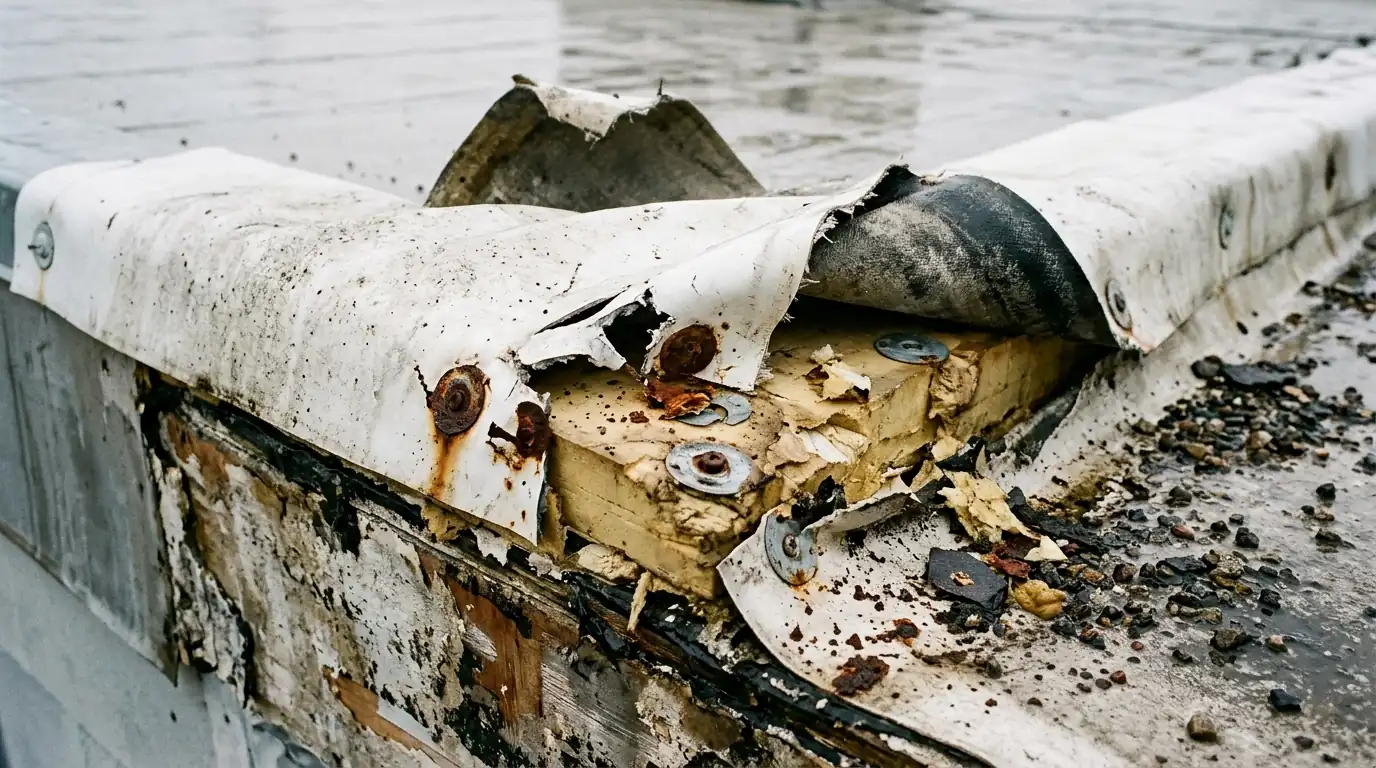
How different roof systems fail in high wind
The attachment method often decides how storm damage looks. Here is what we see on each system.
| Ballasted | Mechanically attached | Fully adhered | |
|---|---|---|---|
| Typical wind failure | Stone scattered, membrane lifted at corners | Fastener pull-through, flutter at seams | Edge peel starting at a corner or flashing |
| Where it starts | Unballasted perimeter and parapet | Rows near the edge with wide fastener spacing | Edge terminations and weak adhesive spots |
| Hidden damage | Pavers or stone in drains and displaced insulation | Elongated fastener holes and worn membrane | Delaminated membrane that sounds hollow |
| Common repair | Re-lay membrane, re-ballast, add edge restraints | Replace torn sections, add fasteners and plates | Re-adhere or replace section, reinforce edge |
| Prevention upgrade | Heavier perimeter ballast or mechanical restraints | Closer fastener spacing at corners | Better edge metal and more edge adhesive |
What storm and wind repairs cost on commercial roofs
Storm repairs vary with how much membrane moved and how long rain entered. These ranges describe typical scopes; we quote after seeing the damage.
| Work | Typical range | What moves it |
|---|---|---|
| Temporary dry-in of a storm opening | $1.65 to $3.15 per sq ft | Tarp or temporary membrane; higher on tall buildings and steep access. |
| Reattach edge metal or coping run | $14.20 to $31.80 per linear ft | Includes new cleat, fasteners and sealant; more for custom profiles. |
| Replace a peeled membrane section | $7.60 to $13.45 per sq ft | Includes tie-in welds or adhesive; wet insulation adds cost. |
| Replace wet insulation under the damage | $4.10 to $8.25 per sq ft | Polyiso board and cover board; thickness changes the price. |
What pushes a price up or down:
- How much membrane moved and whether it can be reused.
- Edge metal profile and whether it must match existing.
- Roof access, height and equipment needed.
- Time rain entered before the opening was covered.
- Number of properties or buildings hit by the same storm.
- Availability of specific membrane colors and thicknesses.
Ranges reflect recent Middle Tennessee work and are not a quote; we price after a site visit. See the full Budget Guide.
Tornado aftermath, flying debris and shifted equipment
The March 3, 2020 tornado cut through North Nashville, Germantown and East Nashville, then on toward Donelson, Hermitage and Mount Juliet. The December 9, 2023 tornado struck near Madison and the Hendersonville area. In both, flat commercial roofs lost parapet caps, rooftop equipment shifted, and roof systems were left open to weeks of rain.
A branch or sheet of loose metal thrown across a roof leaves two kinds of damage. One is a clean puncture through the membrane. The other is a gouge that doesn't go through but thins the surface and fails later. We look for both, mark each with paint, and repair them with patches sized to the damage, not to the cheapest piece we have on the truck.
Rooftop equipment can slide on its curb or tip on its stand in strong wind. A shifted unit pulls on refrigerant lines, conduit and condensate drains, and it can crush the flashing around it. We coordinate with your mechanical contractor, and we don't reflash a curb until the unit is set back where it belongs, because flashing around a moving unit fails twice.
After events like these, the work is rarely just a roof. Surrounding buildings, fallen trees and power lines complicate access, and demand for tarps and crews spikes. Property managers who already have a roofer on call, a photo record of their roof and a plan for temporary dry-in recover faster than those starting from a blank page. Plumbing vents are the quiet casualties: a gooseneck bent by a falling limb may look upright and still have a cracked seal.
What a property manager should document after the storm
Good records speed your claim and our repair. Take these steps as soon as it's safe.
- Photograph the building from the ground, including debris on the lot.
- Record interior leaks and damage by room, with time and date.
- Save any weather reports for the date of loss.
- Locate roof drawings, warranty and prior inspection reports.
- Note what rooftop equipment moved, bent or stopped working.
- Keep receipts for emergency dry-in and temporary measures.
- Avoid permanent repairs before the adjuster has seen the damage.
Why edge metal deserves its own inspection
Wind failures usually start at the edge, and the edge metal is where roofs are most often under-built. ANSI/SPRI ES-1 sets test methods for edge metal resistance to wind, and many designers specify it. If your gravel stop or coping is bent, loose or short on fasteners, the membrane under it isn't protected. We inspect edge metal on every storm repair and tell you where it fails to meet what it should hold.
Need storm & wind damage repair on a Nashville building?
Call (615) 716-3057 any hour. We look at the roof, show you what we found and price the work before anything starts.
Where we do storm & wind damage repair around Nashville
The ZIP codes below cover most of the buildings we work on. Every one links to its local page, and the full locations list has 62 more.
- Nashville 37219
- Downtown Nashville 37219
- East Nashville 37206
- Antioch 37013
- Madison 37115
- Donelson 37214
- Hermitage 37076
- Bellevue 37221
- Green Hills 37215
- Franklin 37064
- Brentwood 37027
- Murfreesboro 37130
- Smyrna 37167
- La Vergne 37086
- Mount Juliet 37122
- Lebanon 37087
- Hendersonville 37075
- Gallatin 37066
- Spring Hill 37174
- Columbia 38401
- Goodlettsville 37072
Work that often goes with storm & wind damage repair
We install and repair systems from Carlisle SynTec, GAF, Johns Manville and Sika Sarnafil, and we patch whatever is already on your roof.
Storm & Wind Damage Repair questions from Nashville owners
What should I do first after wind damages my commercial roof in Nashville?
Protect people and contents, shut off power to wet areas if safe, and photograph the damage. Then call us at (615) 716-3057. We dry in the roof first, then survey for hidden damage. Hold off on permanent repairs until your insurer has documented the loss.
Does wind damage always require a full roof replacement?
No. Many wind events cause edge damage or localized peeling that can be repaired. Replacement becomes likely when large areas lost attachment, when insulation is widely wet, or when the membrane is already near the end of its life. We show you the core, seam and moisture results so the decision is based on measurements.
Can you document storm damage for an insurance claim?
Yes. We photograph and map the damage, record dates and weather, and write a repair scope with price ranges. We don't decide coverage, but a clear record helps your adjuster and your claim. Ask your carrier about their own inspection requirements.
How do I know if my roof lost attachment even if it looks fine?
Signs include billowing membrane, sounds hollow when tapped or pressed, wrinkles near edges and fasteners backing out. We check by walking and probing seams, and use infrared or a moisture scan where needed. Invisible damage often shows up as leaks in the next storm. Call us if in doubt.
Do you repair storm damage on apartment and church roofs?
Yes. We handle flat and low-slope roofs, metal and commercial shingle on apartments, churches, offices and warehouses. After large storms we prioritize active leaks and occupied spaces first, then schedule permanent repairs by risk and by what insurance requires. Phone the 24/7 line and tell us the building type.