Roof recover systems for Nashville flat roofs
Tearing off a roof over an operating pharmacy, clinic or restaurant is disruptive and costly, and you've heard a recover can avoid it. It can, but only when the existing roof is dry and sound, which we verify with a survey and cores.
- Moisture survey first
- Cover board on every recover
- Answered 24/7
Short answer
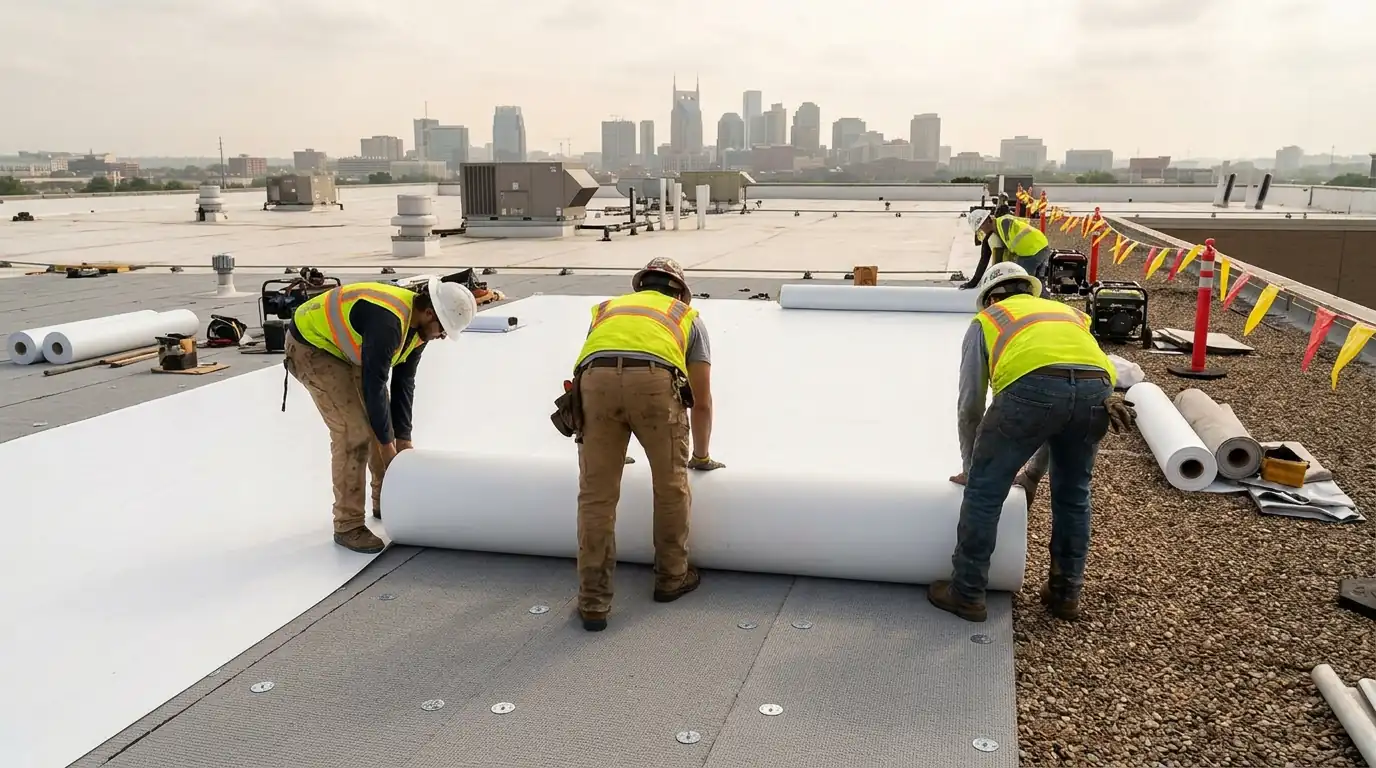
A roof recover installs a new membrane over the existing roof instead of tearing it off. It's allowed only when the existing roof is dry, the deck is sound and codes permit another covering, usually limiting a roof to two. A moisture survey and core cuts decide it. Recovers often cost less and generate less waste than a full replacement.
What a recover is and why owners ask for one
A recover means installing a new roof system directly over the old one, with the old membrane and insulation left in place. Owners ask for it because it avoids the cost of tear-off and disposal, shortens the job, cuts dust and noise and keeps the building drier during the work. For a pharmacy or a dental office in a strip center, that difference matters.
It's not a shortcut for every roof. A recover hides whatever is wrong underneath, so the old roof needs to be an honest foundation. If the insulation holds water, the new membrane will trap it. If the deck is rusted through in places, the new fasteners will have nothing to bite. The survey exists to answer those two questions before a dollar is spent on materials.
Some owners worry a recover is a half measure. It isn't, when the base qualifies. Mid-sized buildings along the Murfreesboro Pike and Gallatin Pike corridors often have a single layer of dry, sound roofing that has simply aged out. A recover on those roofs gives a new weathering surface and more insulation, with a fraction of the waste and disruption.
When a recover is allowed over your existing roof
These conditions must all be true before we'll recommend a recover. If one fails, we say so and price a tear-off.
- The existing roof has only one covering, since codes generally limit a roof to two.
- Moisture surveys and cores show the insulation is dry across the roof, or wet areas are small and can be cut out.
- The deck is sound, with no widespread rust, rot or deflection under foot traffic.
- The structure can carry the added weight of new insulation, cover board and membrane.
- Existing roof surface is clean, relatively flat and without blisters, large wrinkles or loose gravel.
- Added height at parapets, curbs and door thresholds still leaves proper flashing heights.
- The manufacturer allows a recover over your existing roof type with the chosen system.
- Drains and scuppers can be raised or extended to sit at the new roof surface.
How we qualify and install a recover system
The survey comes first and the install follows a set order. Skipping the first step is how recover jobs fail.
Infrared scan
At dusk, we scan for temperature patterns that suggest wet insulation, then mark suspect zones on a roof plan. Scanning works best after a sunny day and under a dry sky.
Core cuts
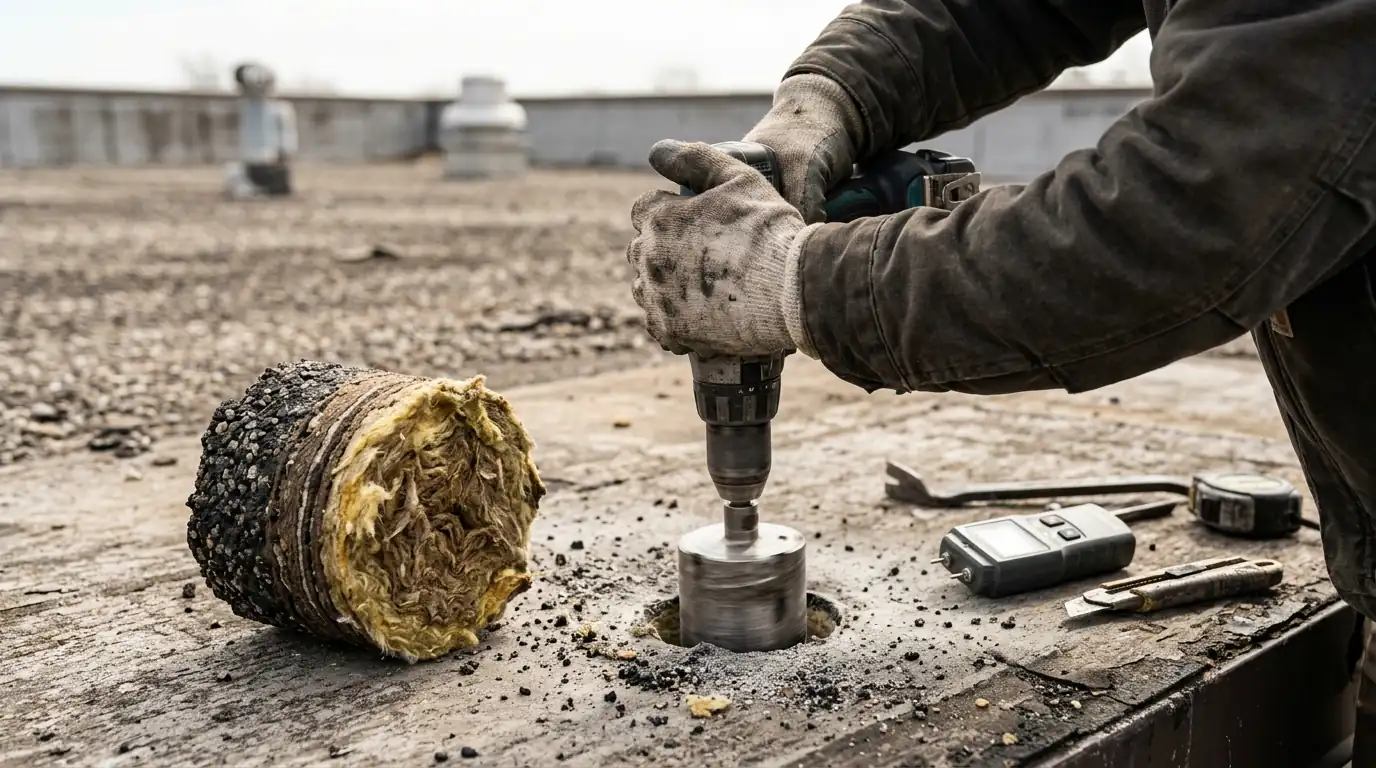
We cut cores through the existing roof at scan results and at random points, checking layers, moisture and attachment.
Deck and layer review
Cores show how many layers exist, what insulation lies under, and whether the deck is rusted or rotted at the cuts.
Remove wet sections
Where small wet areas are found, we cut them out down to deck, replace insulation and bring the area up to level.
Install cover board
A cover board such as high-density polyiso or gypsum-based board goes over the old surface to protect the new membrane.
Fasten or adhere the new membrane
Fasteners reach structural deck where required; adhered systems are glued to the cover board with compatible adhesive. Seams are welded or taped to the manufacturer's detail.
Flash, test and document
We rebuild flashings to correct height, probe-test seams and photograph each detail before the final walk-through.
Recover versus tear-off and replace
Neither is always better. The choice depends on what's under the old membrane and how long you plan to keep the building.
| Recover | Tear-off and replace | |
|---|---|---|
| Cost range | Lower, no tear-off or disposal | Higher, includes removal and landfill |
| Disruption | Less noise, dust and debris | More noise, hauling and open-roof exposure |
| Deck visibility | Hidden under old roof | Fully inspected and repaired as needed |
| Insulation outcome | Old board stays, added board on top | New insulation to current code |
| Allowed when | One covering, dry insulation, sound deck | Any condition; required with two coverings |
| Weight added | New layers sit on existing load | Weight stays near original |
What a recover costs in Middle Tennessee
Recover pricing runs below tear-off and replace on roofs that qualify. We quote after the moisture survey, and these ranges are for planning.
| Work | Typical range | What moves it |
|---|---|---|
| Moisture survey with infrared and core cuts | $0.18 to $0.44 per sq ft | Smaller roofs carry a minimum fee. Core patching is included. Results are reported in writing with photos. |
| Cover board installed over existing roof | $1.55 to $2.70 per sq ft | Board type depends on existing surface and attachment method. |
| 60-mil TPO recover, mechanically attached | $4.85 to $7.60 per sq ft | Installed price including flashing; excludes wet insulation replacement. |
| Cut-out and replace small wet insulation areas | $6.20 to $11.35 per sq ft of repaired area | Only where the survey finds contained moisture. |
What pushes a price up or down:
- Number and size of wet areas found by the survey.
- Surface condition of the existing roof and prep work required.
- Fastener pull-out resistance and deck type.
- Added height at parapets, doors and curbs.
- Rooftop units that must be lifted or reset.
- Whether adhered or mechanically attached systems suit your roof.
Ranges reflect recent Middle Tennessee work and are not a quote; we price after a site visit. See the full Budget Guide.
Cover boards, fasteners and the details that fail first
A cover board is not an optional extra. It protects the new membrane from the old surface, whether that's gravel, granules, a bumpy ballast or the seams of an aged cap sheet. It also adds puncture and hail resistance. We specify the board by what's underneath: a high-density polyiso for most single-ply recovers, a gypsum-based board over gravel-surfaced built-up roofs.
Fastener length matters more than people think. In a mechanically attached recover, fasteners have to pass through the new cover board, the new insulation, the old roof and into the structural deck. A fastener that stops short grips old insulation and pulls out in the first big wind. We confirm deck type during the survey and choose lengths from the core results.
Flashings are the other weak point. A recover raises the roof surface by an inch or several, and walls, curbs and door thresholds don't rise with it. We check each one; where the extra height leaves flashing shorter than it should be, we extend or rebuild the curb. We include the drain work in the recover bid so it isn't a change order later.
Drainage needs a look as well. A recover raises the surface, so drain bowls, scuppers and overflow openings can end up below the new roof plane. We extend or reset them so water leaves the roof instead of pooling beside them, and we confirm overflow height meets what the plumbing design calls for.
Roofs that rarely qualify for a recover
Some roofs fail the test even before we cut cores. These conditions usually send us to a tear-off.
Already two roofing layers
Building codes generally stop at two coverings, so a roof with two layers must be torn off to deck.
Soft spots across the surface
Spongy areas that move underfoot usually mean saturated insulation or a weakened deck.
Large blisters in built-up or mod-bit
Blisters trap moisture and make a poor base for new fasteners or adhesives.
Rusted steel deck at the cores
Where cores show scaling or holes in steel flutes, fasteners can't hold and the deck needs repair first.
Heavy ponding that has been there for years
Old low areas rarely improve with recover; tapered insulation or full replacement is a better fix.
Existing roof is in too poor a state
If the old membrane is brittle, wrinkled and delaminating, the recover has no stable base.
The warranty may depend on the survey
Manufacturers set their own rules for recovers, and some require infrared or core documentation before they'll consider a warranty. The terms differ by system, thickness and building. We keep the moisture survey report with photos and core logs so you have proof the roof was dry when the new system went on. That record also protects you if a leak shows up later and someone asks whether the old roof was sound. Phone (615) 716-3057 to start with the survey.
Need roof recover systems on a Nashville building?
Call (615) 716-3057 any hour. We look at the roof, show you what we found and price the work before anything starts.
Where we do roof recover systems around Nashville
The ZIP codes below cover most of the buildings we work on. Every one links to its local page, and the full locations list has 62 more.
- Nashville 37219
- Downtown Nashville 37219
- East Nashville 37206
- Antioch 37013
- Madison 37115
- Donelson 37214
- Hermitage 37076
- Bellevue 37221
- Green Hills 37215
- Franklin 37064
- Brentwood 37027
- Murfreesboro 37130
- Smyrna 37167
- La Vergne 37086
- Mount Juliet 37122
- Lebanon 37087
- Hendersonville 37075
- Gallatin 37066
- Spring Hill 37174
- Columbia 38401
- Goodlettsville 37072
Work that often goes with roof recover systems
Repairs and new roofs on Mule-Hide, GenFlex, Polyglass and Henry systems, matched to what the building already has where we can.
Roof Recover Systems questions from Nashville owners
Can you install a TPO recover over my existing Nashville roof?
Possibly. We first run an infrared scan and cut cores to confirm one covering, dry insulation and a sound deck. If those check out, we install a cover board and TPO. If cores show wet insulation or two layers, a tear-off is the better and required path.
How many roofing layers are allowed before tear-off is required?
Building codes generally limit a roof to two coverings, so a roof with two layers must be torn off before the next system goes on. Local permit offices administer this, and rules vary by jurisdiction. We check requirements for your location before bidding a recover.
Does a recover cost less than a full replacement?
Usually, because it avoids tear-off labor, hauling and disposal fees. The savings shrink if wet insulation must be cut out, if the surface needs heavy prep or if flashings and curbs need extending. We price both options after the survey so you can compare.
Will a recover shorten the life of my new membrane?
Not if the base is dry and flat and the cover board is right. Problems come from trapped moisture, short fasteners or uneven surfaces. A properly qualified recover should perform like a new roof, with the added insulation and cover board improving puncture resistance.
What is a cover board and do I really need one for a recover?
A cover board is a rigid panel, such as high-density polyiso or gypsum-based board, laid over the old surface and under the new membrane. It separates incompatible materials, smooths the base and adds puncture resistance. We include it on every recover we install.