Spray foam roofing for Nashville commercial buildings
Your roof has domes, curves, dozens of penetrations or a pitch no sheet membrane wants to follow. Spray polyurethane foam fills those shapes in one continuous layer, and we apply and recoat it across Nashville.
- Closed-cell SPF
- Topcoat renewal plans
- Answered 24/7
Short answer
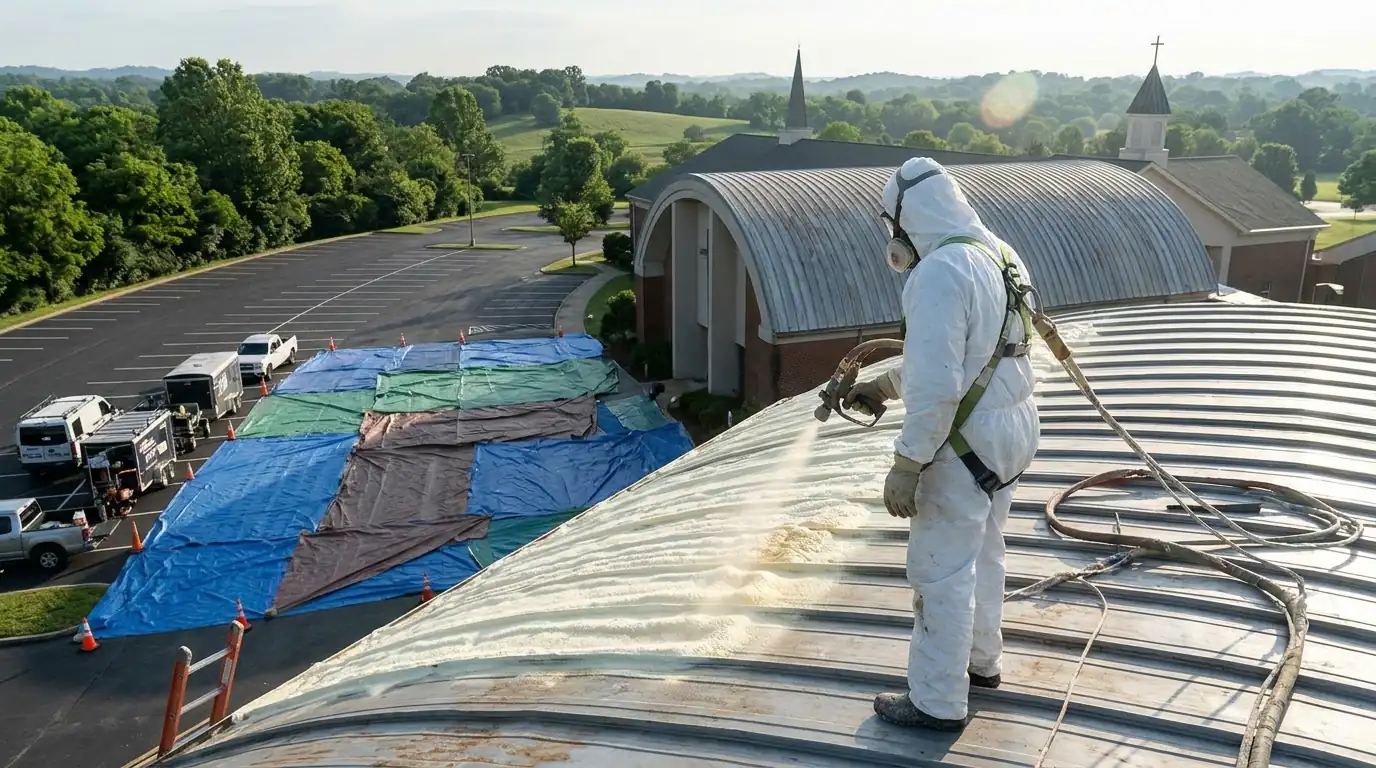
Spray polyurethane foam, or SPF, is a closed-cell insulating layer sprayed onto a roof and protected by an elastomeric topcoat such as silicone or acrylic. It adds R-value, has no laps and conforms to odd shapes. Nashville installed cost typically runs $6.90 to $11.25 per sq ft, and topcoats are renewed on a cycle. We quote after a site visit.
Why odd-shaped roofs call for foam instead of sheets
Sheet membranes want flat or gently sloped fields they can lay across in straight runs. Real buildings aren't always that cooperative. A church with a barrel-vaulted sanctuary, a round bank branch, a metal building with dozens of skylight curbs, a warehouse crowded with ducts and gas lines: each of those gives a sheet product dozens of seams, boots and cut-ins. Every one is a place for water to try its luck later.
Spray polyurethane foam goes on as a liquid and expands into a rigid, closed-cell layer. It follows curves, wraps around penetrations and finishes at walls without a lap or a seam. Because it's also insulation, the roof gains R-value while it gains waterproofing. On a building with high cooling bills and a sound substrate, that combination is hard to equal with a single product.
Foam isn't a cure-all. It needs a clean, dry substrate, decent weather on application day and a topcoat that is renewed on schedule. It also doesn't forgive wet insulation underneath. We evaluate the roof first, tell you honestly whether SPF fits, and say so when a conventional membrane would give you a better result for the money.
Density and thickness are specified, not guessed. Roofing foam is closed-cell, applied in lifts that each cure before the next, and finished to a thickness that gives drainage, insulation value and a surface the coating can protect. A thin, wavy application leaves low spots where water stands and the topcoat fails early. We map slope with a level and a string line before spraying, then use extra foam to push water toward drains, scuppers or the roof edge. That is how a foam roof can fix mild ponding that a sheet roof would simply cover up.
How a spray foam roof goes on, start to finish
Foam is sensitive to surface conditions and weather, so the order of work is strict. Skipping the cleaning or the weather check is the fastest way to end up with a roof that blisters in its first summer.
Substrate evaluation
We check the existing roof or deck with core cuts and a moisture scan. Wet insulation comes out first.
Cleaning and priming
The surface is power washed, repaired and primed if needed so the foam adheres across its full area. Rust on metal roofs is wire-brushed or treated, and loose granules or gravel are removed.
Weather and masking
We check wind, humidity, dew point and surface temperature, then mask vents, cars, glass and neighbors' walls from overspray.
Foam application
Passes of closed-cell foam are sprayed to the target thickness, typically in lifts, building a slope toward drains where needed.
Thickness verification
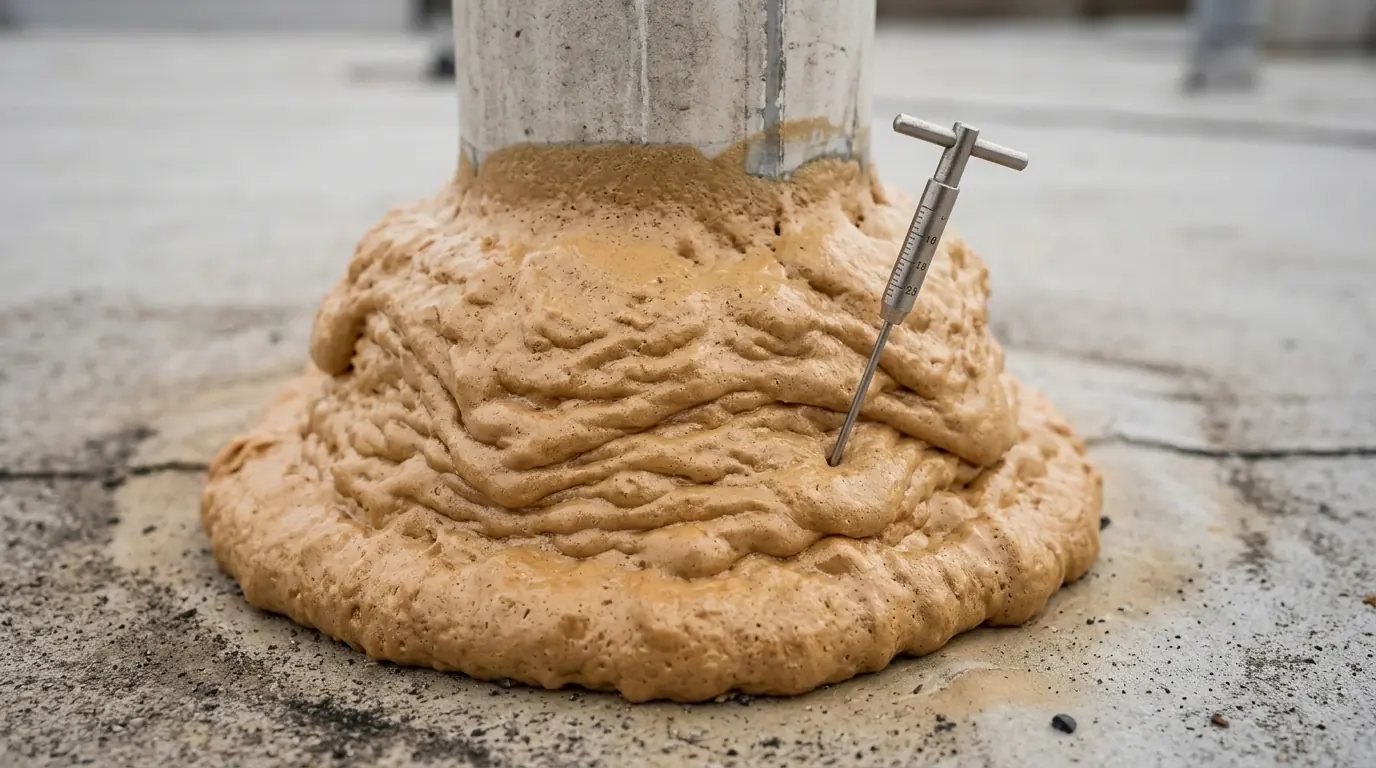
We probe the foam at a grid of points to confirm depth and shape, trimming high spots where water could stand and spraying low spots until the slope runs to the drain.
Topcoat and granules
A silicone, acrylic or urethane topcoat goes on to protect the foam from sunlight and water. Granules are added in traffic zones.
Spray foam against a replacement single-ply membrane
Both can make a good roof. These are the tradeoffs we walk through with building owners.
| Spray foam with topcoat | Single-ply replacement | |
|---|---|---|
| Seams | None across the field, since foam is monolithic | Welded or taped seams at every sheet edge |
| Insulation | Adds R-value as part of the system | Needs separate insulation boards |
| Odd shapes | Conforms to domes, curves and crowded penetrations | Needs many cut-ins and boots on complex roofs |
| Weather during install | Needs dry, calm conditions and careful masking | More forgiving of wind and shoulder-season weather |
| Upkeep | Topcoat is renewed on a cycle to protect the foam | Periodic inspection and seam or flashing repair |
| Wet substrate | Not suitable over wet insulation | Tear-off and replacement of wet board is common |
Spray foam roofing costs in Middle Tennessee
SPF pricing depends on foam thickness, substrate prep and topcoat choice. These ranges are for typical commercial jobs, not a bid, and we quote after a site visit.
| Work | Typical range | What moves it |
|---|---|---|
| 1-inch to 2-inch closed-cell SPF with silicone topcoat | $6.90 to $9.85 per sq ft | Common on metal buildings and curved roofs. |
| 3-inch SPF for added R-value and slope build-up | $8.30 to $11.25 per sq ft | Used where drainage or insulation goals call for more depth. |
| Topcoat renewal on existing SPF | $1.85 to $3.60 per sq ft | Done on a cycle to protect the foam from sun and water. |
| Foam patch and topcoat spot repair | $425 to $1,320 per repair visit | Based on how many hail dents, bird pecks or cracks need work. |
What pushes a price up or down:
- Foam thickness needed for insulation goals or to build slope
- Condition and cleanliness of the substrate
- Number of penetrations, curbs and equipment pads to mask and detail
- Topcoat type, number of coats and granule use
- Wind and weather windows that affect scheduling
Ranges reflect recent Middle Tennessee work and are not a quote; we price after a site visit. See the full Budget Guide.
The topcoat is the roof's sunscreen, and it has a renewal cycle
Bare polyurethane foam breaks down in sunlight, so the topcoat is not optional. It's the only thing standing between the foam and UV. Silicone coatings shed ponding water well and hold their color, acrylics are economical and reflect heat, and urethanes are tough underfoot. The right choice depends on drainage, traffic and budget, and we explain the tradeoffs before you pick.
A foam roof doesn't wear out the way a sheet does. It gets renewed. After a number of seasons, depending on the coating and exposure, the surface needs a fresh coat so the protective layer stays thick enough to do its job. Plan for that cycle in your capital budget, and a foam roof can be extended again and again without a tear-off. Skip it, and the foam is exposed to UV and weather, which accelerates repairs.
Walk traffic is the other thing to plan around. Foam is rigid but not hard, and a technician's boots in the same lane every month will wear a path through the coating. We add granule-embedded walk paths from the hatch to each rooftop unit, and we keep other traffic off the foam altogether. For a church with a bell tower or a property with rooftop mechanical yards, a short list of who may go on the roof, and where, protects the investment better than almost any coating upgrade.
What a tired spray foam roof looks like
These are the symptoms we see on SPF roofs that have missed a renewal or taken a hit from weather or wildlife. Most are cheap to fix when caught early and costly when ignored through a wet winter.
Chalky or thin topcoat
If gray or tan foam shows through the coating in patches, the UV shield is gone in those areas. That is the moment to recoat, before the exposed foam starts to powder and lose thickness.
Hail dimples
Round dents from spring hail can crack the coating. Foam beneath may be fine, but cracks let water in, so we mark each dent with chalk, photograph it and repair the ones that broke the surface.
Pecked holes
Birds sometimes peck into foam. Small holes need patching with foam and coating before moisture spreads.
Blisters or bubbles
Raised areas can signal trapped moisture or a spot where the foam never adhered. We probe them, cut out any that hold water, and re-spray the area with fresh foam and coating.
Ponding that discolors the coating
Standing water that stains the surface needs a fix, either a slope build-up or a coating chosen for ponding.
Cracks around curbs and drains
Movement at details can open the coating and leave the foam exposed.
What to prepare before foam day
Foam is a one-day wet application, so planning ahead matters more than it does for a sheet roof.
- Move cars and equipment away from the building, since overspray travels on the wind and settles on paint and glass farther away than most people expect
- Close and seal fresh-air intakes, vents and operable windows on the day
- Tell tenants about odors and the timing of application and curing, and ask anyone sensitive to fumes to plan to be out of the building that day
- Confirm the roof surface is dry and the forecast shows no rain for the cure window
- Locate and mark rooftop utilities and conduit before masking
- Identify which areas get walked often so granules can be added
- Set a topcoat renewal date in your maintenance calendar, and keep the coating product data sheet with the building records so the next contractor uses a compatible coating
Wind is the real scheduling problem in a Nashville spring
Spring brings straight-line wind and fast-moving storms across Middle Tennessee, and foam crews can't spray into a gusty afternoon. Overspray can drift onto cars, glass and neighboring buildings, so we watch the forecast closely and will postpone a day rather than gamble. If your building sits near a busy road such as Murfreesboro Pike or Charlotte Pike, plan for masking and traffic control. A delayed day is much cheaper than a paint-shop bill for a parking lot. We also avoid spraying when the dew point is close to the surface temperature, since moisture trapped in the foam shows up later as blisters.
Need spray foam roofing on a Nashville building?
Call (615) 716-3057 any hour. We look at the roof, show you what we found and price the work before anything starts.
Where we do spray foam roofing around Nashville
The ZIP codes below cover most of the buildings we work on. Every one links to its local page, and the full locations list has 62 more.
- Nashville 37219
- Downtown Nashville 37219
- East Nashville 37206
- Antioch 37013
- Madison 37115
- Donelson 37214
- Hermitage 37076
- Bellevue 37221
- Green Hills 37215
- Franklin 37064
- Brentwood 37027
- Murfreesboro 37130
- Smyrna 37167
- La Vergne 37086
- Mount Juliet 37122
- Lebanon 37087
- Hendersonville 37075
- Gallatin 37066
- Spring Hill 37174
- Columbia 38401
- Goodlettsville 37072
Work that often goes with spray foam roofing
Membranes, coatings and metal we work on every week include Versico, Duro-Last, Elevate and Gaco, plus older systems still in service.
Spray Foam Roofing questions from Nashville owners
How long does a spray foam roof last in Nashville?
The foam itself can last a long time when it is protected by a topcoat. The coating is what wears, so it is renewed on a cycle based on the product and exposure. We set a maintenance schedule after installation so the roof can be extended rather than torn off.
Can spray foam go over my existing commercial roof?
Often, if the existing substrate is clean, dry and well attached. Wet insulation or a failing membrane has to be removed first. We cut cores and scan for moisture before we recommend foam, because it can't dry out a wet roof.
Is spray foam good for metal buildings with many fasteners?
It can be, because foam covers fasteners, seams and curbs in one layer. The panels need to be sound, clean and primed. We check for rusted-through panels and failed laps first, and replace or repair those so the foam isn't covering hidden damage.
Does hail damage spray foam roofs?
Large hail can dent the foam and crack the coating. The damage often shows as round dimples that need patching before water gets in. After a spring storm, we inspect the roof, document dents, and patch with foam and topcoat as needed.
Can you apply spray foam at night or in an emergency?
Foam needs daylight, dry surfaces and calm weather, so application isn't an emergency service. For an active leak, phone (615) 716-3057 any hour. We answer 24/7, stop the water with a temporary repair, and plan the foam work for the next suitable window.