Commercial roofing in Opryland & Pennington Bend, Nashville (37214)
The Opryland district sits in a bend of the Cumberland River, so its roofs deal with wind off the water, big rooftop plants and the memory of the May 2010 flood. We repair and replace large low-slope roofs here.
- Buildings
- Resort hotels, convention space, big-box retail, light industrial
- Corridor
- Briley Parkway, Music Valley Drive, McGavock Pike
- Watch for
- Ponding on wide decks, equipment curbs, post-flood repairs
- Access
- Event calendars, guest hours, heavy tourist traffic
Short answer
Opryland and Pennington Bend roofs are mostly very large, low-slope roofs on hotels, convention space, retail and service buildings. The common problems are ponding on wide decks, worn flashing around heavy mechanical equipment, and water that entered during the 2010 flood recovery work. We survey with core cuts and quote after a site visit. Phone (615) 716-3057 any hour.
Why a roof in the Pennington Bend looks different from one in town
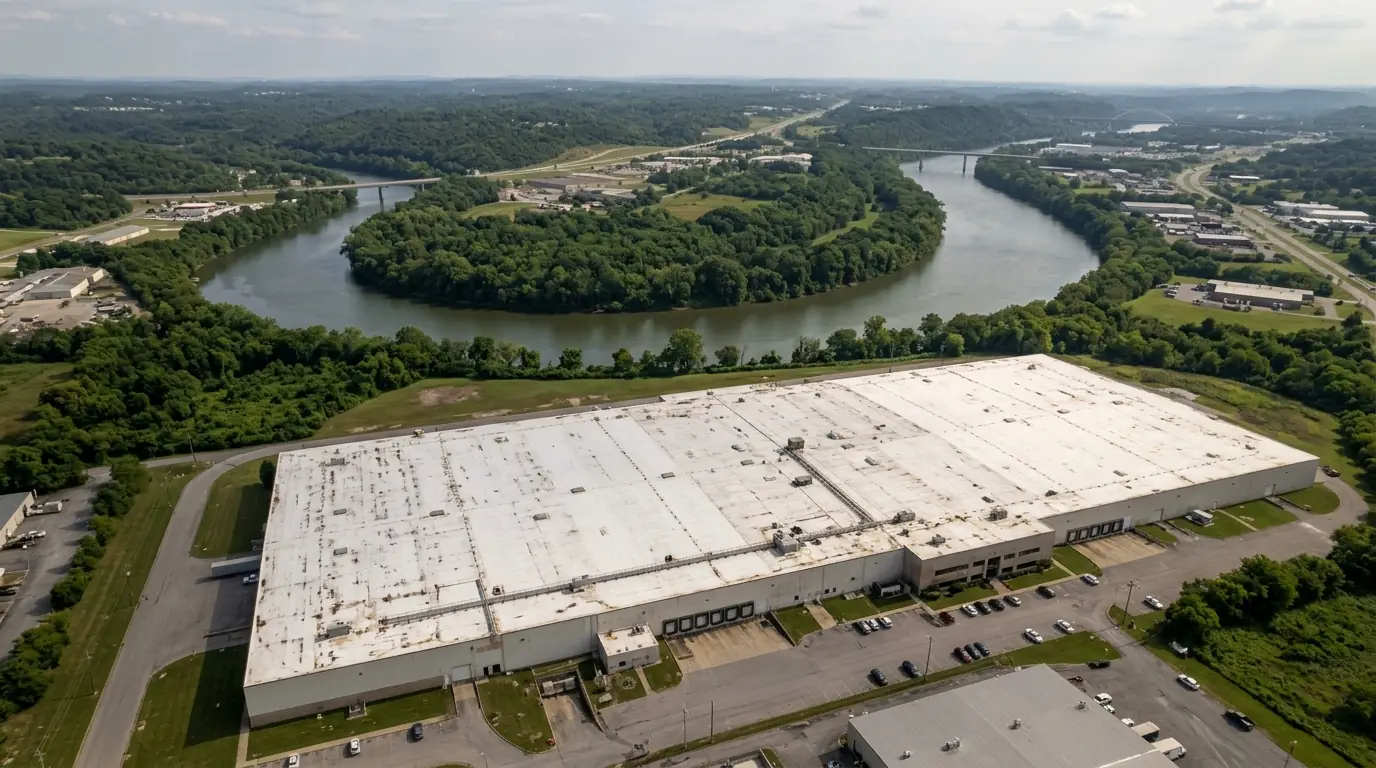
Pennington Bend is a low, wide piece of ground that the Cumberland River wraps around. Buildings here were built big and flat: a resort complex, an arena-scale convention floor, a mall, and hotels and service buildings spread out around Briley Parkway. Roofs on that scale behave differently from a corner store roof. A single section can cover several acres, and the distance from the center to the nearest drain can be a long way for water to travel.
Wide roofs pond. Even a roof designed with slope toward interior drains will settle a little over the years, and a quarter inch of dip across a hundred feet holds more water than most people expect. We walk these roofs after a rain, not before, because standing water shows exactly where the deck has moved. Tapered insulation, added crickets and drain sumps are the usual fixes, and they work best when they are designed from a survey rather than guessed from the surface.
Wind matters too. Open ground near the river and the parkway gives storms a long run at the roof edge. Edge metal, coping and the first few feet of membrane carry the load, so we check fastener spacing and the condition of the perimeter before we look at the field of the roof. On roofs this large, a failed edge can peel back a long way before anyone notices from the ground.
What the May 2010 flood means for a roof
The May 2010 flood put water through this district from the ground up, and the recovery work that followed was rushed across hundreds of thousands of square feet of building. Rooftop equipment was replaced, penetrations were added and moved, and some roof sections were patched to keep a reopening date. Those changes are worth a second look. A new curb or conduit pass-through made in a hurry may never have been flashed to the roof's membrane properly. Ask who touched the roof during recovery, and survey every penetration made then.
Problems we find on large hotel and convention roofs
These show up again and again on big low-slope roofs near Briley Parkway and Music Valley Drive.
Ponding at drain sumps
Water that sits more than two days after a rain means the deck dips or the drain is set high, and the membrane above it ages faster.
Cracked pitch pans around old pipes
Sealant in pans shrinks and splits. Replacing the pan with a proper boot or flashed curb stops the repeat leak.
Chiller and cooling tower staging
Heavy equipment and the foot traffic around it wear through membrane unless walk pads and protection board are in place.
Seam lifting on wide TPO fields
Heat-welded seams that were cold-welded at the edges of a pass open up under thermal movement.
Kitchen exhaust grease on the surface
Grease attacks some membranes and loosens seams. A grease-rated walkway and curb cleaning schedule slow the damage.
Expansion joint covers that have split
Large buildings move, and the cover over the joint tears long before the rest of the roof wears out.
Retail and service buildings around Opry Mills
The retail side of the district is a different job. Opry Mills and the stores and restaurants around it have deep, wide roofs with many rooftop units, and the tenants change often. Each new restaurant or store adds a kitchen hood, a vent stack or a larger unit, and each one is a place for water to enter. We map every opening on the roof, mark the ones that are abandoned, and remove and seal them correctly instead of leaving a capped pipe.
Service buildings and light industrial spaces off McGavock Pike and Briley Parkway more often carry metal roofs or older built-up membranes. Their problems are fasteners that have backed out, panel laps that have opened and gutters that fill with leaves from the tree line along the river. A metal retrofit or a restoration coating can extend their life if the deck and insulation are dry, and a core cut or infrared survey tells us whether they are.
How we schedule work around events and guests
A resort or convention roof cannot close for a week. We plan around the calendar.
- Get the event and convention schedule before we set a start date
- Keep loud tear-off work away from guest wake-up and sleep hours
- Position hoists and staging away from main entrances and shuttle routes
- Close or cap fresh-air intakes while hot materials are on the roof
- Dry in every section at the end of each shift, with no open deck overnight
- Protect rooftop equipment and walkways used by building engineers
- Hold deliveries to windows that avoid heavy tourist traffic on Music Valley Drive
- Photograph each stage so facilities staff can see what is under the membrane
Roofing work we do most in Opryland & Pennington Bend
Six services building owners here call about most. The full catalog has 45.
Close to Opryland & Pennington Bend
Roof trouble in Opryland & Pennington Bend?
Call (615) 716-3057 about a building in Opryland & Pennington Bend (37214). The line is answered 24/7, and the first question is always where the water is showing.
Roofing questions from Opryland & Pennington Bend
How do you handle roof ponding on large Opryland area buildings?
We survey after rain to find where water stays, then fix it with tapered insulation, added crickets or lowered drain sumps. Patching the membrane without fixing the low spot only repeats the problem.
Were Pennington Bend roofs affected by the May 2010 flood?
The water itself did not reach most roofs, but recovery work did. Equipment swaps, new penetrations and rushed patches from that period are worth surveying for flashing that was never finished.
Can you reroof a hotel near Opry Mills without closing it?
Yes, if we phase the work. We work in zones, avoid sleeping hours for noisy steps, cap fumes near air intakes and dry in each section nightly so the rooms below stay protected.
What roof problems are common on retail buildings along Briley Parkway?
Abandoned vents and old unit curbs from past tenants, grease on the membrane near restaurants, and edge metal that wind has loosened. We map every opening and seal or remove the unused ones.