Commercial roofing in Sylvan Park & Charlotte Ave, Nashville (37209)
Charlotte Avenue mixes older one-story shops and clinics with newer mixed-use buildings, so roofs here range from tired modified bitumen to new TPO. We repair, recover and replace both without disrupting tenants.
- Buildings
- Medical offices, small retail, restaurants, mixed-use
- Corridor
- Charlotte Avenue, Charlotte Pike, 46th Avenue North
- Watch for
- Added rooftop units, shared walls, clinic exhaust
- Access
- Street parking, patient hours, tight rear lots
Short answer
Sylvan Park and Charlotte Avenue roofs are mostly low-slope roofs on small medical offices, retail shops, restaurants and mixed-use buildings. Frequent problems are rooftop units added over the years, tight parapet walls and neighbors sharing a roof edge. We map every penetration, core test for wet insulation and quote after a visit. Phone (615) 716-3057 any time.
A strip where old and new roofs share a wall
Charlotte Avenue through Sylvan Park is a working commercial street, not a single-style district. A 1960s clinic with a gravel-surfaced built-up roof can sit next to a three-story mixed-use building finished within the last few years. The older buildings are usually low, flat and shared-wall, and the newer ones come with taller parapets, elevators and roof decks. Each calls for a different repair approach.
Older strip buildings tend to have one long roof broken into tenant bays. Water that enters over one bay often shows up in a neighbor's ceiling, because it follows the insulation or the deck joints before it drops. We trace leaks by cutting cores and using moisture scans, not by guessing from stain locations, and we tell the property manager which bay owns the failure.
Shared walls between buildings need extra care. Where one roof rises above another, the flashing has to stay watertight while both buildings move at different rates in the heat. A rigid sealant bead cracks within a season or two, so we use flexible flashing and a counterflashing that can slide.
Roof traffic is another thing the older buildings were never designed for. Every HVAC technician, sign installer and satellite crew walks the same path across the membrane, and the path shows as scuffed, thinned and sometimes punctured material. We recommend walk pads along routes to rooftop units and a simple rule that nobody stores spare parts or ladders on the roof surface.
Clues that a Charlotte Avenue roof is near replacement
Small offices and shops rarely have a facility manager watching the roof. These are the signs an owner can spot from a ladder or a ceiling tile.
Gravel bare spots on built-up roofs
When the stone washes out of an area, the asphalt below is exposed to sun and cracks.
Alligatoring on the surface
A cracked, scaly pattern on old bitumen means the top layer has hardened and cannot move with temperature changes.
Stained ceiling tiles in a patient room
A brown ring that returns after every storm often means saturated insulation above the tile.
Soft spots underfoot
A spongy feel near a rooftop unit points to wet insulation or a deteriorated deck.
Patches stacked over patches
More than a handful of repair squares on one roof signals it is time to price a recover or replacement.
Open seams at wall flashing
Peeled membrane at the parapet base lets rain run straight down behind it.
Medical offices and clinics have their own roof rules
Small medical and dental offices along Charlotte Avenue run exhaust fans, vacuum and compressor systems, and sometimes oxygen or gas lines, and many of those pass through the roof. A leak in a treatment room is a disruption, not an annoyance. We aim to finish a roof in one or two continuous work phases so rooms below stay in use, and we schedule noisy tear-off outside appointment hours where the layout allows.
Odor and dust matter just as much. Hot asphalt and solvent-based adhesives can find their way into air intakes, which is why we favor mechanically attached or heat-welded single-ply systems near occupied clinics. We also cover or temporarily relocate intake screens, and we keep debris off the parking spaces patients need.
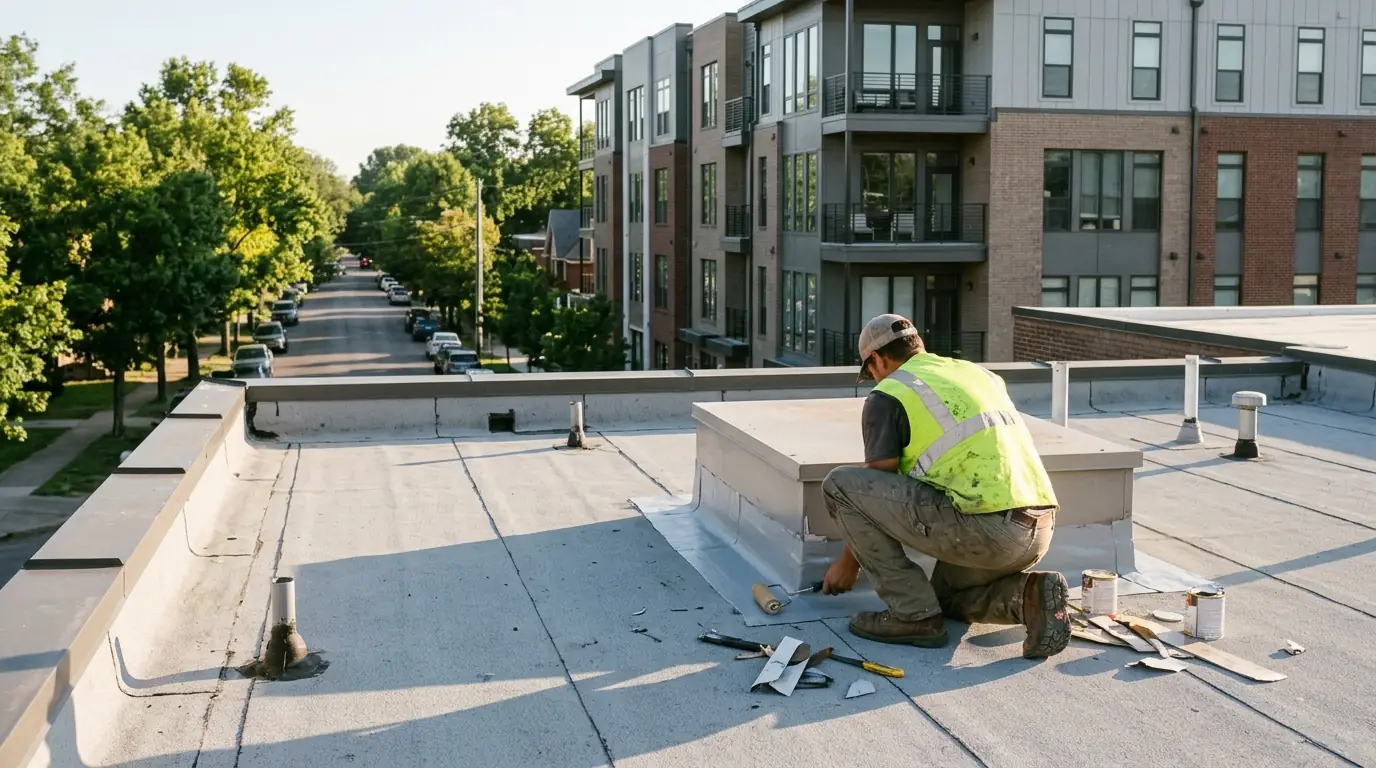
Rooftop units are another common surprise. A practice that added an air handler in 2012 may have had it curbed by an HVAC company and flashed by no one. We inspect each curb, replace failed counterflashing and tell the owner where a unit is overdue for a raised curb or a proper pitch pan.
Sylvan Park's newer buildings raise a different set of questions. Roof decks, terraces and green screens come with pavers or pedestals over the membrane, and a leak underneath has to be found without lifting the whole amenity. We trace those leaks with electronic leak detection where the membrane allows it, then lift only the pavers over the failure and rebuild the drainage layer around the repair.
Plan for tight lots and busy street frontage
Most buildings along Charlotte Avenue have little space behind them. Staging often means a single parking bay, an alley, or an adjacent lot with permission from the neighbor. We stage material loads in small batches, use a lift or a hoist instead of a large crane where possible, and agree on a delivery time with the property manager. Customers and patients keep the front door and the closest spaces.
What a property manager should have ready before a survey
None of this is required, but it speeds up the visit.
- Roof access location, and whether a ladder or a hatch is used
- Tenant bay layout and which tenants have reported stains
- Any past roofing invoices or warranty papers in the file
- A list of rooftop units and who services them
- Any plans to add equipment, a solar array or a deck
- Business hours for each tenant, especially medical offices
Roofing work we do most in Sylvan Park & Charlotte Ave
Six services building owners here call about most. The full catalog has 45.
Close to Sylvan Park & Charlotte Ave
Roof trouble in Sylvan Park & Charlotte Ave?
Call (615) 716-3057 about a building in Sylvan Park & Charlotte Ave (37209). The line is answered 24/7, and the first question is always where the water is showing.
Roofing questions from Sylvan Park & Charlotte Ave
How do you find which bay a Charlotte Avenue roof leak belongs to?
We cut cores and run moisture scans, because water travels in the insulation before it drops. That shows where the failure starts, so the repair goes where the problem is, not where the stain is.
Can a Sylvan Park medical office stay open during roof work?
Usually, yes. We phase the job, keep sections dried in each day, schedule noise outside appointment hours and choose systems that do not push fumes toward air intakes.
Is a recover allowed on an older Charlotte Pike area roof?
Only if the existing roof has no more than one covering and the insulation under it is dry. A core cut tells us. If it fails either test, replacement is the right call.
What happens at the shared wall between two Sylvan Park buildings?
We use flexible flashing with a counterflashing that lets the two roofs move. Rigid caulk at that joint cracks in a season or two, so we avoid relying on it.