Edge metal and sheet metal work in Nashville
The roof edge is where wind starts peeling a membrane, and loose fascia or a bent gravel stop is the usual first sign. We brake, fit and fasten new metal to hold.
- ES-1 tested edge systems
- Custom brake metal
- Answered 24/7
Short answer
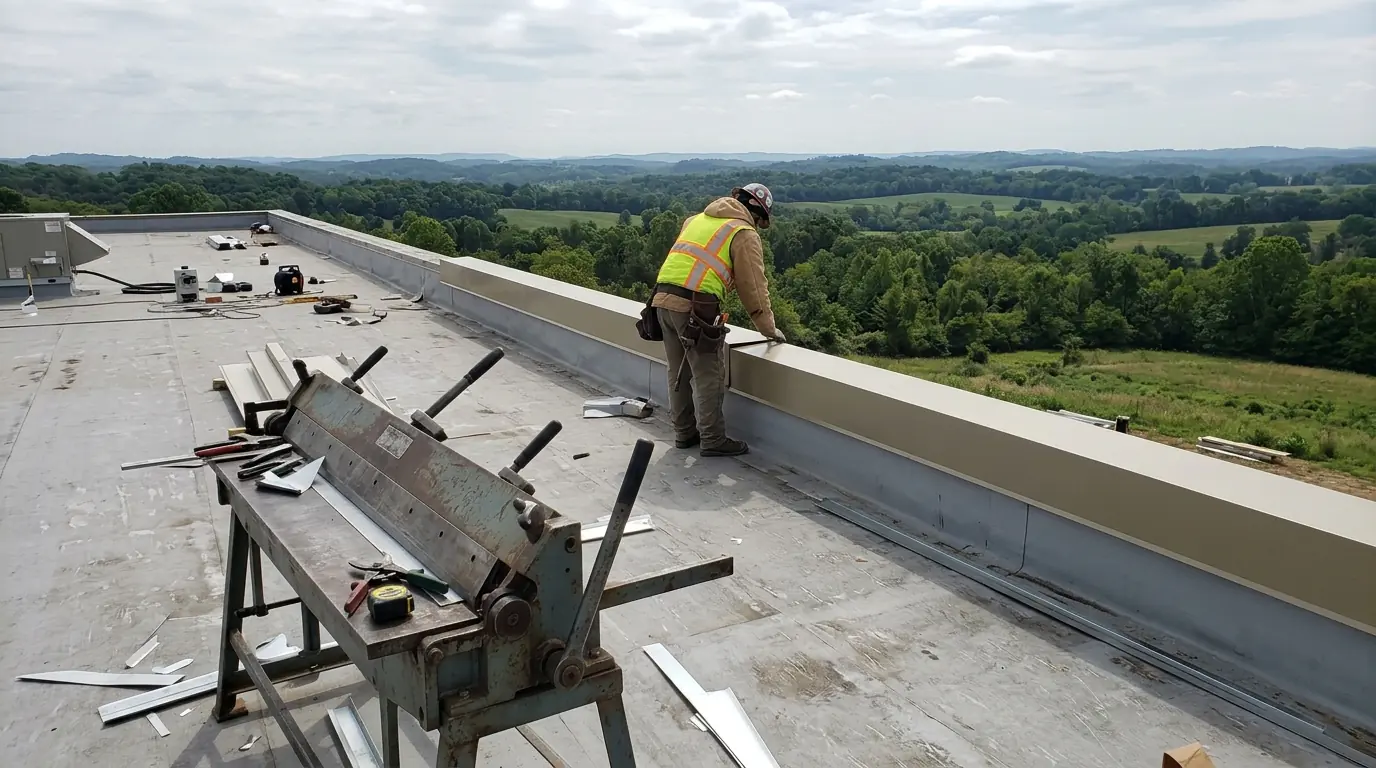
Edge metal is the formed metal at the perimeter of a low-slope roof: gravel stops, fascia, drip edge and coping. It seals the membrane edge and resists wind uplift. Installed costs run about $19.80 to $47.30 per linear foot for ES-1 tested systems. We quote after a site visit and a measured edge survey.
What edge metal actually protects
On a flat or low-slope roof, the perimeter is the most stressed part of the whole assembly. Wind that crosses the building has to go somewhere, and at the corners and edges it creates suction that tries to lift the membrane from underneath. A loose or underbuilt edge metal gives that wind a place to start. That is why we look at the edge before we look at the field on any wind-damage call.
Edge metal does two jobs at once. It finishes the roof visually, hiding the membrane termination and the insulation edge. More importantly, it clamps the membrane down so wind cannot get under it, and it sheds water away from the wall below. A bent fascia that looks like a cosmetic problem is often a structural one for the membrane. A fascia that rattles in a light breeze is already telling you the clamp has loosened, even if the membrane still looks flat.
We fabricate much of what we install. Standard stock profiles work for simple buildings, but older Nashville structures, strip malls and metal-framed warehouses usually have odd heights, offsets and corners. Brake metal formed to the actual dimensions fits better, seals tighter and looks cleaner than stock trim trimmed on the roof.
Corners deserve their own attention. Wind pressure at roof corners is much higher than at the middle of an edge, which is why tested edge systems and attachment patterns change in those zones. We shorten cleat spacing, add fasteners and use heavier gauge material at corners, and we avoid placing a splice joint at the corner itself, because that is where it opens first. A corner built this way costs a little more and rarely comes back.
Gravel stop, fascia cover or coping: choosing the edge
Which profile fits depends on the wall, the membrane and what the building owner wants to see from the street. Our crews carry sample profiles so you can see the face height and color before anything is ordered.
| Gravel stop | Fascia with drip edge | |
|---|---|---|
| Best fit | Built-up and modified bitumen roofs with a raised lip to hold surfacing | Single-ply roofs like TPO and PVC on low walls |
| Wind rating | Available in ES-1 tested assemblies with continuous cleats | Available in ES-1 tested assemblies when cleats and clips are specified |
| Membrane edge | Membrane stripped in at the flange | Membrane terminated under the flange with sealant |
| Appearance | Squared top face, industrial look | Cleaner, thinner face line |
| Common failure | Flange nails back out of wood nailers | Face panel bends outward at the corners |
| Cost per foot | Moderate, rises with the height of the face | Moderate, rises with the number of joints and corners |
Signs your roof edge needs attention
Edge failures are often visible from the ground, so a walk around the building after a wind event tells you a lot.
Metal that waves or flutters in wind
A moving fascia means the cleat or the fasteners have loosened, and the membrane behind it has lost its clamp. Watch the corners first, because they move before the straight runs do.
Lifted corners at the roof perimeter
Corners see the highest uplift forces. If the membrane lifts there, expect the problem to extend along the edge.
Gaps at splice joints
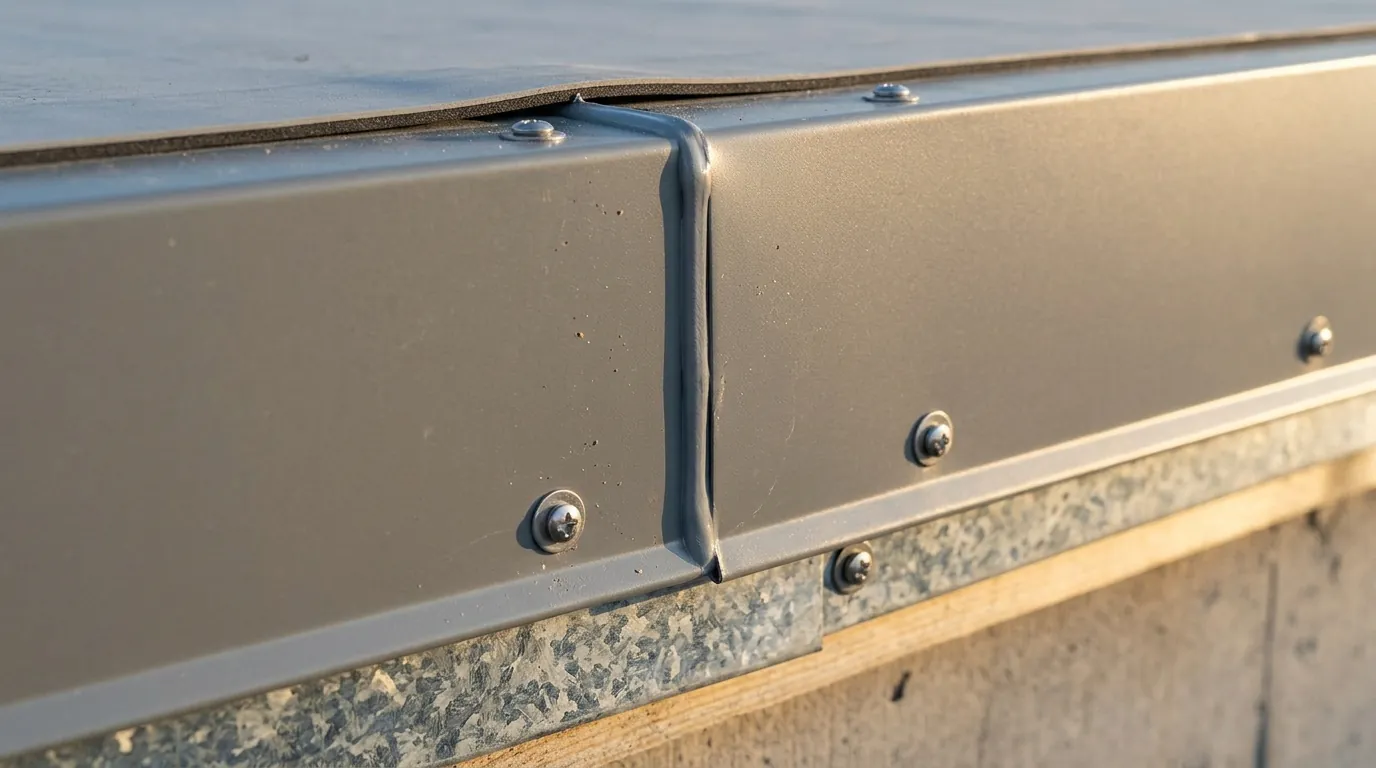
Open joints between sections allow water directly into the wall and the insulation beneath.
Rust streaks below the edge
Corroding fasteners and metal edges bleed rust onto the wall and signal that sealant has failed.
Missing sections after a storm
Hail seasons and straight-line wind regularly peel the first few feet of a perimeter. Missing metal means the membrane is next.
Roof surfacing washed onto the ground
Gravel or granules at the base of the wall means the edge flange is no longer holding the roof cover in place.
Chalky sealant at splice plates
Cracked or powdery sealant at a joint means the splice no longer sheds water. It takes minutes to check from a ladder and hours to repair after it soaks the nailer.
How we replace roof edge metal
The work looks simple from the ground. On the roof, every step affects whether the next big wind event takes it off.
Measure the edge and the wall
We take field dimensions for each run, noting offsets, corners and stepped walls. Those measurements go straight to the brake.
Check the wood nailers and substrate
Rotted nailers or loose blocking are replaced first. New metal fastened to bad wood will not hold, whatever its test rating. A soft nailer found now costs a few dollars per foot; found after the metal is installed, it costs the metal too.
Select the tested assembly
We choose a gauge, cleat and fastener spacing that matches the ES-1 tested configuration for the wind zone and building height.
Form the metal
Pieces are brake-formed in lengths that keep splice joints to a minimum and are cut to fit corners with welded or sealed miters.
Set cleats and install
A continuous cleat is fastened first. The face panel snaps over it, and the top flange is set in sealant under the membrane or stripped in.
Seal, strip in and inspect
Splices get backer plates and sealant, membrane edges are heat-welded or stripped in, and we walk the whole perimeter checking every joint.
Document the tested assembly
We record the gauge, cleat spacing, fastener type and test reference for each run, then add the sheet to your building file for the next owner or roofer.
Sheet metal beyond the edge: counterflashing, curbs and scuppers
Sheet metal shows up all over a commercial roof, not just at the perimeter. Counterflashing laps over base flashing at walls. Equipment curbs wear metal caps. Scuppers pass water through parapets and need a formed liner. Each piece is a custom part, and each is a spot where generic trim will fail within a few seasons. We bring formed trim in common profiles to the first visit, so a minor repair does not wait on a custom order.
We fabricate these on the same break we use for edge metal. Counterflashing for a stucco wall is different from counterflashing for brick, because the reglet cut and the receiver differ. A curb cap for a small rooftop unit differs from one for a large air handler that needs a sloped, welded top. We bring the right pieces up the first time. The difference shows up in a simple pull test: a properly cleated counterflashing stays put, and a surface-mounted one lifts.
Material choice also matters. Galvanized steel suits dry interior details. Prefinished aluminum and Kynar-coated steel stand up better outdoors, especially in the heavy humidity of a Nashville summer. Stainless steel fasteners prevent the rust staining that cheap screws leave down a wall. Stainless fasteners cost little against the price of repainting a stained wall.
Reroofing is the best time to replace edge metal, and the worst time to skip it. A new membrane clamped under an old, loose fascia inherits all of the old edge's weakness. We bring the edge to current standards while the membrane is open, and we check the manufacturer's edge requirements before ordering metal so the warranty terms and the tested assembly line up on paper from the start.
What edge metal and sheet metal work costs
The ranges below cover materials and labor for typical Middle Tennessee jobs. Height, gauge and custom shapes change them, and we quote after a site visit.
| Work | Typical range | What moves it |
|---|---|---|
| Prefinished fascia with drip edge, ES-1 assembly | $19.80 to $34.60 per linear foot | 24-gauge steel or 0.040 aluminum; includes continuous cleat |
| Gravel stop on built-up or modified bitumen roof | $22.15 to $39.40 per linear foot | Includes nailer check and membrane stripping |
| Custom counterflashing at masonry or stucco | $17.90 to $36.75 per linear foot | Reglet cut extra on masonry |
| Formed scupper with liner and collector | $310.00 to $865.00 each | Larger drainage openings cost more |
| Wood nailer replacement at the roof edge | $8.35 to $16.90 per linear foot | Treated lumber, fastened to the structure |
What pushes a price up or down:
- Metal gauge and finish, such as galvanized, aluminum or Kynar-coated steel
- Wind zone and building height that set the required test rating
- Number of corners and offsets that need custom miters
- Condition of existing nailers and the need to replace them
- Lift or scaffold access along the full perimeter
- Color selection and delivery time on prefinished stock
Ranges reflect recent Middle Tennessee work and are not a quote; we price after a site visit. See the full Budget Guide.
Before you approve an edge metal bid
A few questions help you compare bids that look similar on paper.
- Does the bid state an ANSI/SPRI ES-1 test and the design pressure?
- Is the cleat continuous or spot-fastened?
- What gauge and finish are being installed?
- Are corners welded or sealed miters, not just overlapped?
- Who replaces rotted wood nailers, and at what unit price?
- How are splice joints covered and sealed?
- Does the work coordinate with the membrane manufacturer's edge detail?
- Who removes and disposes of the old metal and fasteners
- What color and finish warranty comes with the metal
Spring wind in Middle Tennessee tests every edge
Nashville gets sharp spring thunderstorms with gusts that can top forty miles an hour, plus the occasional tornado warning. Flat roofs on open sites like industrial parks off I-24 or retail pads along Gallatin Pike catch that wind full on. If you manage buildings like these, an edge survey in February, before storm season, is far cheaper than finding a peeled membrane in April. Metro Nashville and the surrounding counties each run their own permit offices, so ask which one covers your site before you schedule metal replacement.
Need edge metal & sheet metal on a Nashville building?
Call (615) 716-3057 any hour. We look at the roof, show you what we found and price the work before anything starts.
Where we do edge metal & sheet metal around Nashville
The ZIP codes below cover most of the buildings we work on. Every one links to its local page, and the full locations list has 62 more.
- Nashville 37219
- Downtown Nashville 37219
- East Nashville 37206
- Antioch 37013
- Madison 37115
- Donelson 37214
- Hermitage 37076
- Bellevue 37221
- Green Hills 37215
- Franklin 37064
- Brentwood 37027
- Murfreesboro 37130
- Smyrna 37167
- La Vergne 37086
- Mount Juliet 37122
- Lebanon 37087
- Hendersonville 37075
- Gallatin 37066
- Spring Hill 37174
- Columbia 38401
- Goodlettsville 37072
Work that often goes with edge metal & sheet metal
We install and repair systems from Carlisle SynTec, GAF, Johns Manville and Sika Sarnafil, and we patch whatever is already on your roof.
Edge Metal & Sheet Metal questions from Nashville owners
What does ANSI/SPRI ES-1 mean for edge metal in Nashville?
ES-1 is the test standard for roof edge flashings, measuring how much wind pressure a gravel stop, fascia or coping can resist before it fails. Building codes reference it. For Nashville commercial roofs, we match the tested assembly to the building height and wind exposure.
Can you fabricate custom edge metal in odd sizes?
Yes. We brake-form edge metal, counterflashing and curb caps to field measurements, including stepped walls, offset corners and tall transitions. Custom pieces fit tighter than stock trim and let us keep the ES-1 tested configuration where the wind rating is specified.
Why does fascia keep bending away from my building?
Usually the cleat is missing or spot-fastened, the nailer behind it has rotted, or the gauge is too thin for the exposure. Wind then pulls the face outward at the corners first. Replacing it with a continuous-cleat system on solid blocking stops the pattern.
Does new edge metal require a new roof membrane?
Not always. If the membrane is sound, we can strip it into the new edge metal or terminate it under the flange with sealant. If the edge has been open for a long time, moisture may have reached insulation, and we check before closing it in.
How soon can edge metal be installed after a storm?
Emergency securing happens right away: we fasten or remove loose metal so it cannot fall or tear the membrane. Custom replacement takes longer because pieces are formed to measure, and stock profiles are usually quicker. We tell you the timeline when we quote.