TPO roofing for Nashville commercial buildings
Your TPO roof is ponding, pulling at the seams, or leaking around penetrations, and you need to know if it can be saved. We survey it, cut cores, and tell you what the membrane and insulation can still do.
- Heat-welded seams
- Core cuts on every survey
- Answered 24/7
Short answer
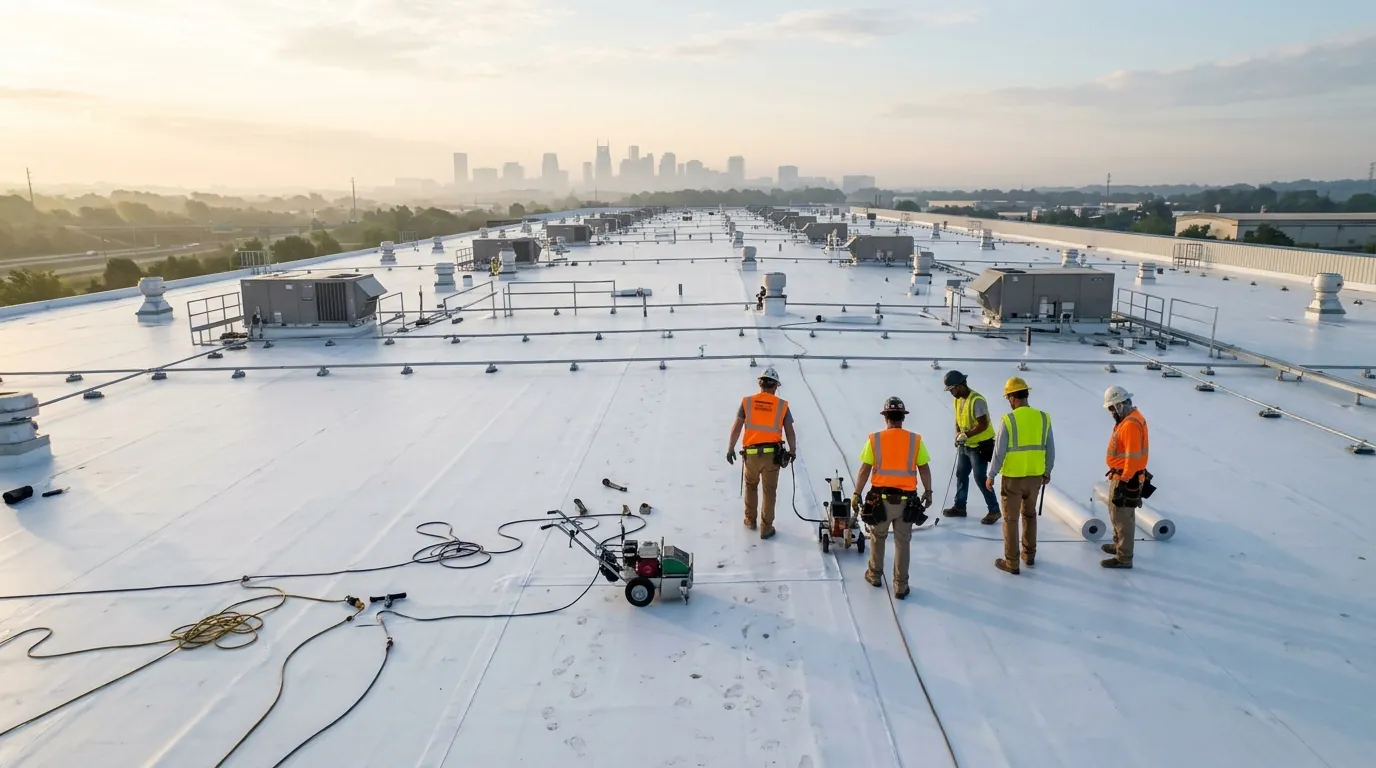
TPO is a white single-ply membrane with heat-welded seams, sold mostly in 60-mil and 80-mil thicknesses. In Nashville, a new TPO roof typically runs $7.15 to $11.80 per sq ft installed on a clean deck, and a sound system can be repaired for years before replacement. Site conditions change that number, so we quote after a site visit.
60-mil or 80-mil: which thickness fits your building
Thickness is the first decision on any TPO bid. A 60-mil sheet is the workhorse for warehouses, strip retail and office buildings with light rooftop traffic and a decent maintenance routine. An 80-mil sheet carries a thicker wear layer over the scrim, which helps against foot traffic from HVAC technicians, spring hail, and debris that moves in straight-line wind. Neither thickness fixes a wet deck or poor drainage, so we look at those first.
We lean toward 80-mil on roofs with weekly service visits, rooftop units set close together on narrow walk paths, and buildings under tall trees along Gallatin Pike or Nolensville Pike where limbs and leaves collect. We lean toward 60-mil on low-traffic roofs with clean drains and walk pads at the hatch and units. The price gap is real but small next to the cost of tearing off a roof early, and we price both so you can compare.
Color matters as well. TPO ships white, and a white membrane runs far cooler than black in a Nashville July, when humidity holds the heat well after sunset. That trims cooling load on the top floor and slows the expansion and contraction that stresses seams. Dirt and algae will dull the surface over time, which is normal. We wash and inspect rather than paint, because TPO is not meant to be coated.
Penetrations decide how long a TPO roof stays tight. A Nashville restaurant with six exhaust fans, a medical office with plumbing vents and a church with a bell tower curb all give water more places to find a way in. We count every pipe, curb, scupper and drain before pricing, and we call out which ones get molded boots, which get field-welded flashing, and which should be moved or removed. A roof with fewer details nearly always lasts longer between repairs than one crowded with old equipment pads.
Fully adhered or mechanically attached: how the two TPO systems differ
Both systems use the same membrane. The difference is how the sheet is held to the roof, and that changes noise, wind behavior and what the substrate has to look like.
| Fully adhered | Mechanically attached | |
|---|---|---|
| Wind behavior | Glued down across the whole sheet, so it can't billow or flutter in a gust | Held at seam laps by plates and screws, so the field can lift and settle in wind |
| Surface look | Smooth, with no fastener lines showing | Visible lap lines where the fastener rows sit |
| Substrate | Needs a clean, dry cover board or insulation face that adhesive will bond to | Works over steel deck and substrates that won't hold adhesive, if fasteners reach the deck |
| Weather window | Needs dry surfaces and workable temperatures for bonding adhesive | Can often proceed on cooler or damper shoulder-season days |
| Installed cost | Higher, because of adhesive, cover board and added labor | Usually lower per square foot on a clean steel deck |
What TPO costs per square foot in Middle Tennessee
These ranges come from typical Nashville-area commercial jobs on a clean, dry deck. We quote after a site visit, because decks, drains, insulation and access change the number.
| Work | Typical range | What moves it |
|---|---|---|
| 60-mil mechanically attached, new or tear-off | $6.85 to $9.40 per sq ft | Steel deck, standard insulation thickness, and a few penetrations. |
| 60-mil fully adhered over polyiso and cover board | $8.35 to $11.80 per sq ft | Higher because of the cover board and adhesive labor. |
| 80-mil fully adhered | $9.20 to $13.15 per sq ft | Thicker sheet for roofs with heavy foot traffic and tree debris. |
| Seam and flashing repair on aged TPO | $385 to $1,240 per repair visit | Depends on how many details need work and how much cleaning the old membrane needs. |
What pushes a price up or down:
- Wet insulation found by core cuts adds tear-off and replacement board
- Tapered insulation or crickets for ponding water change both material and labor
- Number of curbs, pipes, drains and scuppers drives flashing time
- Crane or hoisting needs for tight downtown Nashville sites
- Edge metal that has to meet ANSI/SPRI ES-1 for the manufacturer warranty
Ranges reflect recent Middle Tennessee work and are not a quote; we price after a site visit. See the full Budget Guide.
How we install a TPO roof, in order
The sequence matters more than the brand on the roll. Skipping the survey or the test welds is where most TPO leaks begin, and fixing a bad weld after the crew has left costs far more than checking it on the day.
Survey and core cuts
We walk the roof, map ponding and soft spots, and cut cores to see the real layers. Each cut is patched the same day.
Moisture scan
Infrared or capacitance readings show which insulation is wet. That decides between a recover and a tear-off.
Deck and insulation prep
Bad deck sections are replaced, polyiso goes down in staggered layers, and a cover board is added where adhesive needs a clean face.
Membrane set
Sheets are laid out against the wind direction, then adhered or fastened according to the system we priced.
Heat welding and probing
Seams are welded with automatic machines, hand welders do the details, and we probe the seam edges looking for cold welds.
Flashings and edge metal
Curbs, pipes, drains and parapets get molded boots or welded flashing. Edge metal is set to code and warranty requirements.
Final walk and photos
You get photo documentation of seams, drains and flashings, plus the warranty paperwork if the system qualifies.
Signs your existing TPO is past simple patching
TPO fails in recognizable ways. If you see more than two of these, ask for a core cut before spending on another patch.
Seams opening at the edges
A visible gap or lifted lip along a welded seam usually points to a cold weld or heavy shrinkage.
Crazing or cracking
Fine surface cracks near flashings and at the base of curbs suggest the membrane is losing flexibility.
Ponding that stays after 48 hours
Standing water speeds up dirt and algae growth and signals low spots or failed drains.
Soft spots underfoot
A spongy feel means the insulation or cover board is holding moisture.
Repeated leaks at the same detail
If a pipe boot or curb has been patched three times, the flashing needs to be rebuilt.
Chalky or heavily stained surface
Surface staining alone is cosmetic, but combined with cracking it hints at an aged sheet.
What we check before repairing a TPO seam
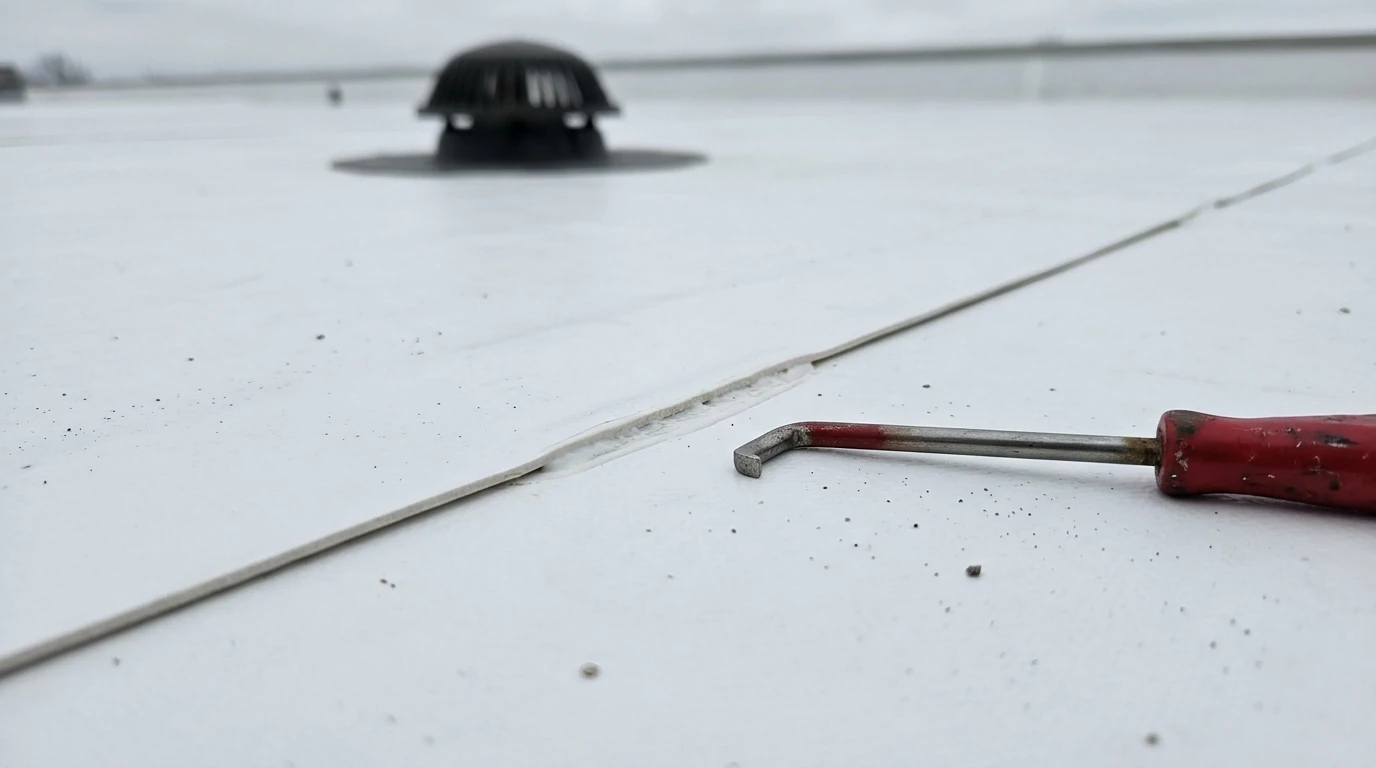
A seam repair is only as good as the surface under it. Old TPO that has been walked on, rained on and sunburned for ten or fifteen years picks up dirt and a thin oxidized layer that blocks a hot-air weld. We scrub the area with cleaner made for TPO, rinse it, let it dry, and then test a small patch before committing to a long run. If the test patch peels with no cohesive bond, we tell you that the membrane is too aged to weld reliably.
That is the point where repair stops making sense for some roofs. If the membrane takes a weld, we can often extend its life by re-welding failed seams, replacing pitch pan details with molded boots, and adding walk pads. If it doesn't, a recover over dry insulation may be allowed, or a full tear-off if building codes limit the roof to two coverings. We show you the cores and the test patch so the decision rests on what the roof actually shows.
Flashings are the other half of the story. Base flashing at a brick parapet in Germantown or a metal-sided wall in a Smyrna distribution center takes more movement than the field of the roof, and the old sealant on termination bars dries out well before the membrane does. We pull the bar, clean the substrate, re-seat the flashing, and reseal with a compatible lap sealant. Sometimes that single detail repair clears a leak that three earlier patches on the open roof never touched.
What to gather before we survey your TPO roof
None of this is required to phone us, but it speeds up an accurate quote. The more we know about the roof's history before we climb up, the less time we spend guessing at layers and leaks.
- Any past roof plans, warranty papers or invoices for the current membrane
- Roof access details: ladder, interior hatch or exterior stair, and lockbox codes
- Locations of known leaks and the dates they showed up after rain
- Whether tenants have complained of stained ceiling tiles or odors
- Names of any rooftop equipment vendors who service the units
- Whether the building is in a flood or tornado recovery zone with insurance involved
- Any planned rooftop additions such as solar, antennas or new HVAC
After the 2020 and 2023 tornadoes, check TPO in the wind corridors
If your building sat in the path of the March 3, 2020 tornado through North Nashville, Germantown and East Nashville, or the December 9, 2023 tornado near Madison and Hendersonville, look at TPO edges and corners first. Wind lifts membranes from the perimeter inward, and even a roof that looks intact can have loosened plates or stressed seams along the parapet. We check those zones with a probe and a camera before any other part of the roof. If an insurance adjuster is involved, we document the findings with dated photos so your claim file shows what the wind actually did.
Need tpo roofing on a Nashville building?
Call (615) 716-3057 any hour. We look at the roof, show you what we found and price the work before anything starts.
Where we do tpo roofing around Nashville
The ZIP codes below cover most of the buildings we work on. Every one links to its local page, and the full locations list has 62 more.
- Nashville 37219
- Downtown Nashville 37219
- East Nashville 37206
- Antioch 37013
- Madison 37115
- Donelson 37214
- Hermitage 37076
- Bellevue 37221
- Green Hills 37215
- Franklin 37064
- Brentwood 37027
- Murfreesboro 37130
- Smyrna 37167
- La Vergne 37086
- Mount Juliet 37122
- Lebanon 37087
- Hendersonville 37075
- Gallatin 37066
- Spring Hill 37174
- Columbia 38401
- Goodlettsville 37072
Work that often goes with tpo roofing
Membranes, coatings and metal we work on every week include Versico, Duro-Last, Elevate and Gaco, plus older systems still in service.
TPO Roofing questions from Nashville owners
How long does a TPO roof last on a Nashville commercial building?
Service life depends on thickness, drainage, foot traffic and maintenance more than the calendar. A well-drained 60-mil or 80-mil TPO roof can give many years of service, but heat, ponding and poor seam welds shorten it. We judge remaining life from core cuts and test welds, not from age alone.
Can you repair TPO that has started shrinking at the seams?
Sometimes. If the membrane still takes a hot-air weld in a test patch, we can re-weld seams and rebuild flashings. If the sheet has lost flexibility and the test patch won't bond, repair is a stopgap. We explain which situation your roof is in before we price anything.
Is 80-mil TPO worth the extra cost over 60-mil?
On roofs with heavy rooftop service traffic, tree debris or a long warranty target, usually yes. On a quiet roof with good drainage and walk pads, 60-mil is often enough. We price both thicknesses on your building so you can compare the cost gap directly.
Can new TPO go over my existing roof without tearing off?
Only if the existing insulation is dry, the deck is sound, and local codes allow another covering. Building codes limit roofs to two coverings before a full tear-off. Core cuts and a moisture scan tell us whether a recover is allowed on your building.
Do you handle TPO emergencies after hours?
Yes. Phone (615) 716-3057 at any hour, and we answer 24/7. For an active leak, we explain what we can do to stop water coming in, and we schedule the proper TPO repair once the roof is dry enough to weld.