Metal roof repair for Nashville commercial buildings
Water is coming through a metal roof at a screw line, a seam or a curb, and it's dripping onto stock, equipment or tenants. We find where it enters and stop it, then fix it properly once the panels are dry.
- Temporary seals first
- Fastener and seam repair
- Answered 24/7
Short answer
Most metal roof leaks come from backed-out or failed fasteners, dried lap sealant, open seams, rusted panels or poorly flashed curbs. Repairs typically run $385 to $1,460 per visit in Nashville, with larger panel or curb work priced by the job. A temporary seal can stop active water the same day. We quote after a site visit.
Where a metal roof actually leaks, and where it doesn't
Standing on a metal roof in the rain tells you very little. Water runs down ribs, slips under laps and drips from the underside of panels far from where it entered. A stain on the ceiling over aisle seven of a warehouse may trace back to a screw forty feet up the slope. That's why we start from the high side and work down, following the water path rather than trusting where the drip lands.
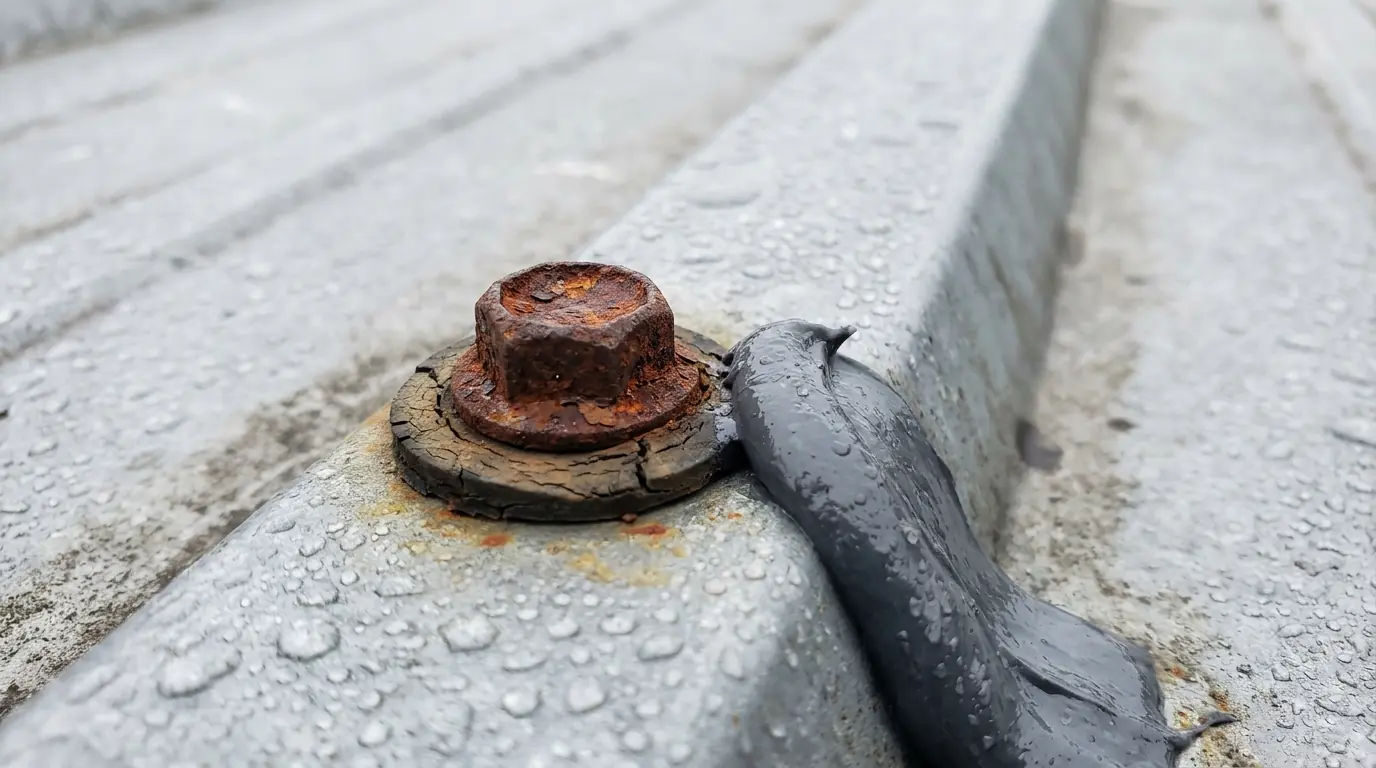
On through-fastened panels, the usual culprits are fasteners. Each screw has a rubber or EPDM washer that ages in sun and cracks. The screw itself backs out slightly as the panel expands and contracts day after day. A few thousand cycles later, the hole is bigger than the shank and rain finds it. On standing seam, leaks tend to show at seam ends, clip areas near penetrations, and ridge or eave closures, where a sealant has dried out or a closure was skipped.
Other leaks start at details: a rooftop unit curb flashed with caulk instead of metal, a pipe boot that has split, a skylight whose flange sealant has failed, a valley that collects leaves. These are fixable, often without replacing a single panel, if the steel underneath is sound. When it isn't, we say so, and we show you where the rust has gone through.
Condensation muddies the diagnosis on larger buildings. A cold deck over a warm, humid interior sweats on winter mornings and drips just like a leak. We separate the two by timing and by looking at the underside of the panels: drips after a dry cold night point to moisture control, while drips only during rain point to a breach. Treating condensation as a leak wastes money on sealant, and treating a leak as condensation lets the damage keep growing.
What to look for on a metal roof that's leaking or about to
Some of these you can spot from a ladder at the eave or a lift in the lot. Others only show up after a close walk of the roof.
Rust bleeding from screw lines
Orange or brown streaks below fasteners mean moisture has been working at that hole for a while.
Washers that look flat, cracked or missing
A washer no longer compressed against the panel is not sealing. Pressing a screwdriver tip against the washer tells you a lot: if it moves or crumbles, the fastener is done.
Daylight at panel ends
Gaps at ridge, eave or wall closures let wind-driven rain travel under the metal.
Open or sagging seams
On standing seam, a seam that has popped open or flattened needs re-seaming or a sealant fix.
Pitted or perforated panels
Tiny holes around rust patches mean the steel has thinned and may need a patch or panel replacement.
Staining around curbs and skylights
Water lines around a curb point to flashing or sealant failure at the roof's mechanical penetrations.
Mold or wet insulation below
Damp blanket insulation under the panels hides a slow leak and can cause condensation later. Wet insulation loses its value and often needs to be pulled and replaced after the leak is fixed.
What happens when you phone us about a leaking metal roof
Speed matters, but so does doing the first visit correctly. This is the order we work in, whether the call comes at noon on a Tuesday or at two in the morning during a thunderstorm.
Call and triage
You describe where water is coming in and what's at risk below. We tell you what to move, cover or shut off while we are on the way.
Roof access and water trace
We reach the roof safely, even in wet weather, and trace the water up the slope to the entry point. If lightning or high wind makes the roof unsafe, we wait, and we work from the interior in the meantime.
Temporary seal
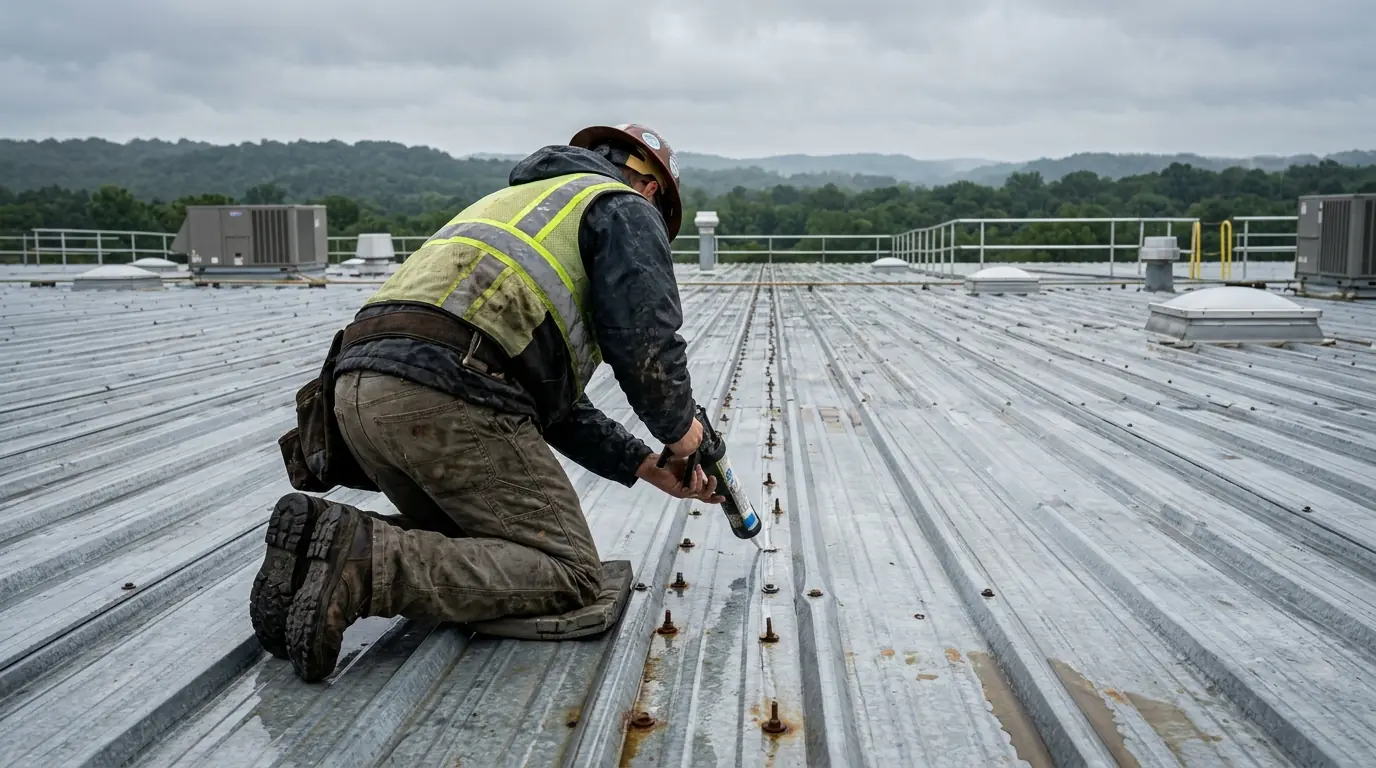
Butyl tape, sealant, a tarp or a patch stops the active leak. The goal is a dry building tonight, not a pretty fix.
Permanent repair
Once panels are dry, we replace failed fasteners, re-seam, patch or replace panels, and rebuild curb flashing with metal. We pick fasteners and sealants that suit the panel metal, so two dissimilar metals don't start a fresh corrosion problem.
Corrosion treatment
Surface rust is wire-brushed, treated and primed before sealing. Perforated areas get a patch or panel replacement.
Photos and next steps
You receive photos of each repair and a written note of anything that will need attention later.
Temporary seal or permanent repair: what each one gets you
A temporary seal is a stopgap, not a solution. This is how we explain the difference to building managers.
| Temporary seal | Permanent repair | |
|---|---|---|
| Goal | Stop active water tonight | Fix the cause so the leak stays gone |
| Typical materials | Butyl tape, sealant, tarp, patch panel | New fasteners and washers, new closures, new flashing, panel replacement |
| Weather needs | Can be done in rain with care | Needs dry panels so sealants and tapes bond |
| How long it holds | Days to weeks, depending on conditions | Years, if the underlying steel is sound |
| Cost | Lower, often one short visit | Higher, but removes repeat service calls |
| Who should choose it | Anyone with water coming in right now and a dry building as the priority | Owners ready to fix the cause once the weather clears and the panels are dry |
What metal roof repairs cost in Middle Tennessee
Prices depend on the leak count, roof height, access and panel condition. We quote after a site visit, and these are typical ranges only.
| Work | Typical range | What moves it |
|---|---|---|
| Fastener replacement and sealant, per repair visit | $385 to $1,460 per visit | Covers a defined area, such as a bay or a leak line. |
| Seam re-seaming or seam sealant on standing seam | $4.60 to $9.85 per linear ft | Depends on seam length and panel condition. |
| Curb or skylight flashing rebuild | $780 to $2,940 per curb | Metal flashing with sealed terminations. |
| Panel replacement, spot or section | $14.50 to $29.80 per sq ft | Higher for custom profiles and panels with long delivery times. |
What pushes a price up or down:
- Roof height, pitch and wet-weather safety needs
- Number of leaks and how widespread rust has become
- Availability of the same panel profile and trim, which is harder on older buildings
- Whether insulation below must be dried or replaced
- Access: lift rental, interior catwalks or ladder-only
Ranges reflect recent Middle Tennessee work and are not a quote; we price after a site visit. See the full Budget Guide.
Rust: when it is a surface problem and when it is structural
Not all rust is equal. Surface rust on a painted or Galvalume panel is common near cut edges and fasteners, and it can be cleaned, treated and sealed. Rust that has pitted the steel or opened holes means the panel has lost its protective layers and thickness. At that point, coatings won't restore the metal. A patch or a new section is the honest answer.
We tap, scrape and probe suspect areas rather than guess. If the rust is limited to a few fasteners and edges, we repair and often recommend a coating later. If it covers large sections, we discuss retrofit or replacement instead of paying for a series of patches. Metal that's rotting from the inside, often from trapped condensation, will keep getting worse until the moisture source is addressed.
Cut edges and scratched finishes are another early rust spot. Where a panel was trimmed on site, the exposed steel edge has no coating, and moisture wicks into it from the first rain. We dress those edges with touch-up paint or sealant during any repair visit, and we look at the roof's drainage as well. A gutter that overflows onto a panel edge, or a downspout that dumps on a lower roof, can rust through steel faster than ordinary weather ever would.
What to do while you wait for us to arrive
These steps protect people and property in the first hour. None of them requires roof access, and all of them make our first visit faster because we arrive knowing where the water is landing and what is at risk.
- Move inventory, files and electronics away from the drip line
- Place buckets or plastic sheeting under active leaks
- Turn off power to any lights or equipment under the leak if water is near wiring
- Photograph the damage and note the time rain started
- Do not climb onto a wet metal roof, since panels are slick
- Tell us the building height and whether a lift can reach the area
- Keep the roof access key or lockbox code handy
After a storm, check the ridge and eave closures first
Straight-line wind and hail across Rutherford, Wilson and Williamson counties often lift ridge caps and eave trim first. A loose closure lets wind-driven rain skip past the sealant and run under the panels. If your metal building took a hard blow, ask us to walk the perimeter and ridge before the next rain. It's a short visit and it often prevents a bigger interior mess. If the building sits in one of the wind corridors the March 2020 or December 2023 tornadoes crossed, look at the roof edges even when nothing seems to leak yet.
Need metal roof repair on a Nashville building?
Call (615) 716-3057 any hour. We look at the roof, show you what we found and price the work before anything starts.
Where we do metal roof repair around Nashville
The ZIP codes below cover most of the buildings we work on. Every one links to its local page, and the full locations list has 62 more.
- Nashville 37219
- Downtown Nashville 37219
- East Nashville 37206
- Antioch 37013
- Madison 37115
- Donelson 37214
- Hermitage 37076
- Bellevue 37221
- Green Hills 37215
- Franklin 37064
- Brentwood 37027
- Murfreesboro 37130
- Smyrna 37167
- La Vergne 37086
- Mount Juliet 37122
- Lebanon 37087
- Hendersonville 37075
- Gallatin 37066
- Spring Hill 37174
- Columbia 38401
- Goodlettsville 37072
Work that often goes with metal roof repair
Membranes, coatings and metal we work on every week include Versico, Duro-Last, Elevate and Gaco, plus older systems still in service.
Metal Roof Repair questions from Nashville owners
Why does my metal roof leak at the screws?
The rubber washer under each screw ages in sun, and thermal movement backs the screw out over time. That leaves a gap for water. We replace failed fasteners with larger or better-sealed ones and add sealant where the panel is worn. If the holes are stripped, we use oversized fasteners.
Can a metal roof leak be repaired without replacing panels?
Often, yes. Fasteners, sealants, closures and flashing account for most leaks. If the steel is sound, those repairs can last. If panels are perforated by rust, a patch or section replacement is needed. We show you the condition of the steel before recommending anything.
How fast can you respond to a metal roof leak in Nashville?
We answer 24/7 and can usually get to the roof as soon as conditions are safe. Wind and lightning can delay roof access, so we talk through safety first. The first visit focuses on stopping water, with permanent repairs scheduled once panels are dry.
Is rust on my metal roof an emergency?
Surface rust is not an emergency, but it is a warning to schedule treatment before it spreads. Pitting or holes are more urgent because water can enter. We inspect, treat surface rust and recommend patching or replacement for damaged sections.
Do you repair leaking curbs and skylights on metal buildings?
Yes. Curbs and skylights on metal roofs often leak because the flashing was done with caulk or has aged out. We rebuild with formed metal flashing, sealed terminations and compatible sealants, then test the area with water when conditions allow.