PVC roofing for Nashville restaurants and plants
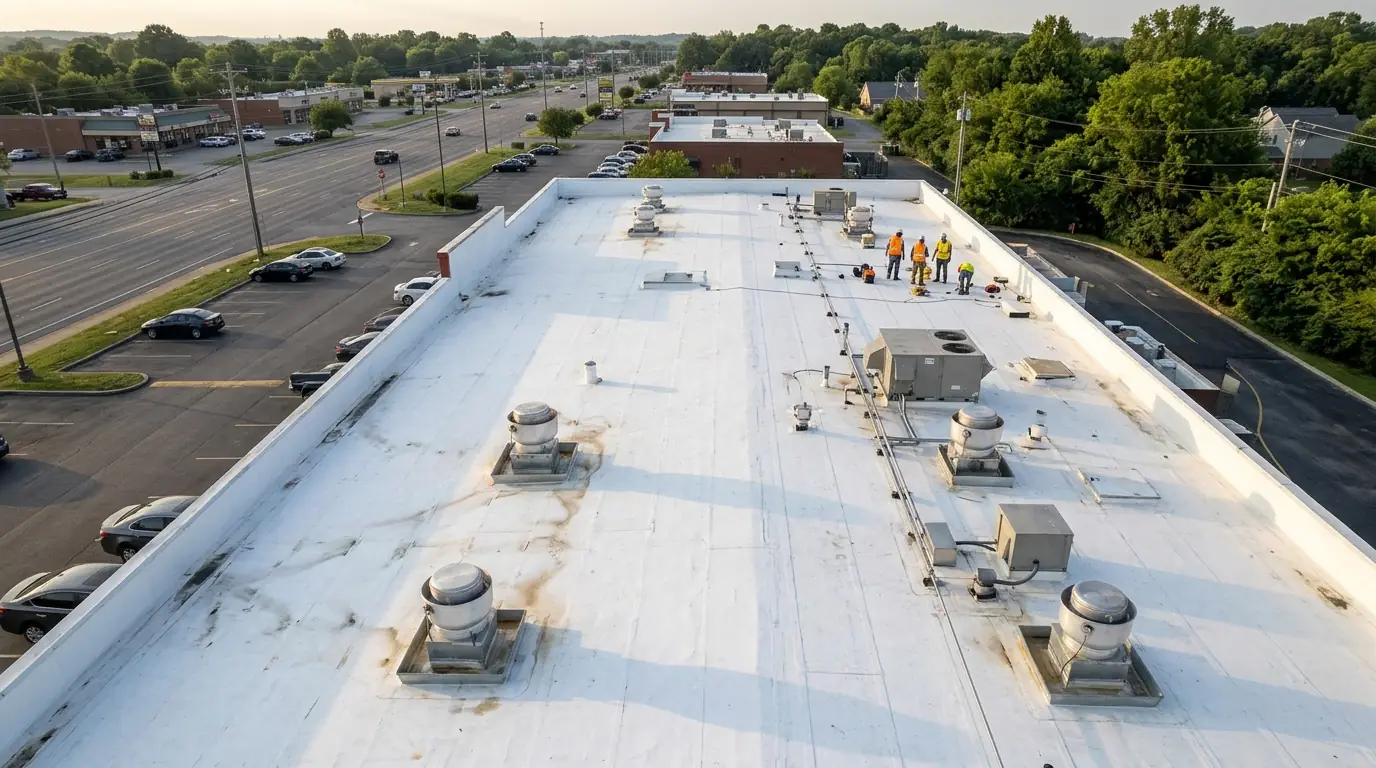
Grease from a kitchen exhaust fan or fumes from a process vent can chew through the wrong membrane in a few seasons. A welded PVC roof is built to shrug that off, and we install and repair it across Nashville.
- Welded PVC seams
- Grease-zone surveys
- Answered 24/7
Short answer
PVC is a single-ply membrane with hot-air welded seams that resists animal fats, oils and many chemicals better than TPO or EPDM. That makes it the usual pick for restaurants and food or lab buildings. Typical Nashville installed cost runs $8.10 to $13.60 per sq ft depending on deck, insulation and details. We quote after a site visit.
Why a restaurant roof cooks a standard membrane
Kitchen exhaust is hard on a roof. Hot, fatty vapor leaves the hood, climbs the duct and settles around the fan. On a busy Broadway restaurant or a strip-center kitchen on Nolensville Pike, that mist coats the membrane within a few feet of the fan day after day. Animal fat and cooking oil attack many single-ply sheets, softening the surface and breaking down the welded seams. The roof can look fine from the parking lot and leak like a sieve around the exhaust curb.
PVC was built for this exposure. The membrane resists animal fat, vegetable oil and many chemicals, and its seams are welded with hot air until sheet and lap fuse into one layer. That's why we put PVC around grease zones even when the rest of the building carries a different system. A hybrid layout can cut the cost of a full PVC roof while giving the dirtiest zone the right material.
Cleaning still matters. Even PVC needs a grease containment pan under the fan, and the pan has to be emptied or the oil spills over the edge. We look at how the kitchen's cleaning company handles the roof, because a spilled grease bucket dragged across the membrane does more harm than the exhaust ever did.
There's also a plain heat issue. Roofs over a working kitchen run warmer than the rest of the building, and a membrane that sits next to a fan blowing hot, damp air goes through a harsher daily cycle than one over the dining room. Welded PVC tolerates that cycling well, but only if the flashing at the fan curb is welded rather than taped. We build those curbs with prefabricated corners and a full-height weld so the hottest, greasiest spot on the roof is also the best-sealed one.
PVC or TPO: how the two white membranes behave over time
They look alike from the street. On the roof they behave differently, especially around fat, solvents and hot exhaust.
| PVC | TPO | |
|---|---|---|
| Grease and oil | Holds up well to animal fat and cooking oil near exhaust fans | Can soften and lose seam strength when fats pool on the surface |
| Chemical exposure | Handles many acids, alkalis and solvent vapors from process vents | Fine for rain and normal rooftop grime, weaker against sustained chemical vapor |
| Seam method | Hot-air welded, with chemical-resistant seam probing | Hot-air welded, similar method |
| Fire behavior | Chlorine content gives the sheet natural flame resistance | Relies on added flame retardants in the compound |
| Cost | Usually a bit higher per square foot | Usually a bit lower, with more bidders |
| Where we place it | Restaurants, food plants, labs, hospitals with exhaust | Offices, warehouses and retail with no heavy vapor |
How we install or repair a PVC roof around grease and fumes
Placement of the membrane is only part of it. Most failures near kitchens come from details, not from the field sheet, so the sequence below spends more time on curbs, boots and containment than on the open roof.
Exhaust map
We walk the roof and mark every fan, hood and vent, noting how far grease travels from each and which way the prevailing wind carries it across the membrane.
Core and moisture check
A core cut and a moisture scan show whether the insulation under the old roof is wet from slow grease-driven leaks.
Tear-off or recover decision
If the insulation is dry and the deck is sound, a recover may be allowed. If not, we strip down to the deck.
Substrate and cover board
We install a cover board that PVC adhesive will bond to, since grease-soaked insulation holds adhesive poorly.
Membrane and welded seams
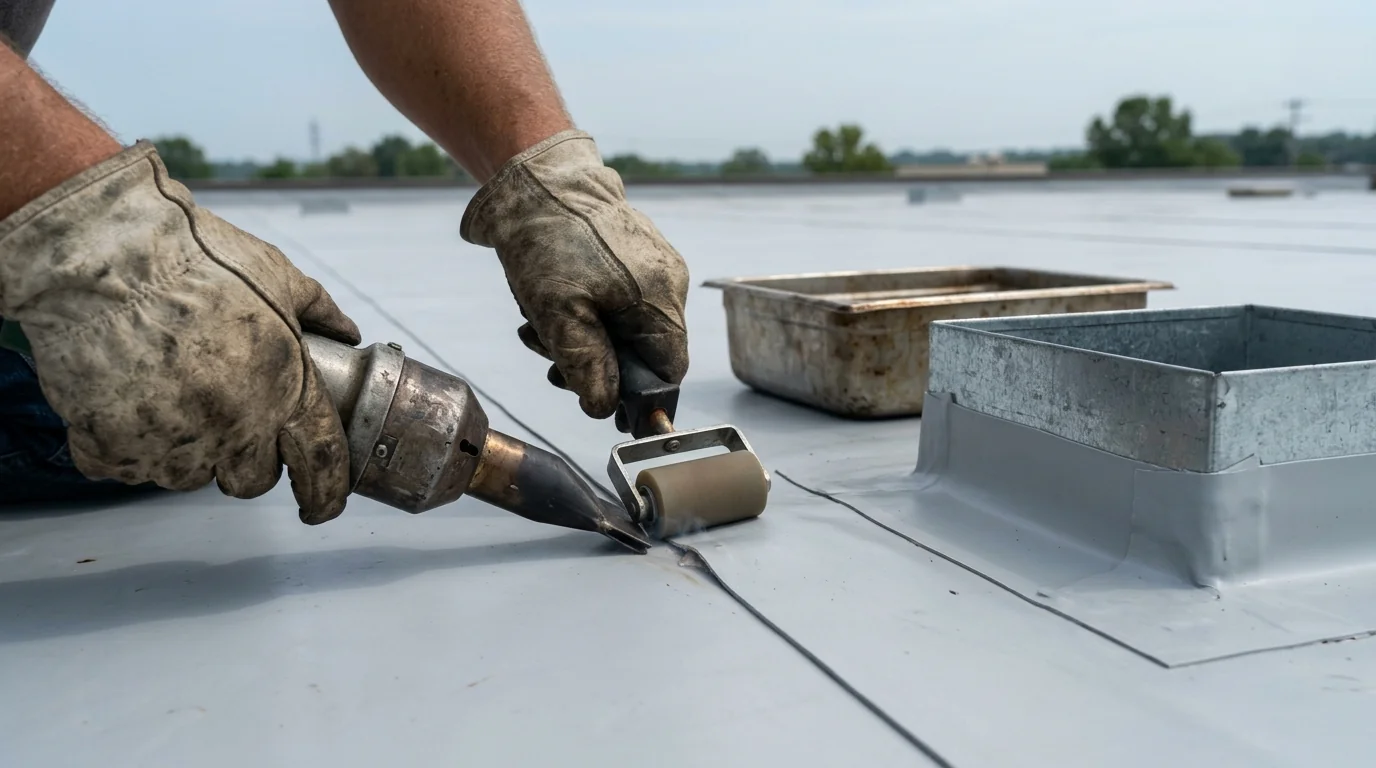
Sheets go down fully adhered or mechanically attached, and every seam is hot-air welded and probed.
Grease-zone details
We add extra-wide PVC walk pads around fans, welded curb flashing, and a containment pan or kit if one is missing.
What PVC roofing costs around Nashville
PVC costs more than TPO and less than most coated metal replacements. Ranges below assume a clean deck and average access.
| Work | Typical range | What moves it |
|---|---|---|
| Mechanically attached 50-mil to 60-mil PVC | $8.10 to $10.95 per sq ft | Works over steel deck with a clean insulation face. |
| Fully adhered 60-mil PVC over cover board | $9.65 to $13.60 per sq ft | Best for kitchen zones where flutter or lifting would be a problem. |
| PVC cap or overlay at an exhaust zone only | $14.25 to $22.80 per sq ft | Smaller footprint, so the unit price climbs. |
| Seam, boot or flashing repair on existing PVC | $420 to $1,380 per repair visit | Based on the number of details and the cleaning needed. |
What pushes a price up or down:
- How much grease is on the surface, because heavy buildup needs degreasing before any welding
- Whether insulation under the old roof is wet or contaminated by fat
- Number of exhaust curbs, grease pans and roof-mounted units
- Crane access on tight downtown or Gulch-adjacent sites
- Fire-rating and insulation requirements that apply to the building type
Ranges reflect recent Middle Tennessee work and are not a quote; we price after a site visit. See the full Budget Guide.
Warning signs on a roof that sees fat, oil or fumes
Grease damage hides under a dark film. Look for these before the first interior stain shows up, because by the time a ceiling tile drops, the insulation underneath has usually been wet for a while.
Dark, slick staining around fans
A film that stays wet-looking after a dry week is fat that the membrane is absorbing.
Blistered or bubbled surface
Small domes near exhaust curbs can mean the sheet is delaminating from the substrate.
Soft membrane in one zone
A spongy, sticky feel near a vent is a sign of plasticizer loss or chemical attack.
Seams lifting beside the exhaust
Seams failing in a cluster near a hood point to contamination, not a general age problem.
Ceiling stains in the kitchen or storage
Stains below the exhaust fan often show up months after the membrane began to fail.
Rust on curbs and fan housings
Corroded metal means the exhaust is aggressive enough to damage more than the sheet, and the same vapor is probably reaching the fastener plates and the edge metal too.
Food plants, labs and medical exhaust are a different problem
Restaurants are the common case, but not the only one. A food processing plant in Murfreesboro or Smyrna can vent steam, sugar and cleaning chemicals. A lab or medical building near Vanderbilt may vent solvents or disinfectants through rooftop stacks. Each of those exposures has its own chemistry, and we ask for the safety data sheets on what's being vented before we recommend a membrane.
Sometimes PVC is still the right answer. Sometimes the answer is a coated metal roof or a spray foam system with a chemical-resistant topcoat. We would rather tell you that after reading the data sheets than put a white membrane on a roof that a vent is going to eat. Where PVC is the right call, we weld it, probe it, and give you photos of the seams around the vent.
Hospitals and clinics bring one more wrinkle: roof access is tied to infection-control rules and sometimes to air intake locations. Before a single sheet is unrolled near an intake, we agree with the facility manager on work hours, odor control during adhesive application, and where staging and hot-work equipment can sit. A welded PVC roof can be installed with mechanical attachment around intakes to keep adhesive vapor away from the building's fresh-air supply. Those details belong in the schedule, not in a surprise phone call on installation day.
What a facility manager should confirm before a PVC bid
Bring these answers to the table and the bid gets sharper. Most of them take a ten-minute walk through the building with the kitchen manager or the maintenance supervisor, and they save us from pricing a membrane that the exhaust will outrun. If you can't answer one, we'll find the answer on the roof, but it adds time to the site visit.
- Which fans or vents on the roof carry grease, steam or chemical vapor
- Whether a containment pan or kit sits under each kitchen exhaust fan
- The name of the vendor who cleans the hood and ducts
- Safety data sheets for any chemicals vented from the building
- Past leak locations, especially near exhaust curbs
- Whether the landlord or tenant is responsible for the exhaust equipment
- Fire marshal or insurer requirements tied to the roof assembly
Put the grease pan on the maintenance calendar
The cheapest way to extend any roof near a kitchen is a grease pan that gets emptied on schedule. We have seen new roofs fail in two seasons because a pan overflowed every weekend after a busy Saturday on Broadway. If we install PVC for you, we leave a simple one-page note for the restaurant manager showing where the pans sit, how often to check them, and where not to roll a cart. Tenants change, managers change, and a note taped inside the roof hatch outlasts both. It also gives your landlord a clean way to hold a kitchen tenant to its share of the roof's care.
Need pvc roofing on a Nashville building?
Call (615) 716-3057 any hour. We look at the roof, show you what we found and price the work before anything starts.
Where we do pvc roofing around Nashville
The ZIP codes below cover most of the buildings we work on. Every one links to its local page, and the full locations list has 62 more.
- Nashville 37219
- Downtown Nashville 37219
- East Nashville 37206
- Antioch 37013
- Madison 37115
- Donelson 37214
- Hermitage 37076
- Bellevue 37221
- Green Hills 37215
- Franklin 37064
- Brentwood 37027
- Murfreesboro 37130
- Smyrna 37167
- La Vergne 37086
- Mount Juliet 37122
- Lebanon 37087
- Hendersonville 37075
- Gallatin 37066
- Spring Hill 37174
- Columbia 38401
- Goodlettsville 37072
Work that often goes with pvc roofing
Membranes, coatings and metal we work on every week include Versico, Duro-Last, Elevate and Gaco, plus older systems still in service.
PVC Roofing questions from Nashville owners
Is PVC roofing better than TPO for a Nashville restaurant?
Usually, yes, near kitchen exhaust. PVC resists animal fat and cooking oil far better than TPO, which can soften where grease pools. If the building has little or no exhaust on the roof, TPO is often the better value. We look at the fan layout before recommending either.
Can you put PVC over an existing grease-stained roof?
Only if the insulation under the old roof is dry and the deck is sound. Grease-soaked insulation holds adhesive poorly and can hide leaks. We cut cores, scan for moisture, and usually add a cover board before the new PVC goes down.
How are PVC seams made and checked?
We weld PVC seams with hot air, using an automatic welder on the long runs and hand tools on details. After the weld cools, we probe the seam edge to make sure it is fused. Any weak weld is re-welded before we leave the roof.
Does PVC roofing cost more than TPO in Middle Tennessee?
Usually it costs somewhat more per square foot, mostly because of the membrane itself and added detailing around vents. The difference is often small next to the cost of replacing a roof that grease has damaged. We price both options when the building allows either.
Who do I call when grease has started leaking through the roof?
Phone (615) 716-3057 at any hour. We answer 24/7. We find the leak path, make the area watertight with a temporary repair if needed, and then plan a proper PVC repair or replacement once we have read the cores and checked the insulation.