EPDM rubber roofing for Nashville commercial buildings
Your black rubber roof has seams peeling open, edges pulling off the parapet, or patches stacked on patches. We tell you plainly whether EPDM repair still pays or whether the roof has had its run.
- Seam and edge repairs
- Core cuts before pricing
- Answered 24/7
Short answer
EPDM is a black synthetic rubber membrane, usually 45-mil to 90-mil, joined with seam tape or splice adhesive. It is tough against hail but prone to seam failure and shrinkage at edges as it ages. Nashville repair visits typically run $365 to $1,190, and replacement $6.20 to $10.45 per sq ft. We quote after a site visit.
Why EPDM still shows up on so many older Nashville roofs
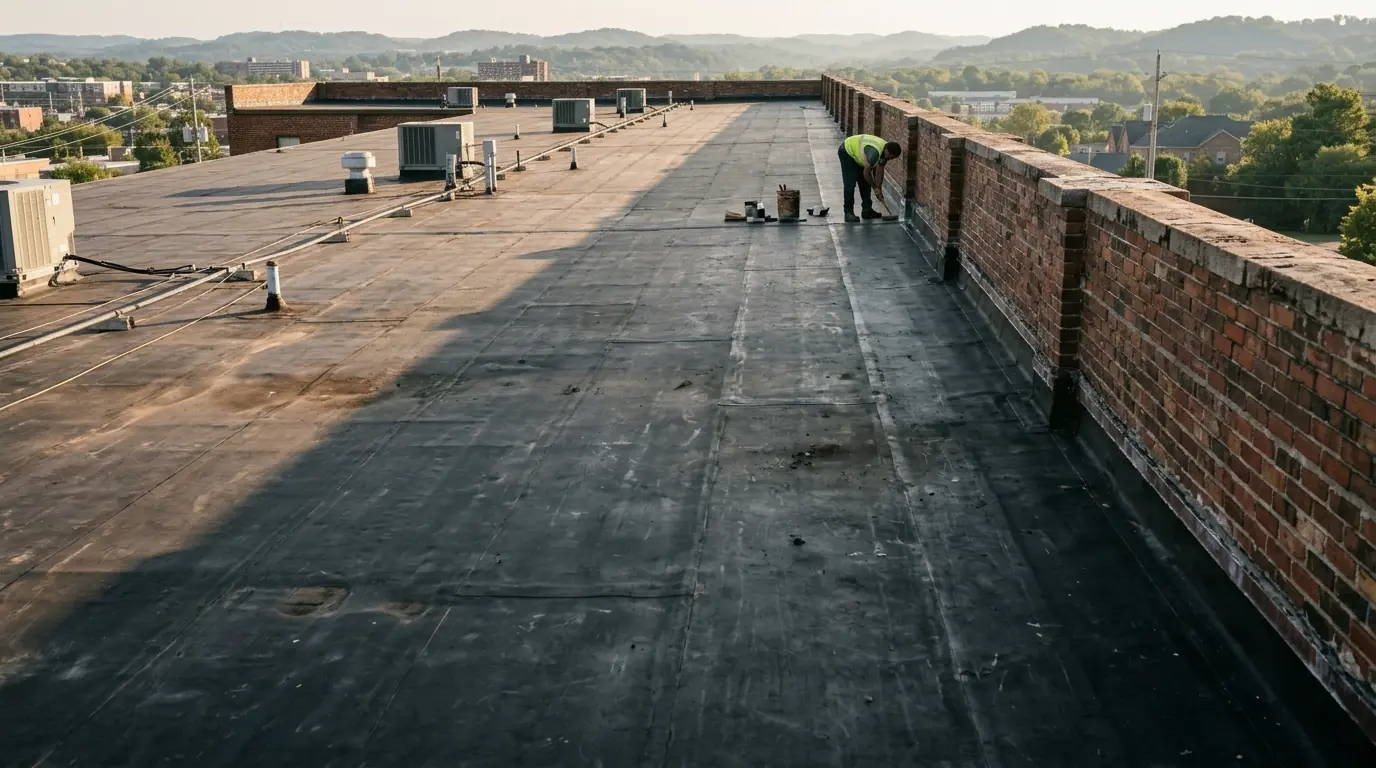
EPDM was the low-slope workhorse for generations of Middle Tennessee construction, and plenty of apartment blocks, schools, small offices and church additions still wear a black rubber roof. It earned that place honestly. The sheet comes in wide rolls, which means fewer seams. It stretches without cracking in a January freeze, and it takes a hailstone better than many stiffer membranes. A well-drained EPDM roof that gets a walk-through each spring can last a long time.
The weak points are the same on almost every building: the seams, the edges and the details. Old EPDM seams are joined by tape or splice adhesive, and both can let go as the rubber ages and moves. The sheet also shrinks slowly, pulling away from parapet walls and curbs and tugging flashings loose. Most leaks we find on EPDM aren't holes in the open field. They're gaps at a seam, a pipe boot or the base of a wall.
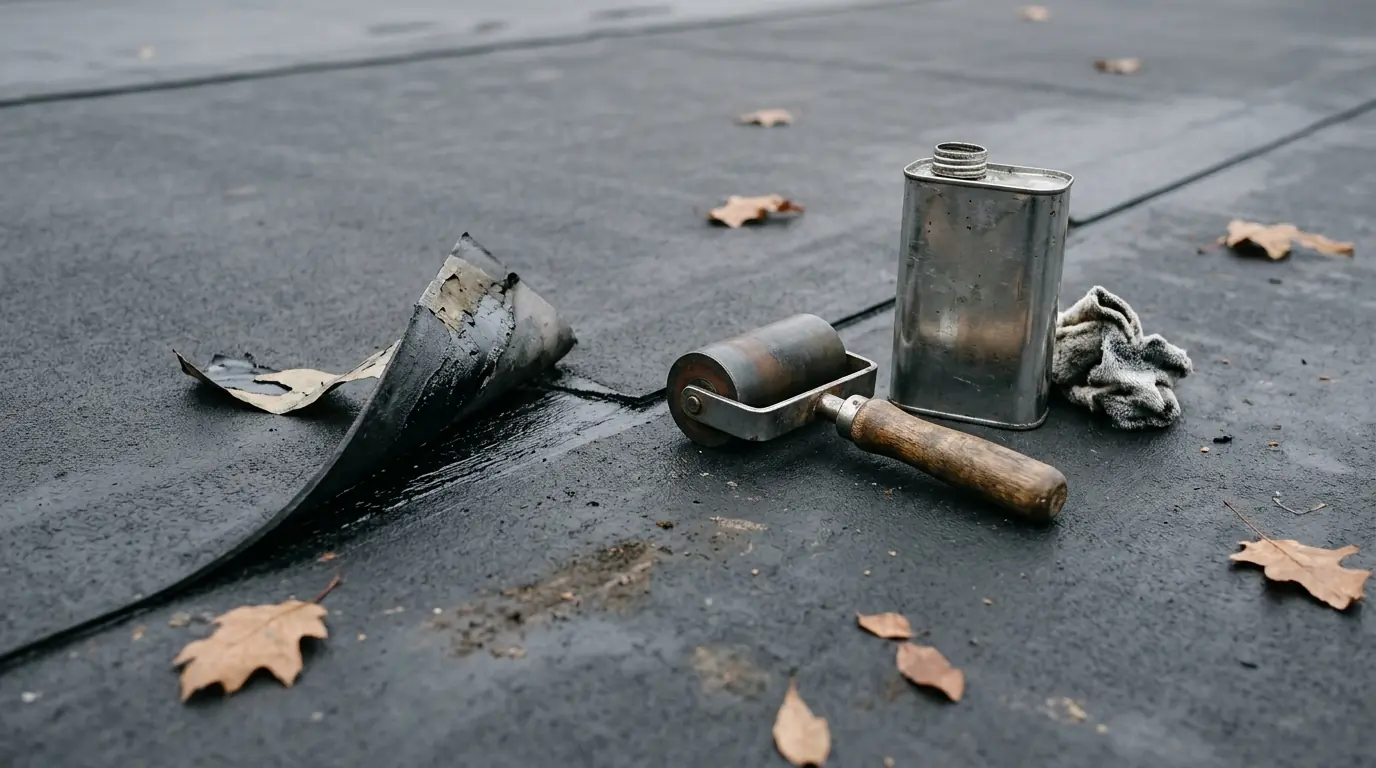
That is useful news, because those failures are repairable when the rubber itself is still pliable. The test is whether the membrane still takes new tape and adhesive. We clean a small area, apply a trial patch, and see whether it grips. If it does, targeted repairs buy real time. If it doesn't, we'll say the roof has reached its limit and show you the evidence.
Thickness and attachment matter here too. EPDM is sold in 45-mil, 60-mil and 90-mil sheets, and older Nashville roofs are often 45-mil, which has less margin for repeated cleaning and patching. A 60-mil or 90-mil sheet takes more abuse from foot traffic around rooftop units. If you're planning replacement, we can explain what each thickness buys and whether a white EPDM makes sense to cut cooling costs on the top floor.
What failing seams and shrinking edges look like from the roof
EPDM doesn't announce its problems the way a blistered built-up roof does. These are the clues we look for when we walk it, and most of them can be spotted from the roof hatch with a flashlight and a screwdriver.
Seam tape edges lifting
A visible ridge or a dark gap along a lap means moisture and dirt are working under the tape.
Membrane pulled tight at parapets
A sheet stretched like a drum at a wall base is shrinking and will tear the flashing next.
Bridging at inside corners
Where the rubber no longer follows the corner into the wall, rain and wind can drive in underneath.
Cracks at the base of pipe boots
Pre-molded boots age faster than the sheet and show hairline splits around the collar.
Stacked patches
Several layers of old patch tape around one detail means the cause was never fixed.
Wrinkles running in one direction
Parallel folds can show the insulation below has shifted or settled. Wrinkles that trap water on the high side of a fold become small ponds that dirty and age the rubber faster.
Repair, restore or replace: how the three paths compare on EPDM
The right answer depends on what the cores show. Here is how we sort the options with building owners, property managers and church facility committees who have to defend the spending to a board.
| Targeted repair | Replace the roof | |
|---|---|---|
| Best when | Rubber is still flexible and the insulation is dry | Insulation is wet, seams are failing across the roof, or the sheet has hardened |
| What gets done | Re-tape or re-adhere seams, replace boots, re-secure edges, add walk pads | Tear off or recover, then install new EPDM, TPO or another membrane |
| Disruption | A day or two with little noise | Days to weeks, with tear-off debris and hoisting |
| Cost | A fraction of replacement, spread across years | Highest upfront, but resets the clock on the whole roof |
| Risk | Hidden wet insulation can keep failing under good patches | Few unknowns once the old layers are open |
How we repair a leaking EPDM roof
A patch is only worth installing after you know where the water is actually coming from. Water travels along the deck and under insulation, so the stain on a ceiling tile rarely sits under the hole in the roof.
Walk and map
We mark every seam, boot, curb and edge, and note dirt lines that show where water has been standing.
Moisture check
An infrared pass or meter readings help us see wet insulation near the suspected leak.
Clean the area
Old EPDM carries a talc-like film from weathering and rooftop dirt. We scrub with splice wash, rinse, and let the surface dry fully so new tape and adhesive can grip.
Repair the detail
Seams get new tape or lap sealant, boots are replaced, and edges are re-secured with termination bar and sealant.
Patch the field only when needed
Reinforced patches go over punctures or tears after the area has been cleaned and primed. We round the corners of every patch, because square corners are where the edges peel first.
Photo and plan
You get before and after photos and a written list of what's left, so you can budget for the next stage. If we think replacement is within a few years, we say so and give you a rough window to plan around.
EPDM repair and replacement pricing in Middle Tennessee
Prices shift with access, roof size, insulation condition and how many details there are. These ranges are typical, not a bid.
| Work | Typical range | What moves it |
|---|---|---|
| Seam and boot repair visit | $365 to $1,190 per visit | Covers several linear feet of seam, plus up to a few boots or small details. |
| Full seam re-tape on a mid-size roof | $1.35 to $2.90 per sq ft | Counts only the roof area worked, not total building area. |
| Fully adhered 60-mil EPDM replacement | $6.20 to $9.15 per sq ft | Includes new adhesive, flashing and edge metal where needed. |
| Replacement with tapered insulation to cure ponding | $8.40 to $10.45 per sq ft | Adds board and cricket work, so the price rises. |
What pushes a price up or down:
- Condition of the insulation under the rubber, because wet board must be replaced
- Whether the roof is ballasted, adhered or mechanically attached
- Number of drains, scuppers, curbs and parapet walls to re-flash
- Access for crane or hoist, especially on older buildings with narrow lots
- Edge metal and coping that need replacing to meet current standards
Ranges reflect recent Middle Tennessee work and are not a quote; we price after a site visit. See the full Budget Guide.
Ballasted EPDM and why stone adds weight and trouble
Some older Nashville flat roofs carry loose river stone over the rubber. The stone holds the sheet in place without adhesive, which is cheap to install, but it makes repair slower. Before we can patch a seam, we have to rake the ballast aside, clean the area, and replace the stone when we're done. Stone also hides leaks, hides ponding and traps leaf litter that clogs scuppers.
When a ballasted roof needs replacement, the decision is often to switch to a fully adhered system. Ballast adds weight the structure has to carry, and wind scour after spring storms can blow stone to the edges and expose the sheet. If the building framing is sound, a lighter adhered membrane reduces load and speeds future repairs. We check the structure and ask a structural engineer when the building looks marginal.
If you'd rather keep the ballast, we can still make it work. We vacuum or rake the stone back from the working area, lay the repair, then replace the stone to the original depth. On roofs by Percy Priest Lake or along the Cumberland, where wind pushes stone around during storms, we recommend a perimeter check after every major blow. Stone that has drifted away from the edges leaves the sheet exposed to uplift, and that is exactly where the first tear tends to start.
What helps us price your EPDM job accurately
You don't need all of it, but each answer cuts guesswork. If you manage several buildings, tell us which ones share the same roof system, since a pattern across them usually points to a common cause.
- The approximate age of the roof and any records of past repairs
- Whether the roof is ballasted, fully adhered or mechanically attached
- Where ceiling stains appeared and how soon after rain
- Whether the parapet walls are brick, block or metal framed
- Any gutters, scuppers or interior drains that back up during storms
- Access: roof hatch, exterior ladder or lift needed
- Whether a tenant will need advance notice for noise or smells from adhesives
Black rubber and a Nashville summer
A black membrane soaks up sun all day and holds heat well after dark in Middle Tennessee's humid summers. That heat load speeds aging of the adhesive and seam tape, and it makes July a poor month to do long adhesive repairs. We schedule EPDM seam work for early mornings when we can, and we suggest a white EPDM or a reflective coating over the top when the building has a high cooling bill and sound insulation. Coating only works on a clean, dry, well-adhered sheet, so it follows a moisture scan and a test patch. Wet insulation under a coated roof just hides the problem.
Need epdm rubber roofing on a Nashville building?
Call (615) 716-3057 any hour. We look at the roof, show you what we found and price the work before anything starts.
Where we do epdm rubber roofing around Nashville
The ZIP codes below cover most of the buildings we work on. Every one links to its local page, and the full locations list has 62 more.
- Nashville 37219
- Downtown Nashville 37219
- East Nashville 37206
- Antioch 37013
- Madison 37115
- Donelson 37214
- Hermitage 37076
- Bellevue 37221
- Green Hills 37215
- Franklin 37064
- Brentwood 37027
- Murfreesboro 37130
- Smyrna 37167
- La Vergne 37086
- Mount Juliet 37122
- Lebanon 37087
- Hendersonville 37075
- Gallatin 37066
- Spring Hill 37174
- Columbia 38401
- Goodlettsville 37072
Work that often goes with epdm rubber roofing
We install and repair systems from Carlisle SynTec, GAF, Johns Manville and Sika Sarnafil, and we patch whatever is already on your roof.
EPDM Rubber Roofing questions from Nashville owners
How long can an EPDM roof last in Nashville?
A well-drained, well-maintained EPDM roof can last a long time, but heat, ponding water and failed seam tape shorten it. The sheet itself often outlives its seams and flashings. We judge remaining life by checking the rubber's flexibility, the seams and the insulation, not by age alone.
Why do EPDM seams fail and can they be fixed?
Seam tape or splice adhesive weakens as the rubber moves and ages, and dirt works under the edge. If the sheet is still flexible, we clean it and re-tape or re-adhere the seams. If the sheet has hardened, a new bond often won't hold, and replacement is the honest answer.
What causes EPDM to shrink at the roof edges?
Over years of sun and temperature swings, the rubber slowly contracts, pulling away from parapets and curbs. That tugs flashings loose and opens gaps. We re-secure the edges with termination bar and sealant, and in severe cases we cut and re-flash the detail with new material.
Should I replace EPDM with TPO or keep EPDM?
Both work. EPDM handles hail and cold well and uses fewer seams, while TPO welds its seams and reflects heat. We price both on your building and recommend based on the deck, drainage and how the roof is used. We show both numbers so you can compare directly.
Can you repair my EPDM roof during a storm leak at night?
Yes. Phone (615) 716-3057 and we answer 24/7. In an active leak we find the entry point, make it watertight with a temporary patch if conditions allow, and then schedule the permanent seam or boot repair once the rubber is dry.