Tapered insulation and crickets in Nashville
Water sits in the same low spots on your roof for days after every rain, and no patch has fixed it. The cure is slope, built with tapered insulation, crickets and sumps that send water to the drains.
- Slope surveyed before design
- Cricket layouts drawn to scale
- Answered 24/7

Short answer
Tapered insulation is polyiso board cut with a built-in slope, usually one-eighth to one-half inch per foot, so water runs to drains instead of ponding. Crickets are small tapered saddles that divert water around curbs and walls. Sumps are tapered pockets at drains. Together they correct drainage on flat roofs during replacement or recover.
Why standing water shortens the life of a flat roof
Water that stays on a roof 48 hours after rain is considered ponding. It adds weight, since an inch of standing water is about five pounds per square foot. It lets algae and dirt build, speeds membrane aging at the waterline and finds every weak seam. On older roofs, the low area often deepens over time as the deck flexes under that load.
Many manufacturers limit or exclude coverage for ponding, so a roof with standing water may not be covered for leaks. Fixing the slope isn't only about appearances. It protects the warranty, reduces the load on the structure and gives you a roof that dries between storms. Most commercial buildings built before current practices simply weren't designed to drain well.
Freeze-thaw makes it worse in Middle Tennessee. A pond that freezes on a January night expands against seams and flashing, then thaws and flows into whatever opened. Summer heat bakes algae into the membrane surface and speeds the breakdown of the top layer. A roof that drains well in all four seasons simply lasts longer than one that holds water.
Signs your roof needs slope, not another patch
Ponding has patterns. When we see these, we start thinking about taper before repair.
Water stays in the same place after every storm
A permanent low spot usually means the slope to the drain is too flat or the deck has sagged.
Dirt rings and algae at the waterline
Dark stains with a defined edge map where water has been standing, often showing pond depth and size.
Water backs up behind rooftop curbs
A curb across the slope acts as a dam. Water collects uphill of the unit and ages the flashing.
Drains sit above the surrounding roof
If the drain bowl is higher than the membrane around it, water can't reach it, which happens when roofs are recovered without resetting drains.
Repeat leaks at the same seam or flashing
A seam in a pond sees constant moisture and soon fails. Fixing only the seam doesn't fix the cause.
Deflection you can see when the roof is wet
A shallow dip that holds a depth of water across a bay tells us the structure has moved or was never level.
Debris and silt collecting in low areas
Sediment and leaves settle where water stops moving. A band of silt across a bay is a good map of the pond.
How we design a slope fix from survey to installation
Slope design is measurement first, drawing second and installation last.
Elevation survey
We shoot elevations across the roof with a laser level, mapping high points, low points and the distance to each drain. The survey takes a few hours on a typical strip center and a day on a large warehouse.
Ponding map
We combine the survey with photographs after rain to see where water actually sits and how deep it gets.
Drain and scupper review
We count working drains, check sizes and overflow, and note any drain above the surrounding surface.
Taper layout
We draw the board layout with taper rates, ridge lines, valley lines, crickets and sumps, labeled so the crew can install from the plan.
Thickness check
We calculate the finished roof height against parapets, curbs and door thresholds, so flashing heights remain sufficient.
Install with the roof system
Tapered board goes under the new membrane during replacement or recover, fastened or adhered to the deck.
Test with water
After installation, we review drainage after the first rain or run a controlled water test, and adjust small details if water still lingers. Photos go in your file.
Ways to fix drainage and where each one works
Tapered insulation is not the only option. Here's how the common approaches compare.
| Tapered polyiso | Crickets and saddles only | Added drains or scuppers | Lightweight insulating fill | |
|---|---|---|---|---|
| Best for | Whole-roof drainage during replacement | Water stopped by curbs, walls and units | Low spots too far from existing drains | Concrete or lightweight deck areas needing slope |
| Corrects | Slope across the entire roof | Local dams at obstructions | Distance to drain, not the slope | Slope with a cast layer |
| Added height | Moderate to significant | Small, local | None on roof | Moderate |
| Limits | Flashing height and structure weight | Doesn't fix general flatness | Needs plumbing and structural review | Weight and drying time |
| Typical cost driver | Board volume and taper rate | Number and size of saddles | Roof penetrations and piping | Thickness and deck type |
Crickets behind curbs and sumps at drains
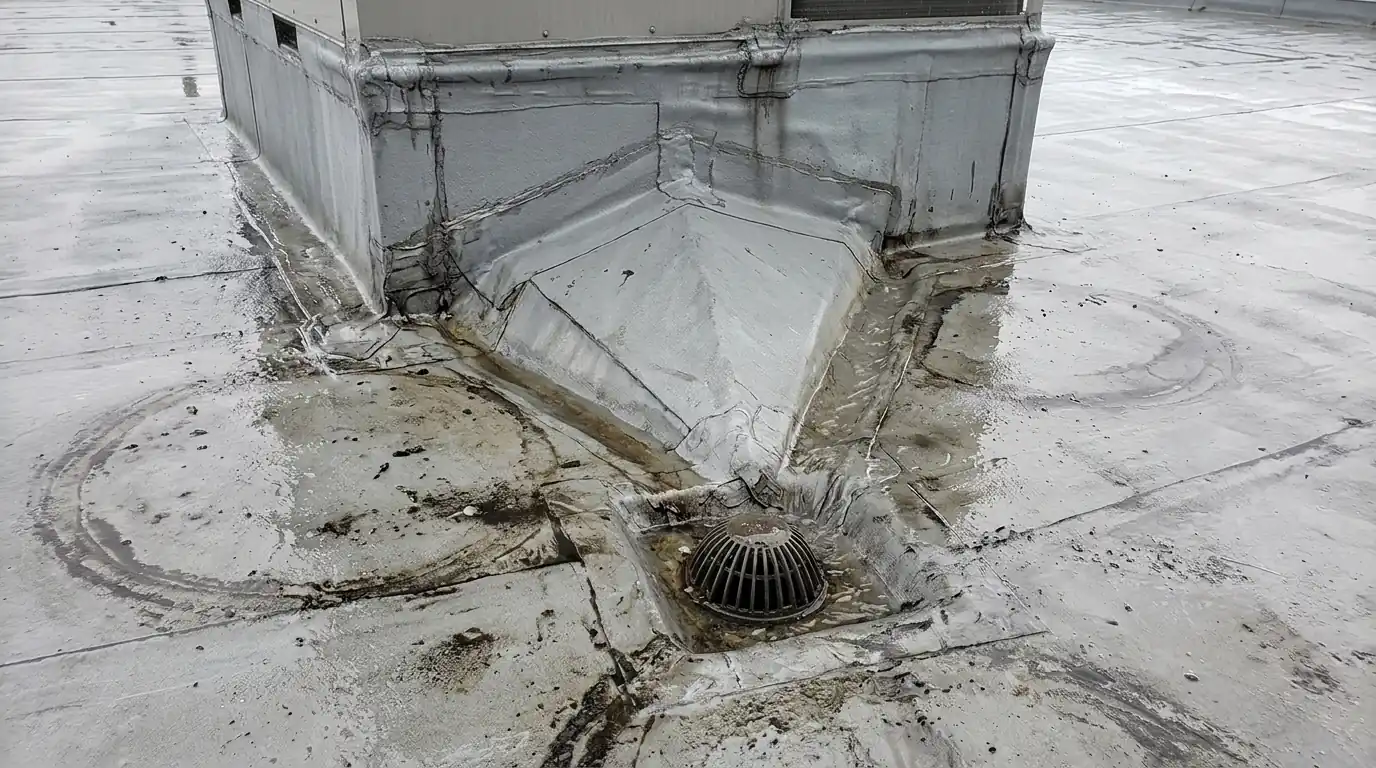
A rooftop unit curb across the slope blocks water like a small dam. Water collects on the uphill side, sits on the flashing and ages it first. A cricket is a tapered saddle built behind the curb that splits the water and sends it around both sides. Size matters: too small and the water still pools; too tall and it sheds the wrong way.
Drain sumps work in a similar way. Insulation around a drain is tapered down toward the bowl, forming a shallow dish so water finds the drain even if the broader field is flat. Many older roofs have drains at the same elevation as the roof around them, which is why water sits within a few feet of the opening.
We lay out crickets and sumps on a drawing to scale, tag each with its dimensions and show you the plan before installation. For a church with a long ridge-shaped roof, a strip center with a row of units or a warehouse with scattered scuppers, the pattern differs. We design for the building, not from a catalog.
Material choice matters too. Polyiso is the usual taper board, but over a lightweight concrete or gypsum deck, designers sometimes pick other materials to manage weight. We match the board to the deck, the fasteners and the membrane, and we check the manufacturer's limits on maximum board thickness per layer.
What tapered insulation costs on a replacement or recover
Taper costs depend on how much slope the roof needs and how many obstructions interrupt it. We price from a survey, and these ranges give a starting point.
| Work | Typical range | What moves it |
|---|---|---|
| Elevation survey and ponding map | $420 to $1,350 per roof | Depends on area and whether drainage plans exist. |
| Tapered polyiso over a flat deck | $2.35 to $5.10 per sq ft | Higher for steeper taper rates and thicker boards. |
| Cricket behind a rooftop curb | $285 to $960 each | Depends on curb width, slope and surface finish. |
| Drain sump with tapered board | $195 to $540 each | Includes new drain ring or reset when needed. |
What pushes a price up or down:
- Roof area and the distance water must travel to each drain.
- Taper rate required, such as one-eighth or one-quarter inch per foot.
- Number and size of obstructions like curbs and equipment.
- Flashing height available at parapets and thresholds.
- Whether drains must be added or moved.
- Structural capacity for the added weight of tapered board.
Ranges reflect recent Middle Tennessee work and are not a quote; we price after a site visit. See the full Budget Guide.
Questions to ask before a taper plan is accepted
A good taper plan answers these before bid day.
- What taper rate is proposed, and how was it chosen?
- Is there a drawing showing ridges, valleys, crickets and sumps?
- How much does the roof rise at parapets and doors after installation?
- Will existing drains be reset to the new surface?
- Does the plan address overflow scuppers and their height?
- How does the warranty treat remaining ponding, if any?
- Who verifies that elevations match the plan after install?
A quarter inch per foot is the usual target, not a guarantee
Building practice calls for positive drainage, generally a quarter inch per foot for new low-slope roofs. Existing buildings often can't reach that without raising parapets, so we aim for the best slope the structure allows and show you where gaps remain. Some roofs get close to a quarter inch. Others get an eighth. We tell you honestly what the plan achieves, because a design that promises full drainage and delivers puddles costs you twice.
Need tapered insulation & crickets on a Nashville building?
Call (615) 716-3057 any hour. We look at the roof, show you what we found and price the work before anything starts.
Where we do tapered insulation & crickets around Nashville
The ZIP codes below cover most of the buildings we work on. Every one links to its local page, and the full locations list has 62 more.
- Nashville 37219
- Downtown Nashville 37219
- East Nashville 37206
- Antioch 37013
- Madison 37115
- Donelson 37214
- Hermitage 37076
- Bellevue 37221
- Green Hills 37215
- Franklin 37064
- Brentwood 37027
- Murfreesboro 37130
- Smyrna 37167
- La Vergne 37086
- Mount Juliet 37122
- Lebanon 37087
- Hendersonville 37075
- Gallatin 37066
- Spring Hill 37174
- Columbia 38401
- Goodlettsville 37072
Work that often goes with tapered insulation & crickets
Repairs and new roofs on Mule-Hide, GenFlex, Polyglass and Henry systems, matched to what the building already has where we can.
Tapered Insulation & Crickets questions from Nashville owners
What is tapered insulation on a Nashville commercial roof?
Tapered insulation is rigid polyiso board manufactured with a built-in slope, installed under the membrane to move water toward drains. It's typically cut in layouts that include ridges, valleys, crickets and sumps. It corrects flat or low areas without needing to alter the structure itself.
What is a cricket on a flat roof and why do I need one?
A cricket is a small sloped saddle placed behind a curb, wall or equipment so water splits and runs around the obstruction instead of ponding against it. Without one, the uphill side of a rooftop unit collects water that ages the flashing and often causes leaks. We draw each one to scale.
Can I add tapered insulation to my existing roof without tearing it off?
Sometimes, in a recover where the existing roof qualifies. Taper goes on top of a cover board or over the old surface, then a new membrane. Added height must still leave proper flashing heights. A moisture survey and drainage review decide whether it works on your roof.
How long should water stand on a commercial roof before it counts as ponding?
Water that remains 48 hours after rainfall under drying conditions is generally treated as ponding. Short-lived puddles that dry within a day are common, but repeated standing water in the same place indicates a drainage problem worth correcting. We measure depth and size during the survey.
Does tapered insulation affect my roof warranty?
It can help. Many manufacturers limit coverage for ponding, so correcting drainage keeps your roof within warranty terms. The taper design must still follow the manufacturer's installation requirements, and we review those before the plan is finalized. Ask for the taper plan in writing.