Commercial roofing in MetroCenter, Nashville (37228)
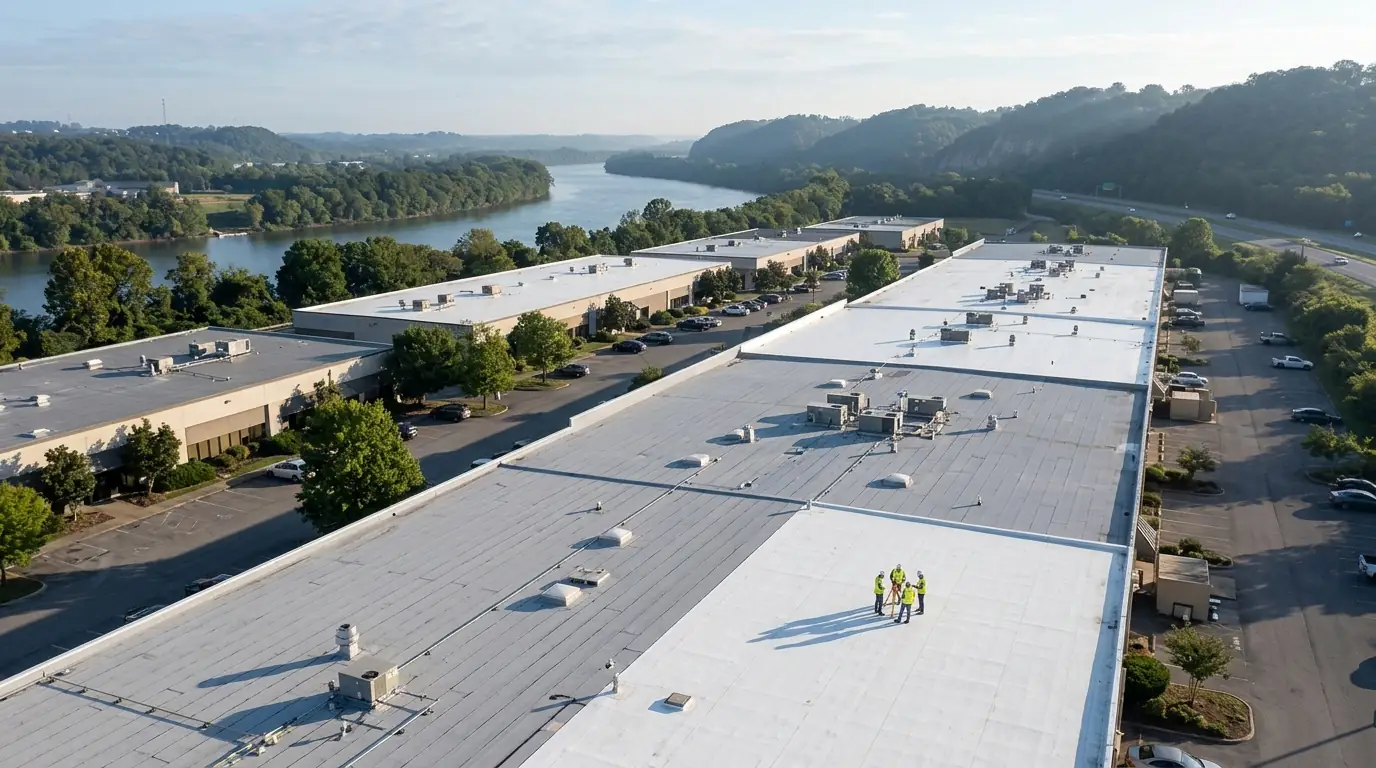
MetroCenter is a business park of office buildings and flex space beside the Cumberland River and I-65. Rows of similar roofs, built to the same specification, tend to wear out in the same season.
- Buildings
- Office parks, flex buildings, light commercial
- Corridor
- Rosa Parks Boulevard, I-65, Cumberland River
- Watch for
- Drainage, river-side wind, aging membranes
- Access
- Large lots, easy truck and crane access
Short answer
MetroCenter roofs are mostly low-slope membranes on office parks and flex buildings, installed in similar eras. Common problems are shared drainage failures, aging seams and rooftop equipment leaks. We survey the whole park, rank buildings by condition, and quote after a site visit. Call 24/7 for urgent leaks.
A business park where roofs age together
MetroCenter developed as a planned business district, with office buildings and flex space laid out in clusters. Buildings of the same type often share a roof design: low slope, interior drains, a single-ply or built-up membrane, and a metal-edge fascia. They went up in the same period, so they reach end of life in the same period.
That is a planning advantage if you own more than one. A single survey can rank every roof, show which ones can be coated and which need replacement, and let you schedule the work across budget cycles rather than reacting to the next storm.
Parking lots in MetroCenter are wide, which helps roof work but also lets wind gather speed across open pavement. Gusts that come off the lots meet building edges at full strength. Perimeter flashing, coping and fascia take the force first, so their condition tells us a lot about how the rest of the roof has fared.
Seasonal storms put the park's drainage to the test. When a downpour hits, a clogged scupper on a single building sends a sheet of water over the edge and onto the parking lot, and interior drains back up into the building. We clear and test drains on every visit and note which ones need an overflow added.
Close to the river means more exposure
MetroCenter sits beside the Cumberland River on relatively open ground. The May 2010 flood is a reminder of how close the river is, and while a flood does not reach a roof, it can leave tenants and owners focused on drainage and moisture control long after. Open ground near the river also catches wind that reaches edges and flashing with fewer obstacles.
Spring storms bring hail and straight-line wind through Middle Tennessee, and the flat expanses of a business park take that without much shelter. Edge metal is the first thing wind attacks, so we check cleats, fasteners and sealant at every perimeter during a survey.
Flex buildings in the park often include a warehouse bay with exposed roof deck from below. That helps us, because we can see daylight at fasteners, rust on the deck and water trails that would be hidden in an office. We use the interior view to confirm what the moisture survey on top suggests, and to decide where core cuts are most useful.
Inspection records are the quiet advantage of a park this size. A short written report for each building, with photos of each drain and seam, makes the next survey faster and lets you see how each roof changes. Over time, those records back up warranty claims and budget requests with real evidence.
Flex and office roof problems to watch for
Flex buildings mix office and warehouse uses, so a leak can affect both. These are the signs to act on.
Stains near interior drain lines
Marks near leader pipes inside show a clogged drain or a failed drain clamp above.
Open seams on aging membrane
Dirt lines and tiny channels along seams show heat-welded or adhered seams starting to release.
Loose or bowed coping
Coping that waves along the wall means fasteners have let go or the substrate behind it is wet.
Equipment curbs with rust
Rust at a rooftop unit curb often means moisture has been collecting there for a long time.
Warehouse bay drips
Drips in the flex bay near a roof fan or vent show a penetration is leaking, not the field membrane.
Bubbles beneath a smooth membrane
Raised areas that move under pressure show trapped air or moisture beneath the membrane.
Planning a multi-building roof program
If you own or manage several MetroCenter buildings, this order keeps the work organized.
- Survey every building with moisture mapping and core samples
- Rank each roof by wet insulation, seam condition and age
- Group repairs, coatings and replacements by season and budget
- Use the same membrane type across similar buildings where practical
- Set a drain and edge inspection schedule for every roof
- Keep a records file with photos, core logs and any warranty terms
- Photograph every drain, scupper and overflow on each roof during the survey
- Document any warranty terms still in effect on each building
Tenants should not lose a day to roof work
Most MetroCenter tenants cannot afford a day of lost work, so we plan around them. We stage material away from entrances, set the hoist in a spot that leaves parking open, and dry in each section by the end of the day. If a tenant needs quiet hours for calls, we shift noisy work earlier or later in the schedule.
Roofing work we do most in MetroCenter
Six services building owners here call about most. The full catalog has 45.
Roof trouble in MetroCenter?
Call (615) 716-3057 about a building in MetroCenter (37228). The line is answered 24/7, and the first question is always where the water is showing.
Roofing questions from MetroCenter
Why do MetroCenter office park roofs seem to fail around the same time?
They were built in a similar period with similar materials. Membranes and seams age at the same rate, so many reach end of life together.
Can you survey every roof in a MetroCenter business park at once?
Yes. We map moisture, cut cores, rank each building, and give you a prioritized plan so you can budget by year.
Does the Cumberland River location matter for MetroCenter roofs?
Open ground near the river increases wind exposure at edges, and drainage matters more after heavy rain. We check edge metal and drains on every roof.
How do you keep MetroCenter tenants working during a roof replacement?
We stage material away from entrances, keep parking open where possible, and dry in each section daily. Noisy work is scheduled around tenant needs.