Skylight and roof hatch service in Nashville
A skylight that drips or a roof hatch that no longer seals is a leak you can see, and a safety exposure you might not. We repair curbs, glazing, gaskets and screens.
- Curbs rebuilt to match roof
- Fall protection screens
- Answered 24/7
Short answer
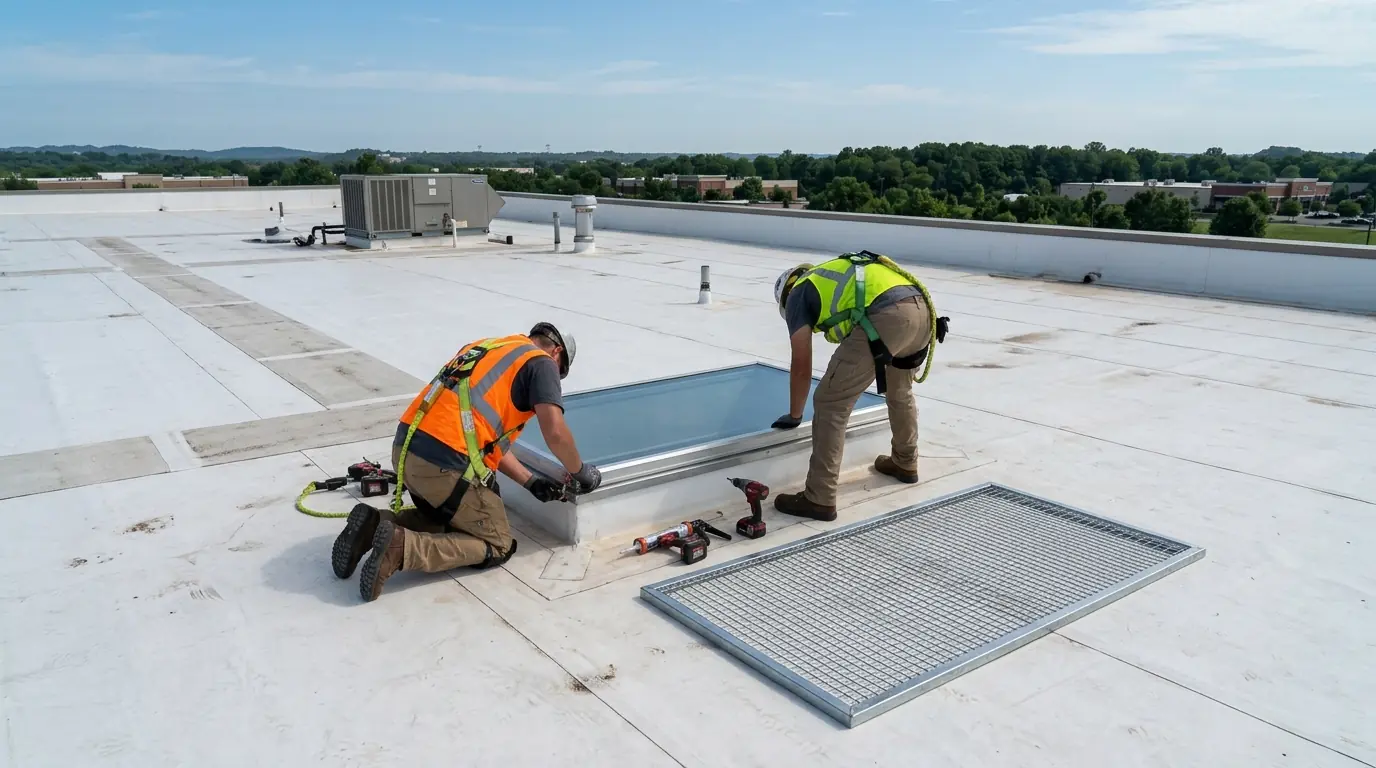
Skylights and roof hatches leak at the curb, the glazing seal or the gasket, and the fix depends on which. Curb reflashing runs $640.00 to $1,780.00 per unit. Full skylight replacement runs from about $2,150.00 to $7,400.00 depending on size and glazing. We quote after a site visit, because the curb condition decides everything.
Where skylights and hatches actually leak
A skylight is a hole in the roof with a window over it. The leak is almost never the glass. It is the curb that holds the unit, the flashing where the curb meets the membrane, or the gasket between the curb and the frame. Building owners often replace the skylight itself, then watch the same ceiling stain return. On a roof with a dozen units, the pattern across them often shows whether the cause is the roof or the glazing.
Roof hatches fail in different ways. The gasket around the lid hardens and stops sealing. The hinges rust, so the lid no longer closes tightly. Condensation forms on the underside of an uninsulated lid and runs down the ladder wall, which looks like a roof leak but is not. Each cause needs its own repair. Condensation drips look similar but tend to be spread evenly around the frame, while leaks concentrate at one corner.
Because skylights and hatches have openings that people use, there is also a safety layer. Open hatch lids are a fall hazard for anyone who steps through. Skylights without screens or domes without guard systems are fall hazards for service techs. We treat water and safety together, since the same crew will be on the roof anyway. A quick check of the hatch arm and the latch tells us whether an open lid is a hazard today.
Daylighting has changed since many of these units were installed. Older acrylic domes let in heat and glare, and tenants often cover the light well with cardboard or paint it over. Replacing a failed dome with insulated, low-emissivity glazing reduces summer solar gain and the condensation that comes with it. If the space no longer needs daylight, we can recommend permanent closure instead of a new unit, which removes the leak point for good.
Signs a skylight or hatch is failing
Interior and rooftop clues usually appear together. Check both.
Water stains on the light well walls
Rings and streaks inside the shaft point to a curb leak or condensation, and the pattern tells us which.
Fogged glazing between panes
Moisture inside a sealed unit means the perimeter seal has failed and the insulating value is gone.
Cracked or yellowed acrylic domes
Plastic domes craze in sun and heat. Once they crack, water gets in during rain and fasteners can pull loose.
Hatch lid that rattles or sits crooked
A lid that does not seat evenly leaves a gap at the gasket and lets rain and insects in. A lid that sits crooked after a storm may also have been bent by wind or by someone prying it.
Ladder rungs that rust through
Damp, corroded access points show that water has been entering the shaft for a long time.
No screen under a dome or no rail near a hatch
Missing fall protection is an exposure for anyone working on the roof, not just a code question.
Drips that start a day after the rain
Water moving slowly through wet insulation around the curb can appear in the shaft long after the storm ended, which misleads people into blaming condensation.
Repair the curb or replace the skylight
The glazing might be fine while the curb is the problem, or the reverse. This is how we decide.
| Reflash the curb only | Replace the skylight unit | |
|---|---|---|
| When it fits | Glazing is clear, frame is tight, leak is at the roof-to-curb joint | Glass is fogged or cracked, frame is corroded or out of square |
| Typical time on the roof | Half day | One to two days |
| Energy performance | Unchanged | Improved with newer low-emissivity glazing |
| Interior disruption | Minimal | Light well may need protection and cleanup |
| Cost | Lower | Higher, but replaces glazing and gaskets in one step |
| Safety | Screen can be added to the existing dome | New unit is ordered with a screen or rated glazing |
How we repair a leaking curb-mounted skylight
We start at the roof and work toward the glass, never the other way round.
Test before taking anything apart
We check whether the leak shows during rain only or also after wash-down, and whether staining matches condensation or a true leak.
Remove the glazing or dome
The frame is unfastened, the old gasket is cut away and the curb is exposed. We keep the old unit if it can be reused.
Inspect the curb and roof insulation
Wood curbs are checked for rot. Insulation around the curb is probed for moisture and replaced where wet. Dry insulation matters here, because a new curb flashing over a wet board only moves the leak sideways.
Rebuild the flashing
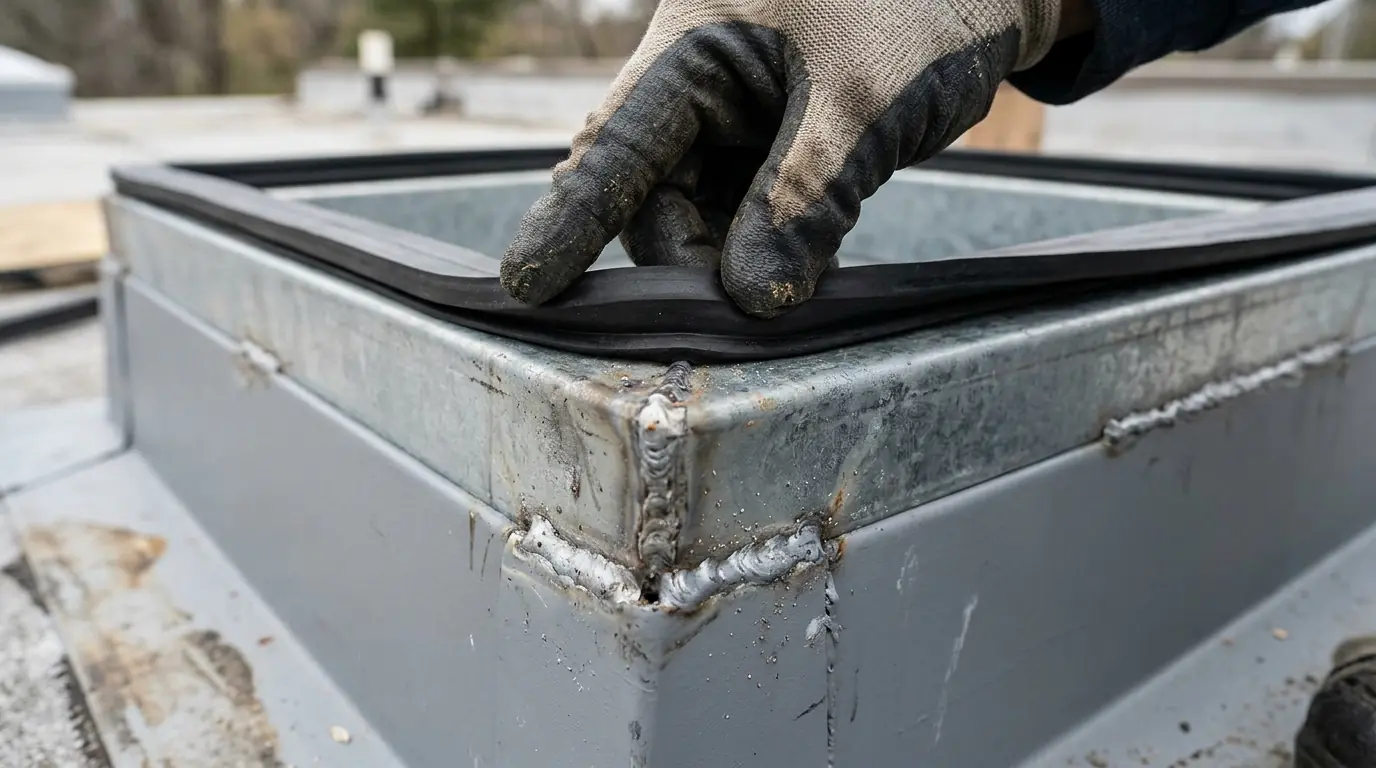
New base flashing wraps the curb with welded or adhered corners, tying into the field membrane and extending up under the frame.
Set new gaskets and the unit
A fresh compression gasket or bedding sealant seats the frame, then fasteners are tightened in sequence to avoid warping.
Add safety screens where required
A steel mesh screen or guard bar is mounted over domes, then the whole assembly is hose tested before we leave.
Photograph and log each unit
Every skylight or hatch gets a tag number, a photo of the finished curb and a note of the gasket and glazing type, so future work can be priced from the record.
Roof hatches, smoke vents and service access
Roof hatches give maintenance crews a way up without exterior ladders. Over time, the gasket compresses permanently and stops sealing. We replace gaskets, hinges and gas struts, and where the lid itself is corroded, we install a new insulated hatch on the existing curb. Insulated lids stop the condensation that drips down the shaft in humid Nashville summers. Hatches that serve as the only roof access deserve a lid that opens easily and stays up in wind.
Smoke vents, sometimes called heat and smoke vents, sit on curbs like a skylight but open automatically during a fire. They have fusible links and release mechanisms that need testing. We repair the curb flashing and gaskets, and we leave operation tests and fire-code inspections to the fire protection contractor who maintains the building.
Some buildings, especially older office and school roofs, have unused hatches or skylights that were abandoned when the building was renovated. Those can be capped and flashed permanently with insulated deck and membrane, which removes a leak point for good. We evaluate whether a unit still serves a purpose before repairing it. Capping a dead hatch also removes a way for birds, wasps and wind-blown debris to enter the stairwell.
Access ladders and rails inside the shaft also get overlooked. A rusted ladder beside a leaking hatch is a fall risk for the next person who climbs it. We note the condition of ladders, grab bars and landings in our report, and we replace corroded fasteners at the hatch. Anything that needs a specialty fabricator is flagged for your safety or facilities contractor so it is not left until someone gets hurt.
What skylight and hatch work costs
These figures reflect typical Middle Tennessee jobs. Unit size, access and the condition of the curb change them, and we quote after a site visit. Quotes for several units on one roof are usually lower per unit, since the crew mobilizes once.
| Work | Typical range | What moves it |
|---|---|---|
| Curb reflash for one skylight | $640.00 to $1,780.00 per unit | Includes new base flashing and curb cap |
| Skylight replacement, standard curb-mounted unit | $2,150.00 to $7,400.00 per unit | Glazing type and size drive the range |
| Roof hatch gasket and hardware refresh | $285.00 to $720.00 per hatch | Replacing the lid costs more |
| Fall protection screen over a skylight | $410.00 to $1,260.00 per unit | Custom size and galvanizing affect cost |
| Permanent closure of an unused skylight | $1,320.00 to $3,950.00 per opening | New deck, insulation and membrane over the opening |
What pushes a price up or down:
- Size of the skylight and number of glazing layers
- Curb material, such as wood, metal or masonry, and its condition
- Access to the roof, including lifts or interior shaft protection
- Whether the light well needs interior drywall or paint afterward
- Wet insulation around the curb that must be cut out
- Fire code requirements for smoke vents and venting areas
Ranges reflect recent Middle Tennessee work and are not a quote; we price after a site visit. See the full Budget Guide.
Safety checks we make at every hatch and skylight
Because people step on and around these openings, we add a short safety review to each repair.
- Hatch lid stays open on its arm and latches shut
- Hinges and struts show no rust-through
- Domes carry a screen or guard rated for impact
- Exposed ladder rungs and rails are sound and firmly anchored
- A fall-protection rail or cover is used near open hatches where practical
- Warning markings are not obstructed
- Condensation drain paths are clear
- Interior light well finishes are protected from drips and dust
- Release mechanisms on smoke vents are left untouched for the fire protection contractor
Condensation is not always a leak
In humid Nashville summers, a cold air handler and a hot, damp roof create heavy condensation on skylight frames and uninsulated hatch lids. Staff often report it as a roof leak. A moisture test on a dry afternoon tells us whether water is coming from outside or forming inside. Fixing the wrong problem wastes a repair, so we check the pattern before opening any curb. On a humid afternoon in July, a skylight frame can drip heavily with no rain in the forecast, and the repair for that is insulation, not flashing.
Need skylights & roof hatches on a Nashville building?
Call (615) 716-3057 any hour. We look at the roof, show you what we found and price the work before anything starts.
Where we do skylights & roof hatches around Nashville
The ZIP codes below cover most of the buildings we work on. Every one links to its local page, and the full locations list has 62 more.
- Nashville 37219
- Downtown Nashville 37219
- East Nashville 37206
- Antioch 37013
- Madison 37115
- Donelson 37214
- Hermitage 37076
- Bellevue 37221
- Green Hills 37215
- Franklin 37064
- Brentwood 37027
- Murfreesboro 37130
- Smyrna 37167
- La Vergne 37086
- Mount Juliet 37122
- Lebanon 37087
- Hendersonville 37075
- Gallatin 37066
- Spring Hill 37174
- Columbia 38401
- Goodlettsville 37072
Work that often goes with skylights & roof hatches
Membranes, coatings and metal we work on every week include Versico, Duro-Last, Elevate and Gaco, plus older systems still in service.
Skylights & Roof Hatches questions from Nashville owners
Why does my skylight leak only during heavy rain in Nashville?
Heavy rain exposes weak points in the curb flashing or the frame gasket that light rain does not reach. Wind-driven rain can also push water up under the glazing perimeter. We test with a hose from low to high to find the exact entry point.
Do commercial skylights need fall protection screens?
Workplace safety rules treat skylights as fall hazards for people working on roofs. A screen, guard rail or cover reduces that risk. We can install screens and guards over existing domes and glazed units as part of the repair, and we note any exposures we see.
Can a roof hatch be replaced without a new curb?
Often yes. If the existing curb is sound, dry and the right size, a new insulated hatch bolts onto it with new flashing at the base. If the curb is rotted or undersized, we rebuild it so the new hatch seals properly.
How long does skylight replacement take on a commercial roof?
A single skylight usually takes one day, sometimes two if the curb needs rebuilding. Several units on one roof can be staged so the building is open to weather for only a few hours each. Rain days are rescheduled and temporary covers are used whenever a unit is open.
Are smoke vent curbs part of your service?
We repair the roof-side curb, flashing and gaskets around smoke and heat vents. We do not test or service the release mechanisms. The building's fire protection contractor handles those, and we coordinate access so the roof work does not interfere with their inspection.