Commercial roof restoration in Nashville, TN
Your membrane is aging but the deck is still sound, and a full tear-off would eat the capital budget. We survey, repair, dry out and coat the roof you have, so it earns another warranty cycle.
- Core cuts before any coating
- Wet insulation cut out
- Answered 24/7
Short answer
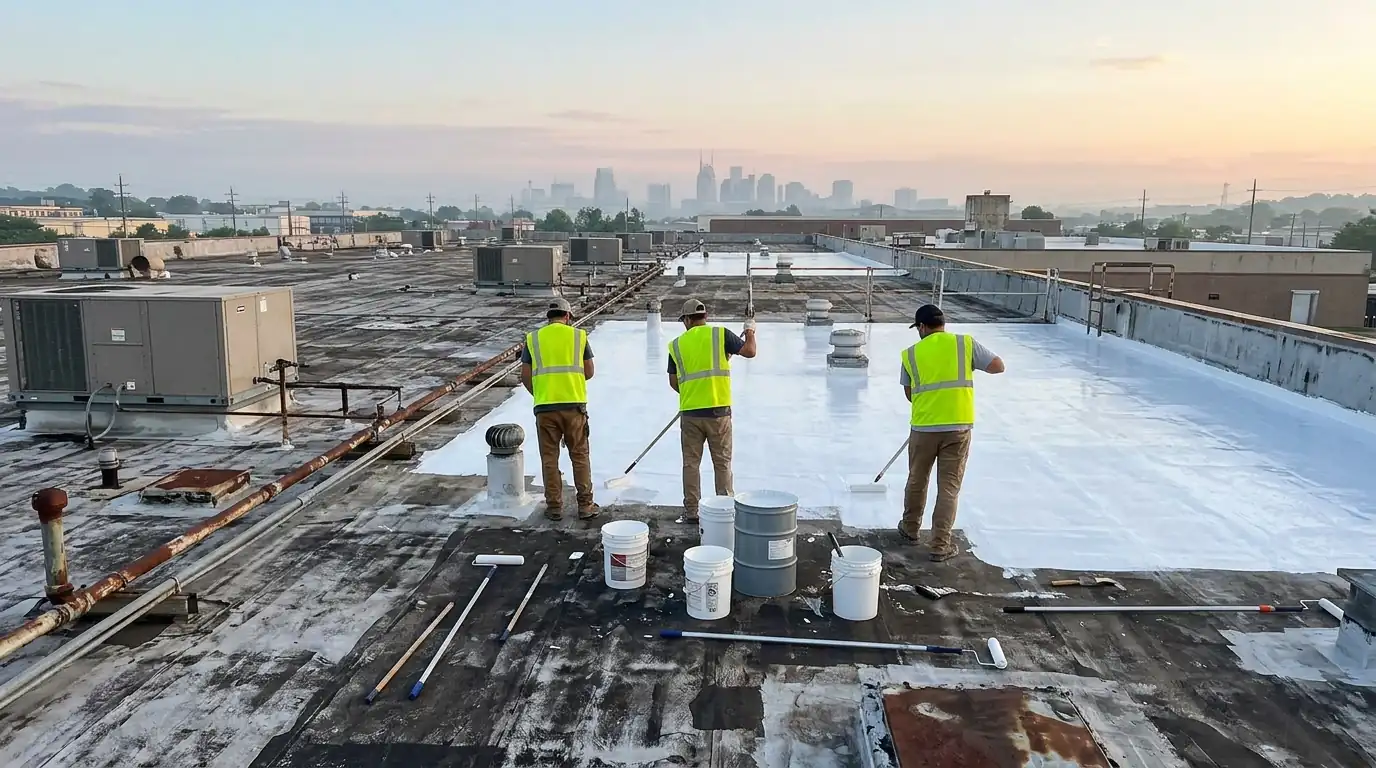
Commercial roof restoration means surveying the roof, repairing seams and flashings, cutting out wet insulation, and applying a fluid-applied coating over a sound membrane. It typically costs far less than a tear-off and can restart a manufacturer warranty when the system and installer qualify. It does not work when the insulation is widely saturated or the deck is failing.
What restoration actually is, and what it is not
Restoration keeps your existing membrane in service and renews it. We find what is failing, repair it, cut out insulation that has taken on water, clean the surface and apply a fluid-applied coating chosen for that substrate. The coating creates a monolithic, reflective skin over the old roof. It is a capital maintenance project, not a cosmetic one, and the coating is the last step instead of the first. Done in the right order, it lets a facility team treat the roof as a managed asset with a known end date, which is what a budget committee actually wants to see.
It is not a coat of paint on a leaking roof. A coating bridges hairline cracks and tired seams, but it cannot dry out saturated polyiso, flatten a sagging deck or stop water that enters behind a failed wall flashing. If someone offers to roll on coating without opening the roof first, ask how they plan to deal with the moisture already trapped underneath. A good restoration bid lists the repair quantities and the test results, not just the coating thickness.
Most restoration candidates around Nashville are single-ply and modified bitumen roofs that are ten to twenty years old, along with weathered metal panels and old built-up roofs. Picture a distribution building on Murfreesboro Pike, an office park off Lebanon Pike or a church fellowship hall with a low-slope section. The membrane has life left, the insulation is mostly dry, and the owner wants the next stretch of the roof planned out. Typical building types include tilt-wall warehouses, strip retail and apartment clubhouses.
Signs your roof is a restoration candidate
Restoration works best when the problems sit on the surface and at the details. These are the conditions that usually put a roof in range.
Chalky or crazed surface
Single-ply roofs lose their top layer to UV. If your hand comes away white and the reinforcing scrim shows in patches, restoration is still on the table. We confirm with an adhesion test before pricing.
Seams lifting in small patches
A few feet of open seam at a time can be cleaned, welded or reinforced. Seams open along entire runs point toward replacement.
Bare asphalt on modified bitumen
Granules wear off the south and west slopes first. If the felts underneath are intact, a primer and coating system bonds well. Bare felts that are cracked through are a different story.
Water standing two days after rain
Mild ponding does not rule out restoration, but it changes the coating we pick and the drainage fixes we price first.
Scattered leaks, not a flood
Three drips in a warehouse bay are a repair list. Water pouring from half the ceiling grid is a wet insulation problem. Core cuts tell the difference in an afternoon.
Rooftop units working harder in July
Dark, heat-soaked membranes push surface temperatures up through Nashville summers. A reflective coating lowers the heat load on the roof surface.
How we restore a roof, from survey to final walk
Every step happens before the coating goes on, because the coating is only as good as what is under it.
Walk the whole roof
We mark seams, penetrations, ponding, blisters, patches and drains on a roof plan, with photos tied to each mark.
Cut cores and test for moisture
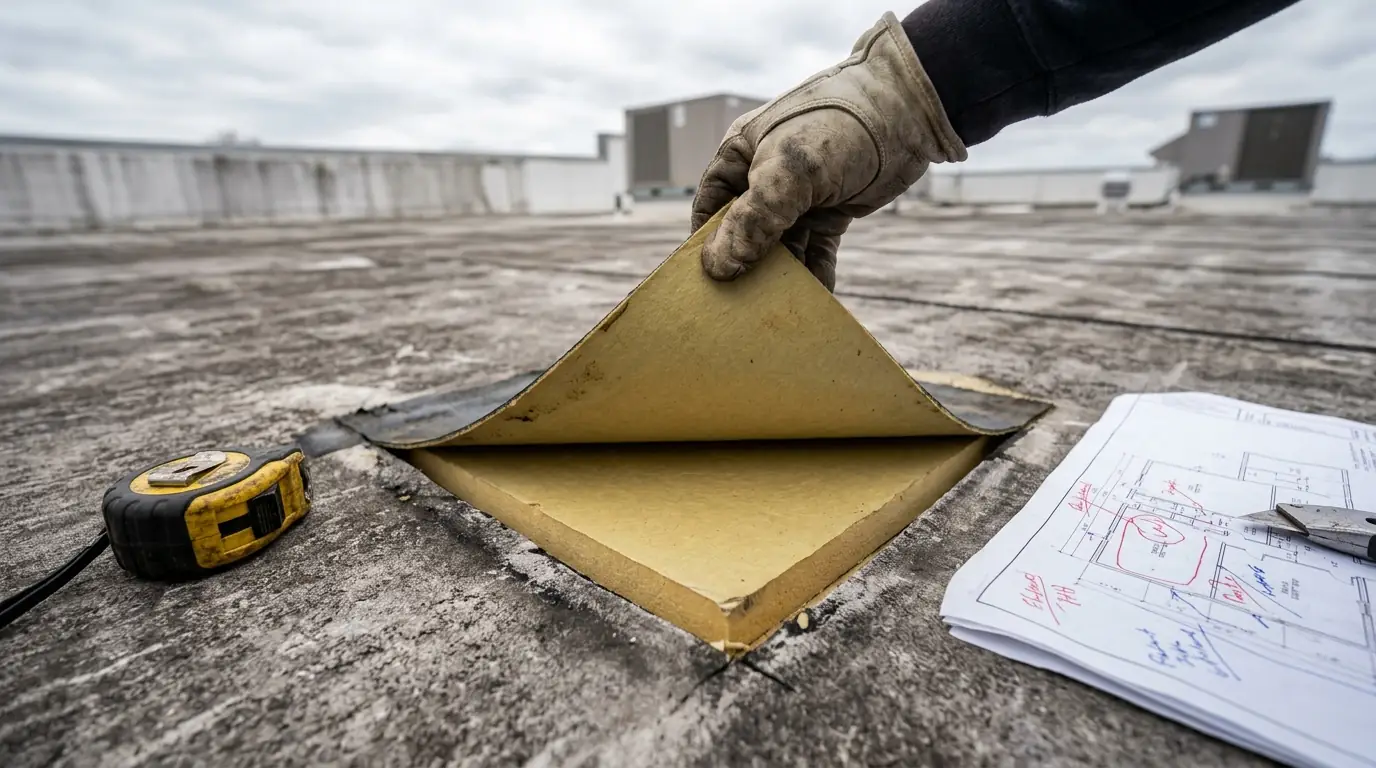
We pull test cuts at suspect areas and confirm with an infrared or capacitance scan when the roof is large. Wet areas get outlined in paint. Moisture mapping is the step most restoration bids skip.
Remove wet insulation
Saturated polyiso or perlite is cut out in squares, the deck is checked, and new insulation and cover board go in flush with the old. Patches are lapped and heat-welded or adhered to the surrounding membrane.
Repair seams and details
Open seams are cleaned and welded or taped, flashings are reinforced, pitch pans are rebuilt and failed sealant is cut out.
Clean, prime and test adhesion
We pressure wash, let the roof dry, then test a patch of coating for adhesion before committing the full surface. Low spots and old repairs are marked so they get extra attention.
Apply coating in measured coats
Base coat, fabric at the details, then topcoat, with wet mil gauges checked against the manufacturer's data sheet at each pass. Thickness is the whole point, so we do not stretch material.
Walk it with you and document
You get photos, material batch records and the warranty paperwork. Drains get a final flush so the roof is clean on turnover.
Restoration, recover or tear-off: how they differ
Property managers usually weigh three paths. This is how they compare on the points that tend to decide the budget meeting. Your choice depends mostly on how wet the insulation is.
| Restoration | Tear-off replacement | |
|---|---|---|
| Building disruption | Little noise, no debris drop, tenants stay in place | Demolition noise and debris; staging and protection needed |
| Insulation condition needed | Mostly dry; wet areas are cut out and replaced | Any condition; all of it gets removed or replaced |
| Deck condition needed | Sound, with only spot repairs | Damaged sections are replaced as found |
| Warranty outcome | A new coating warranty is possible when the system qualifies | A new full-system warranty is available from the manufacturer |
| Budget treatment | Often handled as maintenance or a smaller capital project | A full capital replacement line item |
What restoration costs in Nashville
These ranges cover typical work on a low-slope commercial roof of average size. We quote after a site visit, because every roof has its own condition and access.
| Work | Typical range | What moves it |
|---|---|---|
| Surface repairs and prep | $0.62 to $1.38 per sq ft | Seam welding, flashing reinforcement, sealant renewal and washing. |
| Acrylic coating system on a sound membrane | $1.87 to $3.14 per sq ft | Needs positive drainage; two coats with fabric at details. |
| Silicone coating system | $2.46 to $4.12 per sq ft | Tolerates ponding; higher material cost than acrylic. |
| Wet insulation removal and replacement | $4.58 to $8.26 per sq ft of affected area | Only the wet squares, plus cover board and new membrane patch. |
What pushes a price up or down:
- Total roof area and how many separate roof levels there are
- Percentage of the roof that cores show to be wet
- Membrane type and how well it takes primer in an adhesion test
- Number of penetrations, curbs and units that need detail work
- Access: crane or hoist, lift height and tenant working hours
Ranges reflect recent Middle Tennessee work and are not a quote; we price after a site visit. See the full Budget Guide.
When restoration is not possible
We tell owners straight when a roof is past coating. If core cuts show wet insulation across most of the field, a coating only hides the problem. The insulation stays heavy, the R-value stays poor and the deck keeps rusting from below. In those cases a recover is also out, and a tear-off is the honest answer. Saying that early saves everyone a coating invoice that would have bought nothing.
Deck condition is the second deal breaker. Steel decking with section loss, soft wood fiberboard or planks and cracked lightweight concrete need replacement first. A coating cannot hold a roof together that has lost its structure. We check fasteners and deck underside during the survey wherever we can reach it. If the deck is the problem, the conversation moves straight to replacement or a deck repair scope.
A third case is a roof that already carries two coverings, or a membrane that has shrunk until it pulls from the walls. Building codes generally limit roofs to two coverings before a full tear-off, and a shrunken membrane tears again under any new coating. We will say so, show you the cores and give you a replacement scope instead. A replacement scope can still reuse sound parts, such as a good cover board.
What to gather before we walk your roof
None of this is required to start, but each item shortens the survey and sharpens the numbers.
- Any roof plans, as-builts or earlier warranty documents
- A log of leak locations with dates, even if it is only a notebook page or phone photos
- The date and scope of past repairs or coating work
- A rooftop equipment list, including units that have been replaced
- Tenant hours and any areas that cannot take noise or odor
- Roof access method: ladder, interior hatch or exterior stair
- Location of air intakes, since coating odors must stay away from them
- The budget year you are working toward, if there is one
Pick the coating window, not just the coating
Middle Tennessee gives you two good windows for coatings: late April through June, and September into October. Between them, summer afternoon storms and heavy morning dew keep roofs wet, and winter nights fall below what most products allow. We also check spring hail first, because a roof bruised by a hailstorm needs repairs before it takes any coating. Plan the project for dry weather and call us early. A roof that fails its adhesion test in May is better found in May than in August.
Need commercial roof restoration on a Nashville building?
Call (615) 716-3057 any hour. We look at the roof, show you what we found and price the work before anything starts.
Where we do commercial roof restoration around Nashville
The ZIP codes below cover most of the buildings we work on. Every one links to its local page, and the full locations list has 62 more.
- Nashville 37219
- Downtown Nashville 37219
- East Nashville 37206
- Antioch 37013
- Madison 37115
- Donelson 37214
- Hermitage 37076
- Bellevue 37221
- Green Hills 37215
- Franklin 37064
- Brentwood 37027
- Murfreesboro 37130
- Smyrna 37167
- La Vergne 37086
- Mount Juliet 37122
- Lebanon 37087
- Hendersonville 37075
- Gallatin 37066
- Spring Hill 37174
- Columbia 38401
- Goodlettsville 37072
Work that often goes with commercial roof restoration
Repairs and new roofs on Mule-Hide, GenFlex, Polyglass and Henry systems, matched to what the building already has where we can.
Commercial Roof Restoration questions from Nashville owners
How long does commercial roof restoration take for a typical Nashville building?
A mid-sized roof of around 40,000 square feet usually takes one to three weeks once the survey is done, depending on weather and how much wet insulation comes out. Coating days are weather dependent, so we schedule around dry forecasts and give you a working window rather than a promise.
Does roof restoration come with a warranty?
Many coating manufacturers offer a warranty on restoration when the substrate, thickness and installer meet their conditions. We tell you up front which products qualify for your roof and what the warranty requires, including inspections and records you will need to keep.
Can a Nashville roof with leaks still be restored?
Often yes. Scattered leaks are usually seams, flashings and penetrations, which we repair before coating. If core cuts find wet insulation, we cut it out. Only when moisture is widespread or the deck is damaged do we recommend replacement instead.
What is the difference between restoration and a roof recover?
A recover adds a new membrane over the old roof, which needs dry insulation and a sound deck and adds weight. Restoration coats the existing membrane and adds no new roofing layer. Restoration is lighter and faster, while a recover can suit roofs too worn to take a coating.
Will restoration lower cooling costs for my Nashville building?
A reflective white coating lowers roof surface temperature in summer, which can reduce load on rooftop units and the space below. Savings depend on insulation, ventilation and equipment, so we do not promise a number. The roof life and warranty are the stronger reasons to restore.