Commercial roofing in Eagleville, TN (37060)
Eagleville is a small Rutherford County town where Highway 99 meets Highway 41A, surrounded by farmland. Its commercial roofs are schools, churches, farm buildings and a handful of shops, and most are metal.
- Buildings
- Schools, churches, farm buildings, small shops
- Corridor
- Highway 99, Highway 41A, Rutherford County farmland
- Watch for
- Loose screws, rusted laps, gutter overflow
- Access
- Gravel drives, open fields, long approaches
Short answer
Eagleville's commercial roofs are mainly screw-down metal on farm and storage buildings, shingle and metal on churches, and low-slope sections on schools and small shops. Leaks come from loose fasteners, worn flashings and gutters. We inspect, mark every finding, and quote after a site visit.
Farm country roofs on commercial terms
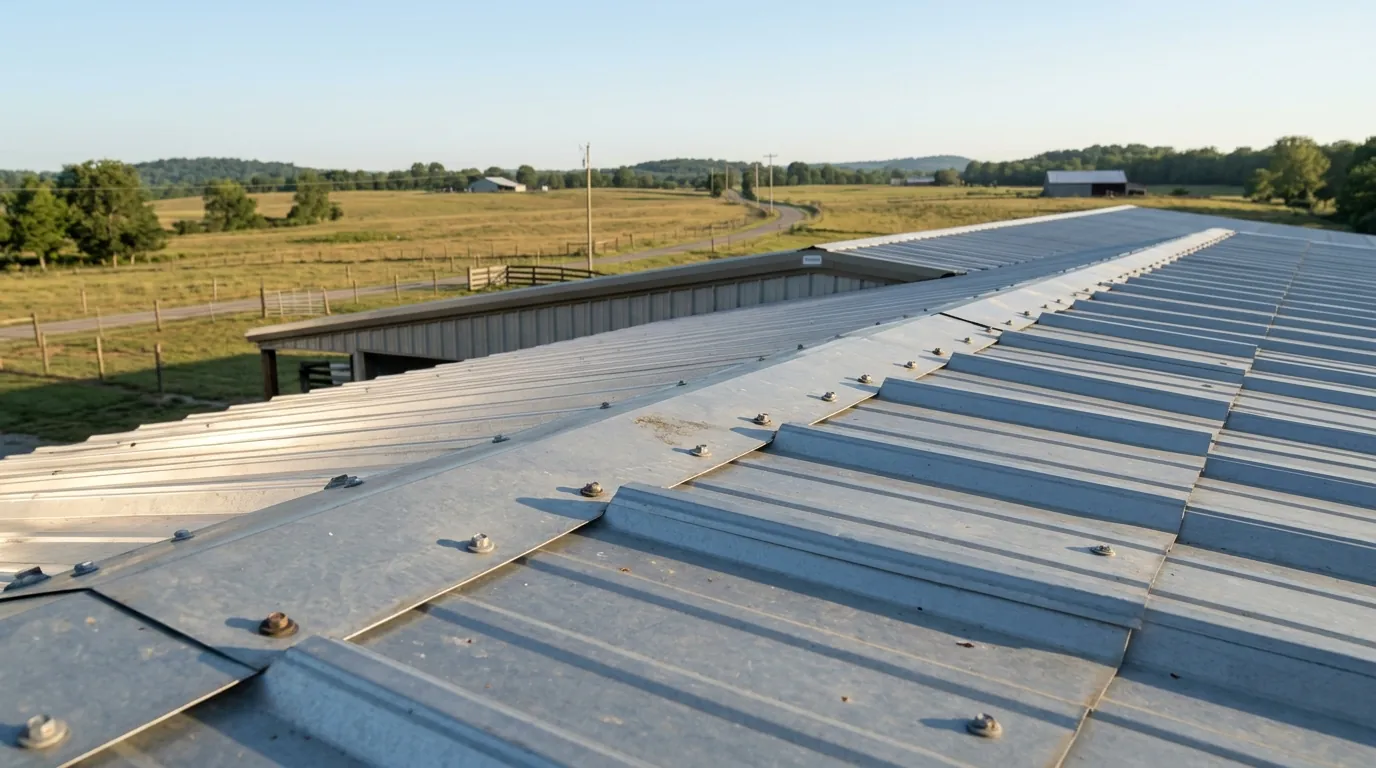
Eagleville sits out where Rutherford County turns rural, and the buildings show it. Equipment sheds, hay barns, feed storage, shop buildings and event barns all carry large, simple metal roofs that nobody climbs until something drips. Those roofs are commercial in use and agricultural in construction.
A screw-down metal panel is only as good as its fasteners. Heat and cold cycle the panels daily, the screws loosen, and rubber washers dry out. We re-set the fasteners with larger screws, replace worn washers, reseal laps and flashings, and photograph what we did so you have a record.
Open ground means wind hits hard. A barn with a long ridge and no windbreak takes lift on the leeward panels in every strong storm, and loose edge trim is the first thing to go.
Many rural buildings are built in stages, with a lean-to or an added bay joined to the original roof. Those joints are the most common leak points, because the slopes rarely match and the flashing is usually improvised. We rebuild the joint with proper trim and sealant rather than another bead of caulk that fails by next summer.
Animal and equipment areas also need dry roofs. Hay and grain spoil quickly when water finds them, so we put stored product ahead of other priorities when we plan a temporary fix, and we move the tarp first to the bay that holds the most at risk.
Eagleville's setting also means long stretches of exposed roof with no neighbor to notice damage. A panel can lift in a night storm and sit open for weeks, so a quick perimeter walk after every big wind event is cheap insurance, and we are glad to do it for you.
Signs of trouble on rural metal roofs
You can spot most of these from the ground with binoculars.
Light visible through the roof from inside
Pinholes or open laps are already letting water in.
Panels humming or rattling in wind
Fasteners have lost their grip on the purlins.
Rust bloom around screw heads
Water is sitting at the fastener and eating through the coating.
Sagging gutters
Heavy debris or loose hangers pull the gutter off the eave.
Dark patches on the underside of the roof
Condensation or leakage is staining the deck and insulation.
Schools, churches and shops near the crossroads
The school and church properties around the Highway 99 and Highway 41A junction have more varied roofs. A sanctuary may have a steep shingled or standing seam roof, while a gym, cafeteria or fellowship hall has a flat or low-slope membrane. Different roofs fail in different ways, so we assess each section separately.
School work is scheduled around the calendar. Summer breaks and long weekends are best, and we plan around bus routes and drop-off times. Churches prefer weekday mornings that avoid Wednesday evening and weekend activities.
Small shops and offices along the highways usually have a single low-slope roof with a few penetrations. A short visit and a couple of repairs often restore it.
The school grounds have flat roof sections over gym lobbies and cafeterias, and those can hold water after storms. We clear drains, check scuppers and measure how long water stays before recommending anything, because a puddle that drains in an hour is a different problem from one that lasts three days.
Churches here often have modest budgets and active volunteers. We are happy to walk a building committee through the roof, explain each finding and mark what can wait a year without risk, so the money goes where it matters first.
Small shops and offices near the crossroads typically have a single low-slope roof with a handful of penetrations. A short visit, a couple of repairs and a written note about what to watch usually restore them, and we say so instead of pushing a larger job.
Getting to the roof when the drive is long
Rural sites mean gravel lanes, locked gates and no one on site when we arrive. When you call, tell us where the roof access is, who has the gate code, and whether animals or equipment are near the building. If the leak is active and the weather is bad, say so, and we will bring tarps on the first trip so we can stop water immediately.
Before we visit an Eagleville building
A short list saves a trip.
- Roof type and approximate age
- Where water appears inside and how often
- Gate or lock details for the property
- Whether livestock or stored equipment sits below the leak
- Days and times when the building is occupied
- Any prior repairs, with dates if known
Roofing work we do most in Eagleville
Six services building owners here call about most. The full catalog has 45.
Roof trouble in Eagleville?
Call (615) 716-3057 about a building in Eagleville (37060). The line is answered 24/7, and the first question is always where the water is showing.
Roofing questions from Eagleville
Can you repair a metal barn or shop roof in Eagleville?
Yes. We reset fasteners, replace washers, reseal laps and flashings, and fix edge trim. We tell you if panels are too corroded to repair.
Do you work on church and school roofs near Eagleville?
Yes. We repair shingle, metal and flat sections and schedule around services, school hours and holidays.
Can you tarp an Eagleville roof the same day?
In most cases, yes. Call (615) 716-3057 any hour. We stop the active leak first and plan the permanent repair when weather allows.
Why do Eagleville metal roofs leak at the screws?
Daily heat and cold movement backs screws out, and the rubber washers dry and crack. Larger fasteners and new washers fix it.