Commercial roof repair for Nashville buildings
Your roof has a seam, a flashing or a puncture that is letting water in, and a quick patch from a hardware store did not hold. We repair the actual failure on the actual membrane, then show you what we found.
- Core cuts on every survey
- Answered 24/7
- Repairs matched to membrane
Short answer
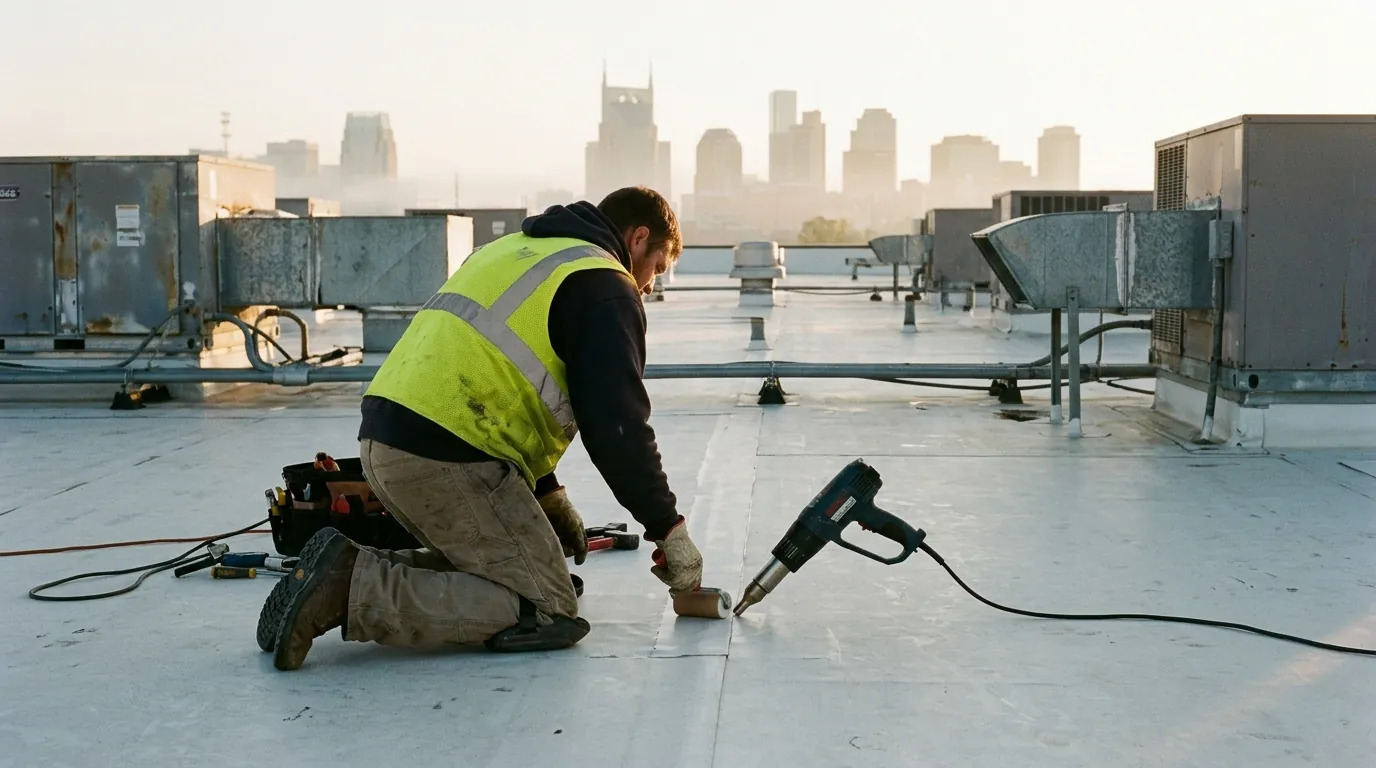
Commercial roof repair means finding the exact point where water enters, then fixing it with materials that bond to your specific membrane. Small repairs on TPO, EPDM or modified bitumen often run a few hundred to a few thousand dollars. Wet insulation or a failing field changes the answer, so we check before we patch.
What a repair crew actually does on a flat roof
A repair call is rarely about one material. A strip center in Antioch might have EPDM with tape seams, the office building next door a 60-mil TPO, and the church off Nolensville Pike a modified bitumen cap sheet with the granules wearing thin. We start by identifying exactly what is on the roof, because the wrong patch on the wrong membrane peels inside a season.
Most repairs fall into a short list: open seams, cracked or pulled flashing at walls and curbs, punctures from foot traffic and HVAC service, split pitch pans, and blisters in built-up membranes. Each one has a repair that holds and a cheaper-looking version that doesn't. We tell you which is which before any work starts, in plain numbers.
Repair is the right call more often than owners expect. A roof with dry insulation, a flexible field and a handful of failed details can run another decade after the right fixes. What it can't do is absorb ignored leaks. Water that sits in polyiso for a season turns a four-figure repair into a five-figure section replacement, which is why we'd rather see the roof early than late.
Signs your membrane needs repair before the next storm
Most failures announce themselves weeks before the first ceiling stain. Walk the roof, or send someone you trust, and look for these.
Lifted or fish-mouthed seams
Seam edges that curl up or gap show the weld or adhesive has let go. Water runs straight into the insulation below.
Cracked flashing at walls and curbs
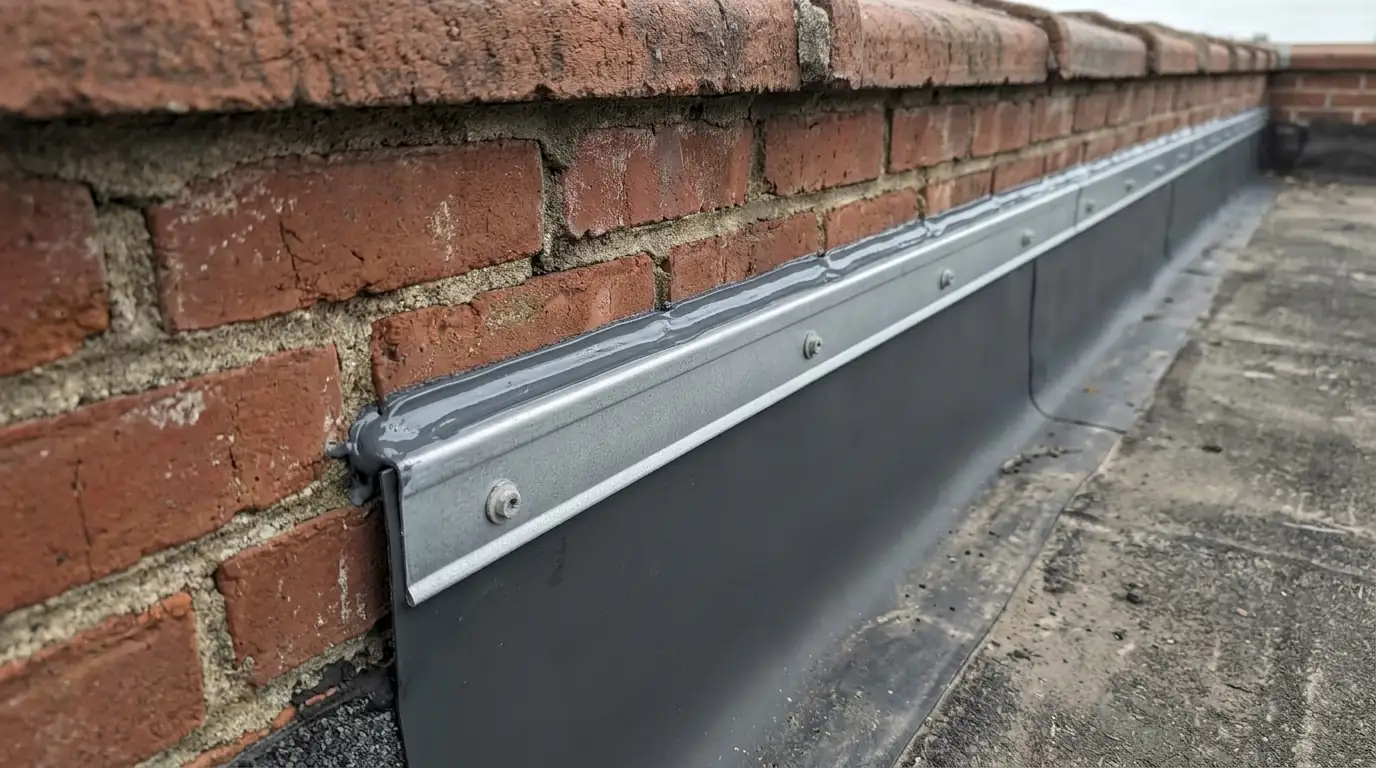
Base flashing shrinks and splits where it meets masonry or an equipment curb. It's the most common leak source we find.
Soft or spongy spots underfoot
A roof that gives under your boot usually has saturated insulation beneath. That moisture won't dry on its own.
Ponding that stays after 48 hours
Standing water ages membrane faster and adds weight. It also shows where the deck has deflected over time.
Exposed scrim or bare fabric
When the reinforcing fabric shows through the surface, the membrane has lost its protective layer and will leak soon.
Punctures near rooftop units
Service techs drop screws, tools and filters. Small holes near equipment are easy to miss and cheap to fix when found early.
Ceiling stains that move around
Water travels along the deck before it drips. A stain in one corner can come from a failure thirty feet away.
How a repair visit runs from first call to dry roof
We keep the sequence the same on every building so nothing gets skipped when the schedule gets tight.
Phone triage
Call (615) 716-3057 any hour. We ask what the roof is made of, where water shows inside, and whether tenants or inventory are at risk.
Roof walk and mapping
A technician walks the whole surface, not only the reported area, and marks every seam, flashing and penetration that looks suspect.
Moisture check
We probe suspect spots and cut a small core where needed to see whether the insulation under the repair area is wet.
Written repair scope
You get a plain list of what we'll fix, what we'd leave alone, and what we'd watch, with a price range tied to what we found.
Surface prep
We clean and, where the membrane requires it, scrub or prime the area. Most failed patches fail at this step, not at the material.
Repair and probe test
Seams are re-welded or taped, flashing is replaced or reinforced, and every edge is checked with a probe before we move on.
Photo report
Before and after photos go in your file, with notes on what to watch. Property managers use them for insurance and capital planning.
Patch, coating or section replacement: which one fits
A repair is not always a patch. Here is how we choose between the three approaches on a membrane with localized damage.
| Spot patch | Seam or flashing rebuild | Section replacement | |
|---|---|---|---|
| Best for | Single punctures, small tears | Open seams, split corners, failed base flashing | Wet insulation or damage across a bay |
| Typical downtime | Under an hour per spot | Half a day to a day | One to three days |
| Holds up when | Membrane around it is sound | Adjacent field is still flexible | Deck and insulation are rebuilt too |
| Fails when | Surface is dirty or the field is aged | Old membrane is too brittle to weld | Edges tie into a worn roof |
| What we check first | Surface cleanliness and age | Seam strength with a probe | Core cuts and moisture readings |
What commercial roof repairs cost in Middle Tennessee
Repair pricing swings with access, membrane type and whether the insulation below is dry. These ranges are typical starting points; we quote after a site visit.
| Work | Typical range | What moves it |
|---|---|---|
| Spot patch on TPO or EPDM | $285 to $760 per repair | Includes cleaning and a tested edge, per puncture or small tear. |
| Seam re-weld or re-tape | $4.35 to $8.90 per linear ft | Depends on seam age and whether the membrane still welds. |
| Base flashing rebuild | $18.40 to $36.75 per linear ft | Higher on tall masonry walls and curbs with many corners. |
| Section replacement with new insulation | $9.15 to $15.60 per sq ft | Used when a core cut shows wet insulation under the damage. |
What pushes a price up or down:
- Roof height and how we get materials up (stair tower, lift or crane).
- Whether tenants are on site and the work has to avoid certain hours.
- Membrane age, since brittle material can't be welded reliably.
- Number of separate repair points and how far apart they are.
- Wet insulation, which turns a patch into a section replacement.
- Weather windows: adhesives and primers have temperature limits.
Ranges reflect recent Middle Tennessee work and are not a quote; we price after a site visit. See the full Budget Guide.
What to have ready when you phone about a leak
You don't need to be a roofer to give us useful information. A few details speed up triage and help us bring the right materials.
- The building address and which part of the building is leaking.
- Whether the roof is white, black, gray, metal or gravel-surfaced.
- Any roof plans, warranty papers or past repair invoices you can find.
- Where rooftop units, vents and skylights sit relative to the stain.
- When the leak began and whether rain or snowmelt triggers it.
- Who has roof access and whether a key, ladder or hatch code is needed.
- Whether an insurance claim is open, so we document the right things.
Repairing around tenants, inventory and daily operations
A repair on a vacant building and a repair above a working restaurant kitchen are two different jobs. We ask who's underneath before we pick tools. Hot-air welders, solvent-based primers and torches each carry smells, noise or fire risk, and some products simply can't be used over certain spaces. If a clinic, daycare or food operation sits below, we plan the product and the hours around it.
On apartment communities, we coordinate ladder placement and stair-tower access with the property manager so residents aren't surprised by a technician on a balcony. For warehouses along Murfreesboro Pike or Lebanon Pike, we stage materials away from dock doors and forklift lanes, and we tarp or cover pallets inside if a ceiling drip can't wait until the repair is finished.
Our crew leaves the roof cleaner than we found it. Scrap membrane, adhesive cans, cut fasteners and wrapping come off with us, because debris left near a drain is the next leak call. You get a photo of each repaired spot and a short note on what to watch over the next two storms.
Why Nashville weather punishes patches
Middle Tennessee gives a roof every kind of stress in one year: summer heat and humidity that soften membranes, spring hail and straight-line wind that lift edges, and winter freeze-thaw that opens small cracks. A repair done on a cold, damp morning with the wrong primer can look perfect and release by July. We pick products by temperature and surface condition, wait for dry substrate, and tell you honestly when a repair has to be scheduled around the weather.
Need commercial roof repair on a Nashville building?
Call (615) 716-3057 any hour. We look at the roof, show you what we found and price the work before anything starts.
Where we do commercial roof repair around Nashville
The ZIP codes below cover most of the buildings we work on. Every one links to its local page, and the full locations list has 62 more.
- Nashville 37219
- Downtown Nashville 37219
- East Nashville 37206
- Antioch 37013
- Madison 37115
- Donelson 37214
- Hermitage 37076
- Bellevue 37221
- Green Hills 37215
- Franklin 37064
- Brentwood 37027
- Murfreesboro 37130
- Smyrna 37167
- La Vergne 37086
- Mount Juliet 37122
- Lebanon 37087
- Hendersonville 37075
- Gallatin 37066
- Spring Hill 37174
- Columbia 38401
- Goodlettsville 37072
Work that often goes with commercial roof repair
Membranes, coatings and metal we work on every week include Versico, Duro-Last, Elevate and Gaco, plus older systems still in service.
Commercial Roof Repair questions from Nashville owners
How long does a commercial roof repair in Nashville usually take?
A spot repair on a TPO or EPDM roof often takes under an hour per location, and a seam or flashing rebuild usually fits within a day. Section replacements run one to three days. Weather and access change that, so we give you a time window after walking the roof.
Can you repair a roof that is still under manufacturer warranty?
Yes, but the order matters. Many warranties list who may perform repairs and how, so we ask for the warranty paperwork first and document our work with photos. Where the manufacturer requires its own notification, you or your property manager should make that call before we begin.
Is it better to repair or replace my flat roof?
It depends on how much of the membrane is still sound and whether insulation is wet. If cores show dry insulation and the field is flexible, repairs are usually the better spend. If wet areas keep spreading, we'll say so and show you the numbers.
What causes repeat leaks after a roof repair?
The most common causes are dirty surfaces during the repair, patching over wet insulation, and fixing the stain location instead of the water entry point. Water can travel many feet along a deck. We trace the source before we touch the membrane.
Do you repair roofs on apartment complexes and churches too?
Yes. We repair flat and low-slope roofs, metal panels and commercial shingle on apartments, churches, offices, warehouses and retail. Occupied buildings get a plan for noise, ladder access and tenant notices so the repair doesn't disrupt daily use. Call (615) 716-3057 and tell us the building type.