Plaza deck and balcony waterproofing in Nashville
Water is coming through a plaza slab into a garage, a lobby or a unit below, and the pavers on top make every repair a demolition job. We find the failure first and rebuild only what has to come up.
- Flood tests before rebuild
- Hot-applied and PMMA systems
- Answered 24/7

Short answer
Plaza deck and balcony waterproofing is a membrane system under pavers, planters or topping slabs, over garages and occupied space. Hot-applied rubberized asphalt, PMMA and sheet systems are the common choices. In Nashville, rebuilds commonly run $24.60 to $58.90 per sq ft including paver removal and reset. We quote after a site visit and a flood test.
Why a plaza deck leak is harder than a roof leak
A roof membrane sits in the open, where you can see it. A plaza membrane sits under pavers, pedestals, planters, bar furniture and sometimes a foot of soil. When water shows up in a parking garage ceiling below, the leak could start anywhere on the slab above, and water travels along rebar, cracks and cold joints before it drips. Without a plan, a repair crew guesses, lifts a few pavers and patches the wrong spot. The garage keeps dripping and the owner keeps paying.
The Gulch, Midtown and SoBro have many mid-rise and high-rise buildings with this exact setup: a podium deck over structured parking, with a courtyard, pool terrace or retail plaza on top. These decks often hold amenities that residents or tenants use every day, so a failure costs more than the membrane. Lost amenity use, damaged garage finishes, corroding rebar and stained commercial ceilings all follow. The earlier the problem is traced, the smaller the rebuild.
Balconies on mid-rise condos and apartments fail for a different reason. Railing posts, door thresholds, slab edges and drains are small details that take most of the weather. A balcony that looks fine from the sidewalk can have a cracked coating, a failed drip edge and rusting steel at the edge of the slab. We treat balconies as detail work first and surface coating second, because a new coating over an open edge just seals the water inside.
Insurance and liability complicate plaza leaks. When water damages a tenant's goods or a resident's car in a garage, the owner, the association and the original builder may all point at one another. A dated record of the survey, the flood tests and the repairs gives the board a factual file instead of an argument. We photograph each step and mark it on the plaza plan, so whoever reviews the claim later sees what was found and what was done.
Signs a plaza deck or balcony membrane has failed
The deck rarely shows a problem on top. Evidence tends to appear below, on the underside, or at the edges.
White crystals or stalactites in the garage ceiling
Efflorescence and tiny calcium drips mean water has been moving through the slab for a while, carrying lime out as it goes.
Rust stains and spalling concrete under the deck
Corroding rebar expands and pops concrete off the underside. This is a structural warning and needs an engineer's eye as well as ours.
Pavers that sit unevenly or shift underfoot
Pedestals that have settled or sunk into a soft membrane often signal trapped water or a failing drainage layer.
Planters that stay wet or leak at their edges
Planter walls hold soil against the membrane. A crack there lets irrigation water in around the clock.
Stained ceilings in a lobby or retail space below
A leak that reaches finished interior space has already passed through the slab and often through the insulation.
Balcony coating cracked at door thresholds and rail posts
Cracks at thresholds let water run under the coating and into the door frame or unit below.
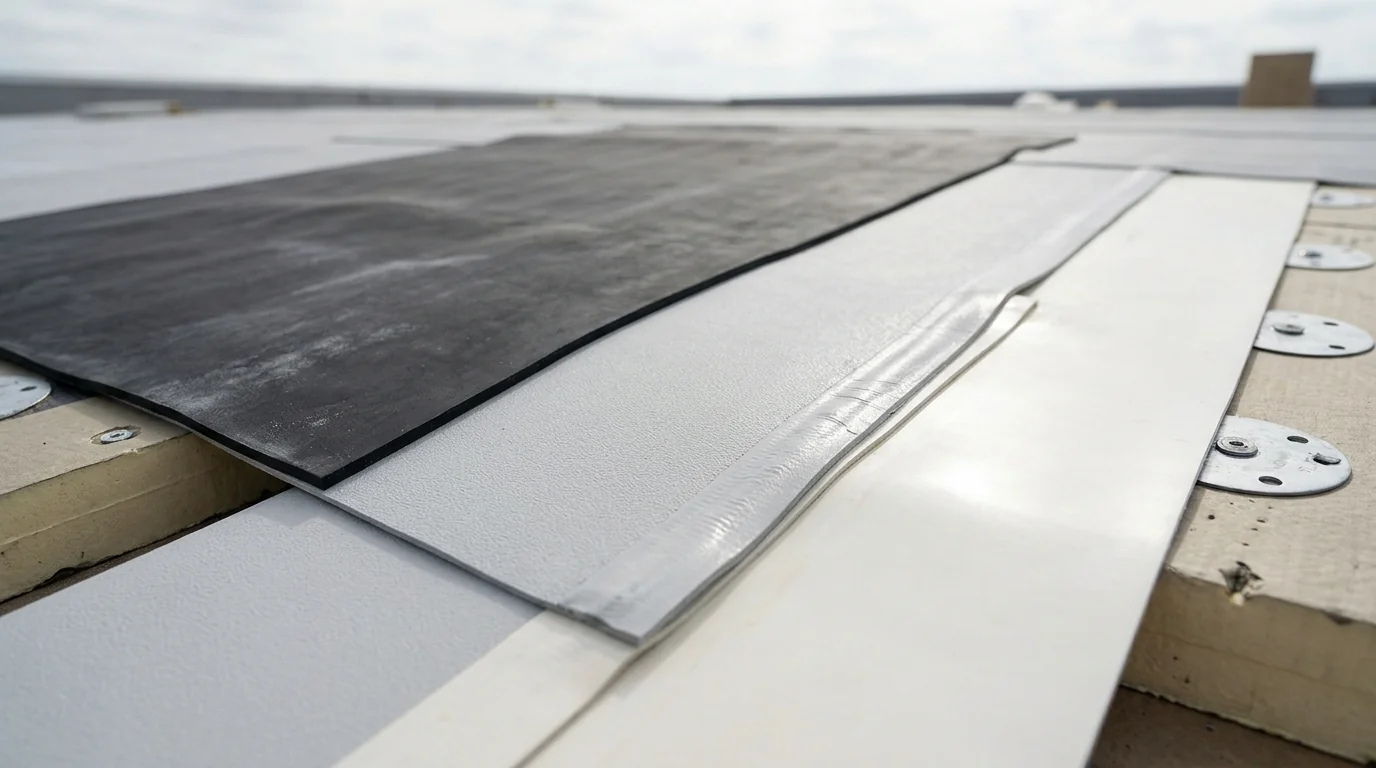
Hot-applied rubberized asphalt, PMMA or sheet membrane under pavers
Each system has a proper home. The choice depends on deck shape, traffic, cure time and how many details the deck holds.
| Hot-applied rubberized asphalt | PMMA liquid membrane | |
|---|---|---|
| How it goes down | Heated in a kettle and poured or squeegeed into a continuous layer | Mixed on site and rolled out, then cures quickly |
| Cure and return to use | Cools in hours but needs a protection layer before pavers | Cures fast, which helps when a deck has to reopen soon |
| Best on | Large, mostly flat plaza areas with moderate detail | Complex decks with many penetrations, corners, drains and curbs |
| Odor and fumes | Heat and smell need planning near air intakes | Strong smell while curing, so ventilation and intake protection matter |
| Weather needs | Dry deck and mild temperatures | Dry deck and temperature windows set by the product |
| Repair later | Patchable with compatible hot material | Patchable with compatible resin and reinforcement |
How we trace a plaza leak and rebuild the waterproofing
Rebuilding a whole plaza when the leak is in one drain is a waste. Rebuilding one spot when the membrane is gone everywhere is also a waste. The order of work separates the two.
Document the leaks from below
We walk the garage or the space under the deck, photograph stains, drips and efflorescence, and mark them on a plan of the plaza above.
Survey the deck above
We check drains, planter walls, joints, expansion covers and wall terminations. Sample pavers are lifted to see the membrane condition and any trapped water.
Run a flood test on suspect zones
Zones are dammed and filled with water while someone watches below. This separates a failed drain flange from a failed field membrane.
Decide between local repair and full rebuild
If the membrane is sound outside a few details, we repair those. If it has lost bond, cracked or blistered across the deck, we rebuild.
Lift and store the surface layer
Pavers, pedestals, planters and soil are removed in zones, cataloged and stored so the reset looks like the original layout.
Install the new system and its drainage
Primers, membrane, flashings and protection board go in. Drains are rebuilt at both the surface and the deck level so water has a path out at each.
Flood test again, then reset
A second test proves the new membrane before pavers go back. Then pedestals, pavers and planters are reset, with sloped pedestals where needed.
Drains at two levels, and why the lower one gets forgotten
A paver deck has two drainage planes. Rain falls on the pavers and passes through the joints to the membrane below, where it flows along the slope to a drain. A surface drain at paver level catches some of it, but the real work is done by the drain at the membrane level, usually a two-part drain body with weep holes or a clamping ring. If that lower drain clogs with grit, leaves or old sealant, water backs up under the pavers and sits against every seam.
On many older plazas, the lower drain was never fitted correctly, or the paver pedestals block the flow to it. We clean and test the drain bodies, replace damaged clamping rings, and add drainage mat or sloped pedestals where flow is blocked. Sloping the membrane to drains by tapered topping slab or tapered pedestals is the sound way to prevent ponding. Relying on pavers to hold water at a flat deck keeps a damp environment right on top of the seams.
Overflow protection matters too. If a main drain stops, water needs a safe place to go instead of pooling against a wall. Overflow scuppers or secondary drains sit above the primary and protect the building during a Middle Tennessee downpour. We check them as part of every plaza job, and we flag the ones that are missing, because the March and April storm season can stack more water on a deck than the main drain alone can take.
Winter matters on plazas in Middle Tennessee. Freeze-thaw cycles work water into cracks in pavers and topping slabs, and de-icing salts attack rebar and concrete. A plaza that is dry in October can be dripping in February. We schedule membrane work in the dry shoulder seasons when we can, and we flag cracks, sealant joints and expansion covers for repair before the first hard freeze so winter doesn't widen the problem.
What plaza and balcony waterproofing costs in Nashville
Deck rebuilds are priced per square foot of membrane, plus separate lines for removal and reset of the surface layer. Ranges here are planning figures, and we quote after a site visit and a flood test.
| Work | Typical range | What moves it |
|---|---|---|
| Hot-applied rubberized asphalt, new membrane under pavers | $11.40 to $19.85 per sq ft | Membrane, protection board and drainage layer; surface removal and reset are separate. |
| PMMA system on a detail-heavy deck | $13.20 to $24.70 per sq ft | Higher price comes from reinforcement at corners, drains and curbs. |
| Paver removal, storage and reset on pedestals | $8.35 to $17.60 per sq ft | Depends on paver size, pedestal type and how much is salvageable. |
| Balcony coating and edge detail rebuild | $14.90 to $31.40 per sq ft | Includes threshold, rail post and slab edge flashing. |
What pushes a price up or down:
- Total deck area and how much surface layer has to be lifted
- Planters, soil depth, trees and heavy amenity loads on the deck
- Number of drains, expansion joints and wall terminations
- Concrete repair under the membrane, including cracks and spalls
- Work phasing so garage access or amenity use can continue
- Cure time and temperature windows that affect scheduling
Ranges reflect recent Middle Tennessee work and are not a quote; we price after a site visit. See the full Budget Guide.
What a property manager or HOA board can bring to the first deck walk
You can phone us without any of this. These items shorten the investigation and keep the repair focused.
- A plan of the deck and a floor plan of the garage or space below
- Photos of stains and drips, with dates and weather notes
- Original waterproofing details or warranty paperwork, if they exist
- A list of past repairs, sealant jobs and who did them
- Information about planters, pools, bars and other heavy items on the deck
- Access routes for equipment, plus any loading dock or crane constraints
- Garage clearances and the hours you can close parking spaces
- Names of the engineer or board member who must approve scope changes
Condo and apartment boards: treat balconies as a building project
Balcony leaks seldom stay on one balcony. Water that gets past a threshold or slab edge on the fifth floor can reach units below and rust the steel at the slab edge. Tennessee boards and managers who fix balconies one unit at a time often repeat the work three or four years later. Survey the full elevation, repair the common details at once and set a reserve schedule that includes membrane work. If water is coming in tonight, phone (615) 716-3057. We answer 24/7 and can protect the opening until the permanent repair.
Need plaza deck & balcony waterproofing on a Nashville building?
Call (615) 716-3057 any hour. We look at the roof, show you what we found and price the work before anything starts.
Where we do plaza deck & balcony waterproofing around Nashville
The ZIP codes below cover most of the buildings we work on. Every one links to its local page, and the full locations list has 62 more.
- Nashville 37219
- Downtown Nashville 37219
- East Nashville 37206
- Antioch 37013
- Madison 37115
- Donelson 37214
- Hermitage 37076
- Bellevue 37221
- Green Hills 37215
- Franklin 37064
- Brentwood 37027
- Murfreesboro 37130
- Smyrna 37167
- La Vergne 37086
- Mount Juliet 37122
- Lebanon 37087
- Hendersonville 37075
- Gallatin 37066
- Spring Hill 37174
- Columbia 38401
- Goodlettsville 37072
Work that often goes with plaza deck & balcony waterproofing
Repairs and new roofs on Mule-Hide, GenFlex, Polyglass and Henry systems, matched to what the building already has where we can.
Plaza Deck & Balcony Waterproofing questions from Nashville owners
How do you find the exact source of a plaza deck leak above a Nashville parking garage?
We map the stains below, survey drains and joints above, then flood test suspect zones in sections while watching the underside. That narrows the source to a drain, a joint or the field membrane before anyone lifts more pavers than needed.
Can plaza waterproofing be repaired without removing all the pavers?
Sometimes. If the leak is at a drain, a planter wall or a joint, we lift only the pavers near it. If the membrane has failed across the deck, full removal is the sound route. A flood test tells us which situation applies.
What is the difference between hot-applied rubberized asphalt and PMMA on a plaza?
Hot-applied rubberized asphalt is a continuous, heated layer that suits large, open decks. PMMA is a fast-curing liquid resin that suits decks with many corners, drains and curbs. Smell, cure time and weather windows differ, so we choose by deck shape and schedule.
Why do balconies on mid-rise condos keep leaking after recoating?
Coatings alone can't fix an open slab edge, a failed threshold flashing or a missing drip edge. Water gets under the coating and keeps moving. We rebuild the edge and threshold details first, then the coating goes over a sound base.
Do plaza decks need drains at two levels?
Yes. Water passes through paver joints and sits on the membrane, so the membrane level needs its own drain body and clear flow path. A surface drain alone leaves water sitting against seams. We test and rebuild both, and add overflow protection where it's missing.