Roof condition assessments for Nashville portfolios
You have a dozen buildings, an annual roof line in the budget and no clear idea which roofs will fail first. We rate each roof, estimate remaining life and give you a ranked plan you can take to the board.
- Every roof rated and ranked
- Five-year budget ranges
- Answered 24/7
Short answer
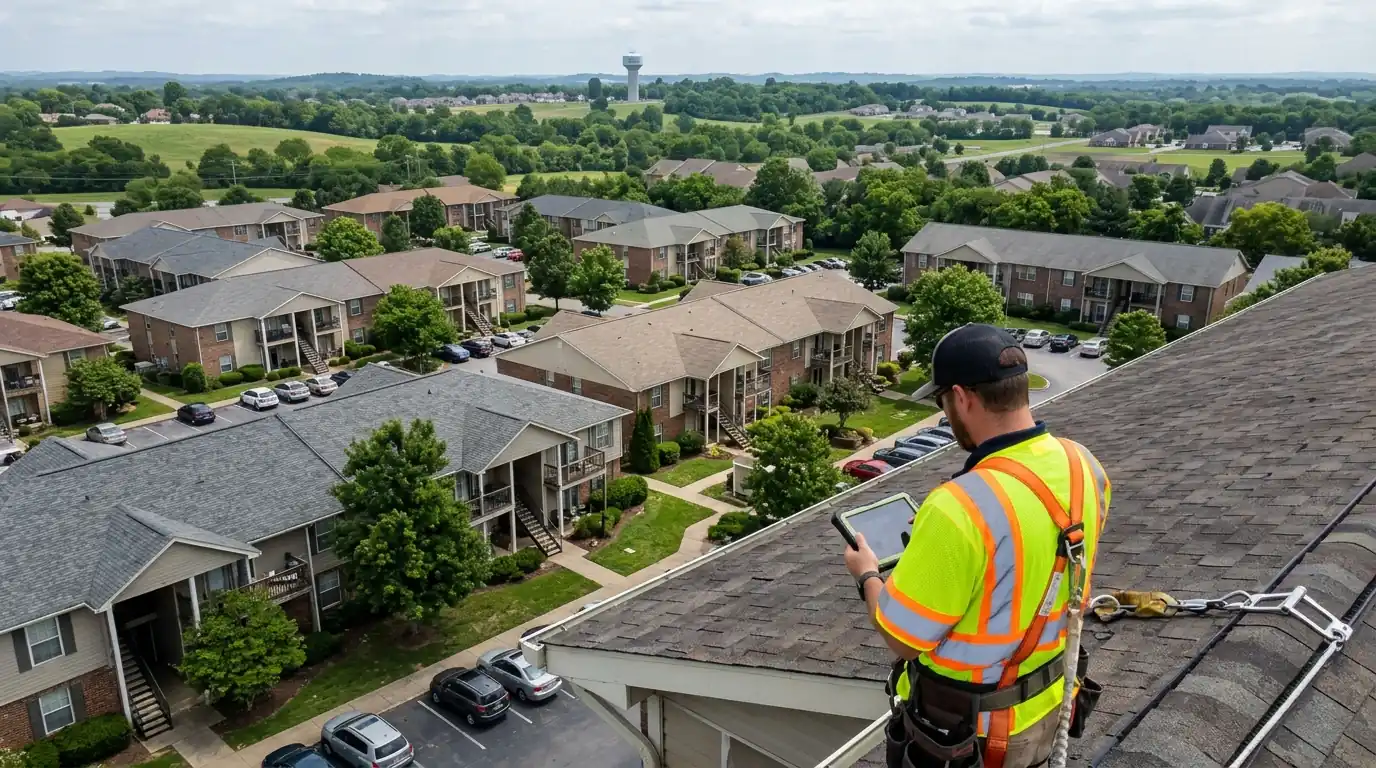
A roof condition assessment rates every roof in a property or portfolio, estimates remaining service life, and turns the findings into a multi-year capital budget. It is built from walks, photos and selective core cuts. Owners use it to decide which roofs to repair, restore or replace, and in which budget year, instead of reacting to leaks.
Why portfolio owners need more than a leak list
A leak list is a record of the past. A condition assessment is a forecast. For an owner of eight apartment communities in Rutherford County or a property manager overseeing office parks along I-65, the question is never whether one roof needs work. It is which roofs need what, in what order, and how much to set aside each year. Without that, money gets spent on whichever roof leaked last.
We approach this the way a reserve study approaches a building: roof by roof, with a rating, a remaining life estimate and a cost range. Each roof gets a walk, photographs, a note of membrane type and age, and test cuts where moisture is possible. The result is a ranked list that turns vague worry into a schedule. We keep the format identical across buildings so you can compare them at a glance.
The same method works for a homeowners association board that has to explain a special assessment to residents. A clear report that shows roof condition by building, with photos and a phased plan, makes the case far better than a single contractor's opinion. You get numbers that can go in a reserve schedule and survive a board meeting. We are happy to present to the board by phone or in person.
How we assess a portfolio, building by building
The process scales from one property to dozens. Here is the sequence we follow.
Build the inventory
We list every roof by address, area, roof level, system type, age if known, and warranty status, using your records and what we see on the walk. Missing data is flagged, not invented.
Walk every roof
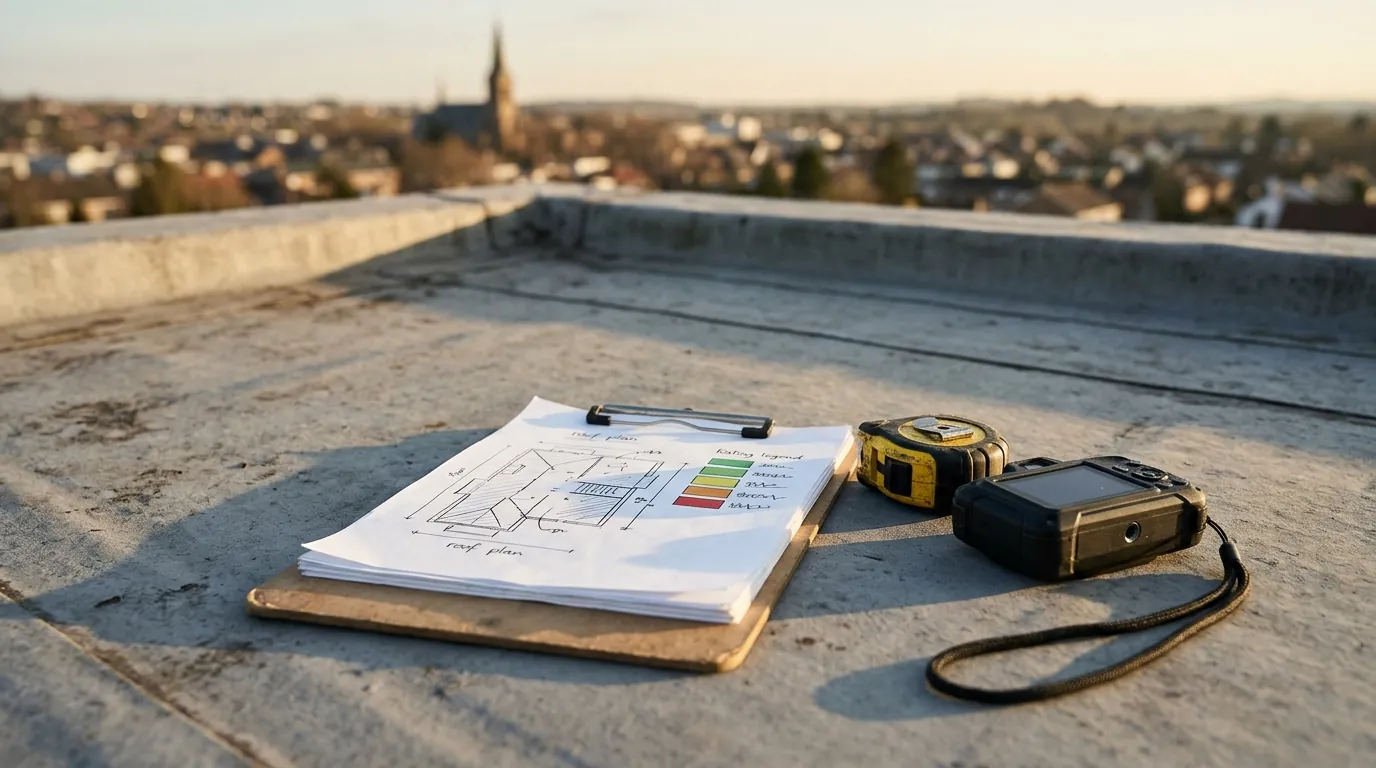
Each roof is walked in a set pattern. We photograph seams, flashings, drains, penetrations and wear, and record ponding and blisters on a plan. Photos are numbered to match the plan, so anyone can find the same spot later.
Cut cores where it counts
Where signs point to trapped moisture, we cut cores and record layers. On large or high-value roofs we may add an infrared survey. Cuts are patched the same day, and the results go in the report.
Rate condition and estimate life
Each roof gets a one-to-five rating and a remaining life range, based on age, materials, observed defects and maintenance history. The scale is explained in the report so the rating reads the same way every year.
Price the options
For each roof we price repair, restoration, recover and replacement ranges, so you can see what each choice costs and when it makes sense. Costs are given as ranges, since conditions change what a roof needs.
Build the multi-year plan
Roofs are sequenced across budget years by risk and cost. We show the year-by-year total and flag what could move up if a roof fails early. The plan shows what moves if a roof fails earlier than expected.
Present and revise
We walk you or your board through the report, answer questions and update the plan after repairs or storms. Revisions are normal after the first repairs or the next big storm.
What each condition rating means for the budget
A simple five-step scale keeps the plan easy to read. This is how we describe each level. The rating scale is the same for every building.
| What we see | What it means for planning | |
|---|---|---|
| 1: Good | Dry insulation, tight seams, clean drains, few repairs | Maintenance only; revisit in the next cycle |
| 2: Fair | Minor wear, a few repaired seams, light ponding | Budget small repairs; plan a coating or restoration later |
| 3: Aging | Widespread surface wear, repeated repairs, early moisture signs | Plan restoration or recover in the next budget cycle or two |
| 4: Poor | Open seams, wet insulation, recurring leaks, soft decks | Budget replacement soon; limit repair spending |
| 5: Failed | Active leaks, structural damage, sections no longer protecting | Immediate replacement or emergency stabilization |
Owners who get the most from an assessment
Anyone with more than a couple of roofs gains from a plan, but these situations stand out.
Multi-building apartment owners
Garden-style communities in Murfreesboro or Antioch have dozens of similar roofs of different ages. The report shows which ones to do first. Ratings help decide whether to repair, restore or replace at each site.
HOA boards setting reserves
A board that has to explain a special assessment needs photos, ratings and a phased schedule that residents can follow. Residents tend to accept a plan better when it is phased and documented.
REITs and institutional owners
Lenders and investment committees expect roof condition data in a standard format. Our ratings and ranges fit that need. Standard ratings make year-end reporting easier.
Church and school campuses
A campus with a sanctuary, education wing and gym has three roof systems. A single plan covers all of them without three contractors. Gym and sanctuary roofs often fail at different times.
Owners acquiring a portfolio
A buyer taking over five properties needs a roof capital number before pricing the deal. Roof data should be part of the price before the closing.
Managers inheriting unknown roofs
A new facility manager can learn a hundred roofs faster from a rated inventory than from filing cabinets. Ratings are a faster start than a stack of old invoices.
How we estimate remaining life without false precision
No one can tell you the exact year a roof will fail. What we can do is give a range based on membrane type, age, exposure, maintenance history and observed defects. A 15-year-old TPO roof with tight seams and dry insulation sits very differently from a 15-year-old modified bitumen roof with open laps. We use ranges, such as three to six years, and we say why. The range is only as good as the evidence behind it, so we note what we could not test.
We weigh factors that charts leave out. Roof traffic from HVAC technicians, trees dropping debris on a drain, a southern exposure that cooks the membrane, past storm damage and the quality of earlier patches all move the estimate. Hail history and the 2020 and 2023 tornado paths in Nashville and Hendersonville matter if a building was in them.
We also separate service life from warranty life. A roof can outlast its warranty or fail inside it. The report lists both, so your budget does not rest on the warranty date alone. We revisit the estimate whenever a core cut, a leak or a storm gives us new information. We also flag roofs where one more storm could change the answer.
What a roof condition assessment costs
Assessment cost depends on the number of roofs and how deep each one goes. We quote after discussing the portfolio, not by phone guess. Larger portfolios usually cost less per square foot.
| Work | Typical range | What moves it |
|---|---|---|
| Single building assessment with report | $0.05 to $0.12 per sq ft | Walk, photos, rating, life range and budget ranges. |
| Portfolio assessment, 10 or more buildings | $0.03 to $0.08 per sq ft | Lower per-foot cost; one report format across all sites. |
| Core cuts and moisture checks | $185 to $395 per core | Added where moisture signs are present. |
| Annual update after repairs or storms | $475 to $1,640 per property | Updated ratings, photos and the revised plan. |
What pushes a price up or down:
- Number of buildings and distance between them
- Roof area and the number of separate roof levels
- Variety of roof systems in the portfolio
- How many cores and infrared scans are justified
- Report format, such as board packet or lender summary
Ranges reflect recent Middle Tennessee work and are not a quote; we price after a site visit. See the full Budget Guide.
Documents that sharpen your assessment
None of these is required, but each one cuts the guesswork in the report.
- Property list with addresses and building counts
- Original construction or roof replacement dates
- Existing manufacturer warranties and expiration dates
- Past invoices for repairs, coatings and tear-offs
- Tenant or resident leak complaints by building
- Current capital budget or reserve study
- Insurance claims and storm damage records
- Lender or investor reporting requirements for roofs
Build the plan around budget years, not just repair dates
A roof that needs replacement in year three should not be repaired heavily in year one. A roof ready for a coating next spring should get its drains and flashings fixed this fall. The most useful assessments sequence work so each dollar supports the next step. We lay out the plan year by year, and we flag which roofs can wait, which cannot, and which small repairs buy you the most time. That is what a board can approve.
Need roof condition assessment on a Nashville building?
Call (615) 716-3057 any hour. We look at the roof, show you what we found and price the work before anything starts.
Where we do roof condition assessment around Nashville
The ZIP codes below cover most of the buildings we work on. Every one links to its local page, and the full locations list has 62 more.
- Nashville 37219
- Downtown Nashville 37219
- East Nashville 37206
- Antioch 37013
- Madison 37115
- Donelson 37214
- Hermitage 37076
- Bellevue 37221
- Green Hills 37215
- Franklin 37064
- Brentwood 37027
- Murfreesboro 37130
- Smyrna 37167
- La Vergne 37086
- Mount Juliet 37122
- Lebanon 37087
- Hendersonville 37075
- Gallatin 37066
- Spring Hill 37174
- Columbia 38401
- Goodlettsville 37072
Work that often goes with roof condition assessment
Membranes, coatings and metal we work on every week include Versico, Duro-Last, Elevate and Gaco, plus older systems still in service.
Roof Condition Assessment questions from Nashville owners
What is a commercial roof condition assessment in Nashville?
It is a documented review of one roof or many, with ratings, photos, selective core cuts, remaining life estimates and a multi-year budget. It tells an owner which roofs to repair, restore or replace and when, so capital dollars go where they matter most.
How do you estimate the remaining life of a flat roof?
We combine membrane type, age, observed defects, moisture findings, maintenance history and exposure. The result is a range, like three to six years, and not a single date. We explain the reasoning so you can challenge it, and we update it when new information appears.
Can a roof assessment help an HOA board plan reserves?
Yes. We rate each building, show dated photos and propose a phased schedule with cost ranges by year. Boards can drop the report into reserve studies and use it in owner meetings. It also explains why some buildings go first, which tends to head off arguments about fairness among residents.
Do you assess multi-building portfolios across several counties?
Yes. We cover Davidson, Williamson, Rutherford, Wilson, Sumner and Maury counties. For a larger portfolio we use one format across every site and schedule the walks by geography. You get one comparable report with the same ratings throughout instead of a stack of different documents.
How is an assessment different from a roof inspection?
An inspection documents defects on one roof now. An assessment adds ratings, remaining life, repair versus replace pricing and a multi-year plan, often across several buildings. Owners usually order an inspection after a problem appears and an assessment when they are planning capital.