Commercial roofing in Smyrna, TN (37167)
Smyrna's roofs work hard: supplier buildings near the Nissan plant, industrial parks with big flat decks, and offices close to the airport. A leak over a production floor or a parts bay costs more than the roof.
- Buildings
- Industrial parks, supplier plants, offices
- Corridor
- Nissan Drive, Sam Ridley Parkway, I-24
- Watch for
- Drain flashing over production floors
- Access
- Wide docks, airport height limits possible
Short answer
Commercial roof trouble in Smyrna comes mainly from large industrial membranes with worn seams and drain flashing, metal roofs with loose fasteners, and buildings that sit close to airport traffic and need careful staging. We survey the roof, mark wet areas, and quote after a site visit. Call the 24/7 line for active leaks.
Why roofs around the Nissan plant don't get a long pause
Nissan's vehicle plant anchors Smyrna, and a ring of supplier and logistics buildings has grown around it. Those buildings run in shifts, and a roof leak above a parts line or a staging bay can stop a process that has nothing to do with the building itself. That changes how we plan. The first question is always what sits under the wet area and what it takes to keep it running.
Most of these roofs are large and low-slope: TPO, EPDM, or aging built-up roofs with gravel. They have dozens of penetrations for exhaust fans, makeup air units and conduit. We spend most of a survey walking around those penetrations, because that is where large industrial roofs fail long before the field of the membrane does.
The supplier buildings tend to have been built quickly to meet production schedules, and the roofs show it. Penetrations were cut after the membrane went on, curbs were flashed by a different trade than the roofer, and conduit runs were sealed with whatever sealant was on the truck. We usually find that the original membrane is in better shape than the details around it.
We also look at what the roof carries. Heavy rooftop equipment, cable trays and walkway paths can concentrate load and wear in a few places. Walk pads under frequently used paths, and clear paths to equipment, save a membrane from foot traffic damage and make later service calls safer. Where equipment is moved often, we add walk pads and mark the route, which is cheap protection for a roof that people cross every week.
What shows up on an industrial roof in Smyrna before a leak does
Facility managers get warnings if they know where to look. These are the ones we see most often.
Ponding around exhaust fans
Heavy fan curbs deflect the deck slightly, and water settles in the low spot beside them.
Cracked pitch pans
Old conduit penetrations were often sealed with pitch that shrinks and cracks within a few seasons.
Loose metal fasteners
On standing seam or exposed-fastener metal, backed-out screws leave open holes that rainfall finds quickly.
Wrinkled or billowing membrane
A mechanically attached roof that flutters in wind is losing fasteners, usually at the perimeter first.
Stained insulation at a core
A dark, wet cut sample tells us a repair is a patch, not a fix, and a recover may no longer be an option.
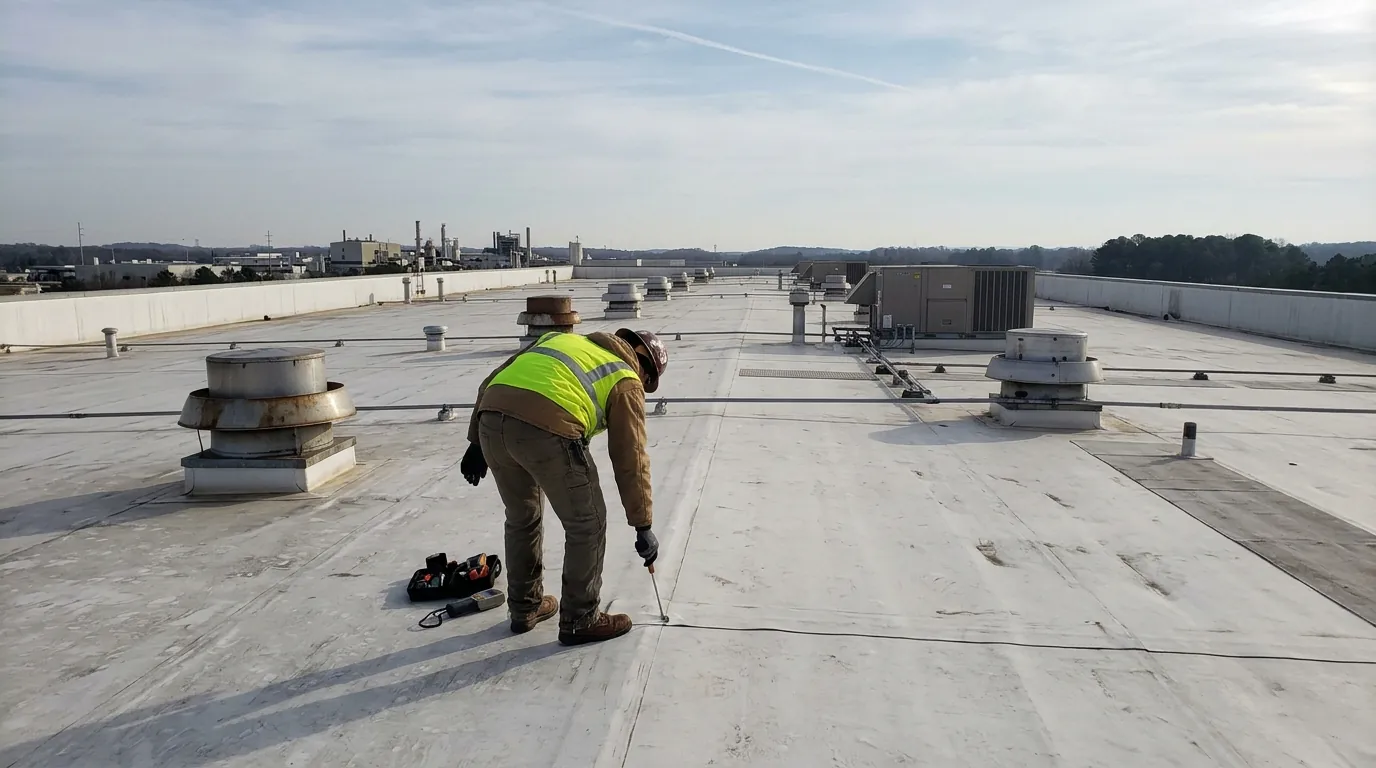
Buildings near the airport and the industrial parks
Smyrna has an airport on its east side, and industrial parks that sit close to it. Near an airfield, a tall crane or lift can raise questions about airspace, so we ask about height and staging before we schedule equipment. Most roof work on one-story industrial buildings stays low, but we confirm early rather than discover a limit on the morning of the job.
Between the plants and the parks, access is generally good: wide docks, long truck aprons and roof ladders. The hard part is timing. A repair that closes one bay for a day needs the plant manager's schedule, and we build the work plan around that instead of around our calendar.
If your building adjoins a flight path or sits near the airport fence, tell us when you call. We will confirm staging, crane reach and any access rules with the property owner before a truck arrives, so the day of the repair is straightforward. If staging has to move, we adjust the plan on site and tell the plant contact before any lift goes up.
Hail and wind come through every spring
Middle Tennessee gets spring hail and straight-line wind every year, and large flat roofs catch more of it than any other building type in town. After a storm, check the perimeter first. Lifted edge metal, torn coping and displaced gravel guards are the early signs. If you find any of them, phone us the same day. A small edge failure on a big roof can peel back a lot of membrane in the next gust.
What we confirm with a Smyrna facility manager first
These answers decide the schedule and the repair method.
- What sits directly under the leak and whether it can be covered or moved
- Whether the plant runs shifts that limit rooftop equipment shutdowns
- The membrane type, thickness and how it is attached to the deck
- Any lift or crane height concerns near the airport
- Where the roof access ladder or hatch is and how safe it is
- Whether the building has a manufacturer warranty that could be affected by a repair
Roofing work we do most in Smyrna
Six services building owners here call about most. The full catalog has 45.
Roof trouble in Smyrna?
Call (615) 716-3057 about a building in Smyrna (37167). The line is answered 24/7, and the first question is always where the water is showing.
Roofing questions from Smyrna
Can you repair a Smyrna plant roof without stopping production?
Often yes. We work in sections, protect equipment below with tarps or temporary barriers, and coordinate with the plant manager so the repair happens around shifts. Some work needs a short shutdown, and we say so before we start.
Does being near the Smyrna airport change how you do roof work?
It can affect crane and lift height, so we ask about staging before we schedule equipment. Most single-story industrial repairs stay low enough that it is not an issue, but we check first.
Why do Smyrna industrial roofs leak around exhaust fans?
Fan curbs add weight and penetrations, and the flashing around them moves with every temperature swing. Over time the seals crack. We reflash the curb rather than just smear sealant on the crack.
How fast can you reach a leak in 37167?
Call the 24/7 line at (615) 716-3057. For an active leak we can tarp or patch quickly, then plan a full survey around your production schedule.