School and daycare roofing in Nashville
You have about ten weeks of summer to replace a roof that was leaking all spring, and a board that needs numbers months before that. We plan the work backward from the first day of class.
- Summer-break scheduling
- Fenced child-safe staging
- Answered 24/7
Short answer
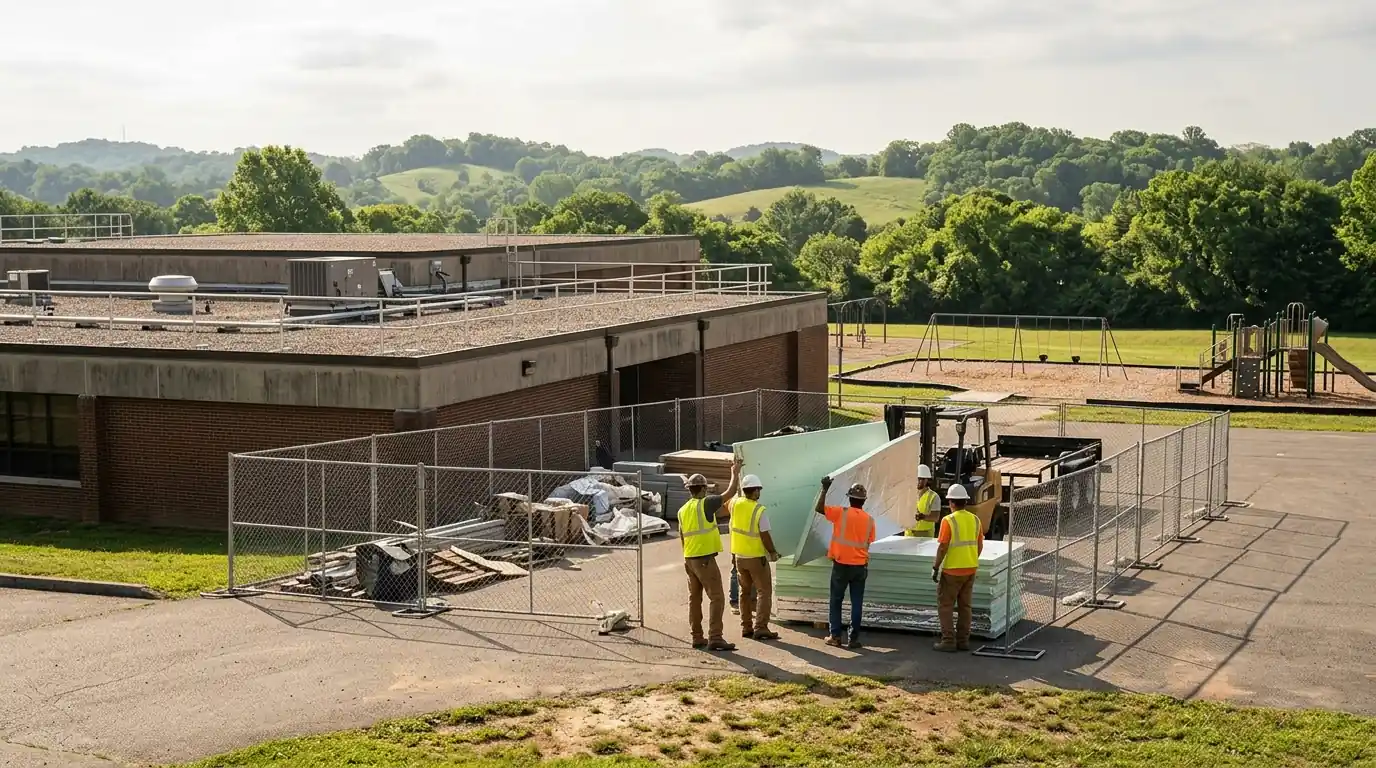
School and daycare roofing is commercial roofing scheduled around students: big jobs in the summer break, small repairs on weekends, and fenced staging away from play areas. In Middle Tennessee, planning ranges run about $7.40 to $13.25 per sq ft installed for flat and low-slope roofs. We give boards and directors written scopes and quote after a site visit.
The summer break is the whole schedule, so the planning starts in winter
Most school roofing happens in one window. Classes end in late May, teachers return in early August, and everything between has to cover design, materials, tear-off, installation and punch list. That sounds like plenty of time until a wet June eats two weeks and a membrane order arrives late. Roofs that get quoted in April for work that starts in June are the ones that finish in September, with students walking under scaffolding. The smart approach is to survey in winter, budget in spring and have materials on order before summer begins.
Both public districts and private schools live by this calendar, but their paths to a decision differ. A public district usually moves through a facilities department, a board vote and a purchasing process with written scopes. A private or church-run school may answer to a head of school and a finance committee. Daycares and early learning centers often answer to a single owner or director. We write the same clear scope for each, then adjust the detail to the audience that has to approve it.
Roof types vary by campus too. Gym roofs are broad, high and often steel-decked, with a long span that makes ponding easy to miss. Cafeteria and kitchen roofs carry exhaust fans, grease residue and steady rooftop traffic. Classroom wings added over the years carry whatever roof was popular at the time. A single campus can hold modified bitumen, EPDM, a metal gym roof and a shingled administration building, so we survey each section and don't assume one answer for all of them.
Public money also carries paperwork. Districts often need a written scope, insurance documents, a safety plan and a schedule before a purchase order is cut. Private schools and daycares usually move faster but still want a clear number and a clear end date. We prepare the same package for each, so a facilities director can hand it to a board member or a parent committee and answer questions without calling us back. Clear paper early prevents a bad surprise in July.
Warning signs on a school roof that shouldn't wait for August
Custodians and maintenance staff are usually first to see trouble. These are the signs we ask them about.
Stained ceiling tiles in the same classroom
Tiles that get replaced every spring and stain again are pointing at a roof detail, usually a drain, curb or wall flashing, not bad luck.
Buckets in the gym after a heavy rain
A gym roof has few penetrations, so repeated leaks usually come from seams, ponded areas or the roof edge. Wet floors also create a slip hazard for students.
Mold spots or damp smell in a daycare room
Infants and toddlers spend time low to the floor and close to walls, so moisture that rises from a ceiling leak becomes a health question quickly.
Cafeteria roof stained around kitchen exhaust
Grease buildup attacks many membranes and can soften seams. Fans that rattle or sit loose on their curbs can tear flashing.
Gutters and downspouts overflowing at the entry canopy
Canopies over bus loops and front doors collect leaves, and an overflow becomes an icy sidewalk in a Middle Tennessee freeze-thaw week.
Roof hatch that is hard to open or won't seal
A warped hatch lets rain into the stair and tempts staff to prop it open, which makes the roof a student hazard.
How we run a school or daycare roof project
A roof over children has rules that a warehouse roof doesn't. We build them into the plan from the first walk.
Walk the campus with facilities staff
We look at every roof, note which rooms are used in summer programs, and ask where buses, deliveries and play areas run so crews stay out of those paths.
Cut cores and test for moisture
Cores show the real layers, and a moisture survey shows which areas of insulation are wet. That tells the district whether a recover is possible or tear-off is needed.
Write a scope the board can read
We list each roof section, the proposed system, the price range and the schedule. Bid-style detail is available for districts that need it.
Set up fenced, child-safe staging
Dumpsters, hoists and material stacks sit inside locked fencing, away from playgrounds and drop-off lanes. Ladders are removed or locked at the end of each day.
Control dust, noise and fumes near occupied rooms
Summer programs and daycares often stay open. We keep tear-off and welding away from open windows and intakes and schedule loud steps for hours outside nap and meal times.
Inspect and hand over before classes start
A final walk with facilities staff covers seams, drains and flashing, with photos and warranty paperwork where the system qualifies. Punch items are closed before the first bus runs.
Keeping children safe around a working roof
Child safety around construction is more than a fence. Children are curious, fast and good at spotting a gap, so every access point needs two layers of control. Material storage sits inside locked, tall fencing. Ladders and lifts are secured at the end of each shift. Ground crews wear high-visibility vests and carry a plan for when a school fire drill or a daycare outdoor session crosses the work zone. We walk that plan with the director before the first truck arrives.
Overhead hazards matter as much as ground ones. We use debris chutes or enclosed trash lines instead of throwing material off a roof edge, and we watch wind speeds because loose insulation boards can blow at the top of a Nashville thunderstorm. Entry canopies and walkways get covered protection when tear-off happens above them. If a section above an occupied hall is open, we schedule it on a day when that hall is empty.
Summer programs and year-round daycares add a wrinkle, because children are present all season. For those buildings we split the roof into zones and work on the side that is away from classrooms in use. Crew parking and deliveries go through service gates, not the front door. Teachers and parents see a posted schedule so nobody is surprised by a crane or a sudden stretch of noise during pick-up.
Weather rules the last week of any school project. Middle Tennessee summers bring afternoon thunderstorms, and a roof opened at 7 a.m. has to be dried in by the time the clouds build. We watch radar, cut each day's work to what can be closed, and keep temporary protection staged at the edge of the open area. That habit matters most over gyms and cafeterias, where a sudden downpour onto an open roof can ruin floors, equipment and weeks of preparation.
Summer replacement or phased repair across the school year
A district with a tight budget often asks whether to replace everything at once or fix pieces over several years. The answer depends on roof condition and cash.
| Full summer replacement | Phased repairs through the year | |
|---|---|---|
| Disruption | One concentrated window with students away | Smaller jobs on weekends and breaks, spread across the calendar |
| Budget fit | Needs a single large approval or bond line | Smaller spending that fits maintenance budgets |
| Risk | Weather delays can push work into the first weeks of class | Leaks may continue between phases |
| Long-term cost | Lower per square foot, with one warranty and a clean start | Higher over time if the roof is already near the end of its life |
| Best for | Roofs with wet insulation or repeated leaks across many rooms | Newer roofs with isolated problems at drains, curbs or flashing |
What school and daycare roofing costs in Middle Tennessee
These ranges are for planning. Public districts need firm bid numbers, and we provide those after a site visit and written scope.
| Work | Typical range | What moves it |
|---|---|---|
| Flat roof replacement, classroom wing or cafeteria | $7.40 to $11.95 per sq ft | Single-ply on a clean deck, with standard tapered insulation and a modest number of curbs. |
| Gym roof recover over dry insulation | $6.25 to $10.30 per sq ft | Only allowed where cores show dry insulation and a sound deck. |
| Daycare or small-building reroof | $5.85 to $12.60 per sq ft | Wide range because small roofs have higher cost per foot and may be shingle or low-slope. |
| Targeted leak repair during the school year | $580 to $2,140 per visit | Priced by the number of details and the access needed. |
What pushes a price up or down:
- Fencing, flaggers and extra safety setup around play areas and bus lanes
- Wet insulation found in cores, which adds board replacement
- Board-required bid format, prevailing wage rules or purchasing steps
- Summer deadlines that call for added crews or material pre-orders
- Asbestos and paint testing on older campuses, which is arranged separately
- Roof height, hoisting needs and weekend access
Ranges reflect recent Middle Tennessee work and are not a quote; we price after a site visit. See the full Budget Guide.
What a facilities director can gather before our first campus walk
Nothing here is required to phone us. It just shortens the first visit.
- Calendar showing the last student day, summer program dates and first teacher day
- Roof plans, past warranties and any recent roof reports
- A list of rooms with repeated ceiling stains and the dates they appeared
- Names of the person who approves scope and the board or committee meeting dates
- Bus lane, playground and daycare outdoor-time locations on the site plan
- Roof access details and who holds the hatch or ladder keys
- Any results from asbestos or paint hazard surveys on older buildings
- Insurance requirements the district or school wants listed on paperwork
Order materials before the school year ends
Membrane, insulation and edge metal for a large school roof can take weeks to arrive, and the weeks right after Memorial Day are when every contractor in Middle Tennessee orders at once. If your board votes in May, ask us to price and hold materials as soon as the budget is likely, not once it is final. A summer spent waiting on a delivery truck is a summer a roof sits open to Nashville thunderstorms. For an active leak at any hour, phone (615) 716-3057 and we'll stop the water.
Need school & daycare roofing on a Nashville building?
Call (615) 716-3057 any hour. We look at the roof, show you what we found and price the work before anything starts.
Where we do school & daycare roofing around Nashville
The ZIP codes below cover most of the buildings we work on. Every one links to its local page, and the full locations list has 62 more.
- Nashville 37219
- Downtown Nashville 37219
- East Nashville 37206
- Antioch 37013
- Madison 37115
- Donelson 37214
- Hermitage 37076
- Bellevue 37221
- Green Hills 37215
- Franklin 37064
- Brentwood 37027
- Murfreesboro 37130
- Smyrna 37167
- La Vergne 37086
- Mount Juliet 37122
- Lebanon 37087
- Hendersonville 37075
- Gallatin 37066
- Spring Hill 37174
- Columbia 38401
- Goodlettsville 37072
Work that often goes with school & daycare roofing
We install and repair systems from Carlisle SynTec, GAF, Johns Manville and Sika Sarnafil, and we patch whatever is already on your roof.
School & Daycare Roofing questions from Nashville owners
How early should a school district in Middle Tennessee start planning a summer roof project?
Start the survey in winter and have a written scope by early spring. That leaves time for the board vote, the bid process and a material order before classes end. Projects started in May often finish after school resumes, which is what you want to avoid.
Can a daycare stay open while the roof above it is replaced?
Often yes, with a zone plan. We work on the section away from rooms in use, keep fumes and noise away from open windows and plan loud tasks outside nap and meal times. Some rooms may need to move for a few days, and we map that with the director.
Do you provide bid-style scopes for public school boards?
Yes. We prepare a written scope that lists each roof section, system, quantities and schedule, along with the price range for planning. Final numbers come after a site visit, and we can follow the format a district's purchasing office asks for.
What protects children from construction near a school roof?
Tall locked fencing around staging, secured ladders and lifts after each shift, covered walkways under active tear-off, and a crew plan for fire drills and outdoor time. We review the plan with the principal or director before work begins and post a simple schedule for staff.
Can you repair a school gym roof leak in the middle of the school year?
Yes. Gym roofs can often be repaired on weekends or evenings with a small crew. We find the source, make a seam or flashing repair, and tell you if the leak is a sign that the whole membrane is nearing the end of its life.