Metal roof coatings and rust treatment in Nashville
Your metal roof is rusting at the fasteners and weeping at the laps, and replacing every panel is more than the building can carry this year. A properly detailed coating system can stop the leaks and slow the corrosion.
- Rust treated, not covered
- Fasteners and laps detailed
- Answered 24/7
Short answer
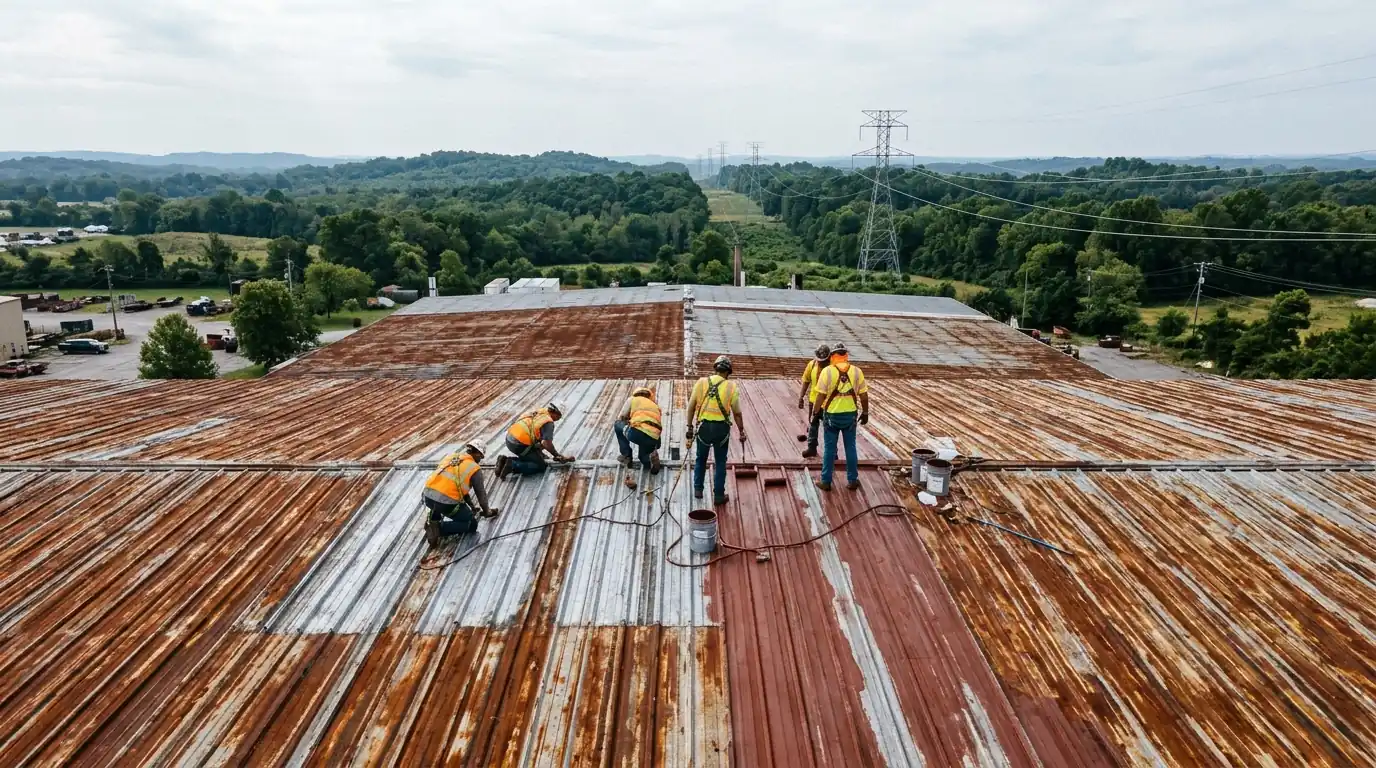
A metal roof coating system treats rust, seals every seam and fastener with butyl tape, sealant and reinforcing fabric, then applies elastomeric base and top coats. It extends the life of sound metal panels and stops leaks at laps and screws. It cannot save panels that are rusted through or a structure that has lost its fasteners.
Why metal roofs leak at the details, not the panels
A metal roof is only as watertight as its fasteners and laps. The panels themselves, whether galvanized corrugated, painted R-panel or standing seam, shed water well for a long time. The leaks start where screws back out from thermal movement, where neoprene washers crack from UV, and where panel laps open as the building flexes. On a warehouse off Nolensville Pike, that adds up to a long list of small paths for water. Tenants usually notice only the stains on ceiling tiles, long after the washers have failed.
Coating a metal roof is a detail job first and a surface job second. Rolling a thin coat over rusty, loose screws only hides the problem for a season. The right sequence is to treat rust, tighten or replace fasteners, tape and fabric the laps, then apply elastomeric coats over a clean, primed surface. We spend most of the time on the part nobody sees afterwards. That is also why a low bid that is all coating and no detail work is a poor deal.
The payoff is a roof that sheds water again, reflects heat off the building and keeps the original panels in service. For an owner of a manufacturing shed in La Vergne or a machine shop in Murfreesboro, that can postpone a six-figure re-roof by many years. The coating is not permanent, and we say how it will be maintained. Corrugated sheds, equipment barns and older church fellowship halls fall in this group.
Our sequence on a coated metal roof
Every step has a reason. Skipping any of them is how coatings on metal roofs end up peeling in two seasons.
Inspect panels, purlins and fasteners
We check rust depth, panel condition at laps and fasteners that no longer hold. We also look from below for daylight and wet insulation. Rust that has spread under old paint tells us how far the problem goes.
Remove loose rust and chalk
Wire wheels and power washing take off scale and oxidation. Pitting that goes through the steel is marked for panel replacement. We bag and remove debris so it does not wash into your gutters.
Replace or upsize fasteners
Backed-out screws get replaced with larger diameter fasteners with new washers, driven into solid purlins and not overtightened. Overtightening crushes the washer and starts the next leak.
Apply rust converter and primer
Surface rust gets a converting primer. Bare or galvanized metal gets the primer the coating manufacturer calls for, so the topcoats bond. The primer choice depends on whether the panel is galvanized, Galvalume or painted.
Seal laps and seams
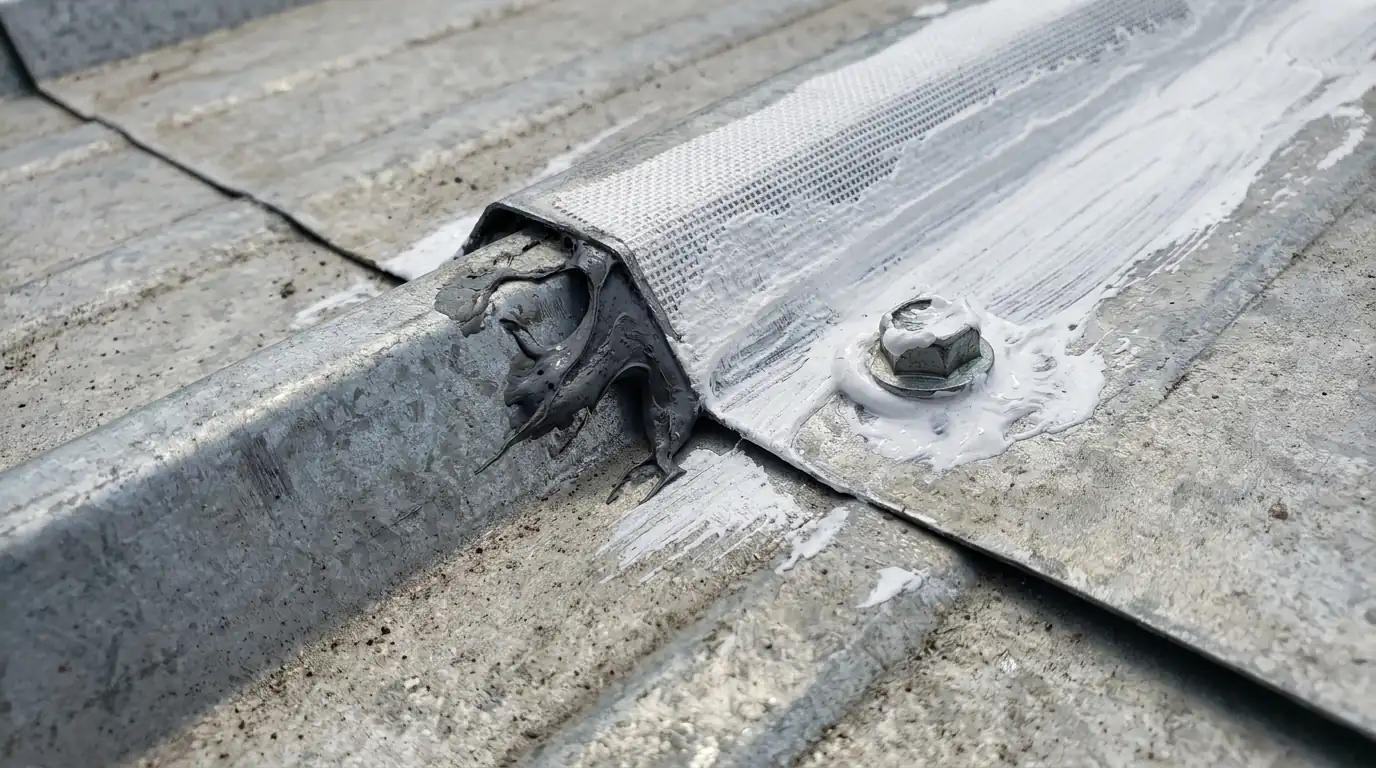
Butyl tape goes into open laps, and a bed of sealant with a strip of reinforcing fabric covers seams, ridge caps and panel ends. Fabric is cut and laid out before the coating so it never wrinkles.
Coat every fastener head
Each screw head gets a dab of sealant and a coating-over layer, so water has no easy path along the shank. It is slow work, and it is the part that keeps water out of the building.
Apply elastomeric base and topcoats
Two coats go on at the specified film thickness, and we measure wet mils at set intervals across the roof. We photograph the gauge readings so you have a record.
Condition checks that decide if coating will work
Coating is a good fit for sound metal. These are the signs we look for before we recommend it.
Surface rust, not rust-through
Orange bloom you can wire brush off is coatable. Holes you can poke a screwdriver through are not. A magnet and a screwdriver test it quickly.
Panels that still lie flat
Buckled or bowed panels that have pulled away from purlins need fastening or replacement before they take a coating. We re-fasten panels to purlins with new screws before coating.
Dry insulation below
A metal building with a thin vinyl-faced blanket may have trapped moisture. We check from the interior before sealing the roof. Wet insulation under the panels is a separate scope.
Existing paint or coating that still bonds
We test a patch for adhesion. Peeling old paint has to come off or be primed over with the right product. Poor adhesion changes the primer or stops the job.
Roof pitch that drains
Metal panels with enough slope shed water quickly, which suits acrylic. Low-slope metal with ponding may need silicone. That decides the product.
Intact gutters and eave details
Rotted trim, sagging gutters or blocked downspouts will keep causing leaks no matter what coating sits on the panels. Fix those first or the coating gets blamed for leaks it cannot stop.
Coating products for metal and where each fits
We pick the coat by the roof, not by what happens to be on the truck.
| Acrylic elastomeric | Silicone elastomeric | |
|---|---|---|
| Best for | Pitched metal that drains in hours | Low-slope metal that holds water |
| Weather during application | Needs warm, dry days with no rain after | Tolerates humidity but needs a dry surface |
| Adhesion to prepared metal | Strong after rust primer; common on corrugated | Strong after the right primer; needs a clean substrate |
| Dirt and appearance | Stays cleaner longer, chalks slowly | Holds dirt; washing restores brightness |
| Future recoat | Recoat with acrylic, or silicone in many cases | Recoat only with silicone |
Butyl tape and fabric at the laps
Panel laps are where water travels sideways under wind pressure. A coating alone bridges a hairline gap but fails when the gap moves. Butyl tape compressed into the lap acts as a gasket that keeps its seal while the panels expand and contract. We pull open laps, tape them and fasten them down so they close. That is the difference between a sealed lap and a lap that opens in January.
Over the top of the lap we set a strip of polyester reinforcing fabric bedded in coating. The fabric spreads movement across a wider band, so the coating does not split at the exact line of the joint. Fabric also goes over ridge caps, end laps and the corners around curbs and skylights.
Standing seam roofs need a different approach. We do not hammer or compress the seams. We clean them, check the clips from the interior where possible and use a detail coat that moves with the panel. If a standing seam roof has failing seam caps, replacing a section may be better than coating it. We tell you which. Some owners keep a few spare panels to avoid color matching later.
What metal roof coating costs per square foot
Metal coating cost depends heavily on how much rust and fastener work the roof needs. We quote after a site visit.
| Work | Typical range | What moves it |
|---|---|---|
| Cleaning, rust treatment and primer | $0.78 to $1.62 per sq ft | Wire brushing, converter and prime coat on sound panels. |
| Fastener replacement and sealing | $0.45 to $1.12 per sq ft | Upsized screws, new washers and sealant on every head. |
| Seam, lap and ridge detailing | $5.85 to $10.40 per linear ft | Butyl tape, sealant and fabric bedded in coating. |
| Two-coat elastomeric system | $1.69 to $3.42 per sq ft | Acrylic at the lower end, silicone at the higher end. |
What pushes a price up or down:
- Amount of rust, from light surface bloom to heavy pitting
- Panel profile and fastener density per square
- Roof height, pitch and how much fall protection is needed
- Number of penetrations, skylights, vents and curbs to detail
- Existing paint or coating that must be removed or tested
Ranges reflect recent Middle Tennessee work and are not a quote; we price after a site visit. See the full Budget Guide.
What to look at on your metal roof before calling
A quick walk from the ground or a drone photo can tell you a lot before we visit. None of these means the roof is beyond help.
- Orange streaks running down the panels near the screws
- Dark stains or daylight at lap lines inside the building
- Screw heads that sit proud of the panel or have washers that look cracked
- Chalky residue on your hands after touching the panel surface
- Sagging or rattling panels in high wind
- Staining at the eaves or around skylights and ridge vents
- Insulation that looks damp or sags under the deck
- Dates of any earlier coating, paint or sealant repair
Hail marks and the March tornado both leave dents
Hail and flying debris dent metal panels and sometimes crack coating or paint. After the March 3, 2020 tornado and spring hail seasons, metal roofs commonly show denting that is cosmetic, alongside some with cracked seams. We tell owners which dents only look rough and which have broken a seal. A coating can bridge cosmetic damage, but panels that are torn, creased or pulled loose from their clips need replacement. We photograph both and give you a written list.
Need metal roof coatings on a Nashville building?
Call (615) 716-3057 any hour. We look at the roof, show you what we found and price the work before anything starts.
Where we do metal roof coatings around Nashville
The ZIP codes below cover most of the buildings we work on. Every one links to its local page, and the full locations list has 62 more.
- Nashville 37219
- Downtown Nashville 37219
- East Nashville 37206
- Antioch 37013
- Madison 37115
- Donelson 37214
- Hermitage 37076
- Bellevue 37221
- Green Hills 37215
- Franklin 37064
- Brentwood 37027
- Murfreesboro 37130
- Smyrna 37167
- La Vergne 37086
- Mount Juliet 37122
- Lebanon 37087
- Hendersonville 37075
- Gallatin 37066
- Spring Hill 37174
- Columbia 38401
- Goodlettsville 37072
Work that often goes with metal roof coatings
We install and repair systems from Carlisle SynTec, GAF, Johns Manville and Sika Sarnafil, and we patch whatever is already on your roof.
Metal Roof Coatings questions from Nashville owners
Can rusty metal roofs be coated instead of replaced in Nashville?
Yes, when the rust is on the surface and the steel is still sound. We wire brush, treat with a converting primer and apply an elastomeric system. Roofs with holes, deep pitting or failed structural fasteners should be replaced or have sections swapped out first.
What is the best way to seal leaking screws on a metal roof?
Replace backed-out screws with larger diameter fasteners and new washers, then seal each head with sealant and coating. Simply tightening a worn fastener rarely holds. We also check that the screws are hitting a solid purlin and not stripped holes.
Does a metal roof coating void a manufacturer panel warranty?
It can, depending on the panel maker's terms. Painted panel warranties often exclude coatings applied afterward. If your roof is still under a panel warranty, check it first. Most roofs we coat are past the point where the original panel coverage matters.
How long does coating a corrugated metal roof take?
A typical industrial roof takes about one to three weeks, depending on rust treatment, size and the weather. Prep and detailing take the most time. Coating goes on faster, but cure windows and rain days add calendar time, so we give you a working window and keep you updated each day.
Can standing seam metal roofs be coated in Middle Tennessee?
Often yes, if the panels are sound and the seams are tight. We clean, prime and detail the seams and clips without compressing them. If seam caps or clips have failed, a coating will not hold, and we suggest panel repair or a retrofit.