Solar-ready roofing for Nashville commercial buildings
A solar array lasts 25 years or more, and a roof that fails at year ten means taking the array off to fix it. We do the roof work so your installer can mount panels on a roof that will outlast them.
- Roof life set to array life
- Attachment flashing details
- Answered 24/7
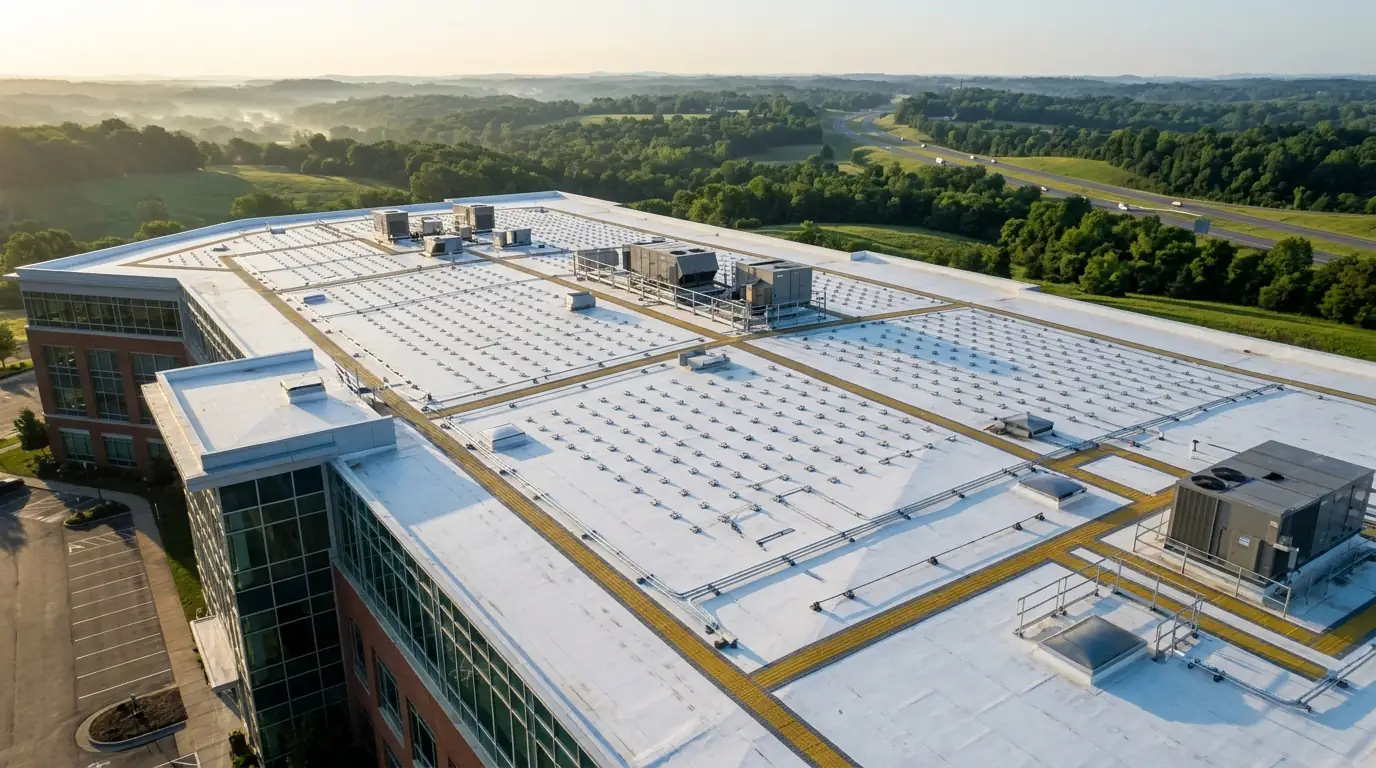
Short answer
Solar-ready roofing means replacing or restoring a commercial roof before an array goes on, so the membrane, insulation and flashings last as long as the panels. In Nashville, a solar-ready reroof commonly runs $8.60 to $15.40 per sq ft, with array attachment flashings priced separately. We do the roof work, and your solar installer handles the array.
Line up the roof's remaining life with the array's 25 years
Solar panels on a commercial roof are a long investment. Most arrays are financed over many years and expected to produce for twenty-five or more. The roof under them is often the oldest part of the building. If the membrane has eight years left and the array has twenty-five, someone will have to remove, store and reinstall panels partway through the array's life. That detour costs more than the roof work itself, and the panels sit idle while it happens.
The cleanest plan is to settle the roof first. We survey the existing membrane, cut cores, check for wet insulation and tell you how many years the roof can reasonably give. If the answer is short, we recommend a replacement or a recover system sized to the array's life. If the roof is young and sound, we mark the details that will need attention at attachment points and leave the rest alone. Either way, the owner decides with real numbers.
We stay in our lane. We don't design the array, size the system, deal with the utility or install panels. Your solar installer does that. What we do is give them a roof that is dry, flat, well drained and documented, plus layout information on what loads, penetrations and walkways the roof can take. That clean handoff avoids the common finger-pointing between a roofer and a solar contractor when a leak shows up near a rack footing.
Money is the usual reason owners hesitate. Roof work before solar is a real cost added to an already large project, and some owners hope to skip it. We run the numbers both ways: the cost of roofing first, and the cost of pulling and resetting panels later, including lost production while they're off. On roofs with less than half their life left, doing the roof first almost always wins. We show you the math in plain figures so the choice is yours.
Ballasted racks or attached racks: what each does to the roof
The mounting method changes the load on the roof and the number of places water could get in. Your solar installer chooses the racking, and we make sure the roof is ready for it.
| Ballasted racking | Attached racking with flashed standoffs | |
|---|---|---|
| How it stays put | Weight of blocks and the array itself holds it down | Fasteners go into the structure and each footing is flashed |
| Penetrations | None, or very few | One per attachment point, each needing a proper boot or flashing |
| Load on the roof | High dead load that the structure must carry | Lower dead load but concentrated at attachment points |
| Best on | Newer membranes and structures with reserve capacity | Buildings with limited capacity or high wind exposure |
| Roof concern | Pad protection, ponding and membrane wear under blocks | Flashing quality at each footing and long-term leak risk |
| Repair later | Panels and blocks must be moved to reach the membrane | Panels over the footing area must be moved for flashing repair |
How we prepare a roof for solar, in order
Order matters because panels cover the work. Anything missed before racks go down gets expensive to reach afterward.
Survey and core the existing roof
We map ponding, patches and soft spots, and cut cores to see layers and moisture. The aim is a clear remaining-life estimate for the roof.
Talk through the array layout with the installer
We ask for rack footprints, row spacing, conduit paths and expected foot traffic so the roof work fits the layout.
Decide on repair, restore or replace
A sound roof might need only drain work and flashing. A tired roof gets replaced or recovered with a system sized for the array's life.
Build in drainage and slope
Tapered insulation, crickets and clear drain paths keep water from sitting under blocks or rack feet, where ponding is hardest to fix.
Install walk paths and protection
Walk pads and protection mats go in where technicians will travel, and under ballast blocks where the installer asks for them.
Prepare attachment points
If the racking is attached, we set curbs, low-profile flashings or manufacturer-approved boots at each location before the installer arrives.
Document the roof before panels go on
Photos, core logs and as-built notes go to the owner and installer, so there's a record of the roof's condition on the day it was handed over.
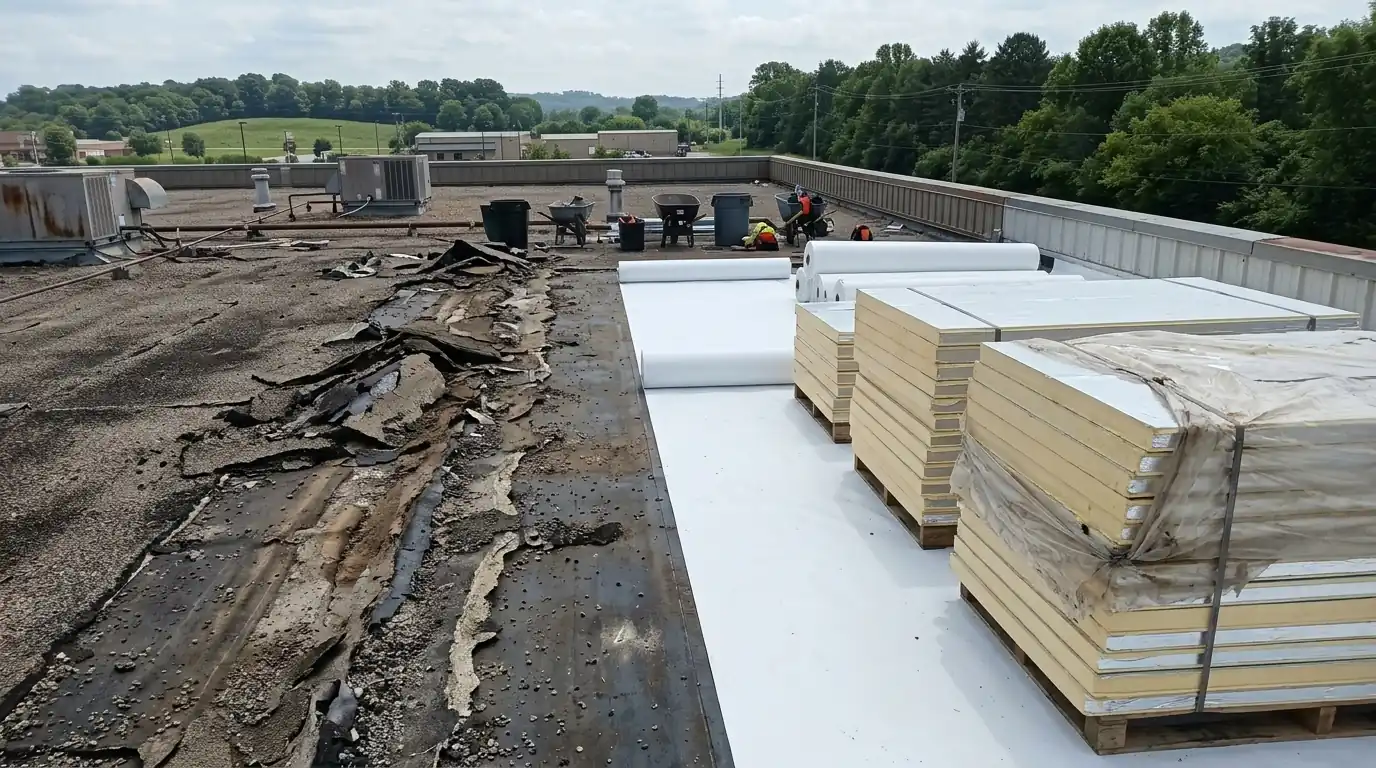
Signs the roof is not ready for an array yet
Installers will often ask for a roof opinion before quoting. These are the red flags we look for in the first walk.
Roof age close to or past mid-life
A membrane that is already halfway through its service life will outrun neither the array nor the financing term.
Ponding that lasts more than two days
Standing water under racks and blocks accelerates wear and makes leak finding nearly impossible later.
Wet insulation or spongy spots
Wet insulation under an array rots slowly and can drive a tear-off, which means removing the panels.
Several patches in the planned array area
Past patches show where leaks have been, and those details are the first to fail again under added load.
Deck deflection or rusted steel
Panels add load. A deck with visible sag or corroded flutes needs a structural review before anything else.
Old, brittle flashings at curbs and walls
Details near the array edge are hard to repair once panels and conduit cover them.
Walk paths, wind zones and keeping the roof serviceable
A roof under an array still needs maintenance, and the panels get in the way. Technicians have to reach drains, rooftop units and flashing without stepping on the membrane. We leave marked walk paths with pads between array blocks and around the perimeter, wide enough for a person carrying a tool bag. If there is a skylight or roof hatch, it gets a clear path that doesn't require crossing racks or conduit.
Wind loading is the other concern. Rooftop arrays catch wind, and the edges and corners of a roof see the highest uplift. Many designs keep panels back from the perimeter for that reason. The roof's own edge metal and perimeter attachment should be rated for the wind zone, and we check them against ANSI/SPRI ES-1 requirements during the survey. After the March 3, 2020 tornado and the December 9, 2023 storm, Middle Tennessee owners have good reason to treat wind details seriously.
Drainage under and around the array needs thought too. Racks can trap debris that clogs scuppers and drains, and shade patterns change where snow, ice and water linger. We set up a simple maintenance plan so the roof is inspected at the same time the installer cleans panels. A yearly walk catches small problems early, when they only take a few hours instead of a crane and a week of moved panels.
Insulation and energy codes come into play as well. When a roof is replaced, energy codes can require added insulation, and thicker insulation raises the roof surface and the flashing heights around the array. We bring that into the design early so parapets, curbs and rack heights still work. A white reflective membrane under a rack also gives some extra cooling benefit to the building, though the exact gain depends on layout and shade.
What solar-ready roof work costs in Middle Tennessee
Prices below are for roof work only, not the solar system. Roof size, current condition and array layout change them, so we quote after a site visit.
| Work | Typical range | What moves it |
|---|---|---|
| Solar-ready single-ply replacement with added insulation | $8.60 to $13.75 per sq ft | Clean deck, fully adhered membrane and tapered insulation where ponding needs it. |
| Recover over dry insulation before an array | $6.45 to $10.20 per sq ft | Only allowed when cores show dry insulation and a sound deck. |
| Coating restoration of a sound roof | $2.35 to $4.80 per sq ft | Silicone or acrylic for roofs with remaining life; panel weight needs review. |
| Attachment boots or curbs for racking footings | $68 to $215 per footing | Depends on roof type and the racking system the installer chooses. |
What pushes a price up or down:
- Existing roof type and the number of coverings already on the deck
- Array size, row spacing and how much of the roof it will cover
- Structural review results and any deck repair needs
- Ballast or attachment design and the number of footings
- Edge metal and wind zone details at the perimeter
- Schedule coordination with the solar installer and utility timeline
Ranges reflect recent Middle Tennessee work and are not a quote; we price after a site visit. See the full Budget Guide.
What to bring to the first solar-and-roof meeting
Each item saves time. If you don't have something, phone us anyway and we'll work around the gap.
- Roof plans, warranty papers and a repair history for the current roof
- The solar installer's name and a draft layout of the array, if available
- Roof age, membrane type and any known leaks or ponding areas
- Structural information about the building, including deck type
- Locations of rooftop units, skylights, vents and roof hatches
- Planned timeline for the solar project and any utility deadlines
- Tenant or lease terms that affect roof access or work hours
- Insurance requirements for work on the roof
Get the roof warranty and the solar contract talking to each other
Manufacturer roof warranties often carry conditions about foot traffic, equipment and penetrations, and solar contracts carry their own rules about who pays when panels must be moved. Read both before signing. Ask whether the roof manufacturer allows the planned racking and what notice it wants. We can tell you what a given membrane and warranty typically require, and we document the roof condition at handoff. Phone (615) 716-3057 and we'll walk the roof with your solar installer, any hour, since we answer 24/7.
Need solar-ready roofing on a Nashville building?
Call (615) 716-3057 any hour. We look at the roof, show you what we found and price the work before anything starts.
Where we do solar-ready roofing around Nashville
The ZIP codes below cover most of the buildings we work on. Every one links to its local page, and the full locations list has 62 more.
- Nashville 37219
- Downtown Nashville 37219
- East Nashville 37206
- Antioch 37013
- Madison 37115
- Donelson 37214
- Hermitage 37076
- Bellevue 37221
- Green Hills 37215
- Franklin 37064
- Brentwood 37027
- Murfreesboro 37130
- Smyrna 37167
- La Vergne 37086
- Mount Juliet 37122
- Lebanon 37087
- Hendersonville 37075
- Gallatin 37066
- Spring Hill 37174
- Columbia 38401
- Goodlettsville 37072
Work that often goes with solar-ready roofing
Membranes, coatings and metal we work on every week include Versico, Duro-Last, Elevate and Gaco, plus older systems still in service.
Solar-Ready Roofing questions from Nashville owners
Should I replace my roof before installing rooftop solar on a Nashville commercial building?
If the roof has fewer years left than the array's expected life, yes, doing it first usually costs less than removing and reinstalling panels later. A survey with core cuts tells us the roof's remaining life, and we give you a plain recommendation.
Do you install the solar panels too?
No. We do the roof work: survey, cores, repair, replacement, drainage, walk paths and attachment flashings. Your solar installer designs and installs the array. We coordinate with them on layout and loads so the roof and the system work together.
Can a ballasted solar array go on any commercial roof?
Not always. Ballast adds weight, so the deck and structure must carry it, and the membrane must be sound under the blocks. A structural review and a roof survey come first, before any layout is final, and the installer's engineer signs off on loads. Some buildings need attached racking instead, with flashed footings.
How are racking attachments sealed so they don't leak?
Each attachment point gets a flashing suited to the roof type, such as a molded boot, a curb or a manufacturer-approved flashing kit. We build them with the installer's footing layout, inspect them before racks go on and photograph them for the record.
Will solar panels void my roof warranty?
They can if the work isn't approved by the roof manufacturer. Many warranties allow arrays when the right details and notice are followed. Ask your manufacturer in writing before installation starts, and we'll document the roof's condition and flashing work to support the request.