Infrared roof moisture surveys in Nashville
You cannot see wet insulation from the surface, and guessing where it is can turn a coating or recover into money wasted. A night infrared scan, checked with cores, shows where the water actually sits.
- Night scan, then core checks
- Wet areas painted on roof
- Answered 24/7
Short answer
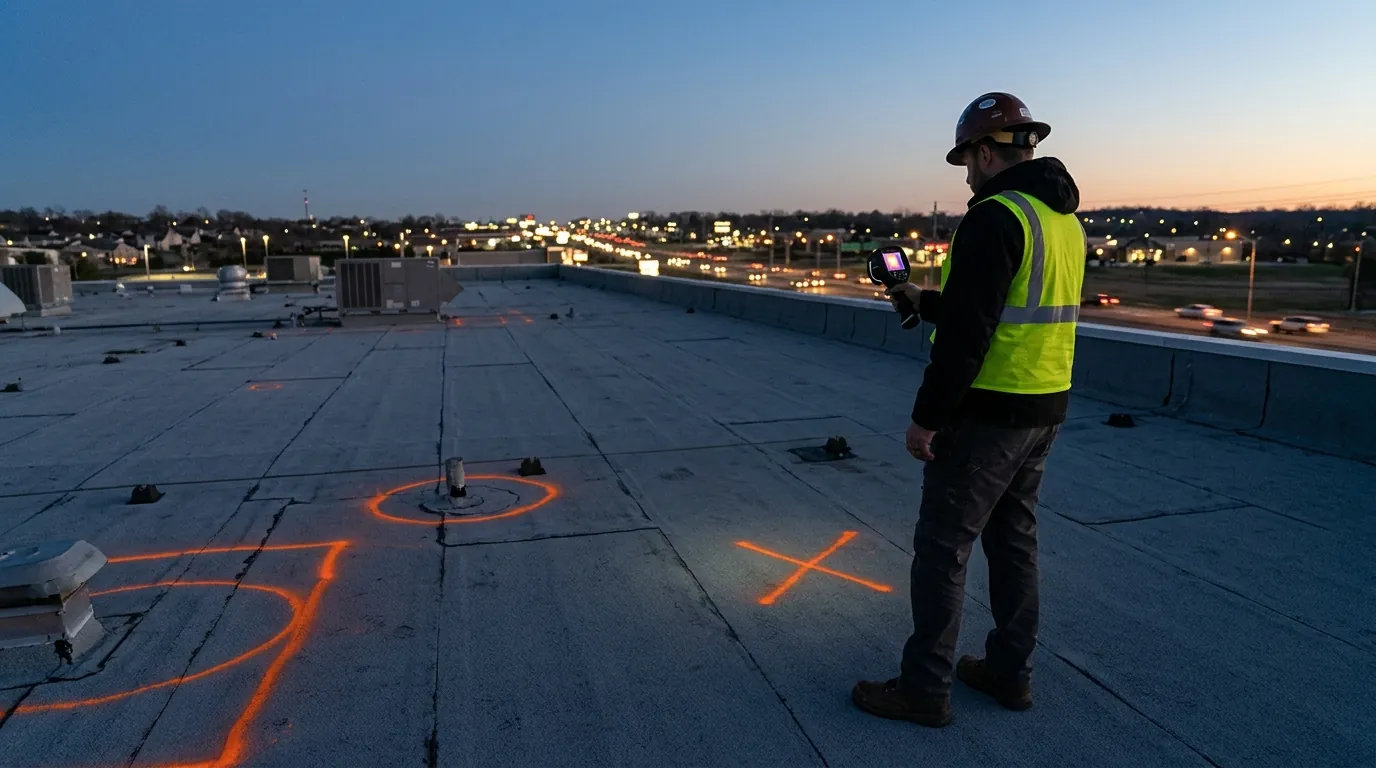
An infrared roof moisture survey uses a thermal camera after sunset to find wet insulation, because saturated areas hold daytime heat longer than dry areas. We mark the anomalies on the roof, cut cores to confirm them, and deliver a wet-area map with square footage. Owners use it to choose between repair, restoration, recover and replacement.
How a thermal camera sees water you cannot
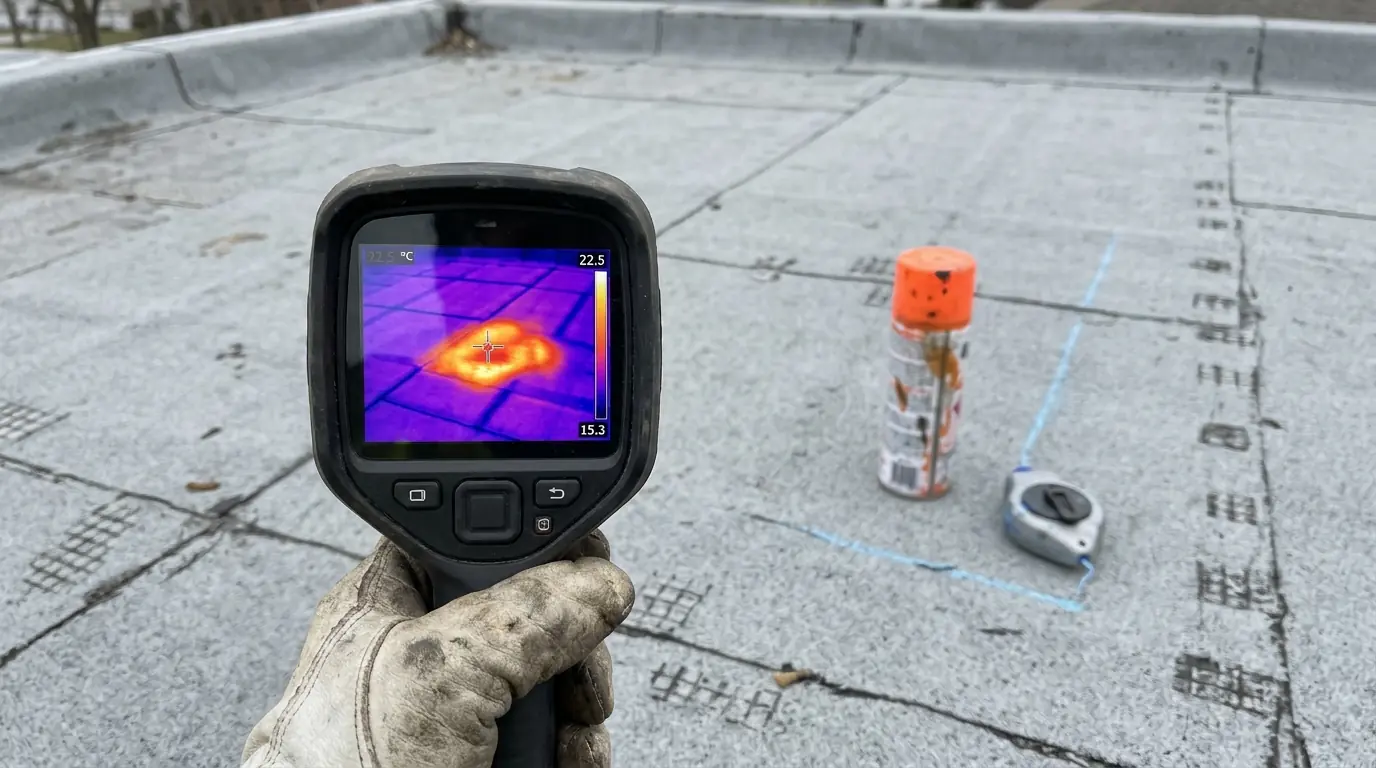
Wet insulation holds heat. During a sunny day, the whole roof warms. After sunset, dry insulation cools quickly, while saturated insulation, which has far more thermal mass, releases its heat slowly. A thermal camera held above the roof shows those slow-cooling zones as warmer patches against a cooler background. Thickness of the insulation matters too, so we read the pattern with the roof plan and not by color alone.
That is the whole principle, and it is why timing matters. We scan on clear, dry evenings with low wind, starting soon after sunset when the contrast is strongest. Cloud cover, rain, wind and a damp surface all blur the image. If conditions are poor, we reschedule instead of delivering a map we cannot defend. A good night is clear, still and dry, and on Middle Tennessee calendars those are most common in spring and fall.
An infrared image shows temperature differences, not water by itself. Warm spots can also be caused by thicker insulation, a mechanical unit below, a dark patch or a metal fastener line. That is why every survey includes core verification. The camera tells us where to look, and the core cut tells us what we are actually looking at. We never mark a roof as wet on the strength of the image alone.
How we run a survey, from daylight walk to final map
The survey starts in daylight and finishes after dark. Here is the sequence.
Daylight walk and grid layout
We walk the roof, note ballast, surface color changes, equipment shadows and drains, and lay out a chalk or tape grid so scan photos tie to locations. Paired photos let anyone match a thermal image to a spot on the roof.
Wait for the right night
We watch the forecast for clear skies, low wind, a dry roof and a sunny day before. If the day was overcast, we postpone the scan. A short delay costs less than a map nobody trusts.
Scan after sunset
Starting shortly after sunset, we walk the grid with a thermal camera and a visible-light camera, capturing paired images at set intervals. Slow, steady walking keeps the images sharp.
Mark anomalies on the roof
Warm zones are outlined in paint or chalk while the image is on screen. Obvious false readings, like ductwork heat from below, are noted. Notes on the plan record why each mark was made.
Verify with core cuts
The next day, we cut cores in marked zones and in nearby dry zones, measure moisture and record the layers. Each cut is patched the same day. Dry control cores give a baseline to compare against.
Draw the wet-area map
We convert the marks and core results into a scaled drawing that shows wet, suspected and dry areas with square footage. The scale and legend are printed so the drawing can go straight into a bid package.
Deliver findings and options
You get the map, paired images, core photos and a plain summary of how much of the roof is wet and what each repair route would involve. Questions are welcome by phone, any hour.
Infrared compared with other moisture detection methods
Infrared is one of two common tools for finding wet insulation. Each has places where it works and places where it does not.
| Infrared scan | Electrical capacitance meter | |
|---|---|---|
| How it works | Thermal camera at night reads heat retained by wet insulation | Hand meter walks a grid and reads the dielectric changes across the roof |
| Best on | Smooth membranes, large roofs, quick coverage | Small or complex roofs, daylight work, ballasted areas with care |
| Weak spots | Needs clear nights; ballast, metal and heavy shade interfere | Slower on big roofs; readings affected by metal below |
| Verification | Always confirmed with core cuts | Also confirmed with core cuts |
| Typical use | Survey before restoration, recover or replacement | Follow-up, small roofs and areas the camera cannot read |
When a Nashville building needs a moisture survey
These are the situations where an infrared survey saves more than it costs.
Before any recover
A recover over wet insulation traps moisture and can fail in a few years. The scan shows if the existing roof is dry enough to cover. A dry result lets the project move on with confidence.
Before a coating project
A large distribution roof off Murfreesboro Pike should be scanned before silicone goes on, because coating over saturated insulation does not fix it. Wet insulation under the coating would stay wet for years.
After repeated leaks that patches did not stop
A leak that reappears usually travels from a wet area. The scan finds the wet zone, which may be far from the stain. Stains on a ceiling tile often sit well away from the entry point.
After a flood or heavy storm
Water that gets into a roof after a major rain or tornado damage can sit in the insulation for months. A scan finds it. Hail damage and tornado debris can open the membrane in ways nobody sees.
On a building you are buying
A scan gives a buyer a square footage of wet insulation, which converts directly into a repair figure. The count also supports price negotiation before closing.
On a roof with unknown history
If previous owners left no records, the scan builds a baseline for future maintenance and budgeting. It also helps a new facility manager learn the roof quickly.
What an infrared survey costs
Survey pricing is driven by roof area and complexity. We quote after discussing the building, since conditions and access vary. Night work can add a small premium.
| Work | Typical range | What moves it |
|---|---|---|
| Infrared scan, roofs up to 50,000 sq ft | $0.07 to $0.16 per sq ft | Includes paired images and anomaly marking. |
| Infrared scan, roofs over 100,000 sq ft | $0.04 to $0.09 per sq ft | Lower per-foot cost at scale. |
| Core verification | $185 to $395 per core | Moisture reading, layer record, photos and same-day patching. |
| Wet-area map and summary report | $725 to $2,150 per building | Scaled drawing with square footage of wet insulation. |
What pushes a price up or down:
- Total area and number of roof levels to be scanned
- Surface type, since ballast, dark membranes and metal change readings
- Number of cores required to verify the scan
- Night-time access and tenant rules for after-hours work
- Weather delays that push the scan to a later night
Ranges reflect recent Middle Tennessee work and are not a quote; we price after a site visit. See the full Budget Guide.
What the wet-area map changes about your decision
The map turns an argument into a measurement. If cores show a small wet area near a drain, a repair and a coating can proceed, with the wet insulation cut out and replaced. If the wet area covers most of the field, restoration is off the table and the conversation moves to recover or replacement. Either way, the decision rests on numbers you can show your board.
The map also lets us price accurately. Wet insulation replacement is priced per square foot of affected area, so knowing the count means a firm range instead of a worst-case guess. For an office park on Lebanon Pike with five buildings, that can mean knowing which roofs get a coating and which get a tear-off. Those buildings often differ in age, so the map saves money roof by roof.
Finally, the map is a baseline. After repairs, a later scan can show whether new moisture has crept in. Owners with a large inventory of flat roofs often scan a building every few years to track changes. If you want that program, we can set it up with your maintenance visits. Tracking trends protects the capital plan.
How to prepare your roof for a night scan
A few steps on your side give us cleaner results and a faster survey.
- Share any roof plans, past leak logs and repair invoices
- Tell us where mechanical units and ductwork sit under the roof
- Arrange night access, including lighting and any alarm codes
- Let tenants and security know a crew will be on the roof after dark
- Move pallets, signage and loose debris that block scan lines
- Clear standing water from the roof surface before the scan day
- Tell us about recent rain, since a wet surface hides contrast
- Choose a daytime slot for core cuts after the scan
Why ballasted and metal roofs need a different method
Infrared works best on smooth membranes. Ballast stone insulates the surface and blurs the heat signature, and metal panels conduct heat so quickly that wet areas hide. On those roofs we lean on moisture meters, core cuts at a tight grid and sometimes interior thermal views of the ceiling. We tell you before the visit if the camera is the wrong tool for your roof, and what we will use instead. Honest limits make a better report than a confident guess.
Need infrared moisture survey on a Nashville building?
Call (615) 716-3057 any hour. We look at the roof, show you what we found and price the work before anything starts.
Where we do infrared moisture survey around Nashville
The ZIP codes below cover most of the buildings we work on. Every one links to its local page, and the full locations list has 62 more.
- Nashville 37219
- Downtown Nashville 37219
- East Nashville 37206
- Antioch 37013
- Madison 37115
- Donelson 37214
- Hermitage 37076
- Bellevue 37221
- Green Hills 37215
- Franklin 37064
- Brentwood 37027
- Murfreesboro 37130
- Smyrna 37167
- La Vergne 37086
- Mount Juliet 37122
- Lebanon 37087
- Hendersonville 37075
- Gallatin 37066
- Spring Hill 37174
- Columbia 38401
- Goodlettsville 37072
Work that often goes with infrared moisture survey
Repairs and new roofs on Mule-Hide, GenFlex, Polyglass and Henry systems, matched to what the building already has where we can.
Infrared Moisture Survey questions from Nashville owners
Why is an infrared roof survey done at night in Nashville?
After sunset, dry insulation cools quickly while wet insulation holds heat longer, which makes wet areas visible as warm patches. During the day the whole roof is hot and the contrast is lost. Clear, calm, dry nights give the best results.
How accurate is an infrared moisture survey on a flat roof?
The camera shows temperature differences, not water directly, so we verify with core cuts. Together, the scan and cores define wet areas reliably on most smooth membranes. On ballasted, metal or heavily shaded roofs, accuracy drops, and we may use meters or interior scans instead.
Can infrared detect leaks as well as wet insulation?
It finds moisture stored in the insulation, which is often the source of repeated leaks. It does not show a hole in the membrane. We use it alongside a daylight inspection and sometimes a flood test or smoke test to locate where water gets in.
How soon can you scan my roof if I have a purchase deadline?
Clear, dry evenings are needed, so timing depends on the forecast. Call the 24/7 line with your deadline and we will tell you the earliest realistic scan night and when you could have the map. Cores and report writing follow the scan.
Should I scan before or after I repair a leaking roof?
Before. A scan shows how far the water has spread so repairs and budgets reflect the true scope. Scanning after repairs can also help confirm that the work worked, and some owners do both, using the first map as a baseline for comparison.