Commercial roof maintenance plans in Nashville
Your roof only gets attention when a ceiling tile drops, and by then the repair costs more than the visit that would have prevented it. A scheduled plan catches small defects before tenants do.
- Spring and fall visits
- Drains cleared every visit
- Answered 24/7

Short answer
A commercial roof maintenance plan is a scheduled program of roof visits, usually in spring and fall, that clears drains, renews sealant, repairs small defects and records everything for warranty compliance. Most manufacturers require maintenance to keep a roof warranty valid. A plan costs a fraction of one emergency repair and helps roofs reach their full service life.
What a maintenance plan buys you that repairs do not
Repairs respond to damage. A maintenance plan prevents it. We visit twice a year, walk the roof against a written checklist, clear what blocks the drains, fix what is small enough to fix on the spot and write down what is not. You stop finding out about roof problems from tenants and start finding out from a report that landed a week before the next rain. The point is not to find more work. It is to keep small problems from turning into the kind of project that needs a budget request.
Most commercial roofs fail at the same handful of places: drains, flashings, penetrations and seams. These are the places a plan inspects first. A clogged scupper on a church in Hendersonville or a loose counterflashing on an apartment building in Smyrna is a ten-minute fix when found early. Left alone, the same issue becomes a wet ceiling and a wet insulation problem. We keep a running list of these spots for your building.
A plan also builds a paper record. Manufacturer warranties usually require owners to maintain the roof and to keep records, and an insurer or buyer may ask for the same history. With dated photos and visit logs on file, you can show the roof was cared for. Without them, you are left arguing from memory. Property managers who carry many roofs in a portfolio use the logs to rank which building needs money first.
What happens on each maintenance visit
Visits follow the same sequence every time, so changes show up in the log and nothing gets skipped.
Review the log and any tenant reports
Before going up, we read last visit's notes and any leak calls or ceiling stains reported since. That tells us where to look first. That keeps repeat problems from slipping through.
Clear drains, scuppers and gutters
Leaves, pollen mats, shingle grit and trash come out of every drain and overflow. We flush each line with water to confirm it runs. A drain that looks open can still be clogged one elbow down.
Walk the field and note changes
We check seams, patches, blisters, ponding and foot-traffic damage, and compare photos to the previous visit. Standing water and soft spots show up better against last time's pictures.
Inspect flashings and penetrations
Base flashings, counterflashing, pipe boots, curb corners and sealant joints are probed for gaps and loose terminations. Water follows the path of least resistance, and it starts at the edges.
Renew sealant and make small repairs
Dried sealant is cut out and replaced, loose fasteners are tightened, and small seam gaps are patched while we are there. Sealant is a consumable, and we treat it like one.
Photograph, log and report
Every action is dated in the roof log with photos. You get a short summary with items that need a bigger repair, priced as ranges. Larger items go on a short list with ranges, so you can plan instead of react.
Why spring and fall are the right two visits
Middle Tennessee weather gives a roof two hard seasons. We time visits to prepare for each and clean up after.
Late fall, after the leaves drop
Oak, maple and tulip poplar debris fills drains and scuppers by November. A visit then clears the roof before winter rain and freeze-thaw. Gutters and box gutters fill fastest.
Early spring, before storm season
Spring hail and straight-line wind arrive from March on. We check edge metal, coping and loose flashings before the first big front. Early spring is also the best time to find winter freeze-thaw splits.
After a hail or wind event
A storm visit is an extra stop on the plan, not a new contract. We document bruising and lifted details for any claim. The extra visit costs less than a claim dispute.
Before summer heat
Sealants dry and crack in July sun. A late spring check renews them while the roof is still cool enough to work on. We prefer to work early in the day when surfaces are cooler.
Before a lease renewal or sale
A recent log with photos reassures a tenant or buyer that the roof has been looked after. Photos and dates carry more weight than a verbal assurance.
Ahead of a warranty anniversary
Maintenance records dated before an anniversary or inspection keep coverage terms clear. Coverage terms differ, so we read yours.
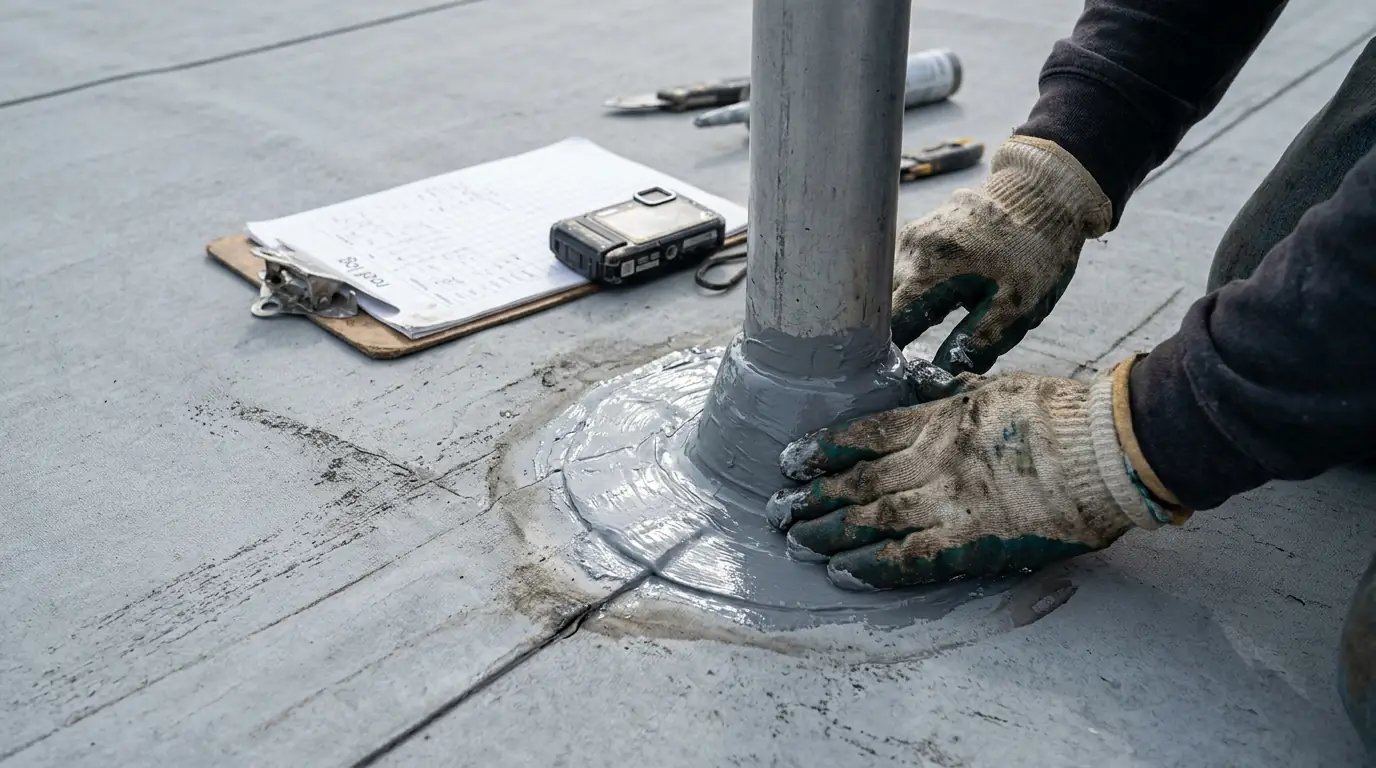
Maintenance plan versus waiting for leaks
Property managers choose between a planned program and a repair-on-demand approach. This shows how the two play out. The difference shows up mostly in cost swings and in the record you have.
| Scheduled plan | Repair when it leaks | |
|---|---|---|
| How problems are found | On a set walk, often before tenants notice | After a stain, a drip or a complaint |
| Typical scope | Small fixes, drain clearing and sealant on the visit | Emergency call, tarp or temporary patch, then a return trip |
| Warranty position | Dated logs and photos on file | Gaps in the record, harder to defend |
| Budget effect | Predictable annual line item | Irregular spikes tied to weather |
| Roof life | Defects fixed early help the roof reach its design life | Water has time to wet insulation and rust decks |
Warranty compliance logs, in plain terms
A manufacturer warranty on a commercial roof usually comes with conditions. Common ones include periodic inspections, prompt repair of defects, clearing of drains and keeping foot traffic off the membrane. If a claim is filed and the owner cannot show maintenance, the manufacturer can deny coverage. The log is the proof. Read the exclusions in the warranty document, because the wording differs from one maker to the next.
Our logs record each visit date, who walked the roof, what was cleaned, what was repaired and what we recommended. We attach photos. Where the warranty names a specific inspection checklist or interval, we follow it and file the paperwork the way the manufacturer expects. If you do not know what your warranty requires, bring us the document and we will read it with you.
The log also helps with transfer. When a building is sold, some warranties can move to the new owner if records are in order. A buyer who sees two years of dated visits, photos and fixes can treat the roof as an asset with a known history instead of a question mark. That makes the log a selling point.
What maintenance plans cost
Plan pricing follows roof area, number of drains and the amount of detail work. We quote after a site walk, since each building differs. Multi-building campuses can be priced as one program.
| Work | Typical range | What moves it |
|---|---|---|
| Twice-yearly plan, roof under 20,000 sq ft | $0.09 to $0.17 per sq ft per year | Two visits, drain clearing, small repairs and logs. |
| Twice-yearly plan, roof over 60,000 sq ft | $0.05 to $0.11 per sq ft per year | Lower rate per foot at scale; same two-visit schedule. |
| Added storm-response visit | $385 to $940 per visit | Walk, photos and temporary protection if needed. |
| Sealant renewal at penetrations | $14.50 to $38.75 per penetration | Cut out old sealant and renew; price rises with detail size. |
What pushes a price up or down:
- Roof area and how many separate roof levels there are
- Number of drains, scuppers and downspouts to clear
- Quantity of rooftop equipment and penetrations to inspect
- Presence of nearby trees dropping leaves and seed pods
- Roof access method and whether safety anchors already exist
Ranges reflect recent Middle Tennessee work and are not a quote; we price after a site visit. See the full Budget Guide.
What to ask any contractor offering a roof maintenance plan
A plan is only worth buying if the scope is written down. Use these questions to compare offers.
- How many visits per year, and in which months?
- Are drains flushed with water to confirm flow, or only cleared by hand?
- Which small repairs are included, and which are billed separately?
- Do you photograph and date each visit in a roof log?
- Will the log follow the manufacturer's inspection requirements?
- What is the response time if a leak starts between visits?
- How are larger findings priced and reported to the owner?
- Is there an extra visit after major hail or wind events?
The December 2023 tornado showed why lists matter
After the December 9, 2023 tornado crossed Madison and the Hendersonville area, many building owners had no clear list of their rooftop equipment, drains or past repairs. A maintenance plan gives you that list in writing. When storms hit, we know where to look first and can tell you what changed since the last visit. Call the 24/7 line the moment you spot damage; we will check the log and start from there. Keep the list updated whenever equipment changes.
Need roof maintenance plans on a Nashville building?
Call (615) 716-3057 any hour. We look at the roof, show you what we found and price the work before anything starts.
Where we do roof maintenance plans around Nashville
The ZIP codes below cover most of the buildings we work on. Every one links to its local page, and the full locations list has 62 more.
- Nashville 37219
- Downtown Nashville 37219
- East Nashville 37206
- Antioch 37013
- Madison 37115
- Donelson 37214
- Hermitage 37076
- Bellevue 37221
- Green Hills 37215
- Franklin 37064
- Brentwood 37027
- Murfreesboro 37130
- Smyrna 37167
- La Vergne 37086
- Mount Juliet 37122
- Lebanon 37087
- Hendersonville 37075
- Gallatin 37066
- Spring Hill 37174
- Columbia 38401
- Goodlettsville 37072
Work that often goes with roof maintenance plans
Repairs and new roofs on Mule-Hide, GenFlex, Polyglass and Henry systems, matched to what the building already has where we can.
Roof Maintenance Plans questions from Nashville owners
How often should a commercial roof in Nashville have a maintenance visit?
Twice a year, in spring and fall, is the usual baseline, with an extra visit after any severe storm. Fall clears leaves before winter. Spring catches storm damage and prepares the roof for summer heat. Roofs under trees or with many penetrations may need more.
Does roof maintenance keep my manufacturer warranty valid?
Many manufacturer warranties require regular maintenance and prompt repair, and they may deny claims without records. We keep dated logs and photos for each visit. Read your warranty, and bring it to us if you want help matching the plan to its terms.
What does a roof maintenance plan include for a church or multifamily building?
The same core work: drain clearing, flashing and seam checks, sealant renewal and a photo log. For churches we also check steeple and dormer details, and for multifamily buildings we check balcony roofs and many small penetrations. The written scope lists exactly what is covered.
Can maintenance plans extend the life of my flat roof?
Often they help a roof reach its expected life by catching leaks, clearing drains and renewing sealant before water gets into the insulation. We cannot promise a number of years, because age, weather and original installation all matter, but maintained roofs usually fail later than ignored ones.
What happens if a leak starts between maintenance visits?
Call the 24/7 line. We review your log, send a crew to find the source and make a temporary repair if needed. A larger repair gets priced as a range after we see the damage. Having the log on hand makes finding the source faster.