Commercial roofing in Wilson County, TN (37087)
Wilson County stretches from the Mount Juliet side of Percy Priest Lake out to Lebanon and the farm country beyond. Its roofs include big church sanctuaries, school-area buildings, strip retail and light industrial space, and each needs a different fix.
- Buildings
- Churches, retail strips, light industrial, metal buildings
- Corridor
- I-40, Lebanon Road, Highway 109, Mount Juliet Road
- Watch for
- Valley flashing, steeple leaks, fastener back-out
- Access
- Sunday schedules, lifts for steep roofs
Short answer
Wilson County commercial roofs include steep church roofs, low-slope retail and industrial membranes, and metal buildings in the rural stretches. Leaks usually come from flashing at steeples and valleys, drains on flat sections, and aging fasteners on metal. We find the source first and quote repair or replacement after a site visit.
Two very different markets: Mount Juliet and Lebanon
Mount Juliet sits close to Nashville and has filled with retail centers, medical suites and churches along I-40 and Mount Juliet Road. The March 3, 2020 tornado damaged parts of this area, and some repaired roofs from that rebuild are now old enough to need a second look at their flashings and edges.
Lebanon, the county seat and home of Cumberland University, has a longer commercial history. Buildings around the square and along Lebanon Road include older brick structures with built-up or modified roofs next to newer metal buildings on the edges of town. Watertown and the rural parts of the county add farm-supply and storage buildings with exposed-fastener panels.
Rural parts of Wilson County bring a different mix of buildings: feed stores, equipment sheds, small manufacturing shops and community halls. Most have metal roofs that have been through many seasons of sun and storms. Some have been patched with roofing cement more than once, and every patch hides a rusted panel or a loose screw.
We try to give owners honest options for these buildings. A full replacement may not be worth it on a storage shed. A coating or fastener replacement may stretch the roof several more years at lower cost. Other times the panels are too far gone, and we say so rather than sell a repair that won't last.
Where church and community-building roofs usually leak
Wilson County has many congregations, and their roofs share a few weak spots. We check these first.
Steeple and bell tower bases
Where a steeple meets the main roof, flashing takes constant movement. Small gaps let water run down interior walls.
Roof-to-wall transitions
Fellowship halls and additions often join the sanctuary at different heights. The step flashing there is a common failure.
Valleys
Leaves and pine needles pack valleys, hold moisture and wear through shingles or metal in a few seasons.
Low-slope sections over entries
Covered walkways and entry canopies often have flat membrane sections with small drains that clog easily.
Skylights and clerestory windows
Old glazing seals fail, and curb flashing around skylights is easy to miss during routine checks.
Gutter overflow
Undersized or clogged gutters send water behind fascia and into the soffit, which shows up as ceiling stains inside.
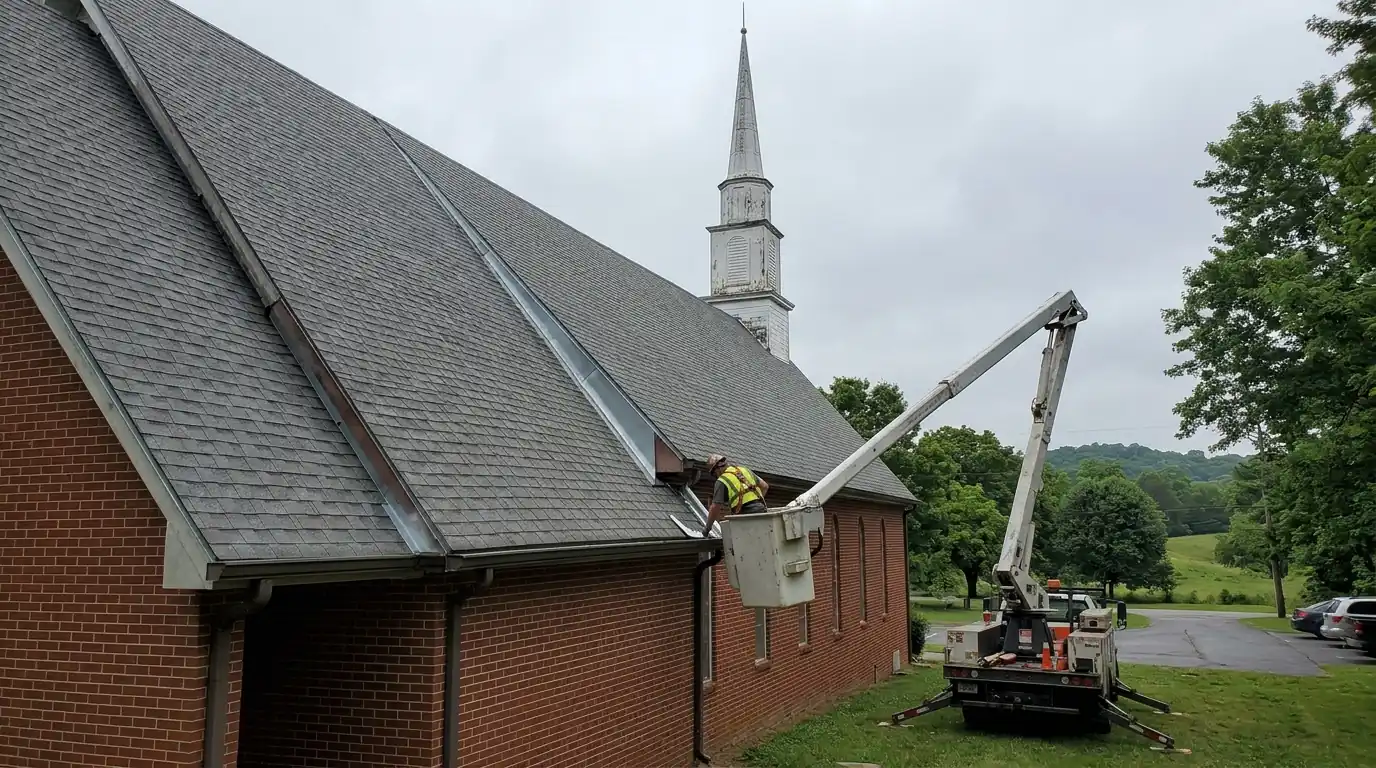
Working around Sunday services and weekday programs
Church committees often want repairs done between services, or on a schedule that won't interrupt a funeral or a weekday preschool. We plan the work around your calendar, put up ground protection at entrances and keep ladders and hoists away from parking areas used for Wednesday evening gatherings.
For larger replacements, we break the job into phases so the building stays dry at every stage. Before any membrane or panel comes off, we confirm the tear-off area can be dried in the same day, and we keep tarps staged in case the forecast turns.
Hail and wind are the regular weather threats, but freeze-thaw cycles in winter also matter. Water that gets into a small crack freezes, expands and widens it. By spring, a pinhole has become a gap. A winter walk after a hard freeze can find those cracks while they are still cheap to fix.
Summer heat is the other side of it. Dark roofs on a hot afternoon can reach temperatures that soften sealants and stress seams. Metal panels expand, and loose fasteners walk. We schedule inspections in both seasons for buildings on a maintenance plan so changes show up in photographs, not as surprise leaks.
What a Wilson County property manager should check each spring
A short walk after winter catches small problems before summer storms find them.
- Clear leaves and debris from gutters, scuppers and drains
- Look for lifted edge metal, loose coping and exposed fasteners
- Check sealant at penetrations, vents and rooftop unit curbs
- Walk the ceilings inside for new stains or soft tiles
- Photograph the roof so changes are easy to compare next year
- Call us if a stain appears after any heavy rain or wind event
Storm history worth knowing
Wilson County sits in a part of Middle Tennessee that sees spring hail and straight-line wind, and the 2020 tornado path crossed Mount Juliet. Roofs repaired quickly after that storm sometimes carry temporary details that were never upgraded. If your building was patched in a hurry, a calm-weather survey can show whether the repair was ever finished properly.
Roofing work we do most in Wilson County
Six services building owners here call about most. The full catalog has 45.
Roof trouble in Wilson County?
Call (615) 716-3057 about a building in Wilson County (37087). The line is answered 24/7, and the first question is always where the water is showing.
Roofing questions from Wilson County
Do you repair church roofs in Lebanon and Mount Juliet?
Yes. We work on steep shingle and metal roofs, low-slope sections and steeple flashing. We schedule around services and weekday programs, and we tarp quickly when water is entering a sanctuary.
What should a Wilson County church committee know before replacing a roof?
Get the roof surveyed first, decide whether repair or replacement fits the budget, and compare bids on the same scope. Ask who handles permits and how the building is protected if weather changes mid-job.
Can you fix leaks on metal buildings outside Lebanon?
Usually. Most leaks on exposed-fastener metal come from backed-out screws, failed washers or sealant at laps. We replace fasteners, reseal laps and flashings, and tell you if the panels are too far gone.
Is there a 24/7 number for storm damage in Wilson County?
Yes, (615) 716-3057 is answered around the clock. After storms we focus first on stopping water with tarps or temporary repairs, then plan the permanent fix once conditions allow.