24/7 emergency roof leak repair in Nashville
Water is dripping onto inventory, tenants or electrical gear right now, and waiting until Monday isn't an option. Phone the 24/7 line and a roofer answers, then a crew heads out to stop the water first and sort out the permanent fix second.
- Answered 24/7
- Interior protection first
- Temporary seal, then permanent fix

Short answer
An emergency roof leak repair stops active water entry within hours using a temporary seal, patch or cover, and protects what's inside the building. It isn't the final repair. Once the weather clears, the roof gets surveyed and permanently fixed. Call (615) 716-3057 any hour; after-hours work is priced higher than daytime work.
The first hour of an active leak decides how much damage follows
Water doesn't wait for a roofing schedule. It soaks ceiling tile within minutes, runs down wall cavities to electrical panels, and lifts flooring that costs more to replace than the roof repair itself. In the first hour, the priority is not a perfect roof. It's keeping water off people, equipment and stock while a crew is on the way.
When you call (615) 716-3057, we ask where the water shows, what's under it, and what the weather is doing. Then we tell you what to do inside the building right now, from moving pallets to shutting off a circuit, so the damage stops growing while we drive over. A crew carries tarps, mastic, patch membrane and a wet-vac, so most visits start work on arrival.
We work at night, on weekends and in rain when it's safe on the roof. If lightning, ice or sustained high wind makes roof access dangerous, we say so and cover the interior until conditions allow a crew up top. Insurance matters in these first hours too. Photos of the damage, the weather that night and the temporary measures all support a claim later. We record what we find and what we did, with timestamps, so your adjuster sees a clear sequence instead of a rushed story. We'd rather say a roof can't be worked safely than rush a crew up.
Which leaks are true emergencies and which can wait a day
Not every drip needs a midnight call. These are the situations where we'd push you to phone us immediately.
Water near live electrical
Wet light fixtures, panels or switchgear are a safety problem first. Shut power to the affected circuit if it's safe to do so, then call.
Ceiling tile or drywall sagging
A bulging ceiling is holding a pocket of water that can drop without warning. It needs relief and a roof seal quickly.
Active flow during rain
Water running, not just staining, means an open path in the membrane or flashing. It won't slow until the opening is closed.
Stock, records or equipment at risk
Pharmacies, server rooms, retail inventory and food storage lose value fast when wet. Speed here saves real money.
Storm-opened edges or missing panels
Flapping membrane or loose metal can tear further in the next gust. A temporary hold-down prevents a small opening from growing.
Leak at an elevator or stairwell
Water in vertical shafts can reach controls and create slip hazards. Building safety teams usually want these closed the same day.
What your staff can do inside before the crew arrives
These steps cost nothing and cut the damage while we're traveling to the building.
- Move inventory, files and electronics away from the drip line.
- Set buckets or trash cans under active drips and lay plastic over shelving.
- Poke a small hole in a bulging ceiling tile over a bucket to release trapped water.
- Switch off power to affected circuits if fixtures are wet and it's safe to reach the panel.
- Take photos and video of the damage with a timestamp for your insurer.
- Note which rooms are affected, including the floor above if there is one.
- Unlock the roof hatch or have the stair tower access code ready.
How we stop the water and set up the permanent repair
Emergency work is quick, but it still follows a sequence that keeps the temporary seal from becoming the new leak.
Triage by phone
We confirm location, roof type, building use and the weather forecast, and give you interior steps to take immediately.
Safety walk
Before anyone works, the crew checks for wet surfaces, soft decking, wind exposure, overhead power lines and fall protection needs, and sets anchor points or guardrails where the roof edge is unprotected.
Find the entry point
We trace upslope from the stain, checking seams, flashings, drains and penetrations rather than patching the spot above the drip.
Temporary seal
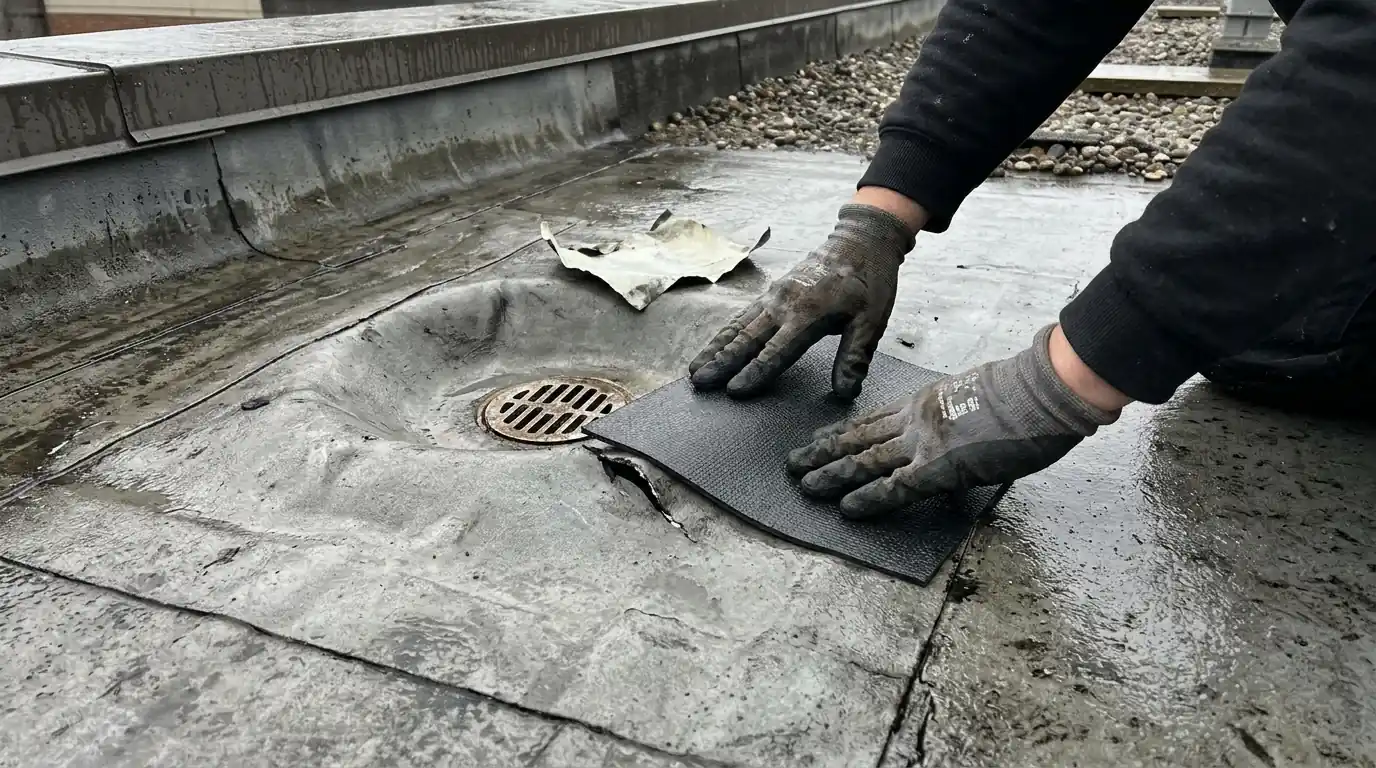
Depending on the surface, that's a reinforced mastic patch with embedded fabric, a peel-and-stick membrane section, or a tarp secured over the area. The choice depends on how wet the substrate is and how long the seal has to hold.
Interior protection
We set up diversion, remove wet ceiling tile if needed, and run a wet-vac so water doesn't spread to dry areas.
Photo record and written note
You get photos, the location of the opening and what the temporary seal is expected to hold through.
Schedule the permanent repair
Once the roof is dry, we survey for wet insulation and quote the lasting fix, often within the same week.
Temporary seals: what holds, what doesn't, and for how long
The right emergency measure depends on what's leaking and how wet the surface is. Here's how we choose.
| Mastic and fabric patch | Peel-and-stick patch | Tarp or sheeting | |
|---|---|---|---|
| Best for | Small seam openings and punctures | Larger tears on a clean, dry surface | Wide openings, storm damage, missing sections |
| Wet surface tolerance | Moderate with the right product | Low, needs drying and cleaning | High, can be laid over wet areas |
| Typical lifespan | Weeks to a few months | Months if the surface was clean | Days to a few weeks |
| Wind resistance | Good once cured | Good with rolled edges | Poor without secure ballast and fasteners |
| Follow-up needed | Permanent weld or replacement | Permanent section repair | Full dry-in or replacement |
What after-hours leak calls cost compared with scheduled repairs
Emergency pricing reflects crew availability, night or weekend labor and urgency. We quote after we see the roof, and these ranges are a starting point.
| Work | Typical range | What moves it |
|---|---|---|
| Emergency call-out and first-hour stabilization | $420 to $890 per visit | Covers travel, safety walk and a basic temporary seal on a small opening. |
| Temporary patch of a single failed seam or puncture | $315 to $745 per repair | Higher if wet conditions require extra drying and prep. |
| Tarp over a storm-opened area | $1.85 to $3.40 per sq ft | Includes ballast and perimeter securing; steep or tall buildings cost more. |
| Interior water extraction and ceiling relief | $275 to $640 per room | Limited to stopping spread; full drying and repair is a separate scope. |
What pushes a price up or down:
- Time of day and day of week when the crew is dispatched.
- Roof access, including hatches, ladders and crane or lift needs.
- Size of the opening and whether the surrounding membrane is sound.
- Rain or wind during the call, which slows safe work.
- Whether wet insulation needs temporary removal.
- How many separate leak points the same storm created.
Ranges reflect recent Middle Tennessee work and are not a quote; we price after a site visit. See the full Budget Guide.
Three common after-hours leak scenarios and how each one is handled
Picture an apartment complex off Gallatin Pike where a second-floor ceiling comes down at 1:40 a.m. The roof is ballasted EPDM and the split sits at a drain sump. We would tarp the sump, redirect the drip into the drain line and keep the unit livable overnight. The permanent fix is a new drain flashing and a re-set sump pan once the gravel is dry.
Now a pharmacy in a Hermitage strip center with water on shelving beside a rooftop unit. The unit isn't the problem; the curb flashing has pulled loose at one corner. A peel-and-stick patch stops the water that night. The following week we rebuild the curb wrap and add a cricket behind it, because ponding against the curb is what pulled the seal in the first place.
Last, a church off Lebanon Pike with a drip on the Saturday before a funeral. The cause is a missing run of coping at the parapet after a windy week. We would secure a temporary metal cap, keep the sanctuary dry for the service, and return Monday to replace the coping and check the wall flashing beneath it for water damage.
In all three cases the pattern is the same. Stop the water, protect what's underneath, document everything, then come back in dry weather with the right materials. The permanent repair is almost never the same product as the temporary one, and the temporary one should be planned for removal rather than quietly left in place for a year.
Why the temporary fix has an expiration date
Emergency seals are built to buy time, not to carry a building through a Tennessee summer or a winter freeze-thaw cycle. Mastic dries out, tarps flap loose, and peel-and-stick patches lose grip when dirt gets under the edge. If your emergency repair is still holding after six months, that's luck rather than design. We mark each temporary seal in your photo report and recommend a permanent repair date so it doesn't become the next call at midnight.
Need emergency roof leak repair on a Nashville building?
Call (615) 716-3057 any hour. We look at the roof, show you what we found and price the work before anything starts.
Where we do emergency roof leak repair around Nashville
The ZIP codes below cover most of the buildings we work on. Every one links to its local page, and the full locations list has 62 more.
- Nashville 37219
- Downtown Nashville 37219
- East Nashville 37206
- Antioch 37013
- Madison 37115
- Donelson 37214
- Hermitage 37076
- Bellevue 37221
- Green Hills 37215
- Franklin 37064
- Brentwood 37027
- Murfreesboro 37130
- Smyrna 37167
- La Vergne 37086
- Mount Juliet 37122
- Lebanon 37087
- Hendersonville 37075
- Gallatin 37066
- Spring Hill 37174
- Columbia 38401
- Goodlettsville 37072
Work that often goes with emergency roof leak repair
Repairs and new roofs on Mule-Hide, GenFlex, Polyglass and Henry systems, matched to what the building already has where we can.
Emergency Roof Leak Repair questions from Nashville owners
How fast can a crew reach my Nashville building for an active roof leak?
It depends on traffic, weather and where you are, but we dispatch as soon as the call is triaged. Downtown, Germantown and East Nashville are often quick, while Wilson, Sumner or Maury County buildings take longer. We tell you an arrival window on the phone.
Will the emergency repair void my roof warranty?
Not if it's done and documented properly. Temporary seals are generally accepted when they're removed or replaced by a permanent repair, but warranty terms vary. Send us the paperwork when you can, and we'll note materials used and photos for your records.
Can you repair an active roof leak while it is still raining?
Often we can place a temporary seal in light rain if the roof is safe to walk. Heavy rain, lightning, ice or strong wind stop roof work. In those cases we protect the interior, dry out the area and return when conditions allow.
Do I need to move tenants or stock out during emergency leak repair?
Usually only the area directly below the leak. We ask what's under the opening, and you may need to move inventory, shut off a circuit or clear a stairwell. The roof work itself rarely requires a full evacuation unless there's a structural concern.
What happens after the emergency repair stops the leak?
We schedule a dry-weather roof survey to find the original failure, check for wet insulation and quote the permanent fix. For minor issues that means a seam or flashing repair. For widespread damage, it may mean a section or full roof replacement.