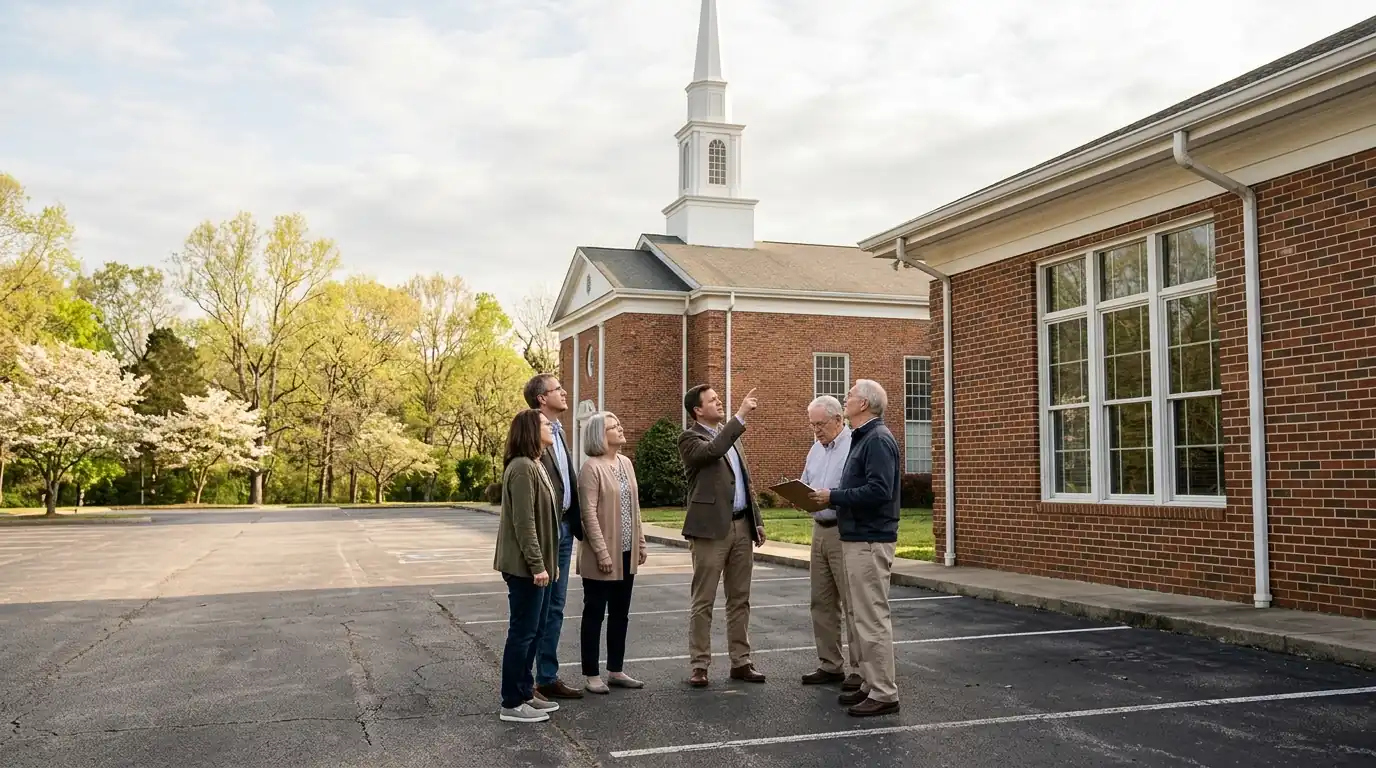
Why roof requests stall in committee
Most board members have never stood on a roof. They see a number, a contractor's name and a reason to worry, and then they hear a different opinion from the neighbor or the deacon who once did some roofing. Without a common set of facts, the safe move is always to wait one more meeting.
Waiting feels like it costs nothing, but it does. Prices change, a small leak turns into a ceiling repair in the sanctuary or a unit owner's living room, and a storm can force the decision on the worst possible terms. Your job as the person bringing the request is to make the cost of doing nothing as visible as the cost of acting.
A good package answers four questions before anyone asks them: what is wrong, what are our choices, what will it cost, and when do we need to decide. Keep it short enough that a volunteer board can read it in ten minutes, and put the detail in an appendix for those who want it.
Build the board package in five moves
This works for a church building committee, an HOA board with a management company or a condominium association with multiple roofs.
Get the roof assessed
A walk, a moisture scan and a few cores give you facts. We write up the findings with photos and a plain summary.
Define three options
Repair, restore or recover, and replace. Each gets a price range, expected life and what it leaves unsolved.
Choose a recommendation
Boards want guidance. Say which option you support and why, in two or three sentences.
Show how it gets paid for
Reserve balance, special assessment, loan or phasing. The board needs a funding path, not only a price.
Ask for a dated decision
Propose a vote at a named meeting and explain what happens if it slips a season.
Show the problem with photos and cores
Photographs persuade where adjectives do not. A close-up of a split seam, a clogged drain, ponding water after a rain and a stained ceiling directly below tell the story faster than a paragraph about aging membranes. Label each image with its location on the building so that the board can follow along.
A core sample is even better. When we cut a core, we pull a round plug showing every layer down to the deck. Wet, dark insulation shows up immediately and cannot be argued with. Passing the actual sample around the table, or showing a close photo of it with a ruler beside it, makes the discussion concrete in seconds.
Include a simple moisture map as a single page. Shaded areas show where insulation is wet, and the percentage of the roof affected is written beside it. Many boards realize at that moment that a quick patch cannot fix a roof where a large share of the insulation is saturated, and the conversation moves from whether to act to how.
Presenting three options without confusing anyone
Use the same rows for each option so the board can compare them. These are general ranges for typical low-slope roofs, and actual costs change with size, access, deck condition and system choice. We quote after a site visit.
| Repair and maintain | Restore with coating or recover | Replace | |
|---|---|---|---|
| Best fit | Dry, sound roof with isolated problems | Dry insulation, one layer, solid deck | Wet insulation, two layers or failing deck |
| Typical range | $0.09 to $0.27 per sq ft yearly, plus repairs | $1.85 to $3.60 coated or $5.40 to $9.15 recovered | $8.25 to $14.70 per sq ft |
| Added life | A few years if patched promptly | Roughly 10 to 15 years for a coating | A full new roof life |
| Disruption | Minimal, short visits | Moderate, some rooftop activity | Highest, tear-off noise and debris |
| Risk if delayed | Leaks spread to ceilings and finishes | Wet areas widen and rule out the option | Emergency replacement at storm-season prices |
Phasing, reserve funds and when to hold the vote
If the full price is more than the board can approve in one vote, phasing can help. A church with a sanctuary, a fellowship hall and a classroom wing can replace the worst section first, then the rest over two or three years. An HOA with several buildings can do the same, starting with the roofs showing wet insulation.
Phasing has trade-offs the board should hear plainly. Mobilization costs repeat, the later phases face price changes and the manufacturer may need compatible systems at tie-in points between roofs. In return, you spread the cost and keep the worst leaks from continuing while you wait for funds.
Reserve funds are built for exactly this. Check your reserve study or reserve policy before the meeting, because many HOA documents set rules for how the money may be used and when a special assessment requires an owner vote. Bring the current balance and the study's roof line item so members can see the plan was anticipated.
Churches often have restricted gifts, building funds and capital campaigns. Be clear which pool the roof draws from, and whether a congregational vote is needed under the bylaws. A well-timed update to the congregation, with a photograph and a short explanation, can raise support before the vote rather than after it.
Middle Tennessee gets spring hail, straight-line wind and the occasional tornado, as the March 2020 and December 2023 storms showed. Roofing crews fill up in late spring and early fall, and material delivery times stretch after major weather. A vote in winter lets you order, schedule and notify members or the congregation before the busy season. A vote in June often means waiting until fall with a roof you already know is failing.
Talking to members before the meeting
Votes are often decided before anyone sits down. A short note to board members a week ahead, with the one-page summary and two photographs, lets them ask questions privately and arrive ready. Surprises in the room tend to produce delay, and informed members tend to produce decisions.
For an HOA, a brief update in the newsletter or at the annual meeting helps owners understand why dues, reserves or an assessment are on the table. Show the roof, not just the number. Owners who have seen a stained ceiling or a wet core are far less likely to treat the request as routine spending.
For a church, invite the trustees or building committee to a short rooftop walk with the contractor, safety gear provided, or share a photo set at a Sunday announcement. People support what they understand. If someone on the board has roofing or construction experience, ask them to review the scope and speak to it in the meeting.
What to put in the one-page summary
A single page that sits at the front of the packet and gets read before the meeting.
- Building name, roof area in square feet, current system and approximate age
- Two or three photographs of the worst conditions, with locations noted
- The moisture scan result and the core findings in one sentence each
- Three options with price ranges, expected life and what each leaves unsolved
- Your recommendation and the reasoning in three sentences
- Funding source, reserve balance and any special assessment or loan needed
- A proposed vote date and the latest start date that still avoids storm season
- What happens if the decision slips: interior damage risk and likely price movement
Objections boards raise, and honest answers
Expect these questions. Prepare a short answer for each, and bring the contractor to the meeting if you can.
Can we just patch it again
Sometimes yes. If wet insulation is limited, patching works. If repair invoices keep rising, show the total and compare it with the cost of a new section.
Why does the price vary between bids
Scope, insulation thickness, edge metal and warranty differ. A line by line comparison explains the gap.
Can we wait until next year
Possibly, but say what a hard winter or a spring hail season could do to the interior, and how much that costs.
Will insurance cover it
Insurance pays for sudden storm damage, not for age or wear. Keep claims and replacement planning separate.
Is the congregation or owner base going to accept this
Share the photographs early. People respond to evidence more than to requests for money.