What we do and what we do not do
We are roofers. After a storm we inspect the roof, document damage, tell you what we find and price the repair or replacement. We do not act as public adjusters, we do not negotiate with your carrier on your behalf and we do not give legal or coverage advice. If you want someone to argue the claim, that is a separate professional.
What we can offer is clear evidence. Photographs, measurements, core samples and moisture readings give your insurer, your adjuster or your own representative something concrete to work from. A claim built on specific findings is easier to evaluate than one built on a general complaint that the roof looks worse since the storm.
Policies differ on deadlines, deductibles and what counts as storm damage. Some carry a separate wind and hail deductible, some exclude cosmetic damage to metal, and some limit payment on older roofs. Read yours, or ask your agent early, before you pay for any repair beyond emergency protection. Early questions save expensive mistakes.
We will explain our findings in plain language and walk the roof with your adjuster or representative if invited. We keep our reports factual, with measurements and photographs, and we avoid language that argues coverage. That keeps the document useful to everyone reading it, including a carrier that wants evidence instead of opinions.
What to capture in the first week
Evidence is easiest to gather before the roof is patched, walked on heavily or weathered by the next storm.
Write down the event
Record the date, time, local reports and any alerts. Note hail size reports and wind gusts if available from weather services.
Photograph widely first
Take overall shots of each roof section, then drift in to close images of specific damage with a scale reference such as a coin or ruler.
Mark and count
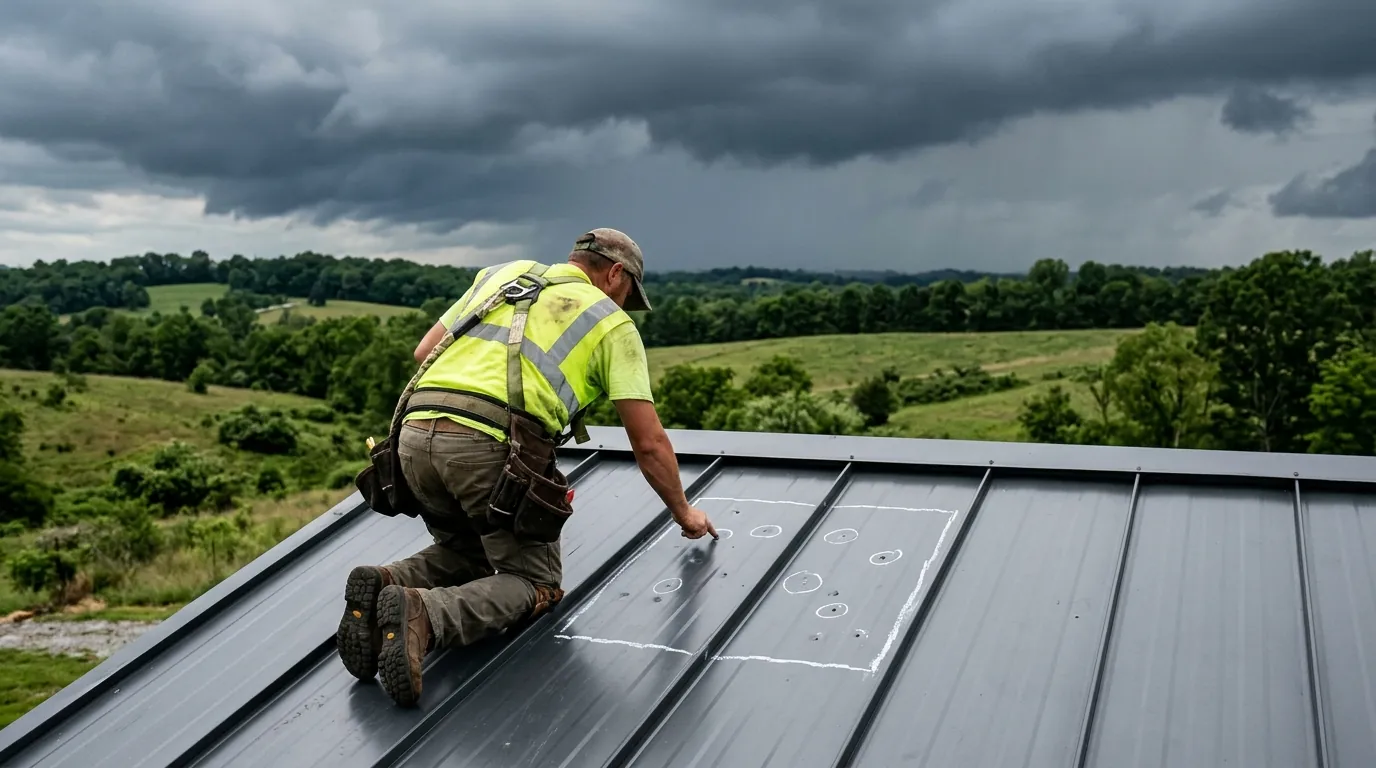
Chalk or tape a test square on the roof, commonly ten by ten feet, and count the hits inside it.
Look at everything metal
Dents in vents, flashing, coping and units show hail size and direction, and carriers often use them as indicators.
Protect from further loss
Temporary tarping or emergency repairs are usually expected. Keep receipts and photograph the work.
Test squares and what they show
A test square is a defined area, usually marked on each slope, where we count and measure damage. On a metal roof we look for dents, fractured coatings and damaged seams. On a single-ply membrane we look for bruising, punctures and fractures in the sheet. The count per square gives a pattern, not just an impression of damage.
Direction matters. Hail usually falls at an angle, so the windward slope shows heavier damage. Documenting each slope separately helps explain why one side may need more work than another, and it keeps a light-damage slope from being used to argue down a heavily damaged one. Mark each slope on a simple sketch of the roof.
Metal panels can have cosmetic dents that do not affect water shedding. Your policy may treat cosmetic damage differently from functional damage, so ask your agent about that exclusion before assuming dents will be covered. We record the dent size and count either way, and describe whether the metal still sheds water.
Square size and method vary by carrier and by roof type, so ask your adjuster what they expect before you spend time marking the roof. Whatever the size, keep the method the same across slopes and write down how you counted. Consistent counting is more useful than a perfect grid.
Damage that is easy to miss from above
Hail and wind leave quiet damage. These are the items that get overlooked in a quick walk.
Membrane bruising
Hail can crush insulation under a membrane without breaking the surface. The bruise shows later as a leak.
Cracked or lifted seams
Wind uplift can pull on seams and flashings, creating thin openings that leak in the next rain.
Displaced coping and edge metal
Straight-line wind loosens fasteners and rolls metal edges, exposing the layers below.
Damaged skylights and hatches
Domes crack and gaskets shift, but the damage looks minor from a ladder.
Wet insulation
Water can enter through tiny breaks and spread for weeks before a ceiling stain appears.
Debris impact
After the March 2020 and December 2023 tornadoes, flying debris punctured many roofs far from the storm center.
Core samples and moisture scans
When bruising is suspected, a core sample shows what the surface cannot. We cut a small circle through the membrane and insulation, examine the layers and then patch the cut properly. Cores in damaged and undamaged areas let us compare. They also confirm whether insulation is crushed, wet or intact, and whether the damage is fresh.
Moisture scans extend the picture across the whole roof. An infrared or capacitance survey outlines wet insulation and tells us where to cut cores. The scan will not say what caused the moisture, so the core and the roof history matter. A wet area that predates the storm belongs to a different conversation.
Date everything. A roof that tested dry last spring and wet this spring tells a clear story, which is why older reports are worth keeping. If you have no earlier survey, the cores can still show whether the moisture is recent by the condition of the insulation facers and the fasteners. Keep the cores' photographs filed with the claim.
Core cuts must be patched correctly and immediately. A careless core becomes a new leak, and an unpatched one can also void a warranty. We seal every cut with matching material, photograph it finished and mark it on the roof plan so a future inspector knows the area has been opened before.
Telling storm damage from wear
Carriers pay for sudden damage from a covered event, not for age. An adjuster will look for evidence that separates the two, and so should you. Fresh hail hits show bright, clean fractures and metal with unoxidized dents. Old wear shows weathered edges, dirt in cracks and granule loss without impact marks.
Wind damage has its own signature. Peeled edge metal, lifted seams, torn flashing and displaced coping point in one direction, and debris may sit downwind of the damaged area. Tornado debris, like the material thrown across Donelson and Hermitage in 2020 or Madison and Hendersonville in 2023, leaves puncture marks that look nothing like hail.
Be honest in your own file about conditions that existed before the storm, such as old ponding or a prior repair. A claim that discloses them is stronger than one an adjuster has to uncover, and it keeps the repair scope focused on what the storm actually did. Honesty here protects your credibility if a dispute arises later.
What to keep in your claim file
Organize it in one folder, paper or digital, so you can respond to your carrier quickly.
- Policy number, carrier contact and the claim number once assigned
- Date, time and weather reports for the storm
- Dated wide and close photographs of every roof section
- Test square counts with diagrams marking each location
- Core sample photographs and moisture scan results
- Previous inspection reports showing the roof's earlier condition
- Invoices and photographs for emergency repairs
- Written repair or replacement scope with line items
- Names and dates of everyone who walked the roof after the storm
Do not let temporary repairs become permanent by accident
Tarping or sealing a leak right away is sensible, and most policies expect it. But photograph the damage first, and do not remove or discard failed materials until your carrier has had a chance to see them. If you're not sure what you can disturb, ask your adjuster in writing. Call us any hour, day or night if water is entering the building and you need the roof protected. Photograph the work before and after, with the date visible.