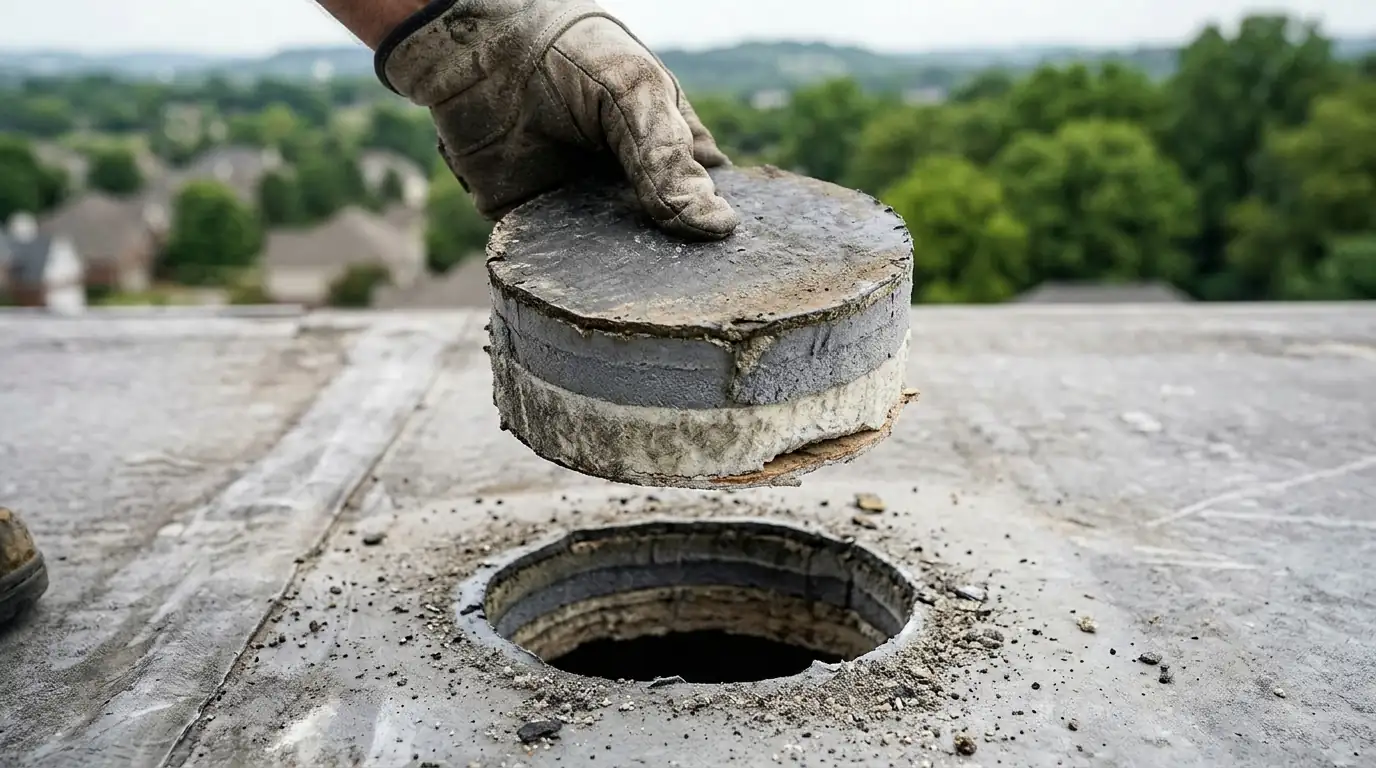
The decision starts below the surface
Most owners ask which option is cheapest. The better question is which options your roof is still eligible for. A coating needs a dry, sound substrate. A recover needs dry insulation and a deck that will hold fasteners. Replacement is always allowed, but it is the most expensive choice and the most disruptive to tenants.
That is why we start with data, not a proposal. An infrared or capacitance survey maps where moisture has traveled under the membrane, and core cuts confirm what the scan suggests. With that map in hand, the choice usually becomes obvious instead of a matter of opinion or a sales pitch from whoever called last.
Four facts drive the outcome: how much of the roof insulation is wet, how many layers are already on the building, the condition of the deck, and how long you plan to hold the property. The sections below take them one at a time. We would rather lose a bid by telling you the truth than win one by offering an option the roof cannot support.
Keep in mind that the cheapest path today is not always the cheapest path over twenty years. A coating applied to a roof that should have been replaced costs money twice, once for the coating and once for the replacement that follows anyway. A recover over wet insulation fails early and can leave you with two layers that both have to come off.
Fact one: how much of the roof is wet
Wet insulation is the single biggest factor. It does not dry in place under a membrane, and it never insulates properly again.
Small, isolated wet areas
A few spots near drains or penetrations can be cut out and patched, then the roof coated or left alone.
A modest share wet
If wet areas are limited and clustered, targeted insulation replacement plus a recover may still pencil out.
Roughly a quarter or more wet
This is a common rule of thumb, not a code. Past that point, patching costs add up and replacement often wins.
Wet along an entire drainage path
If water has tracked from a leak to the drain, the damage is usually wider than the stain suggests.
Wet insulation over steel deck
Moisture corrodes steel from above, so deck repair enters the budget and can change the decision.
Fact two: the layers rule
Building codes limit a roof to two coverings before a full tear-off is required. If your building already has a base roof and a recover, the next roof means removing everything. That is not a contractor preference. It is the rule, and it is checked when permits are issued by Metro Nashville Codes in Davidson County or by the permit office in your own city or county. Two coverings is the ceiling, not a target.
Weight matters too. Each added layer adds dead load, and some older buildings, especially those with lightweight decking, cannot take much more. A core cut shows how many layers exist and what the insulation looks like, which replaces guesswork with a photograph you can keep in the file. Ask any contractor to show you the core, not just describe it.
A one-layer roof with dry insulation has all three options open to it. A two-layer roof has one: replace. Knowing which of those two situations you are in is worth more than any price comparison made before the cores are cut. If the roof has two layers and a failing membrane, the money is better spent on a clean tear-off and a properly detailed new system.
There is a second code point worth knowing. Energy codes can require added insulation when a roof is replaced, which raises the thickness at parapets and doors. A recover can sometimes avoid that trigger, but not always, and the local permit office makes the call for your jurisdiction. Ask your contractor to confirm the local requirement in writing before pricing. Energy code details differ between jurisdictions, so we confirm with the permit office.
If a prior owner added a recover without telling you, a core will show it. Layers are often hidden behind a clean top surface, and we have found three on roofs that looked like one. Never plan a recover until the cuts confirm the count. Confirm that with the permit office before you price. It takes a few minutes and avoids confusion later.
What each option can and cannot do
Use these as general boundaries. Individual manufacturers set their own requirements for warranty eligibility.
| Coat | Recover | Replace | |
|---|---|---|---|
| Insulation condition | Must be dry | Mostly dry, repair wet areas | Any, wet removed |
| Existing layers | Any, within limit | One layer only | Removes all |
| Deck condition | Sound | Sound, solid for fasteners | Repaired as exposed |
| Disruption to tenants | Lowest | Moderate | Highest |
| Typical added life | Roughly 10 to 15 years | A full new membrane life | A full new roof system |
| Rough price range | $1.85 to $3.60 per sq ft | $5.40 to $9.15 per sq ft | $8.25 to $14.70 per sq ft |
Fact three: the deck underneath
A roof is only as good as what it is fastened to. Rusted steel, delaminated plywood, crumbling gypsum or damaged concrete topping all reduce what a new system can bite into. Pull-out tests, where we try to extract fasteners with a gauge, show whether the deck holds. A deck that fails the test cannot take a mechanically attached recover.
Deck repair adds cost, but it is better to find it now than after you have paid for a new membrane. If the problems are limited to a few bays, we repair them and carry on. If they run across the whole roof, replacement with deck work becomes the honest option, and a coating would only hide it for a season or two.
Prices in the table above are general ranges for typical conditions. Real numbers move with access, building height, deck repairs and any tapered insulation, so we quote after a site visit. A coating over a deck problem only delays the discovery, and a recover over one is a warranty risk the manufacturer may refuse to accept.
Why coatings get oversold
A coating is a good tool on the right roof. Silicone and acrylic products can add roughly ten to fifteen years to a sound, dry membrane at a fraction of replacement cost, and they cut surface heat. The trouble starts when a coating is proposed for a roof that does not qualify because that is the cheapest line on the bid.
Coatings do not fix wet insulation. They do not close splits that are still moving, and they do not rescue a membrane that has shrunk away from its flashings. Put silicone over a saturated assembly and you have sealed the moisture in. The next summer the water vapor pushes blisters up through the coating.
Ask any contractor proposing a coating to show you the moisture map and the core photographs that support it. If they have neither, they are guessing. A real coating proposal includes cleaning, seam and flashing repair, primer where required and a stated dry mil thickness, not just a gallon count. Insist on that detail in writing.
How we help you decide, in order
This is the sequence we follow before recommending anything. Nothing here commits you to a project.
Walk the roof
We map drains, penetrations, ponding, seams and visible damage, and photograph each defect.
Run a moisture scan
Infrared or electrical capacitance scanning outlines where insulation has taken on water.
Cut test cores
Cores in dry and wet areas show layer count, insulation type and deck condition.
Test fastener pull-out
Pull tests tell us whether the deck can take a recover.
Match options to the data
We list which options are still open and what each would cost across your holding period.
Fact four: your budget horizon
A coating that buys ten more years is a bargain if you plan to sell in eight. It is a bad bet if you intend to hold the building for thirty and the insulation is quietly saturating. Ask yourself when the roof must stop being a line item. If the answer is within a decade, coat or recover. If it is longer, price the replacement now and spread the capital sensibly across the years.