A range is not a promise
Every manufacturer publishes a lifespan, and every roof tries to disprove it. The number assumes a clean installation, a sound deck, proper drainage and regular upkeep. In practice, two identical buildings on opposite sides of Nashville can differ by ten years because one is maintained and the other is ignored until something drips.
Middle Tennessee is demanding on roofs in a quiet way. Summers are hot and humid, spring storms bring hail and straight-line wind, and winter swings above and below freezing often enough to flex seams and flashings. The March 3, 2020 tornado and the December 9, 2023 tornado reminded many owners that a roof is also a wind structure.
Use the table below as a starting point, then adjust for your building: its color, its drainage, how often people walk on it and whether anyone has looked at it in the last year. Then ask what a realistic remaining life looks like, in years, with the maintenance you are willing to do.
Age alone is a weak predictor. We have seen fifteen-year-old roofs in good shape and eight-year-old roofs that were finished. What separates them is almost always the same short list: drainage, traffic, repair quality and whether a pattern of small leaks was treated as a signal or as a nuisance. A roof assessment puts real numbers behind that conversation.
Typical service life by system
These are general ranges for roofs that are installed well and inspected at least once a year. Neglect, ponding and poor drainage reduce them.
| Typical life | Common limiting factor | |
|---|---|---|
| TPO, 60 or 80-mil | 15 to 25 years | Seam wear, ponding, traffic |
| PVC | 20 to 30 years | Flashing movement, plasticizer loss |
| EPDM | 20 to 30 years | Seam adhesive, oil exposure |
| Modified bitumen | 20 to 30 years | Granule loss, seam laps |
| Built-up roof | 20 to 35 years | Blistering, ponding, flashing |
| Standing seam metal | 30 to 50 years | Fastener and sealant aging |
| Spray foam with coating | 20 to 30 years | Coating recoat cycles |
Heat is slow and relentless
A dark roof on a July afternoon can run far hotter than the air above it. That heat bakes plasticizers out of some membranes, stiffens asphalt and dries sealants until they crack. Thermal cycling is the other piece: a roof that bakes by day and cools by night expands and contracts thousands of times, which tests every seam and flashing it has.
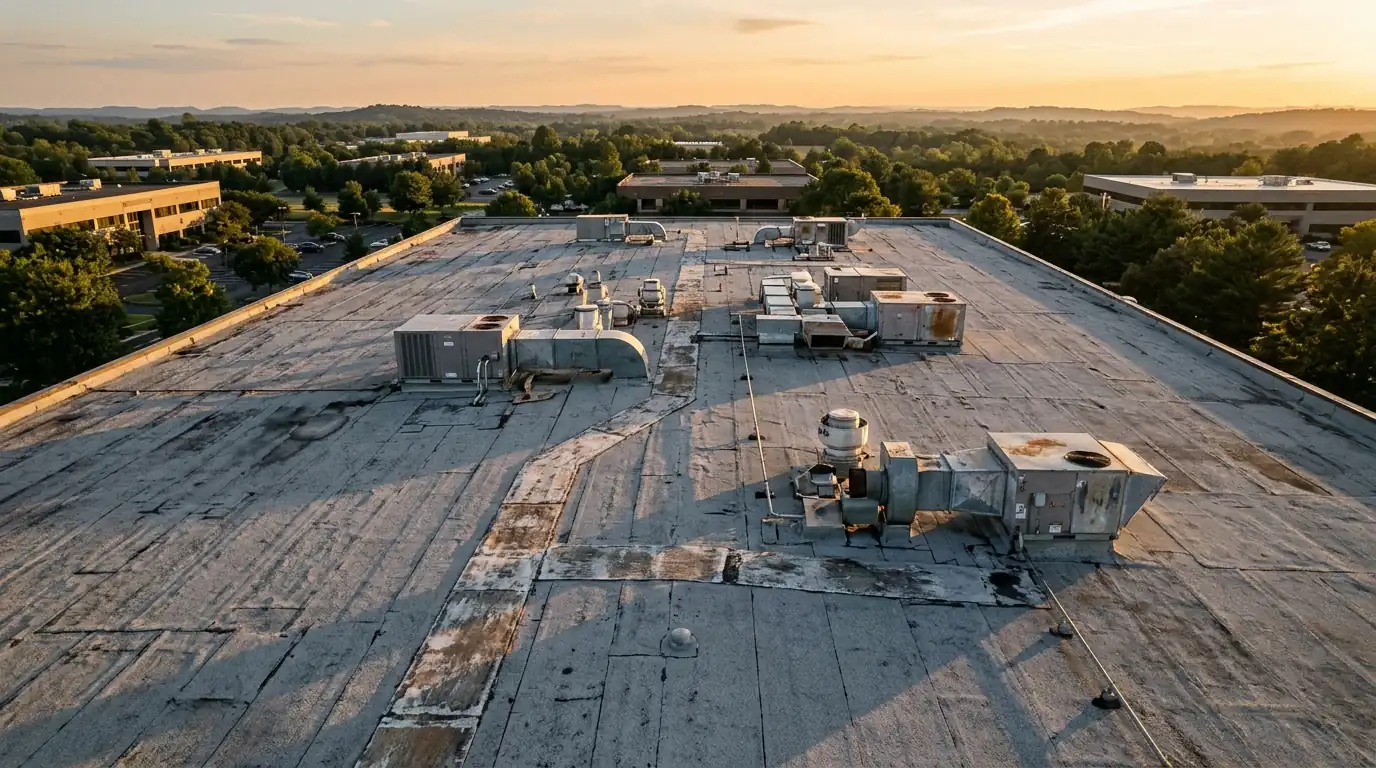
Reflective membranes and coatings reduce surface temperature and slow this aging. White TPO, PVC and silicone-coated roofs generally last better in hot, sunny regions for exactly this reason. Mechanical equipment that vents hot air across the membrane creates localized heat spots, and those spots tend to be the first to alligator, craze or shrink. Check them each spring.
If you can feel heat radiating from a rooftop unit's exhaust path, look for membrane wear in that band. A narrow strip of aged roof beside a unit is a common sign, and it often points to the spot where the first repair will be needed. Dark edge flashings and black pipe boots age fastest of all, because they sit hot and bend with every temperature swing.
Insulation is part of the story too. A thick polyiso layer under a dark membrane makes the surface hotter, because less heat escapes into the building. That is good for energy use and hard on the membrane, which is another reason reflective colors pay off on well-insulated roofs. Ask your roofer what color the roof was designed to be.
Ponding water speeds up everything
Water that sits on a roof for more than a couple of days starts working on the surface. It supports algae and organic growth, speeds the breakdown of some membranes and adds weight the structure was not designed to carry. On older built-up roofs, ponding often shows up as a blister field around a low spot, with granule loss or alligatoring at the edges of the pond.
Ponding is not always a failure of the membrane. It is usually a deck deflection or drain placement issue, and the fix is tapered insulation, a new drain or repaired drainage. We cover the 48-hour rule in a separate guide, including how to tell a normal puddle from a defect. Ask for the slope survey before you buy a bigger membrane.
A roof that drains well can easily outlast the same system on a roof that doesn't. In our experience the difference is often five to ten years, which on a large building is worth a very large number of dollars. Drainage is the cheapest life extension a roof can get, and it is often overlooked until a leak appears. Walk the roof two days after rain to see how your own drains behave.
There is also a freeze component. Water that stays in a pond in January freezes, expands in seams and cracks, and thaws again. A shallow pond that freezes and thaws a dozen times in a Middle Tennessee winter does more mechanical damage than a summer pond that evaporates in a few days.
What shortens roof life in practice
These are the patterns we see most often on Middle Tennessee commercial roofs. Many are easy to fix before they cause damage.
Foot traffic without walk pads
Service techs walk the same path to the same units for years, and the membrane wears down in that lane.
Clogged drains and scuppers
Leaves from mature trees around neighborhoods like Belle Meade and Green Hills block outlets and create ponding.
Skipped inspections after storms
Hail bruising and displaced flashing go unnoticed until a wet spot shows up in a ceiling.
Unsealed penetrations
New cables and pipes added by tenants are often poked through the membrane without proper boots.
Hidden wet insulation
Small leaks soak the insulation first. The membrane looks fine while the assembly fails from below.
Mismatched repairs
Patching with the wrong material or a thin layer of mastic creates new leaks near the repair.
Foot traffic and rooftop equipment
A roof is built to shed water, not to serve as a work platform. Every time a technician crosses the membrane with a tool bag, a refrigerant cylinder or a replacement motor, they add wear. Dropped tools puncture. Dragged equipment scars. Over a decade, that adds up to real life lost, and it seldom shows up in anyone's budget. Even a single mechanical unit on an otherwise empty roof can be the source of the first leak. A roof that gets weekly traffic needs pads on day one, not after the first repair.
Walk pads at each unit and a defined path from the access hatch to the equipment cut this wear dramatically. We discuss this in detail in our rooftop HVAC guide. A written rule that service companies must use the pads, and report any damage they cause, is cheap and effective. Replace any pad that cracks, since a broken pad is a sharp edge.
Metal roofs are not immune. Foot traffic can dent panels and break sealant bonds, especially on ribs and around curbs, and a dented panel holds water that would otherwise run off. Sealant bonds on metal fatigue under repeated stepping, and an open seam at a rib is a leak waiting for the next storm. Where traffic is regular, protect metal with pads that clamp to the ribs instead of sitting on the panels.
Metal, foam and coated roofs age differently
Metal roofs fail at the fasteners and sealants long before the panels give out. On exposed-fastener panels, the rubber washers dry and the screws back out after a decade or two of heat cycling, and the roof starts to weep at those points. Standing seam systems hide the fasteners, so they last longer, but clips, seam sealant and penetrations still need checking.
Spray foam roofs depend on their coating. The foam itself can last a very long time if it stays dry and covered, but the protective coat wears and needs a recoat on a schedule, usually every ten to fifteen years depending on the product. Skip the recoat and the foam begins to erode from sun and hail.
Built-up and modified bitumen roofs age by losing surface protection. Granules wash off, asphalt dries and seams open at laps. These roofs often show warning signs for years, which gives you time to plan. Single-ply roofs are less forgiving: the first sign of a problem can be a leak at a seam that looked fine the prior spring.
The cheapest extension is a yearly walk
A roof inspection once a year, plus one after any major hail or wind event, is the least expensive way to add years to a roof. It finds clogged drains, lifted seams and loose coping while repairs are small. Tennessee's spring storm season means March through June is a good time to schedule one. Keep photographs and dates for each visit. They help with warranty claims, insurance questions and capital planning later on.