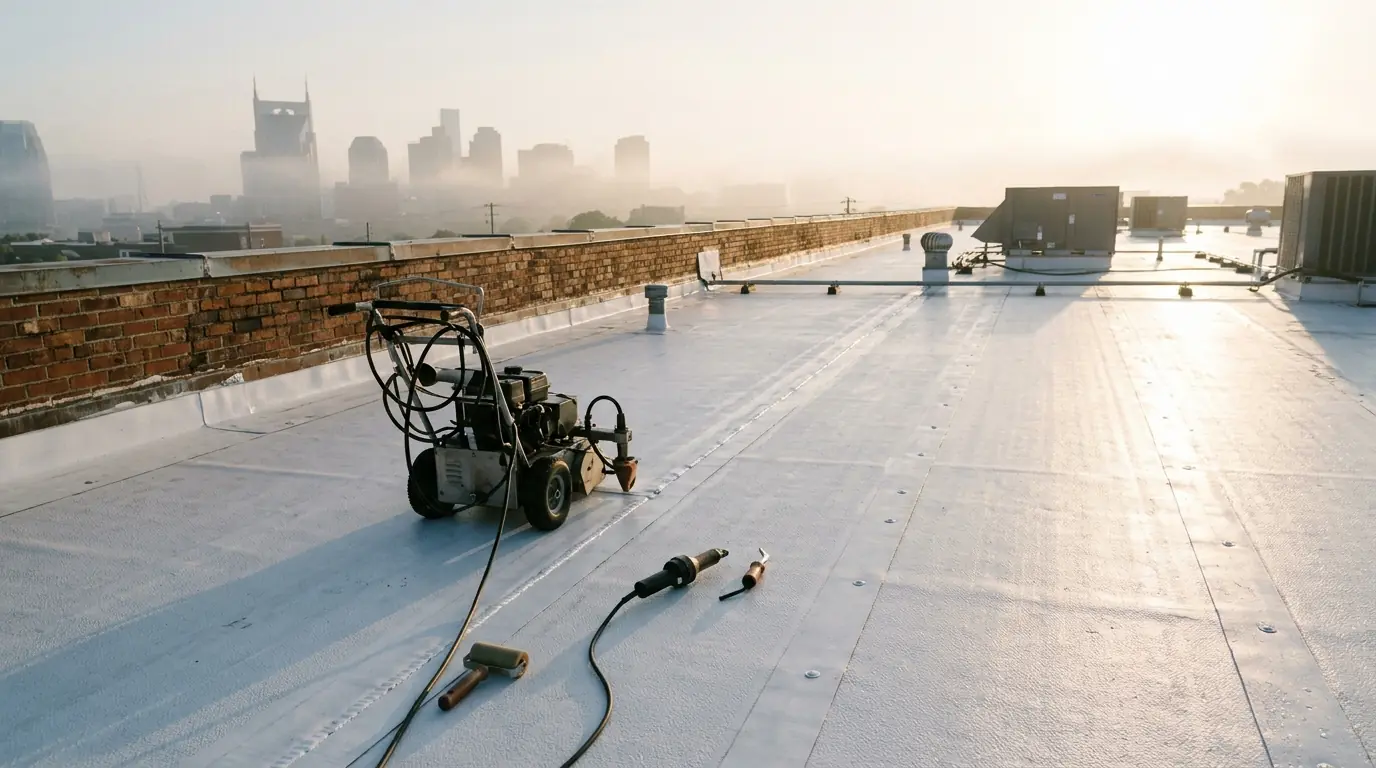
Three membranes, three different jobs
All three are single-ply sheets rolled out over insulation, and all three can last on a Nashville roof when they are detailed well. The real differences show up in how they handle heat, grease, seams and repairs. Most disappointments we see come from picking a membrane out of habit instead of looking at what happens on and around the roof.
TPO and PVC are both thermoplastic, so their seams are welded with a hot-air welder and the seam becomes part of the sheet. EPDM is cured rubber. Its seams are glued or taped, which means the seam is the weakest line on the roof and earns more attention at every inspection. A welded seam can also be probed and tested, while a glued one is judged mostly by eye.
Color is the other split. TPO and PVC are usually white or light gray and reflect sun. EPDM is black unless you order the white version, and black rubber on a July afternoon in Middle Tennessee runs hot enough to stress adhesives at the edges and raise cooling loads on the floor below.
One practical test: ask each bidder to name the seam method, the attachment method and the flashing material in plain words. If the answers come back vague, the proposal is probably built from a template. A good proposal names the exact membrane, thickness, insulation, cover board and edge metal, so you can compare bids line for line instead of by total price.
Side by side: what each membrane does well
Use this as a first filter. It is a general comparison, and individual manufacturers vary in thickness, formulation and what they allow over certain substrates.
| TPO | PVC | EPDM | |
|---|---|---|---|
| Seam method | Heat-welded | Heat-welded | Adhesive or seam tape |
| Grease and chemicals | Fair, check the formulation | Strong, built for exhaust | Weak, oils swell the rubber |
| Surface heat in summer | Cool when white | Cool when white | Hot when black |
| Foot traffic tolerance | Good at 80-mil | Good, stiffer sheet | Good, softer under heel |
| Typical thickness | 45, 60 or 80-mil | 50, 60 or 80-mil | 45 or 60-mil |
| Repair by a patch | Weld a patch | Weld a patch | Glue or tape a patch |
Where TPO is the practical choice
TPO is the membrane we see most often on distribution buildings along I-40, I-24 and Murfreesboro Pike, and on newer apartment buildings across Davidson and Rutherford counties. It is reflective, welds into a continuous sheet and usually costs less than PVC. For a large, mostly empty roof with a handful of units, it is hard to beat on value.
Treat 60-mil as the working minimum for most owners and move to 80-mil where service crews will walk the roof every month. Thin 45-mil sheet saves money on day one and shows scuffing by the first filter change. Formulations also differ between manufacturers, so ask for the data sheet on the exact membrane rather than accepting a generic description of TPO.
A typical range is $7.15 to $11.80 per sq ft installed for 60-mil TPO on a clean, dry deck, before tapered insulation or tear-off. Fully adhered assemblies sit toward the top of a range like that and mechanically attached assemblies toward the bottom, though wind exposure and warranty terms can reverse the choice. Site conditions change the number, and we quote after a site visit.
TPO has one drawback worth naming. Formulations vary more between manufacturers than PVC does, and early-generation products had a mixed record with heat aging and surface crazing. Current products from the major manufacturers are much improved, but it is still worth asking how long the specific membrane has been in service and what the manufacturer's warranty actually promises about surface cracking.
When PVC earns its higher price
PVC costs more per square foot, usually by a modest margin. These are the roofs where that margin pays for itself.
Restaurant exhaust
Grease from kitchen fans attacks many membranes. PVC is formulated to resist animal fats and vegetable oils.
Chemical or lab exhaust
Roofs under medical, lab and manufacturing exhaust see vapors that break down other sheets over time.
Heavy rooftop traffic
Buildings with several tenants' HVAC units get constant service visits and benefit from a tougher, welded surface.
Many penetrations
PVC flashing can be hot-welded into corners and pipe boots, which gives tidy, durable detail at crowded curbs.
Long ownership horizon
If you plan to hold the building for thirty years or more, the extra upfront cost spreads thin.
Why EPDM still has a place
EPDM has been on American roofs for a long time, and a well-installed rubber roof that sees little traffic can outlast a poorly detailed thermoplastic one. It is often the lowest installed price, it stays flexible in cold weather and a leak can be patched with simple materials that most roofers carry on the truck.
The weak points are seams, flashings and oils. Seams are glued or taped, so we check every one on a survey and probe any that look lifted. Roofs near cooking exhaust, or where a service contractor leaves oily residue, will degrade the rubber quickly. A quiet roof with few units and a clean deck is where EPDM makes the most sense.
Black EPDM raises cooling loads in a Nashville summer, which matters if top-floor tenants already complain about temperature. White EPDM exists, but the price gap against TPO shrinks and most of the advantage disappears. If reflectivity is a goal, compare white EPDM and TPO side by side rather than assuming the rubber is cheaper.
EPDM also suits roofs that need frequent small modifications, such as a building where tenants add antennas or conduit. Patching rubber with tape and primer is quick and forgiving. The catch is that every patch is another glued seam, so a roof that is modified often needs a written log of what was added, where and by whom.
Seams and flashings: where single-ply roofs actually leak
Membranes rarely fail in the middle of a field. They fail at seams, corners, curbs, drains and walls, which is why the quality of the detailing matters more than the name on the sheet. A beautiful 80-mil TPO field with a sloppy pipe boot will leak on the first heavy rain, and the owner will usually blame the material.
Ask how corners are formed, whether pipe flashings are prefabricated or hand cut, and how the termination at walls is fastened and sealed. On TPO and PVC, ask whether seam probing is part of the process and how far the weld extends past each fastener plate. These answers tell you more about the finished roof than a brochure does.
Edge metal deserves its own question. Coping and gravel stop that is not tested to ANSI/SPRI ES-1 can peel in the high winds Middle Tennessee gets during spring storms, and a peeled edge pulls the membrane up with it. Specifying it properly costs little. Repairing it after a wind event costs a lot.
Five questions that settle the choice
Answer these before you ask any contractor for pricing. They narrow the field faster than a spec sheet does.
- Is there kitchen, lab or process exhaust within thirty feet of the roof surface?
- How many service visits does the roof get in a typical month, and by whom?
- Will the membrane be fully adhered, mechanically attached or ballasted?
- Is the existing insulation dry and the deck sound enough to take new fasteners?
- How long do you expect to own or manage the building?
- Does the lease or lender require a specific warranty term?
The attachment method matters as much as the sheet
Owners compare TPO and PVC prices and forget to compare attachment. A fully adhered roof costs more than mechanically attached, but it resists wind uplift better and avoids fastener plates that can back out over time. Along open corridors like Briley Parkway or on hilltop sites in Williamson County, ask for the uplift rating of the full assembly, not just the membrane. A cheap sheet over a weak attachment is still a weak roof.