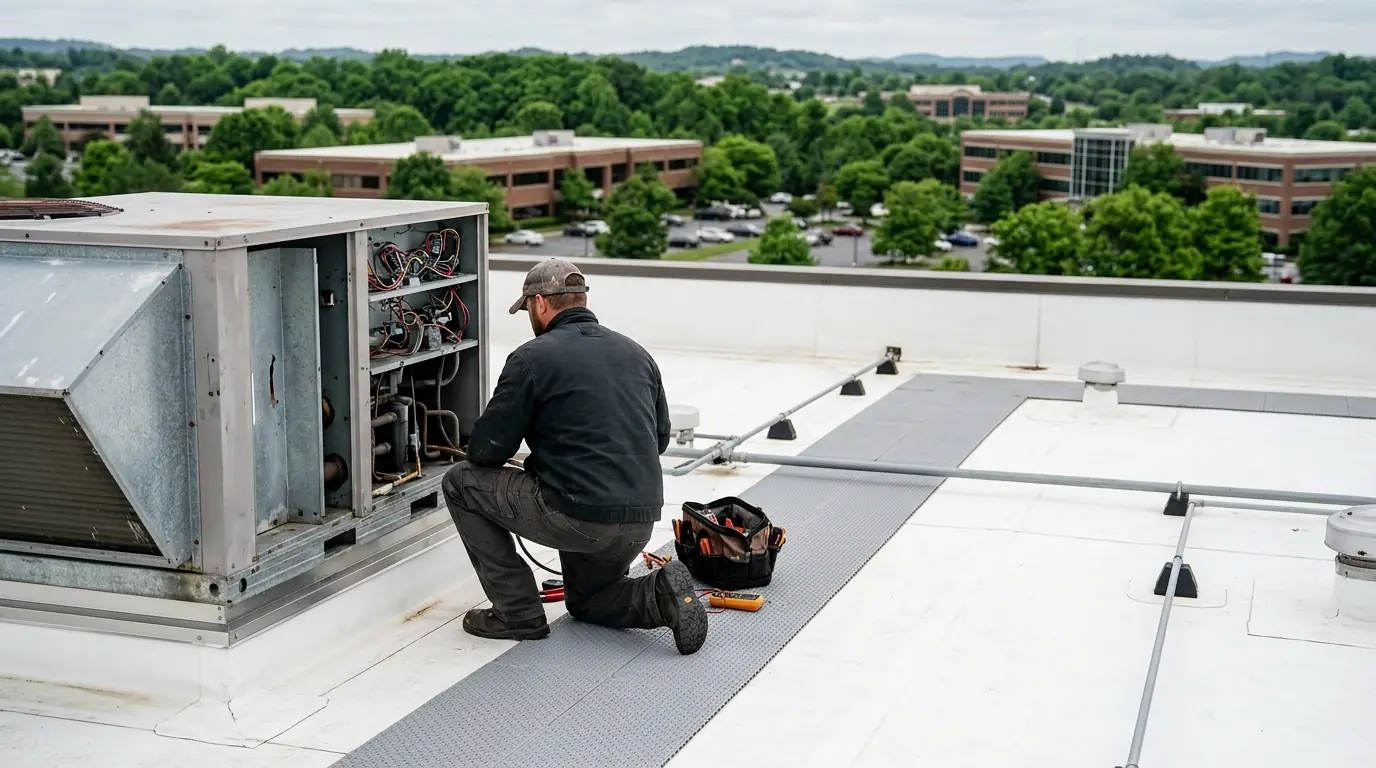
Your roof is a work platform whether or not you planned it
A building with six rooftop units may see a technician every month or two for filters, belts, coils and refrigerant checks. Each visit means boots, tool bags, ladders, gauges and sometimes a replacement part carried across the membrane. Multiply that by a decade and the traffic path is a visibly worn lane across the roof.
Most of the damage is accidental. A technician sets a pipe wrench down, a coil cleaner spills, a panel drags across a seam. None of it is dramatic, but it adds up and tends to show up as a leak months later, long after the visit has been forgotten and the technician's invoice has been paid.
That delay is why the roofing and HVAC contractors often blame each other. The way out is a simple set of rules that make damage rare and trackable, so that when something does go wrong you know who was on the roof, when, and what the membrane looked like before they arrived.
Tenant improvements add to the load. A new antenna, a satellite dish, a kitchen exhaust fan or an extra air handler all mean new crews on the roof and new penetrations. Without a rule that every rooftop job goes through the property manager, the roof collects changes nobody tracks and nobody has flashed properly.
Common ways HVAC work hurts a roof
We see these patterns on warehouses along Murfreesboro Pike, office parks in Brentwood and retail strips along Gallatin Pike.
Worn foot paths
Repeated steps on bare membrane scuff the surface and thin the sheet, especially on TPO and modified bitumen.
Dropped tools and parts
A dropped wrench can puncture or gouge a membrane, and a coil panel dragged across it can cut a seam.
Oil and condensate
Refrigerant oil, coil cleaners and constant condensate drips degrade EPDM and some TPO formulations.
Failed curb flashing
Old sealant at the corners of curbs dries out and cracks, letting water into the insulation.
Unflashed line sets
Refrigerant lines, conduit and drain pipes pushed through the roof with caulk alone eventually leak.
Loose equipment on the membrane
Spare filters, panels and ladders left lying on the roof trap water and chafe in wind.
Fasteners and screws left behind
Sheet metal screws dropped during panel work lie in the membrane path and puncture the sheet under the next boot.
How we protect a roof around rooftop units
These steps cost little compared with the leak they prevent, and they work on most membrane types.
Map the traffic path
We follow the route from the roof hatch or ladder to each unit and note where people already walk.
Install walk pads
Heat-welded or adhered pads go along the path and around each unit's service side.
Raise the curb flashing
We rebuild corners and base flashing to a proper height and secure the termination bar.
Flash every penetration
Pipe boots, pitch pans and prefabricated curbs replace caulk-only details.
Add drip protection
A small pad or tray under oily or dripping components keeps liquids off the membrane.
Photograph and record
We take dated photos so any later damage is easy to compare.
Walk pad options
Pad choice depends on your membrane, your traffic and your budget. Always check compatibility with the manufacturer.
| Welded or adhered pads | Loose rubber pads | Pavers on pedestals | |
|---|---|---|---|
| Fixed in place | Yes | No, can shift | Held by pedestal |
| Cost | Moderate | Lowest | Highest |
| Wind resistance | High | Low to fair | High |
| Best for | Regular service routes | Short-term use | Heavy traffic or terraces |
| Drainage impact | Little | Can trap water | Allows flow if spaced |
| Warranty fit | Usually approved | Check first | Check first |
Curbs, flashing and the leaks that follow
The curb under a rooftop unit is one of the most common leak points on a commercial roof. The roof membrane runs up the side of the curb and is terminated near the top, with a metal counterflashing or sealant joint. If the membrane has shrunk, the sealant has cracked or the height is too short, rain gets behind it.
When a unit is replaced, the curb is often reused or swapped, and the roofer is rarely invited. That is when flashing gets disturbed. If your HVAC contractor is replacing a unit, call us before the crane arrives so the flashing can be redone as the new unit is set. Doing it afterward costs more, because the unit blocks access.
Check line-set penetrations at the same time. Foam and caulk around a copper line are not a roofing detail. A proper pipe boot or a pitch pan with sealer, or a prefabricated curb for bundled lines, keeps water out far longer and can be inspected from above. Ask the roofer to photograph each one before and after.
Condensate lines deserve a look too. A drain line that dumps onto the membrane year after year creates a permanent wet spot, algae and a worn patch of sheet that nobody notices until it leaks. A small splash block or a short drain line routed to a drain keeps that water off the membrane. It is a cheap fix that most buildings skip, so the worn spot under the drain line is a common sight on rooftops across Nashville.
New units, crane days and coordination
Unit replacement is the highest-risk day for a roof. Cranes set loads near the edge, old units get dragged to the hoist point and new curbs sometimes need cutting into the deck. A roofer on site that day can protect the membrane, flash the curb correctly and document the condition before and after the work.
Ask the HVAC contractor for the schedule as soon as the unit is ordered, not the week of the delivery. Equipment delivery times give you weeks of warning, which is plenty of time to book a roofer, order flashing materials and plan walk pads along the new route. Book early, since crews fill up in cooling season.
Add a roof-protection line to the HVAC proposal. Plywood or temporary mats along the crane path, a spill kit and a post-work roof walk with photographs cost very little. Spread across a building's twenty-year life, that care pays for itself the first time it prevents a punctured sheet. Ask for the photographs in writing.
Finally, keep a drawing of where every unit, curb and penetration sits. When a unit is moved or removed, an open curb or a capped line is easy to forget. A roof plan with dated updates prevents orphaned openings that sit under a loose tarp until the first storm. Ask for the photographs. It takes a few minutes and avoids confusion later.
Rules to put in every service contractor agreement
A written rule is easier to enforce than a verbal request. Add these to the HVAC service contract and tenant roof-access policy.
- Technicians must stay on marked walk pads and paths
- Sign in and out at the roof hatch with date, time and unit worked on
- Report any damage found or caused before leaving the roof
- No roof penetrations, cutting or screwing into the membrane without notice to the property manager
- Remove all debris, tools and spare parts at the end of every visit
- Use drip trays for oils, coil cleaner and refrigerant work
- Notify the building before replacing any unit or curb so flashing can be coordinated
Who pays when a technician damages the roof?
Check your service contract and your roof warranty. Many warranties exclude damage by other trades, and many HVAC contracts say nothing. A sign-in log and dated photos are the strongest tools you have. If a leak appears, you can show who was on the roof, when and what the membrane looked like before. Call us for a repair at any hour. We document the cause so you can take it to the responsible party. Ask your HVAC vendor to sign the rules before their next visit.